



 BIS Certification
 CDSCO
CDSCO
 CPCB
CPCB
 LMPC
LMPC
 WPC Approval
 Global Approvals
 TEC
TEC
 ARAI
ARAI
 BEE
BEE
 ISO Certification
 DGCA Certification
 NOC For Steel
 APEDA Registration





















 Business Registration
 FSSAI Mark Certification













 Legal Services
 Trademark Registration
 Copyright Registration
 Patent Registration
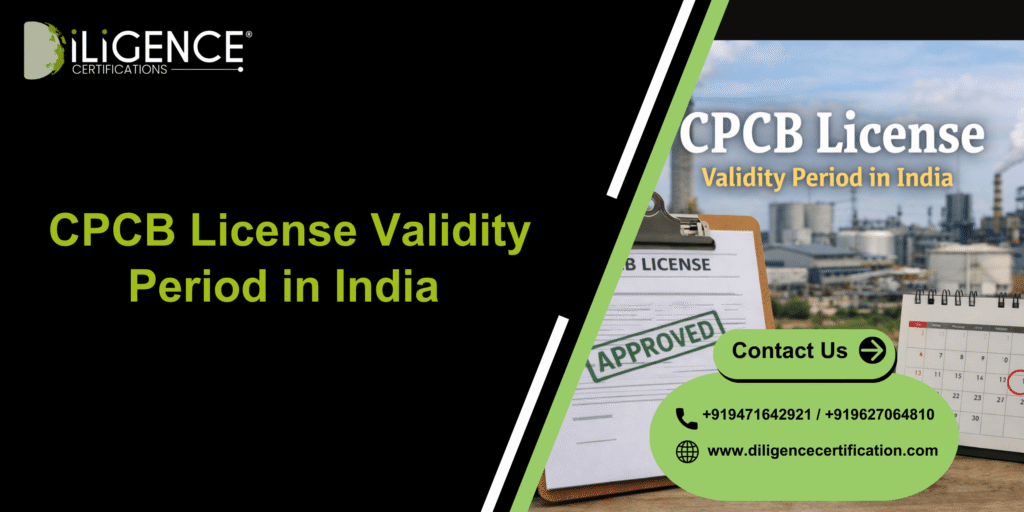
- CPCB License Validity Period in India explains how long pollution control licenses remain valid and when diligence must apply for renewal.
- It clarifies the validity of Consent to Establish( CTE) and concurrence to Operate( CTO) under pollution control laws.
- It helps diligence understand renewal timelines and compliance conditions.
- It prevents penalties, check notices, and legal complications.
- It ensures smooth artificial operations and nonsupervisory compliance.

Introduction
CPCB License Validity Period in India must gain environmental blessings from pollution control authorities before starting operations. One of the most common enterprises among business possessors is understanding the CPCB License Validity Period in India.
The Central Pollution Control Board( CPCB) and State Pollution Control Boards( SPCBs) regulate artificial pollution through Consent to Establish( CTE) and concurrence to Operate( CTO). These warrants are issued for a specific period and must be renewed before expiry.
Understanding license validity is essential to avoid penalties, functional dislocation, or legal action.
What’s CPCB License?
The Central Pollution Control Board( Central Pollution Control Board) is the public authority responsible for controlling and covering environmental pollution in India.
diligence generally bear two types of blessings
Concurrence to Establish( CTE) – needed before setting up a unit
Concurrence to Operate( CTO) – needed before starting product
These warrants are issued under
- Water( Prevention and Control of Pollution) Act, 1974
- Air( Prevention and Control of Pollution) Act, 1981
CPCB License Validity Period in India
CPCB License Validity Period depends on the type of concurrence and the assiduity order( Red, Orange, Green, or White).
Consent to Establish( CTE) Validity
- Generally valid for 1 to 5 Years
- Valid until design perpetration is completed
- Still, revalidation may be needed If construction does n’t begin within the approved period.
Consent to Operate( CTO) Validity
Validity varies grounded on pollution order
- Red order – 5 times( in utmost countries)
- Orange Category – 10 times
- Green order – 10 to 15 times
- White order – generally no concurrence needed( only suggestion)
Note: Exact duration may vary by State Pollution Control Board.
Assiduity Categorization Explained
diligence are distributed grounded on pollution implicit
Red order – largely contaminating diligence
Orange Category – relatively contaminating diligence
Green order – Low pollution diligence
White order –Non-polluting diligence
The higher the pollution eventuality, the shorter the license validity and stricter the monitoring.
Renewal of CPCB License
diligence must apply for renewal at least 90 – 120 days before expiry.
Documents Needed for Renewal
- Previous consent copy
- Compliance report
- rearmost environmental monitoring reports
- Dangerous waste authorization( if applicable)
- Periodic return submission evidence
Failure to renew on time can affect in
- Penalty or environmental compensation
- Closure notice
- Cancellation of concurrence
- Legal action
Why Understanding CPCB License Validity Period is Important
- Prevents functional arrestment
- Avoids heavy forfeitures and penalties
- Ensures smooth business durability
- Maintains nonsupervisory credibility
- Builds trust with authorities and stakeholders
Proper shadowing of license validity is essential for continued artificial operations.
Common Mistakes Businesses Make
- Ignoring concurrence expiry date
- Delaying renewal operation
- Not submitting compliance reports
- Operating without valid CTO
- Assuming automatic renewal
These miscalculations can lead to strict nonsupervisory action.
Conclusion
CPCB License Validity Period in India is a pivotal compliance factor for diligence operating under pollution control regulations. CPCB Certfication
concurrence to Establish and Consent to Operate are issued for specific durations grounded on assiduity type and pollution order. Timely renewal and proper attestation are essential to avoid legal pitfalls.
Businesses should regularly cover their concurrence validity and insure renewal operations are submitted well before expiry to maintain smooth and biddable operations. Proper CPCB Certification strengthens environmental credibility, ensures regulatory transparency, supports sustainable growth, and enhances long term operational stability for responsible industrial development across India markets.
Frequently Asked for Questions
What's the CPCB license validity period in India?
It depends on assiduity order and whether it's CTE or CTO.
How long is CPCB Consent to Establish valid?
CTE is generally valid for 1 to 5 times or until design perpetration.
What's the validity of CPCB Consent to Operate?
CTO validity ranges from 5 to 15 times grounded on pollution order.
Which diligence get shorter CPCB validity?
Red order diligence admit shorter validity due to high pollution eventuality.
Is CPCB license renewal obligatory?
Yes, renewal is mandatory before expiry to continue operations fairly.
When should CPCB license renewal be applied?
At least 90 – 120 days before the concurrence expiry date.
What happens if CPCB license expires?
Expired licenses can lead to penalties, check notices, or legal action.
Does CPCB validity vary by state?
Yes, State Pollution Control Boards may set different validity ages.
Is CPCB license needed for green order diligence?
Yes, though they admit longer validity and simpler compliance.
Who issues CPCB warrants in India?
warrants are issued by SPCBs under the supervision of the Central Pollution Control Board.