



 BIS Certification
 CDSCO
CDSCO
 CPCB
CPCB
 LMPC
LMPC
 WPC Approval
 Global Approvals
 TEC
TEC
 ARAI
ARAI
 BEE
BEE
 ISO Certification
 DGCA Certification
 NOC For Steel
 APEDA Registration

















 Business Registration
 FSSAI Mark Certification












 Legal Services
 Trademark Registration
 Copyright Registration
 Patent Registration
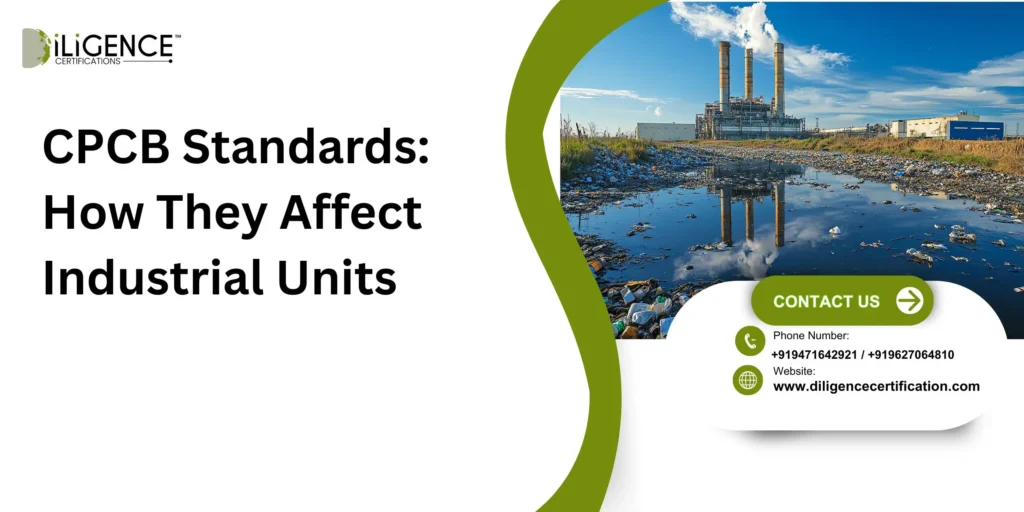
- industrial units CPCB Standards to exercise control over their air emissions, water effluents, and waste disposal activities so that the environmental pollution is kept at a minimum level.
- Installation of Pollution Control Systems: Industries are to install the devices like ETPs, STPs, and air pollution control systems to adhere to the set limits.
- Regular Monitoring and Reporting: It is a must for the industrial units to monitor emissions and effluents and provide compliance reports to the authorities every time.
- Legal and Financial Impact: Non-compliance has the risk of incurring penalties, being shut down or facing legal actions, while compliance has the benefit of uninterrupted operations and regulatory approvals.
- Support for Sustainable Growth: The standards of CPCB are in the favor of cleaner production, resource efficiency, and long-term sustainability of industries.

Introduction
Industrial units, besides being a significant factor in economic growth, were also responsible for the pollution of air, water, and soil to a large extent. The Central Pollution Control Board (CPCB), through its standard setting and pollution control regulation across industries, is the main, indeed, the only `player` in the industrial demarcation and environmental protection conflict. Initially, the Water (Prevention and Control of Pollution) Act, 1974, and the Air (Prevention and Control of Pollution) Act, 1981, empowered CPCB to ensure industrial activities were in accordance with environmental laws.
When operating under the CPCB standards, industries will have to control their emissions, treat their effluents, manage their waste in a manner that does not harm the environment and constant environmental performance monitoring. The benefit of these regulations is a clean society, a healthy nature, and a smoothly run industry that does not adversely affect the environment.
What Are CPCB Standards?
complied with by the industrial units in order to reduce pollution. The following are the exact standards that are laid down:
- – The maximum air emissions that can be allowed for various industrial operations and stacks.
- – The maximum amount of wastewater that can be discharged into the water bodies or land.
- – The regulations for the treatment and disposal of both hazardous and non-hazardous waste.
- – The amount of noise allowed in an industrial area.
- – The requirements for environmental monitoring, reporting, and compliance.
CPCB standards act as a guide for the industries and compel them to maintain pollution within the allowed limits through the entire period of their operations.
How CPCB Standards Affect Industrial Units
1. Pollution Control Infrastructure
Industries are mandated to incorporate pollution control systems such as:
- Effluent Treatment Plants (ETPs)
- Sewage Treatment Plants (STPs)
- Air quality improvement installation including scrubbers, bag filters, and ESPs
These installations support the industries in achieving emission and discharge consents.
2. Operational Modifications
CPCB standards mean that the industry has to sometimes even completely change its processes along with the relevant technologies and resources usages in order to have less waste and no emissions.
3. Continuous Monitoring and Reporting
The authorities need to receive by the industry regular monitoring results of air emissions, wastewater quality, and waste generation and compliance reports should get sent to CPCB or State Pollution Control Boards (SPCBs).
4. Financial and Legal Impact
Upfront compliance can sometimes cost a lot but it is a long way to prevent industries from paying fines, getting closed, and fighting legal battles.
5. Accountability and Transparency
The standards of CPCB hold industries to be open to the public, responsible to the regulators, and keep the environment clean by having good records of their environmental activities.
Why CPCB Compliance Is Mandatory for Industrial Units
Not adhering to the CPCB norms can result in:
- More than usual air and water pollution
- Dangers to the health of people working in the plant and the nearby population
- Imposition of legal penalties, fines, or notice of shutdown
- Withdrawal of operational approvals and loss of business trust
- Higher costs for environmental clean-up operations
On the other hand, CPCB compliance guarantees:
- Following the environmental regulations
- Lower emissions and no or very little impact on the environment
- The place becoming more and more suitable for human beings and animals
- Better public image of the industry and the industry’s acceptance in the market.
Importance and Benefits of CPCB Standards
| Importance | Benefits |
| Regulatory compliance | Legally safe and no shutdowns for operation |
| Pollution control | Less pollution in the air, water, and soil |
| Public health protection | Health risks from industrial pollution are reduced |
| Sustainable operations | Cleaner production methods are promoted |
| Brand credibility | Trust among the regulators and the stakeholders is improved |
Step-by-Step CPCB Compliance Process for Industrial Units
Step 1: Regulatory Identification – Identify applicable CPCB standards based on industry type and scale.
Step 2: Pollution Control Implementation – Install required air, water, and waste treatment systems.
Step 3: Environmental Monitoring – Conduct periodic testing of emissions, effluents, and waste.
Step 4: Documentation & Reporting – Maintain compliance records and submit reports to authorities.
Step 5: Inspection & Enforcement – Cooperate with CPCB/SPCB inspections and implement corrective actions if required.
Documents Required for CPCB Compliance
- Consent to Establish (CTE) and Consent to Operate (CTO)
- Reports on environmental monitoring
- Results of emission and effluent tests
- Records of waste management
- Certificates of compliance and audit reports
Difficulties Encountered by Manufacturing Units
- Complicated and changing environmental regulations
- Expensive pollution control technology
- Technical know-how for monitoring and reporting
- Time-consuming compliance and inspections
- Risk of fines because of documentation gaps
Role of Experts in CPCB Compliance
The environmental consultants and compliance specialists provide the following assistance to the sectors of the industry:
- Interpreting CPCB standards accurately
- Developing efficacious pollution control systems
- Handling documentation and reporting
- Preparing industries for inspections and audits
- Providing timely renewals and regulatory approvals
Timeline, Validity & Review
Monitoring Frequency: Monthly or quarterly, based on the industry category
Compliance Review: CPCB/SPCB periodic audits and inspections
Validity: connected to consent approvals that require timely renewal
Conclusion
CPCB norms acting as a facilitator for responsible industrial activities in India are of great importance. By putting a cap on the emission of gases, release of waste water, and disposal of solid waste, CPCB makes sure that the environment, as well as the public health, does not suffer during the process of industrial development. Meeting the
CPCB standards is not merely an obligation laid down by law, but a decision that is in favor of the environment, obtaining stable operations, and securing business success for the long run. The industrial units that consistently follow the CPCB standards not only contribute to the environment being cleaner but also win the trust of the authorities, and their path of development becomes sustainable.
Frequently Asked for Questions
What exactly are the CPCB standards?
CPCB standards are sets of limitations for the environment that are imposed in order to mitigate pollution from industrial areas such as air, water, and waste.
To whom do the CPCB standards apply?
All the industrial units in India, regardless of their nature, have to abide by the regulations set by the CPCB.
What is the significance of CPCB standards to the industrial sector?
They are important because they help the environment, public health, and also provide a legal framework for the industrial operations.
What are the repercussions if a company exceeds the limits set by the CPCB?
If the violations are serious, the company may face penalties, be forced to close down, or taken to court.
Which forms of pollution do CPCB standards cover?
The areas include air emissions, water effluents, waste management, and noise in the environment.
What kind of documents are needed for compliance with CPCB?
These are Certificate to Establish (CTE), Certificate to Operate (CTO), monitoring reports, waste records, and compliance certificates.
How regular is monitoring by CPCB?
It is done every month or every three months depending on the classification of the industry.
Are CPCB standards imposed on production processes?
The answer is Yes; industries might need cleaner technologies and process changes.
Can the consultants provide any help with CPCB compliance?
Environmental consultants certainly do facilitate compliance, conduct audits, and provide documentation.
What are the advantages of Indian industry becoming CPCB compliant?
Legal protection, eco-friendly practices, better image, and contribution to conservation of nature.