



 BIS Certification
 CDSCO
CDSCO
 CPCB
CPCB
 LMPC
LMPC
 WPC Approval
 Global Approvals
 TEC
TEC
 ARAI
ARAI
 BEE
BEE
 ISO Certification
 DGCA Certification
 NOC For Steel
 APEDA Registration















 Business Registration
 FSSAI Mark Certification











 Legal Services
 Trademark Registration
 Copyright Registration
 Patent Registration
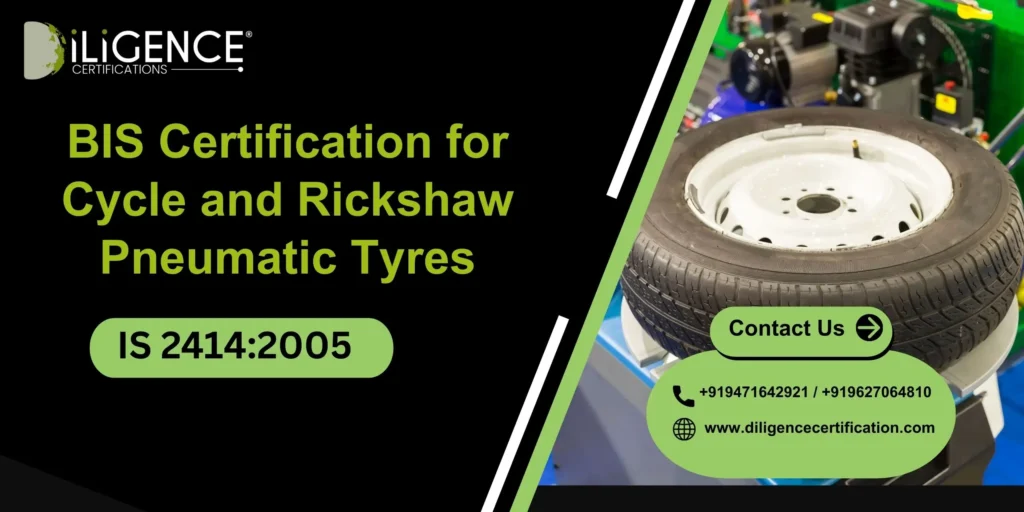
- IS 2414:2005 lays down the specifications for the quality, performance, and safety of pneumatic tyres for cycles and rickshaws.
- The tires should be made of approved rubber compounds and materials to make them strong.
- Tests for air retention, loading capacity, and wear and bursting strength must be conducted in accredited labs by BIS.
- Manufacturers are also compelled to adhere to approved quality control processes of BIS and undergo factory inspections periodically.
- The tyres that possess the ‘ISI Mark’ ensure conformance to Indian norms regarding safety, dependability, and longevity.
Introduction
BIS Certification for Cycle and Rickshaw Pneumatic Tyres, as specified by IS 2414:2005, helps guarantee that the tyres for bicycles and rickshaws adhere to the Indian standards set for such tyres. Being an integral part of the entire system that helps the tyre support the load and facilitate road grip, the tyres for bicycles and rickshaws are extremely important, given the fact that bicycles and rickshaws are used for various purposes and are the primary mode of transport for many people in India, which makes the efficiency of the tyres an important point that needs consideration when the safety of the user is involved. As a result, the Bureau of Indian Standards has developed an IS 2414:2005 standard for regulating the quality and efficiency of pneumatic tyres. This makes it compulsory for the manufacturer of the tyres who will be meeting the Indian standards in regard to quality and efficiency for supplying safe and reliable tyres in the Indian market.
What is IS 2414:2005?
BIS Certification of Cycle & Rickshaw Pneumatic Tyres as per IS 2414:2005:
It can be stated that BIS Certification of Cycle & Rickshaw Pneumatic Tyres as per IS 2414:2005 provides assurance that the cycle & rickshaw tires are meeting the requirements of quality, safety, and durability standards as defined in the Indian Standards.BIS certification of tires provides an assurance that the tires are meeting the standards required in respect of the quality of material used in the manufacture of tires, the process of manufacturing tires, and the performance standards in respect of carrying weight, maintaining inflation pressure, and the life of tires.BIS certification of tires also provides an assurance that the tires that will be sold in the market will be sufficient for meeting the endurance standards of the Indian market.
Key Points:
- Sets standards related to design, composition, and construction of pneumatic tyres on cycles and rickshaws.
- Provides tyres with enough strength and airtightness for comfortable riding.
- Covers performance tests on durability, strength, and wear resistance, as well as bursting resistance.
- Makes firms adhere to the BIS-approved processes for quality control and testing.
- Tyres meeting this criterion are eligible to obtain the ISI mark. This ensures that they are safe to use.
Why is BIS Certification Mandatory
BIS Certification is an instrument to monitor that the products sold in India conform to the prescribed standards of safety, quality, and performance. Poor quality of an item like a cycle and rickshaw pneumatic tyre can cause accidents, apart from reducing the service life and being hazardous to users. Involvement of mandatory BIS certification prevents sale of some substandard or unsafe products, since it enforces adherence to approved manufacturing processes, testing methods, and quality control systems by the manufacturer. Products bearing the ISI mark give consumers confidence that the product complies with Indian Standards and is safe, reliable, and fit for use.
Key Reasons:
- Make sure that products meet safety and quality standards of India before being marketed.
- Helps to stop the flow of substandard, unsafe, or low-quality articles.
- Protects health and safety, particularly with regard to essential products such as tyres and electronics.
- Encourages fair trade practices because it mandates that all manufacturers must meet certain criteria.
- “ISI-marked products instill consumer confidence in reliability, durability, and performance.”
Importance and Benefits of BIS Certification
| Importance | Benefits |
| Identifies that Indian Standards are met in safety, quality, and performance. | Permits the use of the “ISI” mark, thus improving customer confidence. |
| It safeguards consumers from dangerous and poor-quality products. | Improved product acceptance for home use and institutional markets. |
| Aids in maintaining a consistent quality of the product. | This will help to avoid product rejection and potential related legal penalties. |
| Helps with compliance with regulations to enable legal market entry in India. | Improves brand identity and competitiveness. |
| Builds trust and credibility for the product, as well as the brand itself. | Ensures quality and durable product throughout the life cycle. |
Step-by-Step Process of BIS Certification
Step1:Documentation
- Collect required technical documents
- Prepare product specifications
- Gather company registration details
- Ensure documents follow BIS format
Step2:Product Testing
- Send samples to a BIS-approved lab
- Conduct safety and quality tests
- Receive test reports
- Confirm compliance with BIS standards
Step3:Application Submission
- Fill out the BIS application form
- Upload all required documents
- Attach valid test reports
- Pay the necessary BIS fees
Step4:Scrutiny and Inspection
- BIS reviews submitted documents
- Authority verifies test results
- Factory/product inspection may occur
- Clarifications requested if needed
Step5:Grant of License
- BIS approves the application
- License number is issued
- Product can carry BIS mark
- Renewal required before expiry
Documents Required for BIS Certification
| Category | Documents Required |
| Business Documents | Business license/registration, ISO certificate, organizational details |
| Manufacturer Details | Factory layout, process flow chart, machinery list, production details |
| Product Documents | Product specifications, component list, user manual, model details |
| Testing Documents | Test report from BIS-recognized lab, sample details, test request form |
| Legal & Compliance | Authorization letter, brand ownership proof, trademark certificate (if any) |
| Import/Foreign Manufacturer (If applicable) | AIR (Authorized Indian Representative) details, contract agreement, overseas manufacturer documents |
Timelines, Costs, Validity & Renewal
- Timelines: Usually from 20 to 30 days, with only 7-15 days for the testing.
- Costs: The cost of the government and the test varies depending on the product. There can be some additional charges though.
- Validity: The validity period is 2 years in most situations.
- Renewal: The renewal is done before the expiration; there should be updated documents/tests; the renewal
Why Choose Diligence Certifications
By choosing Diligence Certifications, clients are essentially choosing a reliable compliance consultant who can make the entire BIS certification process hassle-free for them. Right from end-to-end facilitation in paperwork, application submission, product testing coordination, to facilitation with the concerned BIS authorities, Diligence Certifications takes care of the entire process in a most competent manner. By being very particular about accuracy and transparency coupled with the required regulatory knowledge, the team at Diligence Certifications makes it most convenient for their clients to obtain certifications in BIS & ISI with the least possible turnaround time in India.
Conclusion
BIS Certification for Cycle and Rickshaw Pneumatic Tyres as per IS 2414:2005 is quite important for ensuring safety, quality, and performance of the tyres. The standard helps a manufacturer ensure that their tyres are robust and of good performance and are appropriate for Indian road and load conditions. BIS certification of Cycle and Rickshaw Pneumatic Tyres, IS 2414:2005, helps meet statutory requirements of the government as well as helps a customer build trust with their brand.
Frequently Asked Questions (FAQs)
What is IS 2414:2005?
It is an Indian Standard, which is related to specifying requirements for quality and safety of pneumatic tires for cycle/rickshaws.
Is BIS certification mandatory for these tires?
Indeed, BIS certification is necessary for selling cycle/ Rickshaw tyres in India.
What is the "ISI" mark on tyres?
The ISI marking denotes that it conforms to safety standards of quality and performance of India.
Who issues BIS certification?
The Bureau of Indian Standards (BIS) issues the certification.
What sort of testing takes place on these tyres?
Testing involves air retention, load capacity, durability, and bursting strength.
Where are tires verified for BIS certification?
The tires get tested at BIS-approved labs.
What entities can be granted BIS certification?
The Applicants may either be tire manufacturers or their authorized representatives.
What is the period of BIS Certification?
The licence is valid for two years and can be extended.
Can foreign tires also acquire BIS certification?
Yes, there is a possibility to obtain certification for imported tires with an Authorized Indian Representative (AIR).
Why is BIS Certification Important?
It makes sure that tyres available in India are safe, long lasting, and appropriate for Indian roads.