BIS Certification
 CDSCO
CDSCO
 PESO
PESO
 CPCB
CPCB
 LMPC
LMPC
 WPC Approval
 Global Approvals
 TEC
TEC
 ARAI
ARAI
 BEE
BEE
 ISO Certification
 DGCA Certification
 NOC For Steel
 APEDA Registration























 Business Registration
 FSSAI Mark Certification












 (32).jpg)
 Legal Services
 Trademark Registration
 Copyright Registration
 Patent Registration
 By
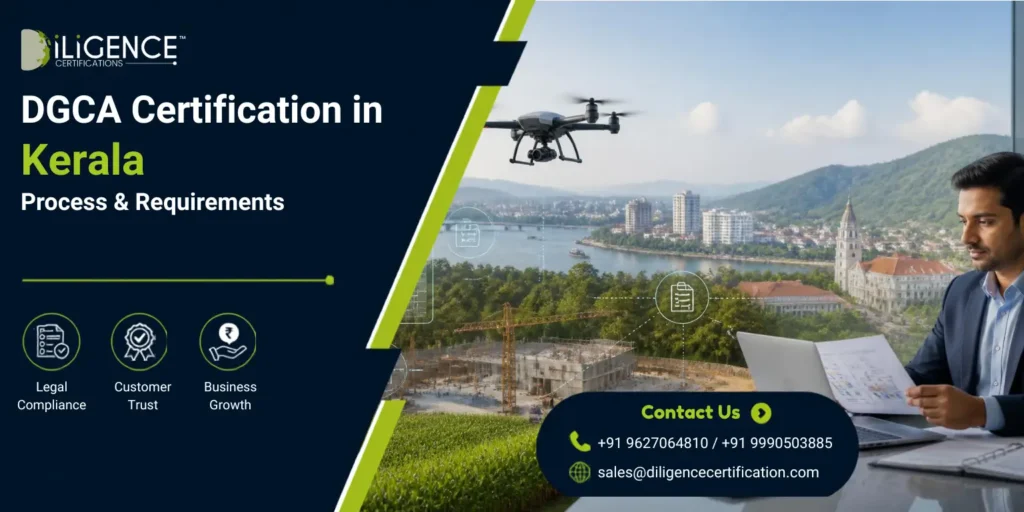
By - DGCA certification in Kerala enables the drone manufacturer or operator, pilot, or aviation business to comprehend the certification and compliance required for their business operations.
- The certification depends on the operations being conducted and may include Type Certification, Digital Sky process, Remote Pilot certification, documentation, testing, and operational limitations.
- Diligence Certifications can help businesses in understanding the DGCA compliance and certification requirements.
Introduction
It could seem that a drone survey firm in Kerala would start with a very simple demand: buy the proper drone and take on projects. But the actual scenario is not like this. In order to start a commercial activity, it will be necessary for the company to determine if the drone, operator, operation and use meet the required criteria set by the Indian aviation laws.
For example, a company in Kochi which will offer aerial survey services for construction projects. There could be another firm in Wayanad that uses drones for agricultural surveillance, and also a firm involved in tourism that would use drones in Munnar to offer aerial photography for resort projects. Thus, each firm has its own use of the drones, and hence, the compliance requirement could differ too.
Here comes the relevance of DGCA certification in Kerala.
DGCA or the Directorate General of Civil Aviation is the civil aviation regulator in India. As regards the drones, there are some regulations governing this area, such as the Drone Rules, 2021 and other relevant directions, standards and digital processes.
It is one point that must be clarified from the beginning that no universal DGCA certificate exists for any drone operation. It will depend upon the aircraft, nature of the operation, organization, pilot, and regulation in force.
What Is DGCA Certification?
DGCA (Directorate General of Civil Aviation) certification means any kind of certification or approval required for an aviation activity within India’s civil aviation environment.
For drones, one important category is Type Certification. The Drone Rules provide the framework within which a manufacturer or eligible applicant can seek Type Certification for an unmanned aircraft system through the prescribed digital process.
Other areas of compliance may include remote pilots, pilot training, aircraft registration and information, operational requirements, and digital regulatory services. The applicable requirement depends on the nature of the drone activity.
Therefore, businesses should first identify the exact regulatory requirement before applying for any DGCA certification or approval.
For a Kerala drone enterprise, some possible compliances are:
- Drone Type Certification
- Remote Pilot Certificate requirements
- Digital Sky procedures
- Aircraft-related compliance
- Technical documentation
- Testing requirements
- Operational compliance
- Airspace restrictions
- Safety procedures
- Regulatory record keeping
Current website of DGCA too provides specific information about drones and mentions that registration of Non-Type Certified (non-TC) UAS has been temporarily suspended. That is why it is very essential to verify the present regulatory stance rather than reading the old drone registration articles.
Why Is DGCA Certification Important in Kerala?
Kerala has a diverse commercial environment in which drones can support surveying, agriculture, construction, infrastructure inspection, tourism, photography and mapping The usefulness of a drone does not remove the need for aviation compliance.
For example, a drone used to inspect a large construction site around Kochi may need a different compliance assessment from a drone manufacturer developing a new aircraft in Thiruvananthapuram.
Proper regulatory assessment helps a business answer basic questions before money is spent on equipment or commercial deployment:
- What approval is actually applicable?
- Does the drone require Type Certification?
- What pilot requirements apply?
- What documentation is required?
- Which digital platform or process is relevant?
- Are there operational restrictions at the intended location?
- What continuing compliance must be maintained?
The purpose is not to create paperwork for its own sake. It is to ensure that the aircraft and the proposed operation fit within India’s aviation framework.
Applications of DGCA Certification in Kerala
Drone technology has practical applications across several sectors in Kerala.
Drone Survey and Mapping
Survey firms can use drones to collect aerial imagery and mapping data for land development, construction, infrastructure and planning projects.
Agriculture and Plantation Monitoring
Kerala’s agricultural sector includes crops and plantations where aerial monitoring can help businesses assess fields, identify problem areas and plan interventions.
Infrastructure Inspection
Drones can assist with visual inspection of:
- Roads
- Bridges
- Buildings
- Transmission infrastructure
- Construction projects
- Industrial facilities
Tourism and Aerial Photography
Kerala’s tourism sector creates demand for aerial photography and videography. Resorts, destinations, event companies and media businesses may use drones for promotional content, subject to applicable aviation and operational requirements.
Disaster and Environmental Assessment
Drones can support aerial observation and data collection after floods, landslides and other events. In a state where monsoon-related conditions can affect accessibility, aerial data can be useful for assessment and planning.
Construction Monitoring
Developers can use periodic aerial imagery to monitor project progress and compare site conditions over time.
Drone Manufacturing and Technology Development
Manufacturers and technology companies need to pay attention to product-level certification requirements rather than treating the process as ordinary drone registration.
Who May Need DGCA Certification in Kerala?
The applicable requirement depends on the activity, but the following businesses and professionals may need to assess DGCA compliance:
- Drone Manufacturers
- Drone Operators
- Remote Pilots
- Survey Companies
- Mapping Companies
- Agricultural Drone Service Providers
- Construction Companies
- Infrastructure Firms
- Aerial Photography Businesses
- Drone Technology Startups
- Drone Training Organisations
- Inspection Service Providers
- Research and Development Organisations
- Aviation Businesses
A manufacturer and an operator should not assume that they have identical compliance responsibilities.
A manufacturer is concerned primarily with the aircraft and applicable certification pathway. An operator has to consider the aircraft being used, personnel, operation and location. A pilot has separate competency and certification considerations where applicable That distinction is often where businesses make their first compliance mistake.
Types of DGCA Compliance for Drone Businesses
The compliance needs of drone companies operating in Kerala could be different based on whether they are engaged in manufacturing, operating, training pilot or offering drone-related services. Knowing what the requirement is before engaging in business will help them save time.
Type Certification
If the drone companies are involved in manufacturing of unmanned aircraft, they could require type certification for the same. The process entails evaluation of the particular drone model against the applicable technical and safety requirements. Proper preparation of the necessary documentation is essential.
Digital Sky Compliance
Digital Sky is an essential component of India’s drone regulation. Based on the nature of the business being done, it could be necessary to make use of the digital sky platform for regulatory purposes.
Pilot Compliance
For commercial use of drones, it might be necessary for pilots to undergo certain training and certification processes. It is vital for businesses to keep the right pilot documentation and confirm that the person who will be using the drone is eligible to carry out such an activity.
Operation Compliance
A certified drone should not be used in any area. The operators should take into consideration issues like airspace restriction, operational condition, safety requirement, and special area restrictions, especially around airports.
Documentations Compliance
For businesses, it is advisable to keep proper documentation for drones, pilots, training, maintenance, and operations.
Documents Required for DGCA Certification in Kerala
The documents depend on the exact certification or approval involved.
For a drone-related application, the documentation may include:
- Certificate of Incorporation or Business Registration
- PAN
- GST details, where applicable
- Authorised Signatory Information
- Address Proof
- Organisation Details
- Drone Technical Specifications
- Product Drawings
- Technical Manuals
- Prototype Information
- Test Reports
- Safety Information
- Operational Information
- Pilot Details, where applicable
- Training Information, where applicable
- Digital Sky application information
- Supporting declarations
- Other documents prescribed under the applicable DGCA procedure
Technical documentation deserves particular attention.
If the specifications in an application do not match the prototype or supporting test information, the applicant may face clarification requirements. For a manufacturer, this can become a much bigger issue because the documentation represents the product itself.
The practical approach is to prepare a document master file before submission and cross-check technical information across all supporting records.
Step-by-Step Process for DGCA Certification in Kerala
Step 1: Identify the Regulatory Pathway
The first step is to ascertain what your drone-related activities are - manufacturing, operation, import, pilot training, surveying, providing services, or developing a UAS - which would guide your path to compliance.
Step 2: Determine Drone Category
This involves verifying the total weight of your drone with its payload. This could determine the category of your drone as nano, micro, small, medium, or large.
Step 3: Gather Technical Documentation
If you are a manufacturer, collect all documents such as specifications, drawings, manuals, test reports, among others. The configuration of your aircraft must be clear prior to commencing certification.
Step 4: Submit Your Application
Complete the applicable DGCA or Digital Sky process with accurate technical and supporting information.
Step 5: Testing and Evaluation
In case of Type Certification, the aircraft or prototype is put through testing and evaluation as per required criteria to confirm compliance.
Step 6: Respond to Questions
Questions from DGCA or the designated testing agency may be raised. Appropriate answers must be technically correct and backed by facts.
Step 7: Get Approval
Approval may be obtained once requirements have been met.
Step 8: Compliance after Approval
Compliance remains even after approval is obtained. Business entities should keep abreast of changes in regulations, Digital Sky processes, aircraft modification, pilot qualifications, operating environment, and documentation.
Timeline, Cost & Validity of DGCA Certification in Kerala
The timeline, cost and validity for DGCA Certification in Kerala cannot be responsibly reduced to one fixed figure because the applicable process varies by certification type.
| Timeline | Cost | Validity |
| Depends on the approval, documentation and testing involved. | Depends on applicable government, testing and professional costs. | Depends on the specific certificate, approval or regulatory requirement. |
| Technical applications may require additional assessment time. | Prototype testing and technical evaluation can affect overall expenditure. | Continuing obligations may apply even after approval. |
| Clarifications or incomplete documentation can affect processing. | The exact requirement should be assessed before budgeting. | Changes in regulations or approved particulars may require further action. |
A consultant promising one universal processing time for every DGCA application should be treated cautiously. A Type Certification application for a manufacturer and a pilot-related compliance requirement are not the same regulatory exercise.
Importance and Benefits of DGCA Certification in Kerala
| Importance | Business Benefit |
| Supports compliance with applicable aviation requirements | Strengthens regulatory credibility |
| Encourages safer drone operations | Builds client confidence |
| Creates a structured documentation system | Reduces avoidable compliance problems |
| Supports proper technical evaluation | Helps professionalise drone operations |
| Improves regulatory preparedness | Supports long-term business planning |
For commercial drone companies, compliance can directly affect business credibility.
Imagine two survey companies competing for the same infrastructure project. One can clearly explain its drone specifications, pilot credentials and compliance process. The other cannot provide basic regulatory documentation. Even if both have capable equipment, the first company is easier for a corporate client to evaluate.
That is where compliance becomes a business asset rather than just a legal requirement.
Why Is DGCA Certification Important for Drone Manufacturers?
Manufacturers face a different level of responsibility from ordinary drone users.
A manufacturer is placing a product into the market. The technical characteristics, safety-related systems and supporting documentation therefore need to be treated seriously.
For a Kerala-based drone manufacturer, certification planning should begin during product development rather than after manufacturing is complete.
The engineering team and compliance team should work together on:
- Product specifications
- Configuration control
- Technical drawings
- Manuals
- Testing
- Safety information
- Certification documentation
- Regulatory submissions
A common mistake is to build the product first and think about certification later. That can result in expensive redesign or retesting A better approach is to treat certification as part of product development from the beginning.
Consequences of DGCA Non-Compliance
Ignoring applicable aviation requirements can create several problems.
Regulatory Risk
A business may face regulatory action if it operates outside the applicable framework.
Project Delays
A client project may have to be postponed if the required aircraft, pilot or compliance arrangements are not in place.
Additional Costs
Correcting technical documents, repeating tests or changing an operational process after deployment can cost significantly more than preparing correctly at the beginning.
Business Reputation
Corporate clients increasingly expect service providers to demonstrate basic regulatory awareness.
Operational Restrictions
- Non-compliance may prevent a business from conducting particular operations until the issue is addressed.
- The sensible approach is to identify compliance requirements before purchasing equipment, signing a major project or launching a drone service.
Renewal and Updating of DGCA Compliance
Not every DGCA-related approval follows the same validity or renewal process.
Businesses should review their position whenever there is a significant change in:
- Ownership
- Company details
- Drone configuration
- Technical specifications
- Pilot personnel
- Operational scope
- Business activity
- Approved documentation
- Regulatory requirements
A periodic compliance review can identify changes before they become operational problems.
DGCA’s current online systems and regulatory pages should be checked regularly because the drone regulatory environment continues to develop. The official DGCA drone page currently carries the specific notice that registration of non-Type Certified UAS is temporarily suspended until further notice This is a good example of why old blog posts and informal advice should not be used as the sole basis for a regulatory decision.
How Can Professional Assistance Help with DGCA Certification in Kerala?
For a straightforward application, it may appear that the main task is filling in an online form.
In practice, the harder question usually comes first:
Which regulatory route actually applies to the business?
Professional assistance can help with:
- Regulatory Requirement Assessment
- Eligibility Review
- Documentation Preparation
- Technical Document Review
- Application Preparation
- Digital Sky Guidance
- Testing Coordination
- Regulatory Query Support
- Compliance Monitoring
- Post-Approval Guidance
For example, a Kerala drone manufacturer may approach a consultant asking for “drone registration.” A proper initial assessment could show that the business actually needs to address Type Certification requirements first.
Getting that decision right at the start can prevent considerable rework.
Why Choose Diligence Certifications for DGCA Certification in Kerala?
Diligence Certifications supports businesses with regulatory and certification-related requirements in India.
For DGCA Certification in Kerala, professional assistance can be structured around the applicant’s actual activity rather than a generic certificate package.
The support may include:
- Requirement Identification
- Eligibility Assessment
- Documentation Assistance
- Application Support
- Regulatory Guidance
- Technical Documentation Review
- Query Handling
- Compliance Advisory
- Post-Approval Support
Diligence Certifications can also help businesses understand the difference between aircraft certification, pilot-related requirements and operational compliance.
That distinction matters. A manufacturer, pilot and drone-service company may all use the word “DGCA certification”, but their actual regulatory responsibilities can be quite different.
Conclusion
DGCA certification in Kerala must be considered based on the nature of the aviation or drone activity and not just any generic DGCA certification.
In the case of manufacturers, Type Certification could be the crucial issue. In case of drone operations, it could be pilot requirements, eligibility of the aircraft, digital sky process and compliance with airspace rules. If you are involved in survey, agriculture, infrastructure or tourism business, then your regulatory status must be determined before initiating commercial drone operations.
The present regulatory status must also be considered before initiating the activities. Presently, DGCA has stated that the registration of non-Type Certified UAS is temporarily suspended, explaining why it is important not to rely on old information for compliance.
If you are considering DGCA certification in Kerala for your drone manufacturing, operations, survey or aviation business, then Diligence Certifications can assist you in determining the appropriate route and in complying with the requirements.
If you require DGCA certification services in Kerala, then contact Diligence Certifications.
Frequently Asked Questions
What is DGCA Certification in Kerala?
It refers to the applicable DGCA certification, approval, authorisation or compliance requirement for a particular aviation or drone activity carried out in Kerala.
Is there a separate DGCA certificate for Kerala?
No. DGCA is a national civil aviation regulator. The applicable requirements are governed at the national level.
Is Type Certification required for drones?
Where the applicable regulatory framework requires Type Certification, the manufacturer or relevant applicant must follow the prescribed certification process.
Can non-Type Certified drones currently be registered?
DGCA currently states that registration of non-Type Certified UAS has been temporarily suspended until further notice.
What is Digital Sky?
Digital Sky is DGCA's online platform for various activities associated with management of unmanned aircraft system activities in India.
Do drone pilots need certification?
The requirement depends on the applicable drone category, operation and current regulatory provisions. Relevant DGCA training material includes Remote Pilot Certificate requirements.
Can drones be used for agriculture in Kerala?
Drone use for agricultural activities is possible subject to the applicable aircraft, pilot, airspace, operational and regulatory requirements.
Can a DGCA-certified drone fly anywhere in Kerala?
No. Certification does not mean unrestricted operation. Applicable airspace and location-specific restrictions must still be followed.
What documents are needed for drone certification?
Documents depend on the application but can include company information, technical specifications, drawings, manuals, test documents and applicant details.
Can Diligence Certifications help with DGCA compliance?
Yes. Diligence Certifications can assist with requirement assessment, documentation, application support and regulatory compliance guidance.