BIS Certification
 CDSCO
 PESO
 CPCB
 LMPC
 WPC Approval
 Global Approvals
 TEC
 ARAI
 BEE
 ISO Certification
 DGCA Certification
 NOC For Steel
 APEDA Registration























 Business Registration
 FSSAI Mark Certification












 (32).jpg)
 Legal Services
 Trademark Registration
 Copyright Registration
 Patent Registration
 By
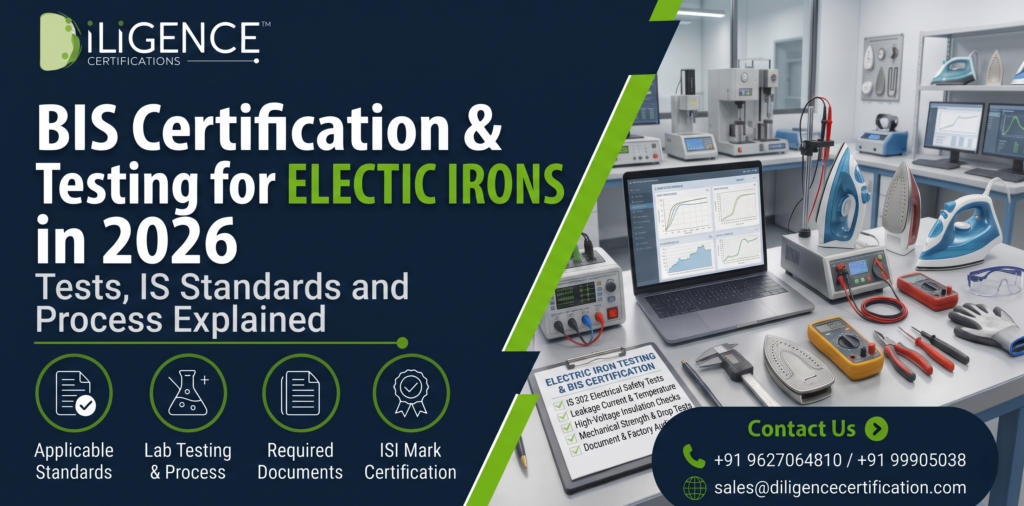
- Electric iron testing checks whether an appliance is safe and reliable for regular use.
- Testing covers electrical safety, heating performance, temperature control and insulation.
- IS 302 (Part 2/Sec 3):2024 is the current specific Indian Standard for electric iron safety.
- Electric irons are covered under mandatory BIS certification requirements.
- Manufacturers and importers must understand applicable BIS requirements before selling products in India.
Introduction
An electric iron is one of the commonly used electrical appliances in Indian homes. From ironing clothes to preparing uniforms and formal wear people rely on electric irons every day.
But what happens if an iron gets too hot has a problem or cannot manage its heat? These issues can ruin clothes give shocks and even lead to fire dangers.
That is why checking irons before they are sold is important.
Electric iron testing looks at parts of the device such, as electrical safety how well it heats how good the insulation is, how it controls temperature and how strong the build is.
For companies people who bring products into the country and brands that want to sell irons in India knowing the testing and BIS certification rules is a key part of making sure products are correct.
In this guide we talk about the standards that apply the tests, the certification steps the papers needed and common errors in simple words.
What Is Electric Iron Testing?
Electric iron testing is the process of examining an iron to see if the electric iron meets safety and performance rules. I know that electric iron testing is crucial, for consumers.
In a testing laboratory the electric iron is examined to find out if the irons electrical parts, heating system, temperature controls and build meet the right standard. We rely on these checks to trust the iron.
For example a maker of a 1200‑watt electric iron must make sure that the electric irons power input, heating performance and insulation satisfy the needed rules. Otherwise the electric iron could be unsafe.
Likewise a steam electric iron requires care because the steam electric iron holds a water tank and makes steam while the electric iron runs. We must test the steam iron carefully.
Electric iron testing generally covers three areas:
- Electrical safety: Insulation, electric shock protection, earthing and leakage current.
- Heating performance: Temperature rise, heating element and thermostat operation.
- Mechanical safety: Handle, soleplate, body and internal component construction.
The main objective is to ensure that the appliance operates safely under the conditions specified by its standard.
Which BIS Standard Applies to Electric Iron Testing in India?
The current specific Indian Standard for electric iron safety is:
IS 302 (Part 2/Sec 3):2024 / IEC 60335-2-3:2022
It talks about safety rules for electric irons and is used together with the general rules for household electrical appliances.
The old standard, IS 302-2-3:2007 was updated in 2024. The final day to use both versions at the time was 23 February 2025.
Companies should look at the updated 2024 standard when getting ready, for testing and getting certified.
Important Standards and Regulations
| Standard / Regulation | Purpose |
| IS 302 (Part 2/Sec 3):2024 | Specific safety requirements for electric irons |
| IEC 60335-2-3:2022 | International safety requirements for electric irons |
| IS 302 (Part 1):2024 | General safety requirements for household appliances |
| BIS Certification Scheme-I | Applicable certification framework |
| Relevant Quality Control Orders | Mandatory certification and Standard Mark requirements |
Note: Always verify the latest BIS notifications, applicable standard and product scope before starting the certification process.
Is BIS Certification Mandatory for Electric Irons?
Yes. Electric irons are covered under mandatory BIS certification requirements in India.
Manufacturers must obtain the applicable BIS licence before manufacturing or selling covered products in the Indian market.
The certification process generally includes:
- Identifying the applicable Indian Standard.
- Preparing product and company documents.
- Arranging product testing.
- Submitting the BIS application.
- Completing applicable factory inspection requirements.
- Obtaining the BIS licence.
- Using the ISI Standard Mark according to licence conditions.
A successful laboratory test report does not automatically provide permission to use the ISI mark. The required BIS licence must be obtained separately.
Who Needs BIS Certification?
- Indian electric iron manufacturers.
- Importers bringing electric irons into India.
- Private-label brands selling electric irons.
- Overseas manufacturers supplying products to India.
- Businesses producing different models of dry and steam irons.
Foreign manufacturers should also consider the applicable Foreign Manufacturers Certification Scheme (FMCS) requirements.
Types of Electric Irons Covered
Electric irons are available in different designs. Their testing requirements depend on construction and features.
| Type | Description |
| Dry Iron | Uses a heating element without producing steam |
| Steam Iron | Uses water to generate steam |
| Vented Steam Iron | Releases steam through soleplate openings |
| Pressurised Steam Iron | Uses a pressurised steam arrangement |
| Spray Iron | Includes a water spray function |
| Cordless Iron | Can be separated from its power base |
| Instantaneous Steam Iron | Generates steam through an instantaneous heating arrangement |
Manufacturers should clearly identify the product type, model number, electrical rating, appliance class and relevant technical specifications.
Why Is Electric Iron Testing Important?
Testing helps manufacturers identify defects and reduce safety risks before products reach consumers.
1. Protection Against Electric Shock
Electric irons contain electrical components that can become dangerous if insulation or wiring is defective. Testing checks protection against accidental contact with live parts.
2. Prevention of Overheating
Uncontrolled heating can damage clothes and create safety risks. Testing evaluates heating behaviour and relevant protective arrangements.
3. Temperature Control
A thermostat helps maintain the required temperature. Testing checks whether the temperature-control system operates as specified.
4. Better Product Quality
Testing evaluates the strength and reliability of important parts, including the handle, soleplate and internal connections.
5. Regulatory Compliance
Products covered by mandatory Quality Control Orders must meet applicable BIS certification requirements.
6. Customer Confidence
Proper testing and compliance help businesses demonstrate their commitment to product safety and quality.
What Tests Are Conducted on Electric Irons?
Electric iron testing includes different checks based on the applicable standard and product design.
| Test | What Does It Check? |
| Protection Against Electric Shock | Protection from contact with live parts |
| Power Input and Current | Electrical power consumption |
| Heating Test | Heating performance and temperature behaviour |
| Leakage Current Test | Electrical current leakage |
| Electric Strength Test | Insulation strength |
| Moisture Resistance Test | Effect of moisture on electrical safety |
| Endurance Test | Performance during repeated operation |
| Abnormal Operation Test | Safety under specified abnormal conditions |
| Mechanical Strength Test | Physical strength of relevant parts |
| Construction Test | Overall product design and assembly |
| Internal Wiring Test | Safety of internal electrical connections |
| Heat and Fire Resistance | Behaviour of relevant materials under heat |
The laboratory determines which tests apply to the particular model.
1. Protection Against Electric Shock Test
This test checks whether users are protected from accidental contact with dangerous electrical parts.
The laboratory uses suitable test probes and equipment to examine the accessibility of live components.
2. Power Input and Current Test
The laboratory measures the electrical input of the appliance under specified conditions.
For example, an iron may have a declared rating of 230 V and 1,200 W. The measured input is evaluated against the applicable requirements.
3. Heating Test
The heating test evaluates the temperature behaviour of the iron during operation.
The laboratory measures relevant temperatures to check whether the heating system works safely.
4. Leakage Current and Electric Strength Test
These tests evaluate the electrical insulation of the appliance.
They help identify insulation weaknesses that could create an electric shock risk.
5. Moisture Resistance Test
Steam and spray irons contain water, making moisture resistance particularly important.
The test evaluates whether moisture affects the appliance’s electrical safety and insulation.
6. Endurance Test
Electric irons are used repeatedly. The endurance test checks whether the appliance and its relevant components can withstand the specified operating cycles.
7. Mechanical Strength Test
This test evaluates the strength of relevant product parts against specified physical stress.
The revised 2024 standard introduced an additional mechanical strength test for irons under Clause 21.102.
8. Abnormal Operation Test
The appliance is evaluated under specified abnormal operating conditions to check whether it remains safe.
9. Construction and Internal Wiring Test
The laboratory examines important construction details, including:
- Internal wiring and electrical connections.
- Heating element arrangement.
- Insulation and protective barriers.
- Handle and soleplate assembly.
- Screws and relevant connections.
- Protective components.
These checks help identify construction-related safety problems.
BIS Certification Process for Electric Irons: Step by Step
Manufacturers and importers should understand the certification process before starting commercial production.
Step 1: Identify the Applicable Standard
I will help you find the Standard, for the Product. The current specific reference is IS 302 (Part 2/Sec 3):2024.
Step 2: Identify Product Models
I suggest you make a list of Product Models with their Wattage, Design, Soleplate, Electrical components and other relevant Specifications.
Different Product Models may have Testing and Grouping requirements.
Step 3: Prepare Documents
Collect company details, product specifications, circuit diagrams and manufacturing information.
Step 4: Select a Suitable Laboratory
Choose a laboratory with the required testing scope. Verify its accreditation and BIS recognition or acceptance for the intended purpose.
Step 5: Submit Samples
Prepare product samples that represent the product as per the applicable product manual and laboratory guidelines.
The BIS product manual for the revised 2024 standard requires four samples. Make sure to confirm the sample arrangement, with the laboratory handling the test.
Step 6: Complete Product Testing
The laboratory will carry out all tests, including electrical safety, heating performance, insulation quality, moisture resistance and any other relevant tests as specified.
.Step 7: Review the Test Report
Check the results carefully. If the product fails, identify the reason and take corrective action.
This may involve improving insulation, modifying wiring or replacing unsuitable components.
Step 8: Submit the BIS Application
Submit the required application. Supporting documents through the applicable BIS certification procedure.
Step 9: Factory Inspection
BIS may inspect the manufacturing facility, quality control system, testing arrangements and production process according to the procedure.
Step 10: Obtain the BIS Licence
After completion of the applicable requirements BIS may grant the licence. The manufacturer must follow its conditions when using the ISI Standard Mark.
Documents Required for Electric Iron Testing and BIS Certification
Documentation is an important part of product compliance.
Company Documents
- Company registration certificate.
- GST registration, where applicable.
- Manufacturing unit address.
- Authorisation letter for the authorised representative.
- Contact details of the responsible person.
Product Documents
- Product name and model number.
- Technical specification sheet.
- Product drawings and circuit diagrams.
- Electrical rating details.
- Heating element specifications.
- Thermostat and protective device details.
- Soleplate and coating specifications.
- Handle and body material details.
- Water tank capacity for steam irons.
Manufacturing and Quality Documents
- Manufacturing process details.
- List of major components and suppliers.
- Quality control procedures.
- Inspection and testing records.
- Testing equipment details.
- Calibration records, where applicable.
- Previous test reports, if available.
Additional Documents for Foreign Manufacturers
- Manufacturer authorisation.
- Factory information.
- Applicable authorised Indian representative details.
- Technical product documents.
- Import-related business information, where required.
The final document checklist should be confirmed before submitting the application.
How Long Does Electric Iron Testing Take?
There is no fixed timeline for every electric iron testing project.
The duration depends on the product type, number of models, applicable tests and laboratory workload.
Simple checks may take less time, while endurance and specialised testing can require additional time.
The complete BIS certification process may also involve application review, factory inspection and document verification.
To avoid delays:
- Finalise the product design before testing.
- Prepare technical documents in advance.
- Confirm sample quantity.
- Select a suitable laboratory.
- Keep additional time for corrective action and retesting.
What Factors Affect Electric Iron Testing Cost?
The testing cost depends on several factors:
- Product type: Dry and steam irons may have different testing requirements.
- Number of models: Multiple models may require additional testing.
- Testing scope: The number and type of applicable tests affect charges.
- Sample quantity: Laboratories may require multiple samples.
- Product construction: Additional features may affect testing requirements.
- Retesting: Failed tests may involve additional charges.
- Laboratory selection: Charges differ between laboratories.
- Certification expenses: BIS application, inspection and other applicable charges are separate considerations.
Always request a written quotation explaining the testing scope and additional charges. Do not choose a laboratory only because it offers the lowest price.
Common Mistakes Manufacturers Should Avoid
Manufacturers can experience unnecessary delays because of small mistakes.
- Using an old standard: The 2007 version was withdrawn after 23 February 2025. Refer to the revised 2024 standard.
- Selecting the wrong laboratory: Check that the required electric iron tests are within its scope.
- Sending incorrect samples: Samples should represent the actual production model.
- Ignoring model differences: Different wattages and construction may affect testing requirements.
- Incomplete documentation: Prepare circuit diagrams and technical specifications in advance.
- Ignoring temperature control: A defective thermostat can affect product safety.
- Changing components after testing: Changes to important components may require additional evaluation.
- Confusing a test report with a licence: A successful report does not automatically permit ISI marking.
Who Needs Electric Iron Testing?
1. Manufacturers: To evaluate product safety and meet applicable certification requirements.
2. Importers: To understand the compliance requirements before importing electric irons into India.
3. Private Label Brands: To ensure that products sold under their brand meet applicable requirements.
4. Overseas Manufacturers: To understand BIS certification and FMCS requirements for supplying the Indian market.
5. Electrical Appliance Businesses: To evaluate product quality and prepare for market entry.
6. Startups: To consider testing and certification during product development rather than waiting until commercial production.
Why Choose Diligence Certifications for Electric Iron Testing and BIS Certification?
Understanding the applicable standard, preparing documents and coordinating testing can be challenging for manufacturers and importers.
At Diligence Certifications, we help businesses understand product compliance requirements and prepare for the certification process.
Our consultancy support includes:
- Identifying applicable BIS standards and requirements.
- Understanding product categories and model specifications.
- Preparing document checklists.
- Guiding businesses on sample preparation.
- Coordinating with suitable testing laboratories.
- Following up on testing reports.
- Providing guidance on BIS application requirements.
- Supporting related product certification and compliance activities.
You can also explore our certification and compliance services.
Diligence Certifications provides consultancy and compliance guidance. We do not claim to perform laboratory testing ourselves or guarantee BIS approval. Testing results and certification decisions depend on the product evaluation and applicable BIS requirements.
Our objective is to make the process easier to understand and help businesses avoid unnecessary delays.
Conclusion
I see that electric iron testing helps keep household appliances safe and reliable.
Electric iron testing by checking the insulation, the heating performance, the moisture resistance and the mechanical strength lets me spot possible problems in the product.
For manufacturers and importers in India knowing the rules of IS 302 Part 2 Section 3 of 2024 and the must‑have BIS certification is especially crucial.
Before you begin make sure you know which standard applies gather all documents pick a good laboratory and check that the product is ready, for testing.
Remember, a good test report is part of compliance but you must also get the BIS licence before you can use the ISI mark.
Frequently Asked Questions (FAQs)
1. What is electric iron testing?
Electric iron testing checks an appliance for electrical safety, heating performance, insulation, temperature control and mechanical strength according to the applicable Indian Standard.
2. Which BIS standard applies to electric irons in India?
The current specific standard is IS 302 (Part 2/Sec 3):2024, aligned with IEC 60335-2-3:2022.
3. Is BIS certification mandatory for electric irons?
Yes. Electric irons are covered under mandatory BIS certification requirements. Manufacturers must obtain the applicable licence before selling covered products in India.
4. What tests are conducted on electric irons?
Important tests include power input, heating, leakage current, electric strength, moisture resistance, endurance, mechanical strength and abnormal operation testing.
5. Are dry irons and steam irons covered under the same standard?
The BIS product manual covers different varieties of electric irons. Applicable requirements depend on the product design and configuration.
6. How many samples are required for electric iron testing?
The BIS product manual for the revised 2024 standard specifies four samples. Confirm the actual requirements with the concerned laboratory and BIS office.
7. How long does electric iron testing take?
The timeline depends on the number of tests, product design and laboratory workload. Retesting may require additional time.