 BIS Certification
 CDSCO
CDSCO
 PESO
PESO
 CPCB
CPCB
 LMPC
LMPC
 WPC Approval
 Global Approvals
 TEC
TEC
 ARAI
ARAI
 BEE
BEE
 ISO Certification
 DGCA Certification
 NOC For Steel
 APEDA Registration




















 Business Registration
 FSSAI Mark Certification











 (32).jpg)
 Legal Services
 Trademark Registration
 Copyright Registration
 Patent Registration
 By
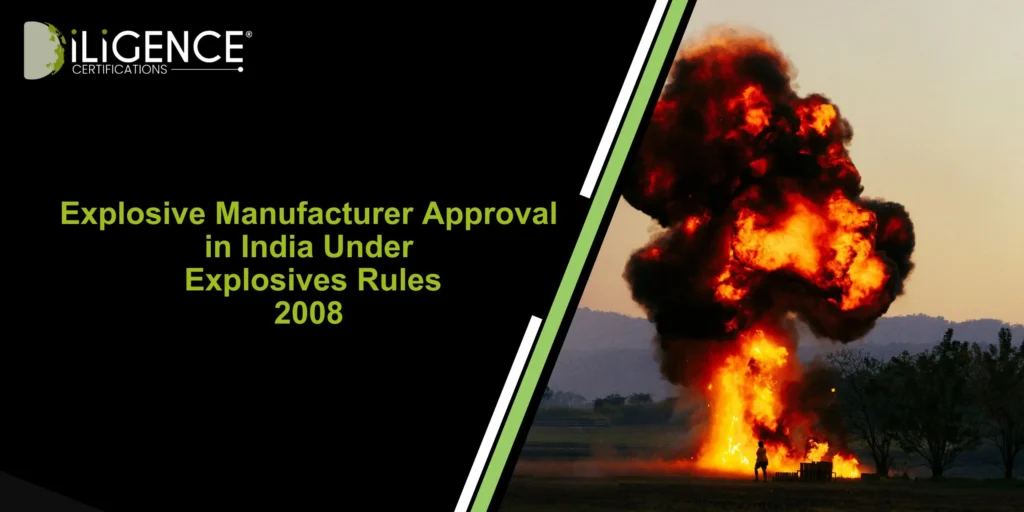
By - Explosive Manufacturer License is strictly regulated under the Explosives Rules, 2008 to ensure safety, security, and environmental compliance.
- Approval is granted by Petroleum and Explosives Safety Organisation (PESO), the primary authority governing explosives.
- Manufacturers must obtain multiple clearances, including site approval, layout approval, and final manufacturing license.
- Compliance involves technical documentation, safety infrastructure, and qualified personnel.
- Non-compliance can result in license rejection, legal penalties, or permanent blacklisting.
Introduction | Explosive Manufacturer License
Explosive Manufacturer License are classified as highly hazardous materials with significant risk potential. In India, their manufacturing, storage, transport, and sale are governed by the Explosives Rules, 2008. Any business intending to manufacture explosives must obtain prior approval from the Petroleum and Explosives Safety Organisation (PESO).
The approval process is not just a formality-it is a technical and compliance-heavy procedure involving safety audits, infrastructure validation, and regulatory scrutiny. This guide explains the complete process, requirements, benefits, and challenges involved in obtaining explosive manufacturer approval in India.
What is Explosive Manufacturer License?
Explosive Manufacturer License is a regulatory authorization issued by PESO that allows a company to legally manufacture explosive substances in India. This approval ensures that the manufacturing unit meets strict safety, technical, and environmental standards.
Key Components of Approval
- Site approval for factory location
- Layout approval for plant design
- License for manufacturing explosives
- Safety compliance certification
- Periodic inspection and renewal
Key Points
- Mandatory for all explosive manufacturing units
- Covers industrial, mining, and defense-grade explosives
- Requires compliance with safety distances and zoning laws
- Involves multiple stages of inspection
- Subject to renewal and audits
Why Explosive Manufacturer License is Required
Manufacturing explosives involves high-risk processes that can lead to accidents, environmental damage, or misuse if not regulated. Explosive Manufacturer License in Explosives Rules, 2008 were introduced to mitigate these risks through strict control mechanisms.
Key Reasons
- To ensure public and worker safety
- To regulate hazardous material handling
- To prevent illegal manufacturing or misuse
- To maintain environmental protection standards
- To standardize industrial practices across India
Key Points
- Prevents industrial accidents and explosions
- Ensures compliance with national safety norms
- Builds trust with government and clients
- Mandatory for legal operations
- Required for export and large-scale supply contracts
Importance and Benefits Explosive Manufacturer License
| Aspect | Benefit |
| Legal Compliance | Avoids penalties, shutdowns, and legal action |
| Business Credibility | Builds trust with clients and authorities |
| Safety Assurance | Reduces risk of accidents and liabilities |
| Market Access | Enables participation in government tenders |
| Operational Stability | Ensures uninterrupted business operations |
| Export Opportunities | Required for international trade compliance |
| Insurance Support | Easier to obtain industrial insurance |
| Risk Management | Structured safety protocols reduce losses |
Process for Explosive Manufacturer Approval in India
The approval process is multi-stage and requires precise documentation and technical compliance.
Step 1: Site Approval
- Select location as per zoning and safety distance norms
- Submit land documents and site plan
- Ensure distance from residential and public areas
Step 2: No Objection Certificate (NOC)
- Obtain NOC from District Authority
- Police verification required
- Local administration clearance mandatory
Step 3: Layout Approval
- Submit detailed factory layout plan
- Include safety distances, building structures, and storage areas
- Must be designed by a competent authority
Step 4: Application to PESO
- Submit application with required documents
- Include safety manuals, risk assessment, and technical details
Step 5: Inspection by PESO
- Physical inspection of site and infrastructure
- Verification of safety compliance
- Evaluation of staff qualifications
Step 6: Grant of License
- License issued after successful inspection
- Conditions and validity period specified
Step 7: Renewal and Compliance
- Periodic renewal required
- Subject to surprise inspections
- Continuous compliance mandatory
Challenges of Getting This Certification Without a Consultant
Attempting the approval process without expert guidance often leads to delays or rejection.
Major Challenges
- Complex Documentation Multiple technical documents, drawings, and safety reports are required. Errors can lead to rejection.
- Regulatory Interpretation Issues Understanding Explosives Rules, 2008 requires legal and technical expertise.
- Design and Layout Errors Incorrect factory layout is one of the most common reasons for rejection.
- Coordination with Authorities Handling multiple departments (district authority, PESO, police) is time-consuming.
- Inspection Failures Lack of preparation for PESO inspections can delay approval.
- Time Delays Without proper follow-ups, applications may remain pending for months.
- Cost Overruns Rework and corrections increase project cost significantly.
Why Choose Diligence Certification
Diligence Certification provides end-to-end support for explosive manufacturer approval, reducing risk and accelerating approval timelines.
What We Do
- Complete documentation preparation
- Site and layout compliance support
- Liaison with PESO and local authorities
- Inspection readiness and audit support
- End-to-end project handling
Key Advantages
- Faster approval timelines
- Error-free documentation
- Expert regulatory understanding
- Reduced rejection risk
- Dedicated compliance support
Real Example
A manufacturer applied independently and faced rejection due to layout non-compliance. After onboarding Diligence Certification:
- Layout redesigned as per PESO norms
- Documentation corrected
- Approval secured within defined timeline
Additional Critical Compliance Factors (Often Ignored)
- Safety distance calculations must be accurate
- Storage capacity limits must be clearly defined
- Emergency response plan is mandatory
- Fire safety systems must meet standards
- Skilled personnel must be employed
Ignoring these leads to rejection or penalties.
Conclusion
Explosive Manufacturer License under the Explosives Rules, 2008 is a mandatory and highly regulated process in India. It ensures that only qualified and compliant businesses are allowed to manufacture hazardous materials.
The process involves multiple stages, strict documentation, and technical validation. Businesses attempting to handle it without expertise often face delays, rejections, and increased costs.
Working with a professional consultancy like Diligence Certification ensures smooth approval, regulatory compliance, and long-term operational stability.
Frequently Asked Questions (FAQs)
Who issues explosive manufacturing licenses in India?
The license is issued by the Petroleum and Explosives Safety Organisation (PESO).
Is explosive manufacturer approval mandatory?
Yes, it is mandatory for any entity involved in manufacturing explosives.
What is the validity of the license?
Typically, licenses are issued for a fixed period and require renewal.
How long does the approval process take?
It can take several months depending on compliance and documentation accuracy.
What documents are required?
Site plan, layout design, NOC, safety reports, and technical details.
Can I apply without a consultant?
Yes, but it increases the risk of delays and rejection.
What are common reasons for rejection?
Incorrect layout, incomplete documents, and safety non-compliance.
Is inspection mandatory?
Yes, PESO conducts a physical inspection before granting approval.
Are there penalties for non-compliance?
Yes, including fines, license cancellation, and legal action.
Can foreign companies apply?
Yes, but they must comply with Indian regulations and local requirements.