

 BIS Certification
 CDSCO
CDSCO
 CPCB
CPCB
 LMPC
LMPC
 WPC Approval
 Global Approvals
 TEC
TEC
 ARAI
ARAI
 BEE
BEE
 ISO Certification
 DGCA Certification
 NOC For Steel
 APEDA Registration













 Business Registration
 FSSAI Mark Certification










 Legal Services
 Trademark Registration
 Copyright Registration
 Patent Registration
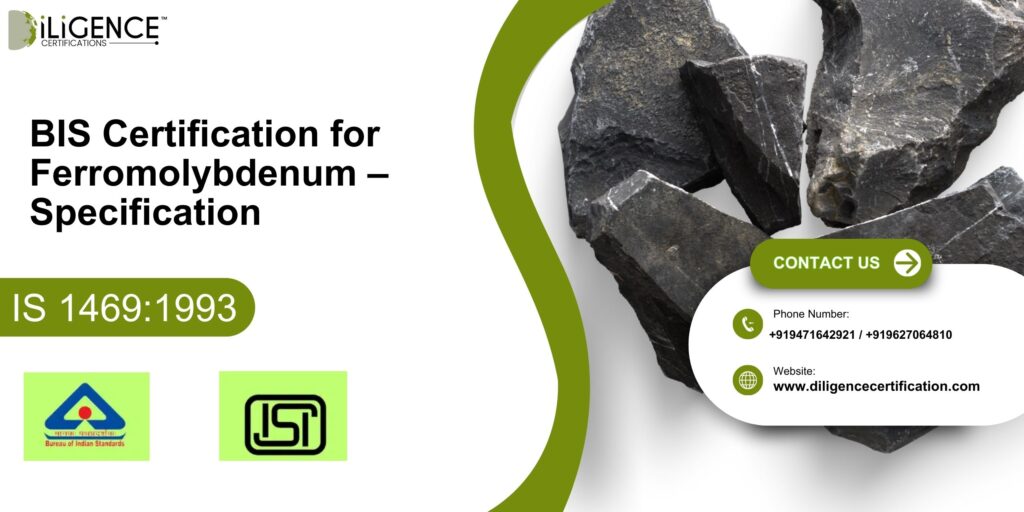
- BIS certification is an assurance that Ferromolybdenum is in compliance with the chemical and metallurgical requirements.
- Stops an alloy inconsistencies that cause the appearance of the defects in the steel.
- Creates a good reputation with large steel plants, alloy manufacturers, and foundries.
- BIS confirms that the company has the capacity to produce, quality control is in place, and there is proper testing infrastructure.
- Holding a BIS licence is a point of attraction for a supplier both for the local and foreign buyers. .
Introduction
Ferromolybdenum is one of the most significant alloying materials that is mainly used in the steel and metallurgical industries to make the products more durable, corrosion-resistant, and to enhance their ability to withstand high temperatures. To maintain the product quality and have a well-controlled chemical composition, the Bureau of Indian Standards has specified the IS 1469:1993 standard for Ferromolybdenum. BIS certification according to this standard is a assurance that the product is in compliance with the specified metallurgical and impurity requirements. It is also a confirmation that manufacturers have the necessary testing facilities, quality control systems, and production capability in place. BIS-certified Ferromolybdenum is the trust-building instrument among steel plants, foundries, and alloy manufacturers, at the same time, it is facilitating the regulatory compliance under the BIS Act, 2016. Bureau of Indian Standards
What is IS 1469:1993?
IS 1469:1993 is an Indian Standard that provides detailed specifications on the chemical requirements, physical properties, impurity limits, and sampling methods for Ferromolybdenum. The document describes Ferromolybdenum as a major alloying material that is utilized in the production of alloy steel, stainless steel, tool steel, and cast iron
Ferromolybdenum under this standard must maintain:
- stable molybdenum percentage
- controlled levels of carbon, silicon, sulphur, and phosphorus
- proper sizing for furnace charging
- uniform metallurgical quality for steelmaking
This ensures reliable hardenability, strength, corrosion resistance, and high-temperature performance in final steel products.
ISI Mark Certification
- Specifies Mo content ranges (typically 60–70%) depending on grade.
- Sets limits for carbon, silicon, sulphur, phosphorus, copper, and aluminum.
- Defines size tolerances for lumps used in steel melting.
- Requires the material to be free from slag, harmful impurities, and moisture.
- Includes mandatory sampling, chemical analysis, and test procedures.
Why is BIS Certification Mandatory?
BIS Certification becomes mandatory when the Government of India issues a Quality Control Order (QCO) to ensure product safety, uniformity, and quality in critical industrial materials. Ferromolybdenum is directly used in steel plants, making its consistency crucial for metallurgical performance.
- QCOs under BIS Act, 2016 enforce mandatory compliance for alloying materials.
- Prevents low-quality or off-grade material from entering Indian steel supply chains.
- Ensures manufacturers follow defined chemical and impurity standards.
- Protects steel plants from production failures caused by inconsistent alloy inputs.
- Creates a fair and regulated environment for domestic producers and importers.
Importance and Benefits of BIS Certification
| Importance | Benefits |
| Ensures Ferromolybdenum meets chemical & metallurgical standards | Prevents alloy failures and improves steel quality |
| Builds confidence among steel plants & metallurgical buyers | Easier approval & long-term supply partnerships |
| Supports regulatory compliance for alloying inputs | Reduces safety risks & metallurgical failures |
| Ensures uniformity in manufacturing processes | Consistent steel melting behavior and predictable results |
| Enhances the supplier’s credibility & brand value | Competitive advantage in domestic & global markets |
Step-by-Step Process of BIS Certification
Step 1: Documentation
- Collect all technical and manufacturing documents
- Prepare product composition details
- Gather company registration certificates
- Ensure documents follow BIS format
Step 2: Product Testing
- Send samples to a BIS-recognized laboratory
- Conduct chemical and impurity-level testing
- Receive test reports
- Verify compliance with IS 1469:1993
Step 3: Application Submission
- Fill BIS application
- Upload required documents
- Attach valid test reports
- Pay applicable BIS fees
Step 4: Scrutiny & Inspection
- BIS reviews all submissions
- Officials verify test results
- Factory inspection may be conducted
- Clarifications requested if required
Step 5: Grant of License
- BIS approves the application
- License number is issued
- Ferromolybdenum can carry the ISI mark
- Renewal required before expiry
Documents Required for BIS Certification
| Category | Documents Required |
| Business Documents | Company registration, ISO certificate, organizational details |
| Manufacturer Details | Factory layout, process flow, machinery list, QC system |
| Product Documents | Chemical composition sheet, production details, grade information |
| Testing Documents | BIS-recognized lab test report, test request form, sampling details |
| Legal & Compliance | Authorization letter, trademark proof (if any), brand details |
| Foreign Manufacturer (if applicable) | Authorized Indian Representative (AIR) contract, overseas manufacturing documents |
Timelines, Costs, Validity & Renewal
- Timelines: 20–30 days on average; testing requires approx. 7–15 days.
- Costs: Vary depending on grade, testing charges, and BIS fees.
- Validity: BIS licence is valid for 2 years.
- Renewal: Requires updated test reports and relevant documents before expiry.
Why Choose Diligence CertificationsC
- Expert team specializing in BIS Alloy & Metallurgical Certifications
- Fast and streamlined processing to reduce delays
- Accurate documentation support and testing coordination
- Transparent process with consistent communication
- High success rate and end-to-end assistance
Conclusion
It goes beyond a mere condition imposed by law to carry out the BIS Certification for Ferromolybdenum according to IS 1469:1993. The main point is the commitment to the same quality of the alloy, metallurgical reliability, and a trust that will last for a long time with the steel producers. The standard lays down the exact chemical and impurity contents that, in a direct way, affect the hardenability, strength, and thermal performance of the steel. As the steel, casting, and alloy industries become more and more selective of the quality of the input materials, BIS-certified Ferromolybdenum is gaining the reputation of being a reliable, high-quality source for all the critical metallurgical applications. By providing expert advice and full compliance support from start to finish, Diligence Certifications makes it possible for manufacturers to obtain BIS certification in a way that is both smooth and accurate. This is the reason why there are faster approvals, proper documentation, and long-term regulatory confidence in India’s metallurgical ecosystem.
frequently asked questions
What Is BIS Certification for Ferromolybdenum?
BIS Certification is a kind of Ferromolybdenum usage certification which specifies that it is of Indian standard quality and that its chemical composition is in conformity with IS 1469: 1993.
Is BIS Certification necessary for Ferromolybdenum in India?
Indeed, it is compulsory if a Quality Control Order for the product is issued by the government.
What is IS 1469:1993?
IS 1469:1993 is the Indian standard that defines the quality, composition, and testing of Ferromolybdenum.
Why do steel manufacturers need a BIS Certification?
This is the way alloy quality stays stable and the scenario of defect occurrence during steel making can be avoided.
What amount of molybdenum is required by this standard?
The standard exists because it requires the molybdenum content to be roughly 60 – 70% depending on the grade.
Does BIS perform factory inspection for Ferromolybdenum certification?
Yes, BIS oversee factory inspections to ensure that production and quality control systems are operational.
How long is the period to get BIS Certification for Ferromolybdenum?
In case all the documents and test reports are good, the whole process is completed within a time frame of 20 to 30 business days.
What is the duration of the BIS licence?
BIS license duration for Ferromolybdenum is normally two years.
Is uncertified Ferromolybdenum allowed to be sold in India?
Uncertified Ferromolybdenum sales are prohibited in India, and it can lead to fines and legal actions.
How can Diligence Certifications help manufacturers?
Diligence Certifications takes care of the entire BIS process from initiation to completion which makes certification fast and without any trouble.