


 BIS Certification
 CDSCO
CDSCO
 CPCB
CPCB
 LMPC
LMPC
 WPC Approval
 Global Approvals
 TEC
TEC
 ARAI
ARAI
 BEE
BEE
 ISO Certification
 DGCA Certification
 NOC For Steel
 APEDA Registration













 Business Registration
 FSSAI Mark Certification



 Legal Services
 Trademark Registration
 Copyright Registration
 Patent Registration
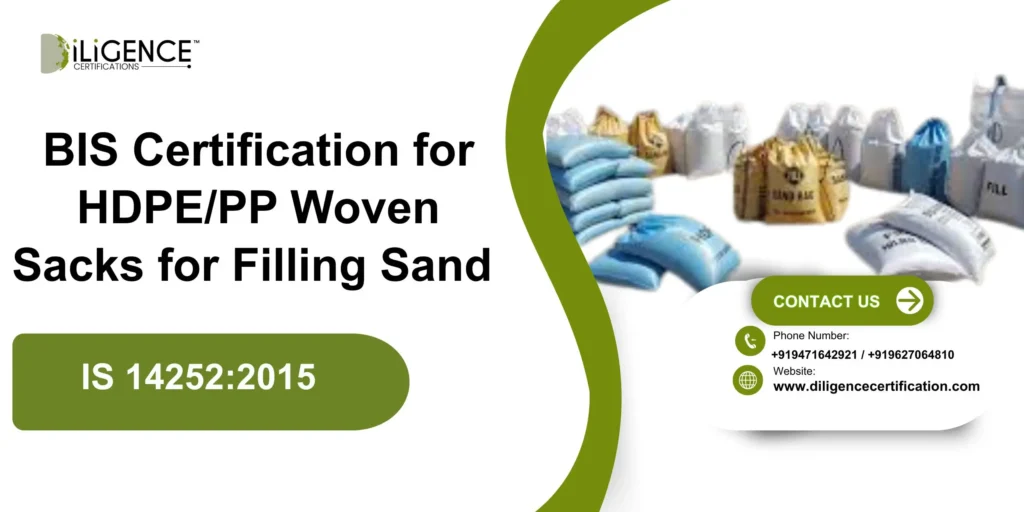
- Mandatory Compliance: Sand, filled and sand, transported HDPE/PP woven sacks Filling Sand must follow the standard IS 14252:2015 set by the Bureau of Indian Standards.
- Material & Construction: The standard lays down the requirements for the quality of raw materials, the construction of the fabric, the width of the tape, the stitching, and the general workmanship.
- Strength & Load Capacity: The specification provides for sufficient tensile strength, seam strength, and load, bearing capacity to enable heavy sand filling and handling.
- Durability & Performance: The sacks have to be protected from tearing, abrasive wear, and damage during filling, storage, and transportation.
- Testing & ISI Mark: The products have to be tested in BIS, approved laboratories, and the ISI mark can be put by licensed manufacturers as a sign of conformity.
Introduction |
BIS Certification for HDPE/PP Woven Sacks for Filling Sand as per IS 14252:2015 is a quality standard certification that ensures the sacks used for packing, handling, and transportation of sand are of standard quality and strength as per India. The certification document issued by the Bureau of Indian Standards focuses on the constituent qualities, the design and make, the ability to hold the weight, and the tear and breakage-resistance qualities to withstand the rigors of extensive usage. The IS 14252-2015 certified woven sacks are safe to use and reliable for application in the construction field.
What is IS14252:2015?
IS 14252:2015 describes the requirements of HDPE/PP woven sacks that are produced using the material required for sand filling. The IS 14252:2015 specifies the quality of material, type, size, strength, and performance of the woven sacks that are needed to withstand heavy loading conditions of sand during filling, transferring, storing, and carrying the sand. Along with that, it also describes the testing methods of various parameters such as strength, seam strength, and workmanship.
Key Points:
- Standardizes the characteristics of HDPE/PP woven sacks that are mainly used for sand filling, handling, and transport.
- Gives details of the quality of the material and the construction of the sack such as fabric, tape width, stitching, and workmanship.
- Indicates that the product must have a high strength and load, bearing capacity so as not to tear or fail under heavy sand loads.
- Specifies performance and durability measures like resistance to abrasion and damage during handling.
- Makes provision for tests in laboratories recognized by BIS, and also allows the ISI mark to be used after BIS certification.
Why is BIS Certification Mandatory
BIS Certification is mandatory to ensure that the products manufactured or sold in India conform to the standards of quality, safety, and performance set. In fact, it is one of the most effective tools to keep substandard goods out of the market and protect consumer interests by ensuring that the product is reliable and standardized. In addition, mandatory BIS certification facilitates the exercise of regulatory control, encourages the implementation of fair trade practices and permits only the manufacturers who are in compliance with the requirements to use the ISI mark, which is a sign of trust and legal market acceptance.
Key Reasons:
- Ensures the safety, quality, and performance of the products in accordance with the Indian standard laid by the Bureau of Indian Standards.
- Safeguards the consumer from unsafe, fault, or low-quality products that are made available in the market.
- Legal manufacturing, importation, and selling of products that are notified in India.
- Avoid regulatory fines, product recall, loss of business because of non-compliance.
- ISI mark helps in increasing consumer loyalty, brand reputation, and smooth market access..
Importance and Benefits of BIS Certification
| Importance | Benefits |
| Mandatory certification for HDPE/PP woven sacks for filling, storage, and transportation of sand in India. | Provides for uniform quality, safety, and performance for woven sacks intended for heavy sand filling. |
| Specifies quality of raw material, fabric type, tape width, stitching, and craftsmanship. | It helps in preventing the sale of poor quality or weak bags. |
| It assures high tensile strength, seam strength, and carrying capacity. | Permits legal manufacturing, importation, and sale of sand filling sacks in the Indian market. |
| Test required in recognized labs of BIS to check the ruggedness and specs. | Adds to customer trust, branding, and market acceptance through ISI marking. |
| Allows using “ISI” marking that will make legal sales possible, building consumer trust. | Eliminates defects, customer complaints, and the possibility of lack of compliance, hence making the business more reliable as prescribed in the guidelines of the Bureau of Indian Standards. |
Step-by-Step Process of BIS Certification
Step1:Documentation
- Collect required technical documents
- Prepare product specifications
- Gather company registration details
- Ensure documents follow BIS format
Step2:Product Testing
- Send samples to a BIS-approved lab
- Conduct safety and quality tests
- Receive test reports
- Confirm compliance with BIS standards
Step3:Application Submission
- Fill out the BIS application form
- Upload all required documents
- Attach valid test reports
- Pay the necessary BIS fees
Step4:Scrutiny and Inspection
- BIS reviews submitted documents
- Authority verifies test results
- Factory/product inspection may occur
- Clarifications requested if needed
Step5:Grant of License
- BIS approves the application
- License number is issued
- Product can carry BIS mark
- Renewal required before expiry
Documents Required for BIS Certification
| Category | Documents Required |
| Business Documents | Business license/registration, ISO certificate, organizational details |
| Manufacturer Details | Factory layout, process flow chart, machinery list, production details |
| Product Documents | Product specifications, component list, user manual, model details |
| Testing Documents | Test report from BIS-recognized lab, sample details, test request form |
| Legal & Compliance | Authorization letter, brand ownership proof, trademark certificate (if any) |
| Import/Foreign Manufacturer (If applicable) | AIR (Authorized Indian Representative) details, contract agreement, overseas manufacturer documents |
Timelines, Costs, Validity & Renewal
- Timelines: Usually from 20 to 30 days, with only 7-15 days for the testing.
- Costs: The cost of the government and the test varies depending on the product. There can be some additional charges though.
- Validity: The validity period is 2 years in most situations.
- Renewal: The renewal is done before the expiration; there should be updated documents/tests; the renewal
Why Choose Diligence Certifications
Diligence Certifications is a professional compliance advisory firm offering credible and end-to-end assistance with regard to BIS certification and other approvals in India. The firm helps with documentation, submission, testing co-ordination, and approval of licenses. With a commitment to customers, Diligence Certifications ensures timely certification, minimization of risks, and easy entry into the marketplace.
Conclusion
BIS Certification of HDPE/PP Woven Sacks for Filling Sand as per IS 14252:2015 is a key step towards ensuring the quality of the product offered in the Indian market. This facilitates the restriction of sub-standard bags being sold, promotes legal manufacture and sale, and generates customer trust through IS compliance standards. The overall impact of BIS certification of HDPE/PP Woven Sacks for Filling Sand as per IS 14252:2015 is improvement of market acceptability and legal compliance.
Frequently Asked Questions (FAQs)
What is IS 14252:2015
It is an Indian Standard that defines quality, strength, and performance specifications of HDPE/PP woven sacks used for filling and carrying sand.
Are BIS certifications mandatory for sand-filled woven bags?
BIS certification is a necessity for legally producing, importing, or selling these sand-filled woven sacks of HDPE/PP materials in India.
Who gives the BIS certification for the sacks?
The certification is provided by the Bureau of Indian Standards.
What are the materials classified in standard IS 14252:2015
The type of woven sacks covered is for those made of HDPE or PP tapes.
What kind of tests are done for BIS Certification?
Tests involved are tension strength, seam strength, load-carrying capacity, dimensional verification, and assessment of workmanship.
Where does the testing of the products occur?
Testing shall only be conducted in BIS recognized labs and/or BIS approved labs.
What is ISI mark? Why is ISI mark important?
This ISI mark is an indication of following Indian Standards to enable the sale of the product and developing consumer trust.
What is the time required for BIS Certification?
The entire process, on average, takes approximately 20 to 30 days.
How valid and reliable is the BIS Certification?
The validity of the certification offered by the BIS or the Bureau of
BIS licenses are valid for a period of maximum 2 years. They need to be renewed before the expiry date.
What will be the consequence of failing BIS certification?
Lack of BIS certification while manufacturing and/or selling goods can lead to fines, seizure of goods, litigation, and disruption of business.