

 BIS Certification
 CDSCO
CDSCO
 CPCB
CPCB
 LMPC
LMPC
 WPC Approval
 Global Approvals
 TEC
TEC
 ARAI
ARAI
 BEE
BEE
 ISO Certification
 DGCA Certification
 NOC For Steel
 APEDA Registration








 Business Registration
 FSSAI Mark Certification



 Legal Services
 Trademark Registration
 Copyright Registration
 Patent Registration
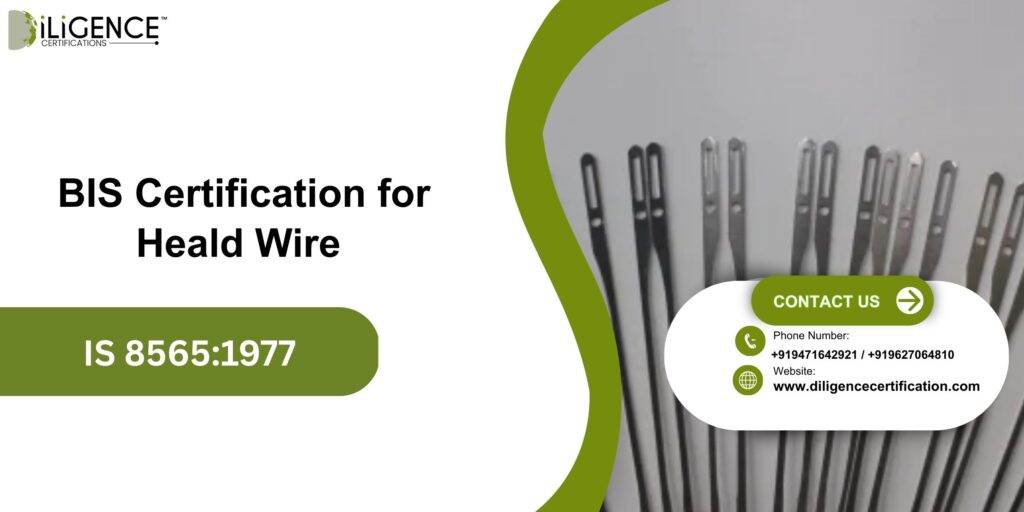
- Heald Wire IS 8565:1977 defines the uniform strength, durability, and dimensional accuracy of heald wires that are used in weaving looms.
- BIS certification is instrumental in the prevention of yarn breakage, fabric defects, and machine downtime that occurs frequently.
- Heald wire with an ISI mark is a source of confidence for textile mills, loom manufacturers, and fabric producers.
- Certified products are a sign of a good manufacturing facility, an efficient quality control system, and standard testing procedures.
- BIS-certified heald wire is a means to better market acceptance, increased brand credibility, and sustained business growth.
Introduction
Heald wire is an essential part of the fabric weaving machinery, which is used to control the warp threads accurately during the operation of the loom. As this wire is constantly subjected to pulling, rubbing, and repeated movements, its quality has the greatest power to determine the output of the process, the look of the fabric, and the life of the machine.
In order to maintain consistent quality and facilitate product standardization, the Bureau of Indian Standards (BIS) has set up Heald Wire IS 8565:1977, which elaborates detailed technical and functional requirements of heald wires. Certification by BIS in compliance with this standard is a guarantee that the product fulfills the set material, mechanical, and dimensional specifications that are necessary for a stable textile industry. Bureau of Indian Standards
What ! is Heald Wire IS 8565:1977?
Heald Wire IS 8565:1977 is an Indian Standard that details the technical characteristics required of headwires, which are made of steel and used in weaving looms. The standard is intended to guarantee that the headwires will remain functional and perform effectively over a long period of time and that they will be suitable for use with high-speed textile machinery.
The standard specifies:
- The chemical composition of the steel
- The mechanical properties of the steel such as tensile strength and flexibility
- The sizes and shapes of the steel products
- The quality of the surface and the absence of surface defects
- The methods of testing and inspection
- Conformity to IS 8565:1977 guarantees that the yarn moves smoothly and that the
ISI Mark Certification for Herald Wire
According to the ISI Mark Certification Scheme, heald wire should conform to Heald Wire IS 8565:1977 in all respects if it is to be sold in the Indian market.
Some of the key ISI standard requirements for certification are:
- Specified mechanical strength limits
- Consistent wire dimensions and shape
- Surface free from any type of corrosion and resistant to it
- Compulsory laboratory testing
- Regular quality control of production
Only producers that have a valid BIS licence can put the ISI mark on their head wire products.
Why Must Wire Certification Be Certified by BIS?
The quality of the flux has a very significant impact on the precision of weaving, the efficiency of the machine, and the safety of the final product. Poorly made wires can cause machinery to break down, fabrics to be rejected, and your maintenance costs to increase.
BIS Certification is a measure that:
- Prevents low-quality wires that do not meet the requirements from being sold in the market.
- Ensures that quality is maintained across different manufacturers.
- Textile mills and OEMs get to know that the products will perform as expected through their confidence being made by BIS certification.
- Reduces production losses and downtime with improved efficiency resulting from quality products.
Importance and Benefits of BIS Certification
| Importance | Benefits |
| Compliance with IS 8565:1977 | Reduces wire fatigue and breakage |
| Uniform mechanical properties | Improves fabric quality and consistency |
| Standardized manufacturing | Enhances loom efficiency |
| Regulatory compliance | Avoids legal issues and market rejection |
| Brand credibility | Competitive advantage in domestic and export markets |
Step-by-Step BIS Certification Process
Step 1: Documentation
Preparation of documents related to the company, factory, and products that meet BIS standards.
Step 2: Product Testing
Sampling of wires and delivery to a lab that is a BIS authorized unit for testing
Step 3: Application Submission
Online filing of the BIS application along with the documents and test reports.
Step 4: Scrutiny and Inspection
Checking of documents and factory inspection for quality control implementation confirmation.
Step 5: Grant of Licence
The signing of the BIS licence permitting the ISI mark to be affixed on the.
Documents Required for BIS Certification
- Company registration documents
- Details of the manufacturing unit
- Heald wire technical specifications
- BIS-approved laboratory test reports
- If any, brand authorization
Timelines, Validity, and Renewal
- Timeline: Around 20–30 working days
- Licence Validity: 1 to 2 years
- Renewal: Updated documents and a compliance confirmation from the authority before the expiry date are required.
Conclusion
Obtaining a BIS certification for Heald Wire IS 8565:1977 is more than just a compliance with the law. It is a commitment that the product will be of good quality, perform well, and be reliable in the textile industry. Standard specification details the stringent requirements for the material and dimensions of the heald wire, which is absolutely necessary for the smooth running of the weaving process.As quality and efficiency issues are increasingly given more attention by textile manufacturers, BIS-certified heald wire is becoming the most trusted solution for production stability and long-term market acceptance.
Frequently Asked Questions
What is Heald Wire IS 8565:1977?
This is the official standard that ensures heald wires that are used in looms are of good strength, safe, and reliable ones.
Why do manufacturers need BIS certification for heald wire?
Just because it is the certification that is recognized worldwide that the manufactures are the ones that produce the quality wires which are necessary for weaving machines to run smoothly is it necessary.
Who mostly uses BIS-certified heald wire?
First of all, textile mills. Secondly, the loom makers and fabric manufacturers are the ones that most of all use it for the good performance that is continuous.
What does the ISI mark on a heald wire indicate?
To confirm that all the BIS testing were successfully passed by the wire and that the wire is of the required Indian Standards is what the ISI mark does.
In what ways would certified heald wire lessen the issues of the machine?
Wire breaking, machine stopping, and unplanned maintenance are among the problems the machine suffers from which can be significantly reduced if the wire is certified.
What sort of trials are employed before the certification?
Some of them are strength and flexibility tests while the others are material and surface quality tests.
How long is the BIS certification usually?
The duration from the very first checking to the final approval is usually about 20–30 days of work.
What are the documents required for BIS certification?
The basic details of the company, the factory setup information, the wire specification, and the lab test reports.
What is the duration of the BIS approval?
The license period can be from 1 to 2 years.
Can a company put the ISI mark on its products without BIS approval?
No, illegally and it is strictly prohibited to do it.