



 BIS Certification
 CDSCO
CDSCO
 CPCB
CPCB
 LMPC
LMPC
 WPC Approval
 Global Approvals
 TEC
TEC
 ARAI
ARAI
 BEE
BEE
 ISO Certification
 DGCA Certification
 NOC For Steel
 APEDA Registration














 Business Registration
 FSSAI Mark Certification











 Legal Services
 Trademark Registration
 Copyright Registration
 Patent Registration
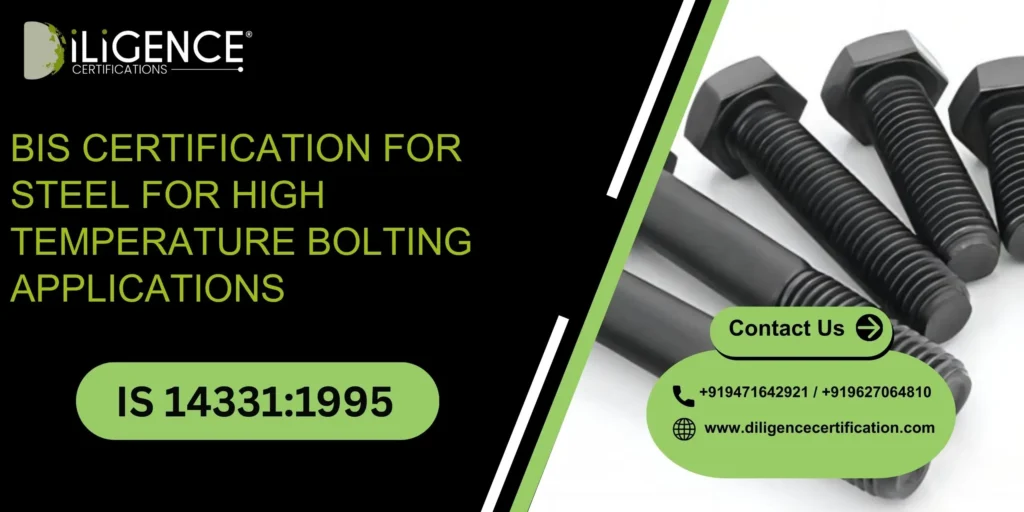
- Providing a specification for the types of steel that can be used for the HIGH TEMPERATURE BOLTING manufacture of bolt, stud, nut, and fasteners used in high temperature applications..
- The specification identifies chemical and mechanical properties, heat treatment methods, and metallurgical quality of steel in order to retain strength, stability, and integrity under the effects of heat and pressure
- The specification will require that all manufacturers/importers who sell or import this steel in India to have BIS certification.
- This specification will aid in preventing catastrophic failures of boilers, turbines, petrochemical plants, and high-temperature equipment
Introduction
To qualify for HIGH TEMPERATURE BOLTING Applications, steel must meet the rigorous performance and Q.C. Conditions established by IS14331:1995 through Bureau of Indian Standards (BIS). This Standard pertains specifically to Special Steel Grades for manufacturing Bolts, Studs/Nuts, and Fasteners exposed to Extreme Temperatures, High Pressures, and Continuous Mechanical Tampering.
Manufacturing or supplying Steel in India compliant to ISI Marks/Steel requires ISI registrations in accordance with BIS rules. A BIS Licence provides the assurance that the material conforms to the required requirements including chemical composition, mechanical properties, heat treatment and high temperature properties.
What is IS 14331:1995?
The Indian Standard IS 14331: 1995 HIGH TEMPERATURE BOLTING outlines specifications and properties of steel used in high-temperature bolting applications. Fasteners such as bolts, studs, nuts and other types are manufactured from steel made to withstand safely the effects of extreme heat, high pressure and mechanical loads exerted by machinery and fixtures.
Key points:
- Chemical composition, mechanical strength, heat treatment and mechanical stability criteria for the design of fasteners to ensure safe operation.
- Methods to determine the integrity and performance of all types of fasteners and their components, at both ambient and high temperatures (i.e. thermal and mechanical stability)
- Testing requirements for all types of fasteners including tensile strength, hardness, creep resistance, and high-temperature resistance testing.
- Fasteners are required to carry the Bureau of Indian Standards (B.I.S.) certification indicating that they meet the standards of safety and performance characteristics required for use in industries which are hazardous or high-risk (e.g. power generation, oil refining, petrochemical processing)
Why is BIS Certification Mandatory
The Bureau of Indian Standards (BIS) requires that all High-Temperature Bolting Steel supplied to applications where catastrophic failure may occur from temperature extremes is certified to the Quality Control Orders (QCOs) issued by the Government of India (GoI). The mandatory certification of High-Temperature Bolting Steel under BIS regulations provides an additional level of protection to both manufacturers and users by ensuring that only high-quality products are supplied within India.
Key points:
- Compliance with IS 14331:1995 for high-temperature strength and durability
- Eliminates the risk of low-quality material being used in boilers, turbines, refineries and petrochemical plants
- Protects manufacturers from loss of production and revenue from bolt failure due to extreme heat
- Mandatory for Manufacturers/Importers as per BIS regulations
- Mandatory to carry out proper testing, heat treatment processing and metallurgical uniformity
Importance and Benefits of BIS Certification
| Importance | Benefits |
| Ensures high-temperature bolting steel meets IS 14331:1995 quality standards | Reduced rejection rates and manufacturing defects during fastener production |
| Protects power, refinery, and petrochemical industries from sub-standard steel | Higher acceptance among industrial buyers and export clients |
| Enforces strict testing, heat-treatment control, and traceability | Stronger market credibility with the ISI Mark for high-temperature steel |
| Ensures steel maintains strength, durability, and integrity at elevated temperatures | Ensures long-term performance and safety of bolting components |
| Standardises production quality across all manufacturers and importers | Supports smoother high-temperature operations with fewer failures |
Step-by-Step Process of BIS Certification
Step1:Documentation
- Collect required technical documents
- Prepare product specifications
- Gather company registration details
- Ensure documents follow BIS format
Step2:Product Testing
- Send samples to a BIS-approved lab
- Conduct safety and quality tests
- Receive test reports
- Confirm compliance with BIS standards
Step3:Application Submission
- Fill out the BIS application form
- Upload all required documents
- Attach valid test reports
- Pay the necessary BIS fees
Step4:Scrutiny and Inspection
- BIS reviews submitted documents
- Authority verifies test results
- Factory/product inspection may occur
- Clarifications requested if needed
Step5:Grant of License
- BIS approves the application
- License number is issued
- Product can carry BIS mark
- Renewal required before expiry
Documents Required for BIS Certification
| Category | Documents Required |
| Business Documents | Business license/registration, ISO certificate, organizational details |
| Manufacturer Details | Factory layout, process flow chart, machinery list, production details |
| Product Documents | Product specifications, component list, user manual, model details |
| Testing Documents | Test report from BIS-recognized lab, sample details, test request form |
| Legal & Compliance | Authorization letter, brand ownership proof, trademark certificate (if any) |
| Import/Foreign Manufacturer (If applicable) | AIR (Authorized Indian Representative) details, contract agreement, overseas manufacturer documents |
Timelines, Costs, Validity & Renewal
- Timelines: Usually from 20 to 30 days, with only 7-15 days for the testing.
- Costs: The cost of the government and the test varies depending on the product. There can be some additional charges though.
- Validity: The validity period is 2 years in most situations.
- Renewal: The renewal is done before the expiration; there should be updated documents/tests; the renewal
Why Choose Diligence Certifications
- Expert team with strong BIS and regulatory knowledge
- Fast, streamlined processing to reduce approval delays
- Accurate documentation and testing coordination
- Transparent guidance with clear communication
- High success rate and complete end-to-end support
Conclusion
The BIS Certification as per IS 14331:1995 is a necessary assurance that the steel used for high-temperature bolting applications has sufficient strength, durability, and heat-resistance. Steel applications in Power Plants, Refineries, Boilers and Petrochemical Units are subjected to the most rigorous use, and any failure could pose a significant safety risk and create costly down time.
By adhering to this standard, manufacturers and importers Diligence Certification ensure that the steel has been adequately tested, heat-treated, and confirmed to have performance characteristics that will withstand elevated temperatures. The ISI Mark therefore increases the certainty of the steel’s reliability and safety in an operational environment while enhancing the steel’s credibility in the marketplace, making it more acceptable to OEMs and ensuring uniform quality through the entire industry.The BIS Certification per IS 14331:1995 is an important step toward the development of safe, effective and economically viable bolting products for industrial high temperature applications.
Frequently Asked Questions (FAQs)
What is IS 14331: 1995 ?
IS 14331:1995: This Indian Standard specifies the steel grades of bolts, studs, nuts, and fasteners used for high temperatures.
BIS Certification for IS 14331:1995 is provided
The issuing authority for the certification is the Bureau of Indian Standards (BIS).
Is BIS certification mandatory for Bolting Steel in high temperatures?
Yes, BIS Certification is mandatory for the production and import of high-temperature bolting steel.
Which products are specified by IS 14331:1995?
The fasteners for bolts, studs, nuts, for use in boilers, turbines, refineries, or petrochemical plants
Why is BIS Certification mandatory for the above steel?
it is safe, strong, heat-resistant, and doesn’t fail at extreme temperatures and pressures.
What tests are required by IS 14331:1995?
Chemical analysis, Tensile strength, Hardness, Creep resistance, High temperature performance.
Which persons are required to apply for BIS Certification?
Suppliers of high-temperature bolting steel in the Indian market.
How long does it take to get BIS Certification?
Usually 20-30 days, involving testing, scrutiny, etc.
What is the validity of BIS License?
The BIS license remains valid for a period of 2 years and needs to be renewed
Is imported steel eligible to be certificated as per IS 14331
Yes, foreign makers can apply through an Authorized Indian Representative.