



 BIS Certification
 CDSCO
CDSCO
 CPCB
CPCB
 LMPC
LMPC
 WPC Approval
 Global Approvals
 TEC
TEC
 ARAI
ARAI
 BEE
BEE
 ISO Certification
 DGCA Certification
 NOC For Steel
 APEDA Registration












 Business Registration
 FSSAI Mark Certification










 Legal Services
 Trademark Registration
 Copyright Registration
 Patent Registration
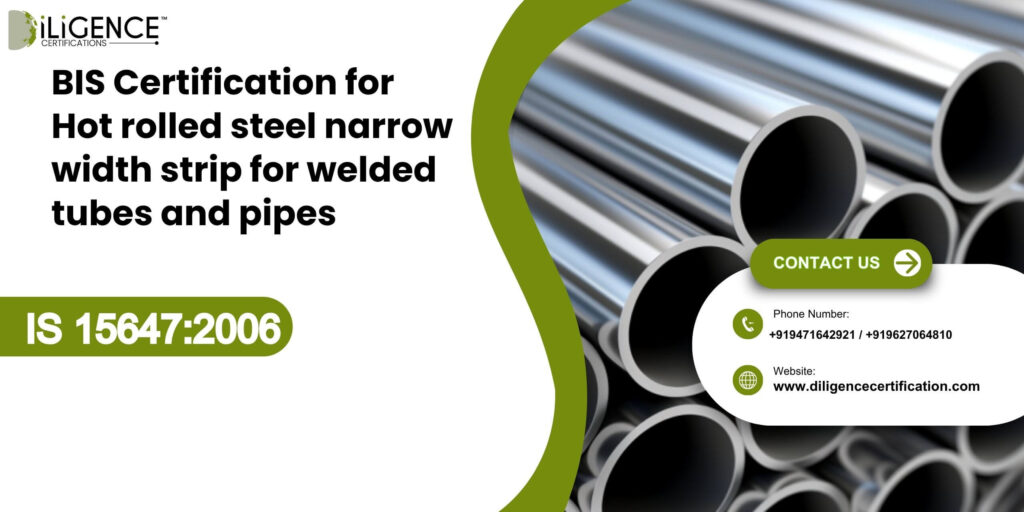
- BIS certification as per IS 15647:2006 is compulsory for Hot rolled steel narrow width steel strips for welded tubes and pipes.
- The standard specifies the chemical, mechanical, and dimensional requirements for the quality of the product.
- Manufacturers must have approved laboratories, quality systems, and BIS inspections to obtain the ISI mark.
- Non-conformance can result in the goods being refused and the imposition of legal penalties.
- Certification is instrumental in increasing the manufacturer’s credibility, facilitating market access, and winning customer trust.
Introduction
One time, a steel manufacturer from Maharashtra had to say no to a big supply deal after their hot rolled narrow width strips were not certified by the BIS according to IS 15647:2006. As the buyer demanded the use of certified material for welded tubes and pipes, compliance has been the most important thing in the steel sector. BIS certification is a guarantee that the strip meets the strict chemical, mechanical, and dimensional requirements. It is the confirmation of product reliability, safety, and quality consistency. Bureau of Indian Standards
What is IS 15647:2006?
IS 15647:2006 is a defining norm set by the Indian government to explain the attributes of technical material detail in “Hot Rolled Steel Narrow Width Strip for Welded Tubes and Pipes”. A standard was created by the Bureau of Indian Standards to detail the quality and the technical parameters of the hot rolled steel strips of up to 600 mm in width used for the production of welded tubes and pipes for non-critical, low-pressure applications, e.g. furniture, water pipes, and general engineering.
The standard covers:

- Firstly, the standard defines the chemical composition of various grades of steel.
- Next, the standard also highlights the mechanical properties of the material i.e. tensile strength, yield strength, and elongation by indicating them in the specification.
- The third item of the standard is that the standard provides dimensional tolerances and surface finish requirements in great detail.
- Fourthly, the standard also indicates the different testing and inspection methods that are compulsory.
- In addition to that, it also provides the certified material’s marking and traceability instructions. ISI MARK
Why is BIS Certification Mandatory
BIS certification is a must to keep the quality, safety, and dependability of the steel products that are either produced or marketed in India. In the case of hot rolled steel narrow width strips under IS 15647:2006, it is used for welded tubes and pipes that the material meets the standard requirements for strength, composition, and performance.
Key Points:
- It guarantees product safety and quality that is maintained consistently.
- Acts as a marker of conformity to IS 15647:2006 standard specifications.
- Substandard or unsafe steel is stopped at the source and thus does not get to users.
- BIS licence and batch marking allow for traceability.
- It is mandated by the Ministry of Steel through Quality Control Orders.
Importance and Benefits of BIS Certification
| Importance | Benefits |
| Ensures product quality and safety | Builds trust with customers and industry buyers |
| Mandatory for regulated products in India | Allows legal sale and wider market access |
| Maintains compliance with Indian Standards | Reduces risk of rejection or penalties |
| Promotes standardization in manufacturing | Enhances brand reputation and reliability |
| Supports government Quality Control Orders | Improves chances for exports and long-term growth |
Step-by-Step Process of BIS Certification

Step1:Documentation
- Gather documents such as company registration, factory license, and details of the organization.
- Write the product specifications and manufacturing process flow.
- Keep the quality control records and calibration certificates.
- Make sure that the documents are in the BIS format and meet the requirements.
Step2:Product Testing
- Send product samples to a BIS-recognized laboratory for testing.
- Tests verify compliance with the relevant Indian Standard (e.g., IS 15647:2006).
- Get the full test reports indicating the chemical, mechanical, and dimensional results.
- Reports from laboratories approved by BIS only will be accepted for certification.
Step3:Application Submission
- Submit an online application through the BIS portal along with test reports.
- Include all supporting documents and product details in prescribed format.
- Pay applicable government and marking fees.
- Track application status and respond promptly to BIS queries.
Step4:Scrutiny and Inspection
- BIS officials review documentation and test results for accuracy.
- A factory inspection is conducted to verify manufacturing facilities and QC systems.
- Inspectors evaluate equipment calibration and sample testing procedures.
- Any non-conformity must be corrected before license approval.
Step5:Grant of License
- BIS issues the ISI certification license upon successful evaluation.
- The manufacturer receives a unique CM/L (Certification Mark License) number.
- The Standard Mark can now be printed on approved products.
- Periodic surveillance and renewal audits ensure ongoing compliance.
Documents Required for BIS Certification
| Category | Documents Required |
| Company Details | Registration certificate, factory license, GST, and address proof |
| Authorized Signatory | ID proof and authorization letter |
| Product Details | Product description, grade, and manufacturing process flow |
| Quality Control | List of test equipment, calibration, and internal test reports |
| Testing Compliance | BIS-recognized lab test report as per IS 15647:2006 |
Timelines, Costs, Validity & Renewal
- Timelines – Most of the time it is done within 30–45 days.
- Costs – Includes expenses for the application, testing, and marking.
- Validity – The license is valid for a period of two years.
- Renewal – It is carried out every two years with new reports and payment of fees.
Why Choose Diligence Certifications
- We provide you with right expert advice about BIS certification and regulatory compliance.
- We are with you in every step of the documentation and application filing.
- We coordinate with BIS officials for quicker approvals.
- We have a highly skilled team that specializes in steel and industrial standards.
- We are with you at every step from testing to license renewal.
- We have been successful in achieving your certification in your required time without giving you any hassle.
Conclusion
The BIS Certification for Hot Rolled Steel Narrow Width Strip for Welded Tubes and Pipes as per IS 15647:2006 is not just a necessity of the law but a token of quality, trustworthiness, and acceptance by the market. Complying with BIS standards is also a defense against legal risks and an encouragement to your customers to trust in your brand’s going for the top. The cooperation with reliable professionals like Diligence Certifications can transfer your journey from being merely a compliance activity to being an accurate and efficient one, thus allowing your products to tick all the boxes of the regulations and quality standards.
Frequently Ask questions
What is IS 15647:2006?
IS 15647:2006 refers to an Indian Standard with details on chemical, mechanical, and dimensional requirements of hot-rolled steel narrow-width strips for welded tubes and pipes.
Why Should These Strips Have BIS Certification?
BIS certification confirms that the product complies with Indian quality and safety standards. Hence, it can be used for the manufacture and sale of other products in India without any legal hindrance.
Who Offers BIS Certification?
The Bureau of Indian Standards (BIS) is the one which awards the certification and ISI mark to manufacturers.
Mentioning Few Major Quality Parameter Covered By Is 15647:2006?
Standard detail the required chemical composition and the mechanical properties such as strength to tension, yielding, and elongation. It also stipulates the dimensional tolerances as well as the surface finish.
Is It Necessary That All Manufacturers Obtain BIS Certification?
Under the Quality Control Order (QCO) issued by the Ministry of steel, the answer is yes, as it is a largely compulsory measure put in place for producers and importers of the products in question.
What Are The Steps required To Obtain BIS Certificate?
Obtaining a document followed by a product test at a BIS-approved lab, and an online application are three steps in the process of getting BIS certification. Other steps in the procedure are factory inspection and issuing a license.
When Is BIS Certification Process Completed?
Usually, the procedure lasts from 30 to 45 days. The in-between period is kept for processing documents, carrying out product testing, and scheduling an inspection.
What Is The Duration of BIS License?
Besides, the two years period for which the license is valid, it also needs a renewal test report and renewal fees for its renewal.
What Are The Non-Compliance Penalties?
Where non-certified products are sold, the offenders may attract legal penalties, their products may be rejected, and the market may be closed to them.
How Manufacturers Benefit from Diligence Certifications?
Diligence Certifications is a one-stop facilitator for the manufacturer needs, that is from documentation, lab testing to BIS coordination for timely and simplified certificate issuance.