



 BIS Certification
 CDSCO
CDSCO
 CPCB
CPCB
 LMPC
LMPC
 WPC Approval
 Global Approvals
 TEC
TEC
 ARAI
ARAI
 BEE
BEE
 ISO Certification
 DGCA Certification
 NOC For Steel
 APEDA Registration














 Business Registration
 FSSAI Mark Certification












 Legal Services
 Trademark Registration
 Copyright Registration
 Patent Registration
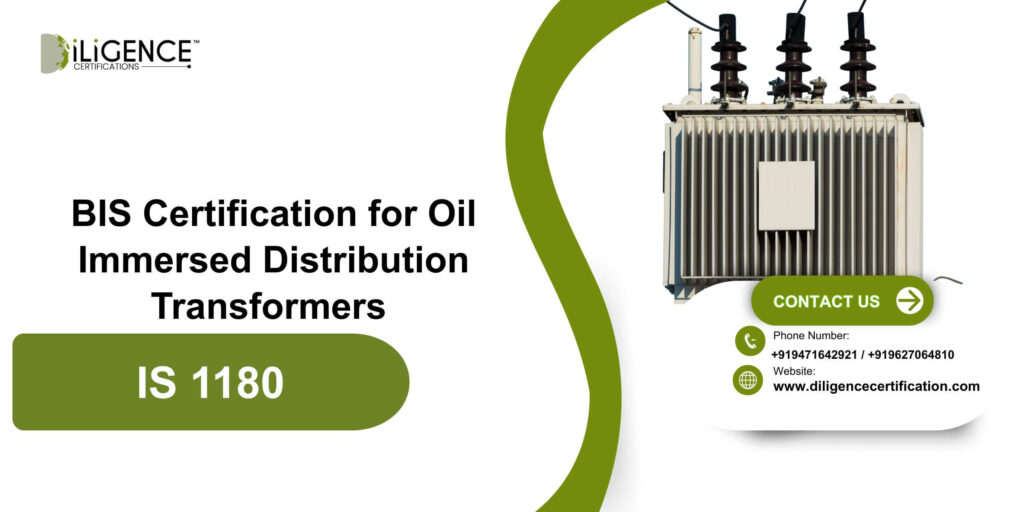
- Compliance with IS 1180 Standards: The oil immersed distribution transformers should be in accordance with the set requirements for the design, the efficiency, the insulation, the temperature rise, and the safety as per the standards given in IS 1180.
- Mandatory ISI Mark Certification: It is only the manufacturers holding a valid BIS licence that are allowed to produce and sell transformers certified to Indian standards.
- Improved Safety and Energy Efficiency: Transformers with BIS certification are the cause of less power losses, their operation is safe, and they can be relied upon to perform under varying load conditions.
- Structured BIS Certification Process: It traces through various stages such as documentation, product testing in laboratories recognized by BIS, factory inspection, technical scrutiny, and issuance of the licence.
- Enhanced Market Trust and Reliability: The risk of failure is minimized through the issuance of the BIS certificate, along with ensuring regulatory compliance, and thus, the trust of the utilities, the contractors, and the consumers gets strengthened.
Introduction
Oil-immersed distribution transformers are necessary mechanical parts of the electrical power distribution grid. They are generally implemented in the localities, shopping malls, manufacturing plants, and rural electrification projects for the purpose of lowering the electric voltage to the levels that can be used.
By the help of insulating oil for cooling and insulation, these transformers are able to operate efficiently even under continuous load conditions and changes in the weather. As they have a direct influence on the quality of power, safety, and energy efficiency, it is mandatory to comply with IS 1180. The Bureau of Indian Standards (BIS), through its certification scheme, assures that oil-immersed distribution transformers conform to safety, efficiency, and performance standards of the nation before they are allowed into the Indian market.
What Are Oil Immersed Distribution Transformers – IS 1180?
Oil Immersed Distribution Transformers IS 1180 is an Indian Standard that outlines the technical detail requirements for transformers that are used in power distribution networks. This standard consists of:
- Design and Construction – It is implied that the design is durable, the insulation is done correctly, and the mechanical strength is sufficient
- Electrical Performance – Defines voltage ratios, impedance, losses, and efficiency levels
- Thermal Performance – Defines the temperature limits that can be allowed for the winding and oil
- Insulation Levels – Helps prevent electrical breakdown and overload situations
- Routine and Type Tests – Keeps the quality at the same level for all production batches
- Safety and Reliability – Prevents the occurrence of electrical faults and operational failures
Transformers that conform to the IS 1180 requirements are capable of providing voltage regulation that is efficient, they have low energy losses, and they can be trusted for a long time of operation.
ISI Mark Certification for Oil Immersed Distribution Transformers
Any oil-immersed distribution transformers marketed in India are required to have an ISI Mark Certification under IS 1180. This certification signifies that the transformer:
- Complies with electrical, thermal, and mechanical requirements
- Meets efficiency and loss parameters specified
- Is subjected to mandatory routine, type, and acceptance testing
- Ensures consistent quality from batch to batch of the manufacture
- Can be safely used for continuous operation in power distribution networks
It is only the manufacturers with a valid BIS license that are permitted to put the ISI mark on oil-immersed distribution transformers.
Why Is BIS Certification Mandatory for Oil Immersed Distribution Transformers?
Use of non-certified transformers may cause very severe situations like:
- Large power losses and energy efficiency reduction
- Overheating, breakdown of the insulating material, or even fire hazards
- More frequent breakdowns and increased maintenance costs
- Interruption of power supply and voltage instability
- Legal penalties and exclusion from government and utility projects
BIS certification is a guarantee of:
- Complete adherence to IS 1180 standards
- Operation of the transformer is safe and dependable
- Lower technical losses and higher efficiency
- Acceptance by the regulatory authorities and eligibility for the project
- Greater trust of utilities and consumers
BIS certification is far from just being a regulatory requirement—it is a very important quality assurance tool for the electrical infrastructure.
Importance and Benefits of BIS Certification
| Importance | Benefits |
| Compliance with IS 1180 | Ensures safety, efficiency, and reliability |
| Standardized production | Maintains uniform quality across units |
| Electrical reliability | Reduces risk of transformer failure |
| Regulatory compliance | Avoids legal issues and project rejection |
| Brand credibility | Builds trust with utilities and power companies |
Step-by-Step BIS Certification Process
Step 1: Documentation
Document company details, manufacturing unit information, transformer specifications, and quality control procedures according to IS 1180.
Step 2: Product Testing
Transformer samples undergo testing in laboratories recognized by BIS for electrical performance, losses, temperature rise, and safety parameters.
Step 3: Application Submission
Filing the application with test reports and necessary documents is done via the BIS online portal.
Step 4: Scrutiny & Factory Inspection
Inspecting the factory, BIS officials verify the production processes, testing facilities, and quality control systems through a factory visit.
Step 5: Grant of Licence
After a good factory inspection and technical evaluation, BIS issues the licence that permits the use of the ISI mark on certified transformers.
Documents Required for BIS Certification
- Company registration certificate
- Manufacturing unit details
- Transformer technical specifications
- Test reports from BIS-recognized laboratories
- Quality control and inspection records
- Brand authorization (if applicable)
Timeline, Validity & Renewal
- Certification Timeline: 20–30 working days
- Licence Validity: 1–2 years
- Renewal: Updated documents submission and proof of continued compliance before expiry.
Conclusion
BIS certification in accordance with IS 1180 is the main point of reference for the safety, energy efficiency, and performance of transformers on a national level. Such certified transformers are the instruments of a stable power supply, minimized energy wastages, and extended life span across networks of residential, commercial, and industrial users.
Being BIS certified is both a must and a hallmark of quality, safety, and reliability for manufacturers. Following the provisions of IS 1180 means not only meeting the regulations but also increasing one’s brand reputation, customer trust, and business sustainability in the energy sector.
Frequently Asked for Questions
What is BIS Certification for Oil Immersed Distribution Transformers?
Briefly, it certifies safety, efficiency and performance of transformers under IS 1180.
"Is BIS certification mandatory for oil immersed transformers in India?
Yes, only transformers that are BIS-certified and bear the ISI mark are allowed to be sold legally.
What does IS 1180 specify for transformers?
Basically, it standardizes the aspects of the product such as design, efficiency, insulation, temperature rise, and safety.
Who can manufacture BIS-certified transformers?
Manufacturers of transformers holding a valid BIS licence only.
What are the benefits of BIS-certified transformers?
First of all, safety through reliable technology; then energy efficiency; next compliance with the requirements of the regulator; and last but not least, market trust.
"What is the BIS certification process?
This includes reviewing documents, product testing, checking of the factory, scrutiny, and license issuance.
"How long is a BIS license valid for transformers?
Generally, the period is 1-2 years after which the holder should apply for renewal.
"What tests are done for IS 1180 transformers?
They are electrical, thermal, insulation, routine and type tests.
Can non-certified transformers be used in India?
The answer is NO. Inappropriate usage of non-certified transformers may result in penalties from the law and create safety issues at the same time.
Does BIS certification improve transformer reliability?
Definitely yes, as it is a guarantee for uniform performance and long-term safety of operations.