 BIS Certification
 CDSCO
 PESO
 CPCB
 LMPC
 WPC Approval
 Global Approvals
 TEC
 ARAI
 BEE
 ISO Certification
 DGCA Certification
 NOC For Steel
 APEDA Registration













 Business Registration
 FSSAI Mark Certification











 (32).jpg)
 Legal Services
 Trademark Registration
 Copyright Registration
 Patent Registration
 By
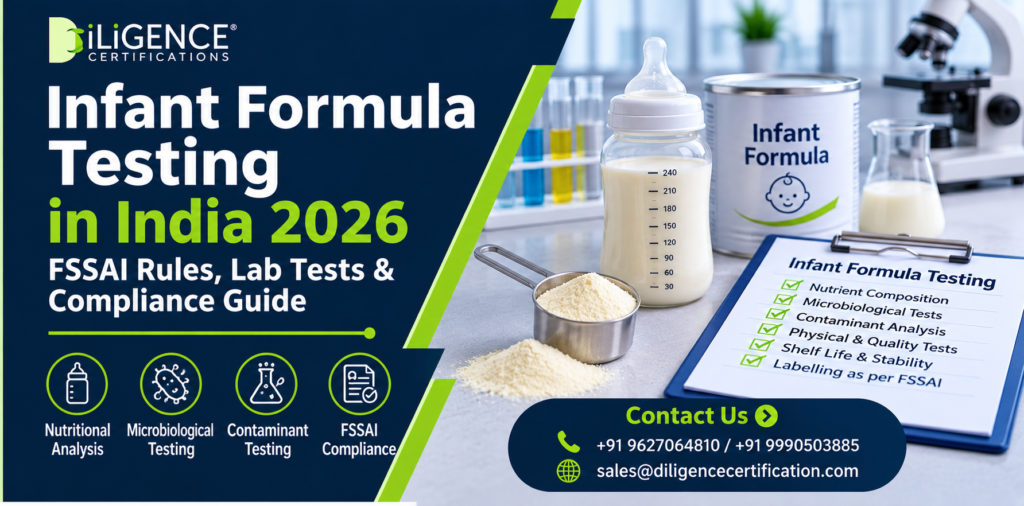
- Infant formula testing checks whether a baby formula is safe, clean and has the right nutrients before it is sold.
- In India, infant formula is covered by the FSSAI Foods for Infant Nutrition Regulations, 2020.
- Tests cover nutrients, germs (microbiology), contaminants, physical quality, shelf life and label details.
- Testing must be done in a lab that FSSAI accepts, and it is needed again and again, not just once.
- Most failures come from wrong nutrient levels, weak hygiene control, poor records and label mistakes.
- Start early, test in-house first, and keep every batch record ready before you send samples.
Introduction
Think about the fuel in a car. If you put the wrong fuel, the engine suffers. Now think of a tiny body that depends on one single food for months. That food must be exactly right.
This is why infant formula testing is one of the strictest types of food testing in India. Every batch has to be checked for nutrition, germs, harmful chemicals and quality.
In this blog, we will explain infant formula testing in very simple words. You will learn which rules apply, what tests are done, how the process works and how to avoid common mistakes.
What Is Infant Formula Testing?
Infant formula testing means checking a formula in a laboratory against the requirements of the Indian food rules. The lab takes samples, runs different tests and writes the results in a test report.
The idea is simple. A good infant formula must do three things:
- Give the baby the right nutrients in the right amount.
- Stay free from harmful germs and chemicals.
- Carry a clear and honest label.
Testing proves all three. If a formula passes, it is more likely to be safe. If it fails, the batch should not go to the market.
In India, the main regulator is the Food Safety and Standards Authority of India (FSSAI). It has made a special set of rules for infant nutrition, and testing is a big part of staying compliant. Please check the latest FSSAI notifications for your exact product, because rules and dates can change.
Infant Formula, Follow-Up Formula and Other Infant Foods: What Is the Difference?
People often mix these up. Here is a quick table.
| Product | Meant for | In simple words |
|---|---|---|
| Infant formula | Babies from birth, for the first months | A breast milk substitute that can be the main food |
| Follow-up formula | Older babies, after the first months | Used along with other foods, not as the only food |
| Infant formula for special medical purposes | Babies with special medical needs | Made for a particular condition, used under medical advice |
| Complementary food | Babies who have started solid food | Cereal-based or other foods for weaning |
This blog mainly talks about infant formula and follow-up formula. The same ideas apply to other infant foods, but the exact limits can differ, so always read the rule for your category.
Which Rules Apply to Infant Formula Testing?
The main rules are given below.
| Rule | What it covers |
|---|---|
| Food Safety and Standards (Foods for Infant Nutrition) Regulations, 2020 | Standards, composition, quality and labelling of infant foods |
| Food Safety and Standards (Labelling and Display) Regulations, 2020 | General labelling rules for all packaged food |
| Food Safety and Standards (Contaminants, Toxins and Residues) Regulations, 2011 | Limits for contaminants, toxins and residues |
| Infant Milk Substitutes, Feeding Bottles and Infant Foods Act | Rules on promotion and supply of infant milk substitutes |
| FSSAI licensing rules | Licence needed to make, store or sell the product |
The 2020 regulations were notified by FSSAI in December 2020. Since then, FSSAI has updated the compilation, so always download the latest version from the FSSAI website before you start testing, and not an old copy.
Simple example: A company makes a cow milk based powder for newborns. It is an infant formula, so the composition table for infant formula applies. The germ limits, contaminant limits and label rules also apply. A company making a formula for older babies will look at the follow-up formula part of the same regulation.
Note: FSSAI is strict about promotion too. The regulations do not allow claims that are only meant to boost sales of infant foods. So a label or advertisement can fail even when the product itself is good.
Why Infant Formula Testing Is Important
- Baby safety: A wrong nutrient level or a harmful germ can affect a baby’s health quickly.
- Legal need: Infant foods must meet the rules to be made and sold in India.
- Brand trust: Parents trust only brands that are open about quality.
- Fewer recalls: Problems found in the lab cost far less than a market recall.
- Better process: Test results show weak points in raw material, process and hygiene.
- Smooth inspections: Neat test records make FSSAI audits much easier.
In recent times, FSSAI has taken action in a few cases where a sample did not meet the required nutrient level in lab testing, and where promotional claims broke labelling rules. The message is clear. Both the product and the claims are checked.
What Tests Are Conducted in Infant Formula Testing?
The exact list and limits are given in the regulations, so please read the latest copy. In simple words, the lab checks the following.
| Test group | What the lab checks | In simple words |
|---|---|---|
| Nutrient composition | Protein, fat, carbohydrate, energy, vitamins, minerals | Is the baby getting what the label says? |
| Microbiology | Harmful and indicator germs | Is the powder free from dangerous bacteria? |
| Contaminants | Heavy metals, toxins, pesticide and antibiotic residues | Is there anything harmful in the product? |
| Physical quality | Moisture, solubility, particles, appearance | Does it mix well and look clean? |
| Additives | Permitted additives and their levels | Is only allowed material used, in the right amount? |
| Shelf life | Quality over time | Does it stay safe and nutritious till the expiry date? |
| Packaging | Pack strength and seal | Does the pack protect the powder? |
| Labelling | Details printed on the pack | Is the label correct and honest? |
1. Nutrient Composition Tests
Infant formula must contain nutrients within a fixed range. Too little is a problem. Too much can also be a problem. The lab measures protein, fat, carbohydrate and energy, and also vitamins and minerals.
Small nutrients matter a lot. A product can look perfect on the main nutrients and still fail on one vitamin that is below the required level. This has happened in the market, so never ignore the small ones.
2. Microbiological Tests
This is the most critical group. Powdered formula is not sterile, so germ control is a big job. The lab looks for harmful bacteria such as Salmonella and Cronobacter, and also checks indicator germs that show poor hygiene.
If a harmful germ is found, the batch is rejected. There is no middle path here.
3. Contaminant Tests
The lab checks for heavy metals such as lead, arsenic and cadmium, natural toxins like aflatoxin, and residues of pesticides and antibiotics. Limits for infant foods are much stricter than for normal food.
Contamination often comes from raw material, so checking your milk and ingredient suppliers is as important as checking the final powder.
4. Physical Quality Tests
The lab checks moisture, how well the powder dissolves, whether there are burnt particles or foreign matter, and how the powder looks and smells. High moisture can spoil the powder fast. Poor solubility creates lumps that can be a feeding problem.
5. Additive Checks
Only permitted additives can be used, and only up to the allowed limit. The lab checks that nothing extra is added and that anything added is within the rule.
6. Shelf Life Testing
A formula must stay safe and keep its nutrition till the end of the shelf life printed on the pack. Manufacturers check this by storing the product and testing it again after some time. Vitamins can fall with time, so this test is very useful.
7. Packaging Checks
The pack must protect the powder from air, moisture and light. A weak seal can spoil a whole batch even when the powder was perfect at the time of filling.
8. Labelling Checks
The label must follow the general labelling rules and the special infant food rules. It must show the correct details, the important notice about breastfeeding and clear usage instructions. It must not carry claims that the rules do not allow.
Raw Materials: Where Quality Really Starts
| Raw material | What can go wrong | What to check |
|---|---|---|
| Milk or milk powder | Germs, antibiotics, adulteration | Supplier records and incoming tests |
| Vegetable oils | Oxidation, contaminants | Quality certificate and fresh stock |
| Carbohydrate sources | Impurities, wrong grade | Specification and test report |
| Vitamin and mineral premix | Wrong levels, poor mixing | Premix certificate and mixing records |
| Packing material | Food safety of the pack | Supplier declaration and test reports |
A small tip. Many companies test only the finished powder. Smart companies also test raw material at the gate. It saves time, money and many headaches later.
Two Kinds of Testing: In-House Lab and FSSAI Accepted Lab
In-house lab: This is the lab inside your plant. It is used for routine checks on raw material, process and every batch. It helps you catch problems early.
Accepted external lab: This is an outside lab that FSSAI recognises, usually accredited by NABL. Samples are tested here for compliance reports and for official needs. Reports from such labs carry more weight.
Both are needed. In-house testing keeps daily quality in check. External testing proves the quality to the regulator.
Step-by-Step Process for Infant Formula Testing and Compliance
- Read the rules. Download the latest infant nutrition regulations and understand which category your product falls in.
- Fix your recipe. Check that your formula design matches the nutrient ranges in the regulation.
- Check your raw materials. Make sure suppliers give proper certificates and test reports.
- Make trial batches. Produce a small lot with the same process you will use in regular production.
- Test in-house. Check nutrients, moisture and basic germ control yourself first.
- Select an accepted lab. Choose an FSSAI recognised lab that can run the full list of tests.
- Send samples with a request letter. Share product details, batch number and sample quantity as asked.
- Study the test report. Check every result carefully. If anything fails, find the root cause, fix it and test again.
- Apply for licence and keep testing. Use the reports and records for your FSSAI licence and keep testing every batch after that.
Testing is not a one-time job. FSSAI can take samples from your factory or from the market at any time, so keep the same quality in every batch.
Which FSSAI Registration Is Needed?
| Business type | What is needed |
|---|---|
| Indian manufacturer | FSSAI licence for the manufacturing unit, as per licensing rules |
| Importer | FSSAI import licence and clearance of each consignment |
| Repacker or private label brand | Licence for own activity and a licensed source for the product |
| Seller or distributor | Valid FSSAI registration or licence as per business size |
| Foreign manufacturer | Must be registered as per FSSAI import requirements |
For imports, the clearance usually includes document checks, sampling and testing in an FSSAI notified lab. So imported formula is also tested, even if it was tested in the home country.
When things change: if you change your recipe, process, plant or pack, check with FSSAI or your consultant whether fresh testing or approval is needed. Do not wait for an audit to find out.
Documents Required
Company documents
- Business registration and address proof
- Plant layout and list of machines
- Details of authorised person
- Food safety plan and hygiene records
Product documents
- Recipe, nutrient calculation and ingredient list
- Supplier details and raw material certificates
- Manufacturing process flow chart
- Label design and pack details
Testing records
- Test report from an accepted lab
- In-house batch test records
- Calibration certificates of lab equipment
- Shelf life study data
Keep all of these in a neat file. A messy file creates doubt, even when the product is good.
How Long Does Infant Formula Testing Take?
The time depends on the lab load, number of tests and whether any result fails. Microbiology and shelf life studies take more time than a quick physical check. Most of the delay comes from retesting after a failure. So the better your in-house control, the faster the whole process moves. Ask your lab for a realistic schedule before you send samples.
What Is the Cost?
There is no single price for infant formula testing. The cost depends on these factors:
- Number of products and batches
- Number of parameters tested
- Lab charges and sample handling
- Retesting charges if a test fails
- Licence fees and audit charges
- Documentation and consultant support
Ask the lab and your consultant for a full breakup in writing. This avoids surprises later.
Common Failures and Easy Fixes
| Common failure | Usual reason | Easy fix |
|---|---|---|
| Low vitamin level | Poor premix mixing or loss over time | Improve mixing and add a correct overage plan |
| Germ contamination | Weak hygiene or dirty equipment | Strengthen cleaning and plant zoning |
| High moisture | Poor drying or weak pack | Control drying and improve packaging |
| Contaminant above limit | Unchecked raw material | Test raw material at the gate |
| Poor solubility | Wrong process or old stock | Review process and storage |
| Wrong label detail | Old template or copy mistakes | Check the label against the rule before printing |
| Not allowed claim | Marketing wording | Get the wording checked by a regulatory expert |
Common Mistakes to Avoid
- Using an old version of the regulations.
- Sending a perfect hand-picked sample that is not like regular production.
- Ignoring small nutrients like vitamins and minerals.
- Skipping raw material tests and checking only the final powder.
- Using lab equipment that is not calibrated.
- Keeping weak or incomplete batch records.
- Writing claims on the pack or in ads that the rules do not allow.
- Treating testing as a one-time task instead of a regular habit.
Who Needs Infant Formula Testing?
- Manufacturers: They need testing for compliance and for every batch they release.
- Importers: They need to make sure imported formula meets Indian rules and clears testing.
- Private label brands: They need to confirm that the source plant is licensed and tests properly.
- Overseas manufacturers: They need to meet Indian rules if they want to supply formula to India.
- Repackers and startups: They need proper testing before launching a new infant food.
Why Choose Diligence Certifications for infant formula testing Certification?
Food compliance looks simple on paper, but small mistakes can cost weeks. A wrong nutrient sheet, a missing document or a sample sent to the wrong lab can slow everything down.
At Diligence Certifications, our team guides you through the full process in plain language. We help you understand the rules, prepare your documents, plan your testing and handle regulator communication. You can also read about our work on our compliance services page.
We do not promise approvals, because only the regulator can grant them. What we promise is clear guidance, honest timelines and careful follow-up, so you can focus on making safe food for babies.
After Registration: What Happens Next?
Getting the licence is not the end. The regulator continues to watch quality in the following ways:
- Regular inspections of the factory
- Sampling from the plant, warehouse or market
- Review of test reports and batch records
- Checks on labels and advertisements
If a product fails, action can follow, such as notices, penalties, recalls or licence action. So keep the same quality in every batch, not only in the first one.
Tips to Pass in the First Attempt
- Study the latest regulation line by line.
- Buy raw material only from checked suppliers.
- Test incoming material before it enters production.
- Keep the plant clean and the zones separate.
- Mix premix carefully and record every step.
- Calibrate lab equipment on time.
- Send samples from regular production, not special lots.
- Take expert help before applying, not after a failure.
Quick Checklist Before Sending Samples
- Latest regulation downloaded
- Recipe and nutrient sheet match
- Raw material certificates ready
- In-house tests done
- Label checked against the rules
- Equipment calibrated
- Batch records complete
- Lab confirmed for all required tests
Conclusion
Infant formula testing is not just paperwork. It is the process that makes sure a baby gets safe and proper food every single day.
If you understand the rules, test early, keep your records clean and take help when needed, the process becomes much easier. Start with the latest FSSAI regulation, test in-house, choose an accepted lab and follow the steps above.
Good testing today means safer babies tomorrow.
Frequently Asked Questions (FAQs)
1. What is infant formula testing?
It is the testing of a baby formula in a lab to confirm that it is safe, has the right nutrients and meets the Indian food rules.
2. Which rules apply to infant formula in India?
The Food Safety and Standards (Foods for Infant Nutrition) Regulations, 2020 are the main rules. Labelling and contaminant rules also apply. Always check the latest version on the FSSAI website.
3. What is the difference between infant formula and follow-up formula?
nfant formula is for newborns and can be the main food in early months. Follow-up formula is for older babies and is used along with other foods.
. What are the main tests done on infant formula?
Nutrient composition, microbiology, contaminants, physical quality, additives, shelf life, packaging and labelling.
5. Why is microbiology testing so important?
Because powdered formula is not sterile, and harmful germs like Cronobacter and Salmonella can seriously affect babies.
6. Can a formula fail because of one vitamin?
Yes. If even one required nutrient is below the prescribed level, the sample can be declared non-conforming.