


 BIS Certification
 CDSCO
CDSCO
 CPCB
CPCB
 LMPC
LMPC
 WPC Approval
 Global Approvals
 TEC
TEC
 ARAI
ARAI
 BEE
BEE
 ISO Certification
 DGCA Certification
 NOC For Steel
 APEDA Registration








 Business Registration
 FSSAI Mark Certification


 Legal Services
 Trademark Registration
 Copyright Registration
 Patent Registration
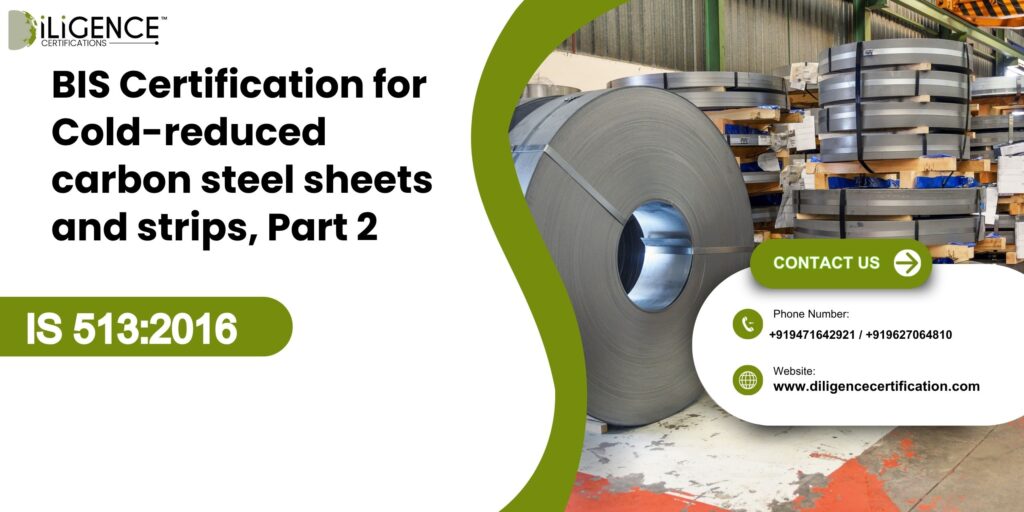
- BIS certification is required for high tensile and multi-phase cold reduced steel conforming to IS 513 (Part 2):2016.
- This standard specifies the grades, elemental composition, mechanical strength, and surface quality requirements.
- Producers are subject to BIS inspection, testing, and annual surveillance to ensure compliance.
- If the product does not meet the requirements, the license can be revoked and the place of trade changed.
- Being certified is very helpful in the promotion of the brand, quality assurance, and getting access to new markets.
Introduction
The steel mill in Pune supplying the automotive industry lost a big order due to the absence of BIS certification for its high-tensile cold-rolled steel sheets. The material was strong and of good quality, however, it was not compatible with IS 513 (Part 2):2016—hence the delivery could not be accepted. This event is an example of how important BIS Certification for Cold Reduced Carbon Steel Sheets and Strips Part 2 High Tensile and Multi-phase Steel under IS 513:2016 has become. The certification is a guarantee that products conform to India’s safety and performance standards. Bureau of Indian Standards
What is IS 513:2016 Part 2?
IS 513:2016 Part 2 is a standard laid down by the Bureau of Indian Standards (BIS) which specifies the quality and performance requirements of high tensile and multi-phase cold reduced carbon steel sheets and strips. The standard is a certification of the steel being used in such vital sectors as automotive, appliances, and engineering industries, being safe and strong enough as per national standards.
Key Points:

- Covers high-tensile and multi-phase steels such as Dual Phase (DP), TRIP, and Martensitic grades.
- Specifies chemical composition, tensile strength, elongation, and bend test requirements.
- Defines surface finish, dimensional tolerances, and inspection procedures.
- Specify fully the characteristics for cold-reduced (cold-rolled) steel sheets and strips. ISI MARK
- Are the standards on which BIS mandatory certification is based under India’s Quality Control Orders.
Why is BIS Certification Mandatory
In order to keep a close watch on the steel products that are sold or imported in India and ensure that they meet the country’s safety, quality, and reliability standards, BIS certification is mandatory. The certification system that it introduces results in the protection of end-users, provision of fair trade, and certification of the accountability of manufacturers.
Key Points:
- Legal Requirement: Under the Steel and Steel Products (Quality Control) Order, BIS certification is compulsory for products like cold-reduced high-tensile and multi-phase steel under IS 513 (Part 2):2016.
- Quality Assurance: The standards that are put in place help to maintain the same mechanical, chemical, and dimensional characteristics of the materials as specified.
- Consumer Safety: The employment of certified steel in the production of vehicles, buildings, and machines is a means of safety assurance for consumers that these products are not made with substandard materials.
- Market Access: Without BIS permission, manufacturers cannot sell or distribute their products in India.
- Brand Credibility: BIS bearing is a major safety measure for the customer and, thus, a decisive factor in industrial and government tendering processes.
Importance & Benefits of BIS Certification
| Importance | Benefits |
| Ensures compliance with Indian standards (IS 513 Part 2:2016) | Market access and regulatory approval that are legal |
| Makes product quality and safety stable | Enhance customer loyalty and acquire a good brand reputation |
| Stop the flow of low-quality steel products | Minimize the risk of rejection and recall |
| Manufacturing is in line with BIS and QCO requirements | Process control is improved and operational efficiency is increased |
| It is a must to sell, export, or import in India | Open new business avenues with OEMs and international buyers |
Step-by-Step Process of BIS Certification

Step1:Documentation
- Gather factory layout drawing, process flow, and quality manuals and other documents that are required.
- Make test reports, raw material records, and product specifications.
- Check if the calibration certificates for the testing instruments are proper and up to date.
- Get ready the Internal Quality Control (IQC) and production traceability records.
Step2:Product Testing
- Submit product samples to a BIS-recognized laboratory.
- Testing covers parameters defined in the relevant Indian Standard (e.g., IS 513 Part 2:2016).
- Ensure samples are representative of regular production batches.
- Obtain test reports confirming compliance with all standard requirements.
Step3:Application Submission
- Register on the BIS portal and fill out the application form under the correct scheme (ISI Mark/Scheme I).
- Upload all supporting documents and test results.
- Pay applicable application and marking fees online.
- Submit the complete file to initiate scrutiny by BIS officials.
Step4:Scrutiny and Inspection
- BIS officers review documents and conduct an on-site factory inspection.
- Verification of manufacturing process, quality systems, and test facilities.
- Random product sampling may be done for independent lab testing.
- Any non-conformities identified must be rectified before approval.
Step5:Grant of License
- BIS issues a license if all criteria and test results meet standard requirements.
- The manufacturer is authorized to use the ISI mark on certified products.
- Regular surveillance audits and sample testing ensure continued compliance.
- License renewal is typically required annually or as specified by BIS.
Documents required for BIS Certification
| Document Type | Details Required |
| Manufacturing Documents | Factory layout, process flow chart, production details |
| Quality Control Records | Internal test reports, inspection formats, calibration certificates |
| Product Details | Grade, size, chemical & mechanical properties as per IS 513 (Part 2):2016 |
| Laboratory Reports | Test results from BIS-recognized or in-house lab |
| Legal Documents | Company registration, GST, PAN, authorization letter |
| Equipment List | Testing and manufacturing equipment with calibration status |
| Raw Material Records | Source, specifications, and traceability details |
| Packaging & Marking Samples | Labels, ISI mark layout, and marking procedures |
Timelines, Costs, Validity & Renewal
- Timelines: Most of the time, the entire process is done within 6-8 weeks.
- Costs: The only money that should be spent is that for the application, testing, and marking fees.
- Validity: License valid for two years.
- Renewal: Requires updated documents before expiry.
Why Choose Diligence Certifications
Diligence Certifications is the one-stop solution for BIS licensing with a customer-friendly, industry-focused approach.
- Expert help from consultants who have a deep knowledge of steel and metallurgical standards.
- Support in documentation, testing coordination, and BIS audit preparation.
- A track record of success in speeding approvals and achieving zero non-conformities for manufacturers.
- Compliance made easy with continuous support for renewals, amendments, and QCO updates.
- Trusted by leading Indian and global steel brands for reliable certification solutions.
Conclusion
BIS Certification for Cold Reduced Carbon Steel Sheets and Strips Part 2 High Tensile and Multi-phase Steel under IS 513:2016 is absolutely necessary for any steel manufacturer or importer who wants to work legally and competitively in the Indian market. Besides giving the compliance assurance with national standards, this certification also elevates the product credibility and acceptance in the market. Certification can be attained easily and without any break if one has the right set of documents, testing, and guidance from an expert. Working with experienced consultants like Diligence Certifications is the way to keep your plant in line with the rules, ready for the audit, and trusted by the top buyers of the steel industry.
Frequently Ask Questions
What is IS 513 (Part 2):2016?
This standard is an Indian Standard that defines different aspects of quality (chemical and mechanical) for High Tensile and Multi-phase Cold-Reduced Carbon Steel Sheets and Strips.
Is BIS certification mandatory for IS 513 (Part 2):2016 products?
Yes, the Steel and Steel Products (Quality Control) Order lays down that a certificate is compulsory in case one is involved in the manufacture, sale, or import of such steel in India.
Who is required to get a BIS certification?
The local manufacturers as well as foreign suppliers who supply India with Hi-Tensile or multi-phase cold-reduced steel sheets or strips should get the certificate.
What is the certification scheme applicable?
The product is certified by BIS under Scheme I (ISI Mark Licensing) of the BIS (Conformity Assessment) Regulations, 2018.
How long is the certification process?
The process usually takes between 6 and 8 weeks and it is dependent on the availability of the documentation, testing in the laboratory, and inspection scheduling.
Which tests are required for IS 513 (Part 2):2016 certification?
The tests are for the determination of the chemical composition of the material, tensile strength, yield strength, elongation, bend test, and surface inspection.
What if a manufacturer fails BIS testing?
Non-compliance problems have to be resolved by the manufacturer, and it may happen that new samples have to be tested before the license is granted.
How long is the BIS license valid?
The license lasts for two years. In addition, the licensee is obliged to renew the license if he intends to continue the activity.
Can imported steel be sold without BIS certification?
The imported material can only be sold when it is from a foreign manufacturer with a BIS certificate or if the material is tested and certified locally before the sale.
How can Diligence Certifications assist in the process?
Diligence Certifications facilitates your certification process by offering services like document preparation, testing coordination, BIS audit facilitation, and license renewal.