BIS Certification
 CDSCO
CDSCO
 PESO
PESO
 CPCB
CPCB
 LMPC
LMPC
 WPC Approval
 Global Approvals
 TEC
TEC
 ARAI
ARAI
 BEE
BEE
 ISO Certification
 DGCA Certification
 NOC For Steel
 APEDA Registration























 Business Registration
 FSSAI Mark Certification












 (32).jpg)
 Legal Services
 Trademark Registration
 Copyright Registration
 Patent Registration
 By
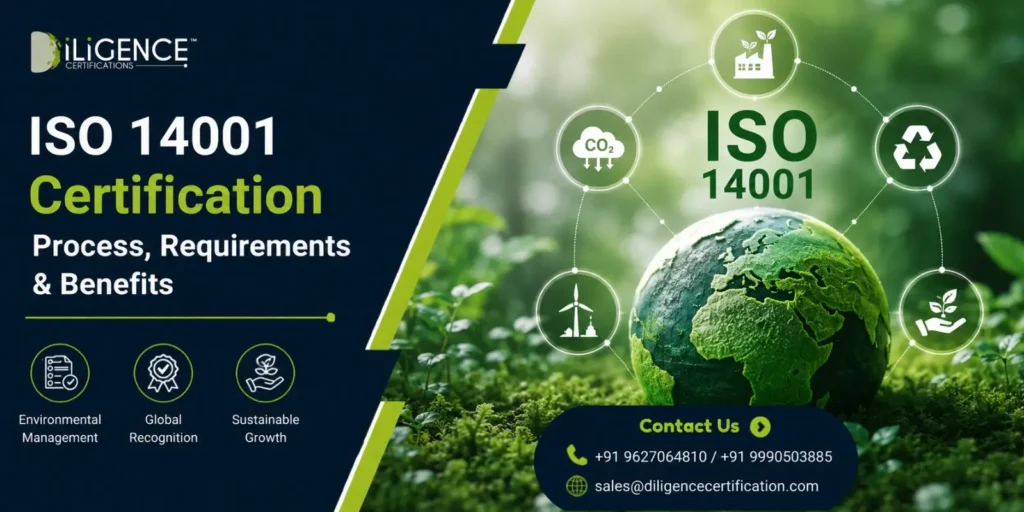
By - The ISO 14001 certificate is the globally accepted environmental management system, which enables firms to effectively manage and reduce their environmental impact.
- Thus, it will help organizations to conserve resources, adhere to environmental legislation, generate reduced amounts of waste, and show their environmental responsibility.
- The ISO 14001 Certificate is applicable to all types of businesses without restrictions, irrespective of their size and nature - manufacturers, constructors, hospitals, logistic firms, food producers, and service providers are examples.
Introduction : ISO 14001 Certifications
Sustainability has become one of the most crucial aspects of any business activity around the world. A business entity is expected to be least harmful to the environment and should follow all the environmental laws and regulations. An Effective EMS will help a business organization to improve its efficiency and earn respect among its customers and stakeholders.
The International Organization for Standardization 14001 Certification is a worldwide accepted standard that will help any business organization to establish, implement, maintain, and improve their Environmental Management System. This will assist any business organization in identifying the environmental risks, preventing pollution, maximizing the utilization of resources, and also complying with the legal requirements.
Whatever type of business organization you have, whether manufacturing, construction, logistics, health care, or any other, International Organization for Standardization 14001 Certification will suit your business best.
This guide will provide you complete information regarding the International Organization for Standardization 14001 Certification including the objective, advantages, eligibility, process of attaining the certification, documents required, costing aspects, and many more things.
What is ISO 14001 Certification?
ISO 14001 is a worldwide accepted certification developed by the International Organization for Standardization (ISO) to have an Environmental Management System (EMS). It helps organizations in managing their environmental responsibilities in addition to increasing the overall efficiency of their business.
Unlike other certifications that emphasize on specific products or services, ISO 14001 offers an opportunity for organizations to develop a process that reduces any negative impact on the environment and improves it constantly. It necessitates that organizations should be aware of environmental issues, set objectives and targets, and follow all the environmental laws and regulations.
An Environmental Management System under ISO 14001 covers various aspects of business operations, including:
- Environmental policy development
- Identification of environmental impacts
- Compliance with legal requirements
- Resource conservation
- Waste management
- Pollution prevention
- Emergency preparedness
- Continuous performance improvement
International Organization for Standardization 14001 Certification can be acquired by any organization irrespective of its size or field of operation. It is highly recognized all over the world and can improve organizational credibility when dealing with customers and authorities.
Objectives of ISO 14001 Certification
International Organization for Standardization 14001 Certification’s main purpose is to help companies manage their environmental duties and achieve business growth.
Its key objectives include:
- Reduce environmental impact caused by business operations.
- Prevent pollution through effective environmental controls.
- Improve energy and resource efficiency.
- Minimize waste generation and promote recycling.
- Ensure compliance with applicable environmental regulations.
- Identify and manage environmental risks.
- Enhance environmental awareness among employees.
- Improve operational efficiency.
- Promote sustainable business practices.
- Achieve continuous improvement in environmental performance.
By focusing on these objectives, organizations can create a balance between business growth and environmental protection.
Who Needs ISO 14001 Certification?
ISO 14001 Certification can be applied to any type of business irrespective of its size. Any business that wants to improve its environmental performance may go for International Organization for Standardization 14001 Certification.
Industries that commonly obtain ISO 14001 Certification include:
- Manufacturing companies
- Construction firms
- Chemical industries
- Pharmaceutical companies
- Food processing units
- Textile manufacturers
- Automobile industries
- Logistics and transportation companies
- Warehousing businesses
- Energy and power companies
- Mining industries
- Healthcare organizations
- Hospitals
- Hotels and hospitality businesses
- Educational institutions
- Information Technology (IT) companies
- Government organizations
- Small and Medium Enterprises (SMEs)
- Exporters and multinational companies
Regardless of the industry, International Organization for Standardization 14001 helps organizations establish environmentally responsible operations while improving business efficiency and stakeholder confidence.
Key Requirements of ISO 14001 Certification
For the purpose of getting International Organization for Standardization 14001 certification, an organization needs to develop an effective Environmental Management System (EMS).
The following are the main requirements:
- Environmental Management System (EMS): Create a system that is intended to protect the environment, avoid pollution, and enhance it.
- Aspects of Environmental Impact: Consider aspects of environmental impact and manage them.
- Compliance: Follow all environmental legislation.
- Objectives of the Environment: Define objectives to make environment-related performance better.
- Controls of Operations: Manage waste and emissions, as well as use resources properly.
- Training Employees: Train staff concerning environmental issues and EMS operation.
- Document Management: Store all policies, procedures, audit reports, and compliance.
- Audits: Perform internal audits for checking the effectiveness of EMS.
- Management Review: Review the performance of EMS and work out improvements.
- Continuous Improvement: Assess performance, make necessary changes and improve.
Importance & Benefits of ISO 14001 Certification
| Importance of ISO 14001 Certification | Benefits of ISO 14001 Certification |
| Improves environmental performance by reducing pollution, waste, and environmental impact. | Minimizes operational cost by utilizing energy, water, and other resources efficiently. |
| Ensures compliance with environmental laws and regulatory requirements. | Improves business image and credibility of brands. |
| Establishes a structured Environmental Management System (EMS). | Builds up customer trust and stakeholder confidence. |
| Supports pollution prevention and sustainable environmental practices. | Gives a competitive edge in government bids and international business. |
| Encourages organizations to identify and manage environmental risks. | Manages risks effectively through prevention of any environmental mishaps. |
| Promotes responsible use of natural resources and waste management. | Increases operational efficiency due to improved environmental control systems. |
| Helps organizations achieve long-term environmental sustainability. | Contributes towards sustainable growth and profitability of businesses. |
| Follows the Plan-Do-Check-Act (PDCA) approach for continuous improvement. | Fosters continual improvement in environmental and business practices. |
Eligibility Criteria for ISO 14001 Certification
One of the major advantages of International Organization for Standardization 14001 Certification is that it is suitable for organizations of all sizes and sectors. There are no strict eligibility requirements based on business size or annual turnover.
An organization is generally eligible if it:
- Has established business operations.
- Wants to implement an Environmental Management System (EMS).
- Is committed to complying with environmental regulations.
- Seeks to improve its environmental performance.
- Is willing to maintain proper documentation and records.
- Can implement the requirements of International Organization for Standardization 14001.
Organizations that commonly apply include:
- Manufacturing companies
- Construction firms
- Food processing businesses
- Pharmaceutical companies
- Chemical industries
- Textile manufacturers
- Logistics and transportation companies
- Hospitals and healthcare facilities
- Hotels and hospitality businesses
- Educational institutions
- IT companies
- Government organizations
- Small and Medium Enterprises (SMEs)
Documents Required for ISO 14001 Certification
The exact documentation requirements may vary depending on the nature and size of the organization. However, the following documents are commonly required during the certification process:
- Company Registration Certificate
- GST Registration (if applicable)
- PAN Card of the organization
- Business Address Proof
- Organizational Structure
- Scope of the Environmental Management System
- Environmental Policy
- Environmental Objectives and Targets
- Process Flow Diagram
- Legal and Regulatory Compliance Records
- Risk and Opportunity Assessment
- Operational Procedures
- Employee Training Records
- Internal Audit Reports
- Corrective Action Records
- Management Review Reports
Maintaining accurate and updated documentation helps ensure a smooth certification process.
ISO 14001 Certification Process
International Organization for Standardization 14001 Certification requires a process for establishing and implementing an effective Environmental Management System. While the certification process may differ from one certification body to another, it will basically involve the following steps.
Step 1: Initial Consultation and Application
The organization applies for International Organization for Standardization 14001 Certification and identifies its scope of certification. This step is followed by evaluation of the business processes and certification requirements by the certification body.
Step 2: Gap Analysis
Gap analysis is done at this stage to see whether the current environmental management practices of the organization meet International Organization for Standardization 14001 requirements.
Step 3: Documentation Preparation
The company undertakes preparation of all the necessary EMS documentation, which includes the organization’s environmental policy, goals, procedures, control measures, and record keeping.
Step 4: EMS Implementation
The Environmental Management System is put in place within the organization. Employees undergo training, roles are defined, and environmental controls are instituted.
Step 5: Internal Audit
There is an internal audit to confirm that the Environmental Management System is working well and conforms to the International Organization for Standardization 14001 standards. Non-conformities are corrected.
Step 6: Certification Audit
The certification body conducts an external audit in two stages:
Stage 1 Audit
The auditor reviews the organization’s documentation, preparedness, and overall EMS framework.
Stage 2 Audit
The auditor evaluates the implementation and effectiveness of the Environmental Management System through on-site verification.
Step 7: Certificate Issuance
If the organization successfully meets all International Organization for Standardization 14001 requirements, the certification body issues the ISO 14001 Certificate.
Timeline, Cost & Validity of ISO 14001 Certification
| Timeline of ISO 14001 Certification | Cost of ISO 14001 Certification | Validity of ISO 14001 Certification |
| The period taken to obtain certification is largely influenced by the nature of the company’s operation. | There is no fixed amount for the cost of International Organization for Standardization 14001 Certification and it changes according to the needs of the business. | International Organization for Standardization 14001 Certification is usually valid for three years from the date of certification. |
| Those that have small operations might easily finish the certification process, but those with larger operations might take some time. | Cost depends on various factors like the size of the business, number of staff, location, type of activity, certification body, and available management system of the company. | Surveillance audits are usually done during this time to make sure that an organization complies with all International Organization for Standardization 14001 standards. |
| Good planning, proper employee involvement, and effective EMS implementation will help one go through the certification process without problems. | For the estimation of cost, it is advised to contact a good certification consultant. | Once the cycle of certification comes to an end, organizations are supposed to do a recertification audit. |
Industries That Need ISO 14001 Certification
The ISO 14001 certification can be used by firms of all sizes and sectors who wish to enhance their environmental efficiency and adopt sustainable practices. Though the International Organization for Standardization 14001 certification is not required for all firms, many firms opt for ISO 14001 certification due to their wish to enhance their performance and reduce their environmental impact.
The following industries commonly benefit from ISO 14001 Certification:
- Manufacturing Industry
- Construction Firms
- Chemical Industry
- Pharmaceutical Industry
- Food Industry
- Textile and Apparel Industry
- Automotive and Automotive Parts Industry
- Oil and Gas Industry
- Mining Industry
- Logistics and Transport Industry
- Warehouse and Distribution Industry
- Energy and Power Industry
- Hospitals and Health Care Industry
- Hotel Industry
- Educational Institutes
- IT Industry
- Government Agencies
- Small and Medium Sized Enterprises (SMEs)
Implementing International Organization for Standardization 14001 helps these organizations improve resource efficiency, reduce waste, comply with environmental regulations, and enhance customer confidence.
Common Challenges During ISO 14001 Certification
Organizations may face some challenges while implementing an Environmental Management System (EMS). Identifying and addressing these issues helps ensure a smooth certification process.
- Absence of Management Commitment: The lack of engagement from management may influence the implementation of EMS.
- Documentation: Inadequate documentation could slow down the certification process.
- Inadequately Aware Employees: The absence of employee training will cause improper implementation of environmental practices.
- Identification of Environmental Hazards: Organizations could experience challenges while assessing the environmental impacts.
- Non-compliance With Legal Requirements: Non-compliance with environmental requirements can cause audit challenges.
- Inadequate Internal Audit: Poor internal audits could fail to detect non-conformities.
- Change Resistance: Employees may take time to adopt new environmental practices.
ISO 14001 vs ISO 9001
ISO 14001 and ISO 9001 are both international management standards, but they focus on different areas. ISO 14001 focuses on environmental management, while International Organization for Standardization 9001 focuses on quality improvement and customer satisfaction.
| Feature | ISO 14001 | ISO 9001 |
| Focus | Environmental Management | Quality Management |
| Objective | Reduce environmental impact | Improve product and service quality |
| System | Environmental Management System (EMS) | Quality Management System (QMS) |
| Main Goal | Environmental protection and compliance | Customer satisfaction and process improvement |
| Validity | 3 Years | 3 Years |
Legal Compliance under ISO 14001
International Organization for Standardization 14001 Certification is neither a legal license nor government clearance. It is a standard recognized worldwide and helps organizations develop a process-based approach for handling their environmental responsibilities.
The standard requires organizations to:
- Identification of relevant environmental legislation.
- Identification of changes in legislation.
- Retention of documentation of compliance responsibilities.
- Periodic evaluation of compliance.
- Taking action where there is non-compliance.
By implementing ISO 14001, organizations can reduce legal risks and demonstrate their commitment to meeting environmental compliance requirements.
Common Mistakes to Avoid During ISO 14001 Certification
Avoiding common implementation mistakes can significantly improve the chances of achieving certification successfully.
- Poor management system documentation.
- Poor employee training programs.
- Poor legal requirements observation.
- Conducting poor internal audits.
- Failure to identify environmental issues.
- Implementing late corrective actions.
- Poor periodic review of environmental goals.
- Poor management involvement.
- Using outdated data for record-keeping.
- Treating certification as a one-time process rather than an ongoing process.
Regular monitoring and periodic reviews help organizations maintain an effective Environmental Management System.
Why Choose Diligence Certifications for ISO 14001 Certification?
At Diligence Certifications, we simplify the International Organization for Standardization 14001 Certification process by providing expert guidance from application to certification.
Our Services Include:
- Experienced professional suggestions.
- Documentation and implementation help.
- Gap assessment and compliance help.
- Complete certification process guidance.
- Coordination with accredited certifying agencies.
- Easy and fast certification process.
- Competitive and clear pricing.
- Customer support during the entire certification process.
Our goal is to help organizations achieve ISO 14001 Certification efficiently while ensuring compliance with international environmental management standards.
Conclusion
ISO 14001 Certification is a globally recognized process through which an organization can establish its own Environmental Management System. It enables the company to reduce waste production, save natural resources, abide by environmental legislation, and build a good reputation among customers.
No matter if it is a manufacturing organization, construction company, logistics company, health care organization, or any service organization, once you have ISO 14001 Certification, it will prove that you care about the environment and sustainability of your business processes.
In case you want to acquire ISO 14001 Certification, you may seek help from some professionals like Diligence Certifications.
Frequently Asked Questions
What is ISO 14001 Standard?
ISO 14001 is an international standard for Environmental Management System (EMS), which aims at minimizing environmental effects and making efficient use of resources as well as helping companies to adhere to environmental laws.
How is ISO 14001 different from ISO 45001?
ISO 14001 addresses issues relating to the management and sustainability of the environment, whereas ISO 45001 relates to occupational health and safety management and protection of workers from various dangers at work.
Explain ISO 14001 in simple terms?
ISO 14001 is a standard used by businesses to manage their environmental duties by minimizing wastage, reducing pollution, and encouraging sustainable development.
Is there any update coming in ISO 14001 for 2026?
The ISO standards are regularly reviewed and updated to cater to business and environmental changes. Organizations are supposed to comply with the latest requirements released by ISO.
What are the document requirements for ISO 14001 Certification?
Some common requirements include company registration details, environmental policy, EMS documents, internal audits report, legal compliance documents, and management review report.
How long will it take to get ISO 14001 Certification?
On average, ISO 14001 Certification process takes about 4 to 16 weeks.
What are the advantages of ISO 14001 Certification?
This will help you improve your environmental performance, reduce waste, comply with the law, save money, build reputation, and gain client trust.
What is Environmental Management System (EMS)?
This is a systematic approach aimed at helping organizations identify, manage, monitor, and improve their environmental performance.
Can a small business achieve ISO 14001 Certification?
Yes, it can. ISO 14001 standard applies to any organization regardless of its size, including startups and SMEs.
How can Diligence Certifications assist me in ISO 14001 Certification?
We can provide you with consultation, documentation assistance, implementation services, and audit preparation.