BIS Certification
 CDSCO
CDSCO
 PESO
PESO
 CPCB
CPCB
 LMPC
LMPC
 WPC Approval
 Global Approvals
 TEC
TEC
 ARAI
ARAI
 BEE
BEE
 ISO Certification
 DGCA Certification
 NOC For Steel
 APEDA Registration























 Business Registration
 FSSAI Mark Certification












 (32).jpg)
 Legal Services
 Trademark Registration
 Copyright Registration
 Patent Registration
 By
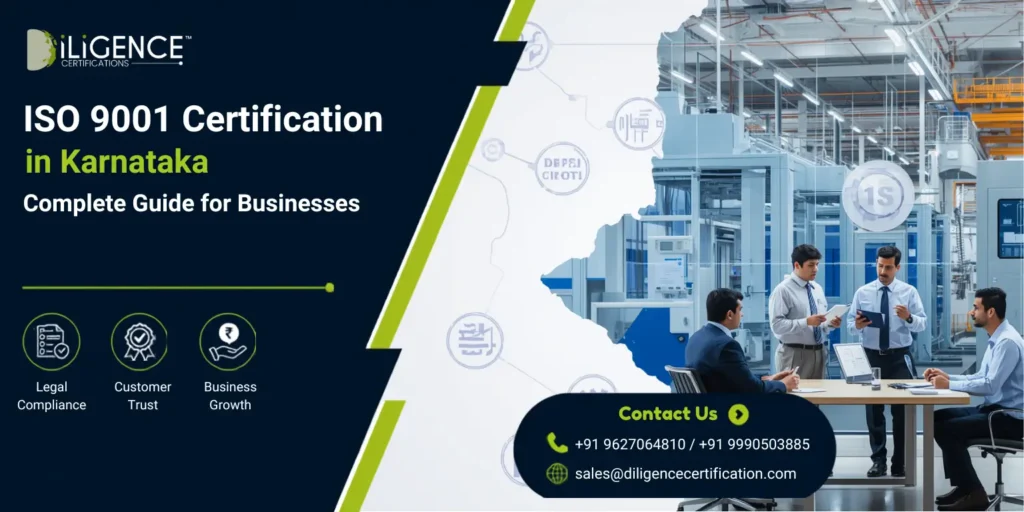
By - The process of obtaining an ISO 9001 Certificate in Karnataka helps organizations adopt an internationally accepted Quality Management System (QMS).
- It will enable manufacturers, MSMEs, IT firms, exporters, health care institutions, educational establishments, and service organizations in Karnataka to leverage ISO 9001 certification in building credibility and increasing business prospects.
- Diligence Certifications offers comprehensive consulting services for obtaining ISO 9001 Certification in Karnataka.
Introduction
An up-and-coming electronics manufacturer in Bangalore approached us at Diligence Certifications due to their failure to win a significant export contract. Their products were meeting the required international quality standards; however, the overseas client demanded that the supplier must have a proven system of Quality Management System which should be certified to meet ISO 9001 standards. They understood immediately that a structured quality control process is just as critical as providing high-quality products.
This kind of experience is quite common among the businesses in Karnataka. Irrespective of whether you run your business in Mysuru, IT company in Bangalore, Pharma company in Hubballi, or a food processing industry in Mangalore, the customers are demanding the implementation of internationally accepted Quality Management Systems.
Getting ISO 9001 Certification in Karnataka can help your organization achieve consistency, increase customer confidence, eliminate inefficiencies in the process and successfully compete both in the domestic and international markets.
What is ISO 9001 Certification?
ISO 9001 is the globally recognized QMS standard issued by the International Organization for Standardization (ISO).
ISO 9001 does not assess individual products; instead, it assesses the organization’s effectiveness in managing their business processes that help them produce quality products and services.
ISO 9001 is based on some quality management principles, which include:
- Customer focus
- Leadership commitment
- Risk-based thinking
- Process approach
- Employee engagement
- Evidence-based decision making
- Continual improvement
A properly implemented Quality Management System enables businesses to improve efficiency while maintaining consistent quality.
Why ISO 9001 Certification in Karnataka Matters
Karnataka is a top state of industry and technology in India. Some of the well-established industries in this state are aerospace, electronics, IT, biotechnology, pharma, engineering, food processing, textile, automobile manufacture, and health care.
While businesses continue to penetrate the national and international markets, consumers and buyers begin to favour suppliers that have quality management systems certified internationally.
ISO 9001 certification is one of the qualifications of suppliers in many government departments, multinational corporations, original equipment manufacturers, exporters, and private organisations.
ISO 9001 Certification Implementation in Karnataka will be of benefit to organizations.
Industries That Benefit from ISO 9001 Certification in Karnataka
Nearly all organizations can adopt ISO 9001 effectively. There are certain sectors in Karnataka that benefit considerably from business perspective.
Information Technology (IT)
- Karnataka, especially Bangalore, is the technology capital of India.
- ISO 9001 assists software companies to enhance project management, customer service, documentation, and continual improvement.
Electronics Manufacturing
ISO 9001 brings improved quality management, supplier management, manufacturing and customer confidence to the electronics manufacturing industry.
Aerospace & Defense Sector
- The state of Karnataka has a robust aerospace industry catering to governmental and private enterprises.
- ISO 9001 helps in systematic quality management with sector-specific standards.
Engineering & Industrial Manufacturing
Engineers utilize ISO 9001 to make improvements in manufacturing process, reducing defects, standardization, and customer satisfaction.
Pharmaceutical Industries
ISO 9001 brings improvements to documentation, process control, employee accountability, and quality management for pharmaceutical manufacturers.
Food Processing Industry
ISO 9001 and ISO 22000 are implemented by food processing industry organizations to provide better performance and customer confidence.
Healthcare Organizations
Hospitals, laboratories, and healthcare providers implement ISO 9001 to provide better patient services, quality management, documentation, and performance.
Educational Institutions
Schools, colleges, universities, and training institutes increasingly adopt ISO 9001 to standardise academic and administrative processes.
Benefits of ISO 9001 Certification in Karnataka
While most businesses start seeking ISO certification due to customer demands, the eventual benefits from improvements in operations might be the largest.
Increased Customer Satisfaction
ISO 9001 calls for organizations to analyze customer requirements, measure feedback, and continuously improve products and services.
Happy customers tend to form business relationships that last.
Better Process Standardization
Procedures clearly stated decrease inconsistency and increase coordination within various departments.
Decreased Errors and Re-work
Proper procedure decreases production errors, customer complaints, and operational expenses.
Reputation of the Company
ISO 9001 is internationally recognized and shows the organization’s dedication to quality management.
It helps with company reputation among customers, suppliers, investors, and regulators.
Increased Bidding Possibilities
A lot of government and public organizations, as well as OEMs and multinational companies, insist on the supplier’s ISO 9001 certification.
Such certification opens new business opportunities.
Increased Employee Responsibility
The clear definition of responsibilities increases cooperation, efficiency, and responsibility.
Risk Management
ISO 9001 requires analyzing operational risks before they turn into business problems.
Continuous Improvement
The Quality Management System includes continuous review and improvement of the performance.
Who Should Apply for ISO 9001 Certification in Karnataka?
ISO 9001 is suitable for organisations of every size and industry.
Eligible organisations include:
- MSMEs
- Manufacturers
- IT Companies
- Startups
- Engineering Companies
- Exporters
- Importers
- Electronics Manufacturers
- Aerospace Suppliers
- Pharmaceutical Companies
- Food Processing Units
- Healthcare Organisations
- Educational Institutions
- Construction Companies
- Logistics Providers
- Warehousing Companies
- Consultancy Firms
- Government Contractors
- Service Providers
- Chemical Manufacturers
Whether an organisation employs 20 people or several thousand, ISO 9001 can be implemented according to its operational requirements.
How Does ISO 9001 Certification Work?
Most businesses tend to view ISO certification as getting an ISO certificate.
- However, the certification process entails putting into place an efficient Quality Management System which improves business operations.
- These usually involve the following steps.
Step 1 - Gap Assessment
A review of current business practices is done with a view to determining what gaps exist in comparison with ISO 9001 standards.
Step 2 - Documentation
Preparation of quality policy, objectives, SOP, procedures, work instructions, process flowcharts, and operational documents takes place in accordance with the needs of the organisation.
Step 3 - Implementation
Implementation of the Quality Management System in different departments and training of staff takes place.
Step 4 - Internal Audit
An internal audit takes place to assess the efficiency of the system in line with the ISO 9001 standard.
Step 5 - Management Review
The performance of the Quality Management System is reviewed by senior management through the analysis of audit results, customer input, quality goals, risks, opportunities, and corrective actions before the certification audit.
Step 6 - Certification Audit
The certification audit is carried out by an accredited certification body in two stages.
Stage 1 Audit
The auditor reviews documentation, policies, procedures, and the readiness of the organisation to achieve ISO 9001 certification.
Stage 2 Audit
- The auditor checks whether the Quality Management System has been implemented effectively within all concerned departments.
- If the audit is successfully completed and all non-conformities are corrected, the certification body awards the ISO 9001 certificate.
Documents Required for ISO 9001 Certification in Karnataka
The required documentation varies depending on the organisation’s size and business activities. Common documents include:
- Certificate of Incorporation, Partnership Deed, or MSME Registration
- GST Registration Certificate
- PAN Card
- Organisation Structure
- Scope of Certification
- Quality Policy
- Quality Objectives
- Standard Operating Procedures (SOPs)
- Process Flow Charts
- Risk and Opportunity Register
- Internal Audit Reports
- Management Review Records
- Employee Training Records
- Customer Complaint Records
- Calibration Records (where applicable)
Well-prepared documentation supports smooth implementation and long-term process improvement.
How Long Does ISO 9001 Certification Take?
The certification timeline depends on several factors, including:
- Organisation size
- Number of employees
- Number of operational locations
- Existing documentation
- Complexity of business processes
- Readiness of the Quality Management System
Businesses with established documentation and management commitment generally complete certification more efficiently.
What Determines the Cost of ISO 9001 Certification in Karnataka?
There is no fixed government fee for ISO 9001 certification. The total cost depends on:
- Number of employees
- Number of business locations
- Industry sector
- Scope of certification
- Audit duration
- Selected certification body
- Existing management systems
- Consultancy support required
Choosing an experienced consultancy often reduces delays, improves implementation quality, and provides better long-term value than selecting the lowest-cost option.
Common Mistakes Businesses Make During ISO 9001 Implementation
- Many organisations focus on obtaining the certificate instead of improving business processes.
- The following mistakes often reduce the effectiveness of ISO 9001 implementation.
Copying Generic Documentation
Templates downloaded from the internet rarely reflect actual organisational processes and frequently lead to audit observations.
Limited Employee Participation
Quality management should involve every department rather than being handled by a single coordinator.
Ignoring Internal Audits
Internal audits identify improvement opportunities before the certification audit and strengthen compliance.
Treating Certification as a One-Time Activity
Successful organisations continuously monitor performance, review customer feedback, and improve their processes even after certification.
Major Industrial Cities in Karnataka Where ISO 9001 Certification is Popular
Businesses across Karnataka are increasingly implementing ISO 9001 to improve operational efficiency and remain competitive in domestic and international markets.
Major industrial hubs include:
- Bengaluru
- Mysuru
- Hubballi-Dharwad
- Mangaluru
- Belagavi
- Tumakuru
- Shivamogga
- Davanagere
- Ballari
- Hosur industrial belt (serving Karnataka businesses)
- Kolar
- Hassan
Industries including IT, electronics, aerospace, engineering, biotechnology, pharmaceuticals, healthcare, food processing, automotive, textiles, and logistics are adopting ISO 9001 to strengthen quality management systems.
Why Choose Diligence Certifications?
Achieving ISO 9001 certification requires more than preparing documentation. It requires practical implementation that improves business performance.
Diligence Certifications offers complete consultancy for ISO 9001 Certification in Karnataka, including:
- Gap Assessment
- Documentation Preparation
- Quality Management System Implementation
- Employee Awareness Training
- Internal Audit Support
- Certification Audit Coordination
- Corrective Action Assistance
- Post-Certification Guidance
Consulting assistance for our clients has successfully been provided to MSMEs, manufacturers, exporters, IT companies, health care providers, educational organizations, engineering companies, and multinationals throughout India.
We provide documentation that is practical and relevant to your business processes.
Conclusion
Organizations based in Karnataka work in one of the most competitive industrial and technologically advanced atmospheres in India. There is an increasing expectation from customers, multinational companies, government buyers, and export buyers that organizations should exhibit their international quality management practices.
Regardless of whether your organization is functioning in Bengaluru, Mysuru, Mangaluru, Hubballi, Belagavi, or any other industrial belt, you can benefit from ISO 9001 Certification in Karnataka by increasing efficiency, improving customer satisfaction, reducing business risks, and opening up new avenues of growth for your organization.
The Diligence Certifications team will assist you throughout the process of obtaining your ISO 9001 Certification in Karnataka.
Frequently Asked Questions
What is ISO 9001 Certification in Karnataka?
ISO 9001 Certification in Karnataka is a Quality Management System certification that helps organisations improve processes, quality standards, and customer satisfaction.
Who can apply for ISO 9001 Certification in Karnataka?
Manufacturers, MSMEs, IT companies, exporters, healthcare organisations, educational institutions, and service providers can apply.
Is ISO 9001 Certification mandatory in Karnataka?
No, it is voluntary, but many businesses require it for tenders, supplier approvals, and international contracts.
What are the benefits of ISO 9001 Certification in Karnataka?
It improves operational efficiency, reduces errors, increases customer confidence, and creates better business opportunities.
What documents are required for ISO 9001 Certification in Karnataka?
Required documents generally include business registration details, quality policies, SOPs, process records, audit reports, and management review records.
How long does ISO 9001 Certification take in Karnataka?
The timeline depends on the organisation’s size, processes, documentation readiness, and implementation requirements.
What is the cost of ISO 9001 Certification in Karnataka?
The cost varies based on company size, number of employees, locations, certification scope, and consultancy requirements.
How long is ISO 9001 Certification valid in Karnataka?
ISO 9001 Certification is generally valid for three years with annual surveillance audits.
Can MSMEs get ISO 9001 Certification in Karnataka?
Yes, ISO 9001 Certification is suitable for MSMEs, startups, and large enterprises across all sectors.
Why choose Diligence Certifications for ISO 9001 Certification in Karnataka?
Diligence Certifications provides complete support for ISO 9001 documentation, implementation, audits, and successful certification.