



 BIS Certification
 CDSCO
CDSCO
 CPCB
CPCB
 LMPC
LMPC
 WPC Approval
 Global Approvals
 TEC
TEC
 ARAI
ARAI
 BEE
BEE
 ISO Certification
 DGCA Certification
 NOC For Steel
 APEDA Registration











 Business Registration
 FSSAI Mark Certification










 Legal Services
 Trademark Registration
 Copyright Registration
 Patent Registration
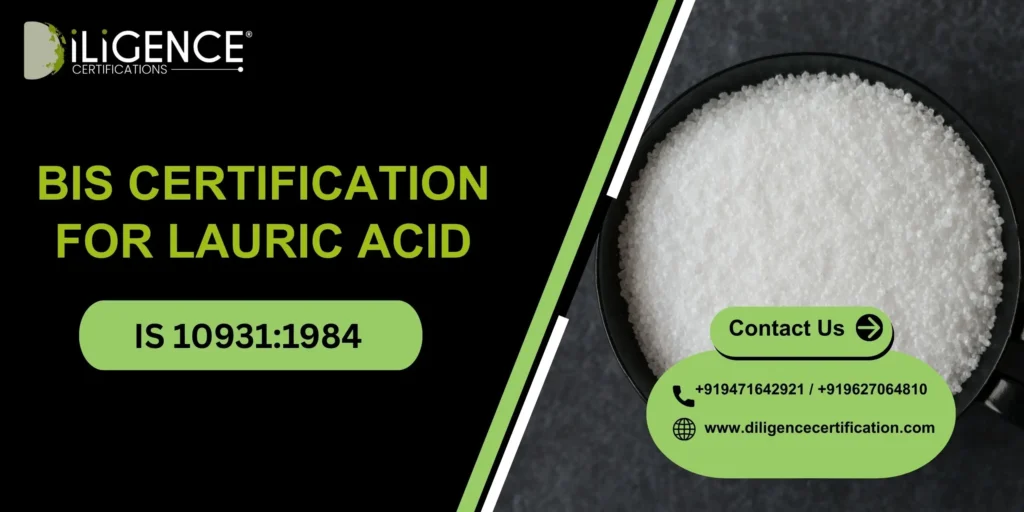
- Ensures Compliance with Indian Standard IS 10931:1984 :BIS certification is an assurance that the quality, purity, and safety levels of the particular chemical, i.e., lauric acid, meet the standards set in IS 10931: 1984.
- Specifies composition and purity requirements :Composition limits for fatty acids, moisture content, and impurities are also included in the standard, ensuring the quality of the material, along with the performance of processing
- .Ensures Safe Use in Industrial Applications :Certified lauric acid has the scope to be used in the formulation of soap, detergents, cosmetics, pharmaceuticals, and the chemical industry, all of which are made both safe and effective.
- Requires Testing and Quality Control Procedures: The test carried out during the BIS certification of the product includes testing, inspection, and quality control procedures, all of which check the requisite physical and chemical properties of the product with reference to lauric acid.
- Enhances Market Acceptance and Consumer Confidence : When the lauric acid carries the BIS certification, it instills confidence in the buyers of the product, thereby enhancing the acceptability of the market.
Introduction
BIS Certification for Lauric Acid The Indian Standard for Lauric Acid, which is IS 10931:1984, is mandated to ensure that the Lauric Acid produced and supplied in India meets the quality, safety, and purity requirements specified in the BIS. Lauric Acid is a saturated fatty acid mainly obtained from Coconut Oil and Palm Kernel Oil. Normally, the Lauric Acid is used in a number of industrial purposes such as the manufacture of soaps and detergents, cosmetics, pharmaceuticals, the production of chemicals, among many other uses. The Indian Standard for Lauric Acid, which in this case is the IS 10931:1984, describes the chemical composition, purity, moisture content, and other relevant physical and chemical characteristics.
What is IS 10931:1984?
IS 10931:1984 is an Indian Standard issued by the Bureau of Indian Standards (BIS). This is related to the requirements for lauric acid to be used in the industrial sector. This Indian Standard specifies the quality, purity, chemical composition, and test methods to ensure the acceptability of lauric acid in the manufacture of soaps, detergents, cosmetics, and pharmaceuticals.
Key Points:
- The standard also specifies minimum purity levels and impurity limits to ensure that lauric acid used is perfectly safe and effective for industrial applications.
- Specifies chemical composition:The following are some of its benefits: It acts as a guideline for fatty acid content, moisture content, and chemical composition.
- Physical and Chemical Properties IS 10931:1984 includes requirements for the requirements of melting point, acid value, and appearance, etc.
- Includes Testing and Sampling Methods It describes the testing procedure and sampling to check for specific quality requirements.
- Guarantees Suitability for Industrial Use Compliance with the Indian Standard IS 10931:1984 ensures that lauric acid can be used safely in the manufacture of soaps, detergents, cosmetics, and other chemical products.
Why is BIS Certification Mandatory
Certification by BIS is, therefore, necessary to ensure that lauric acid meets the requirements concerning quality, safety, and performance prescribed under Indian Standard IS 10931:1984. Lauric acid is commonly used in soaps, detergents, cosmetics, pharmaceuticals, and many other industrial applications, where consistency in purity and quality is required. BIS certification ensures that the lauric acid has been tested and verified according to standardized procedures, thereby reducing such risks as contamination, poor performance, or safety issues.
Key Reasons:
- Ensures Compliance with Indian Quality Standards:BIS certification is a guarantee that lauric acid has adhered to the regulations of purity, composition, and performance as prescribed under IS 10931:1984.
- Protects Product Safety and Quality:It also ensures that lauric acid is safe and appropriate for use in soaps and detergents, as well as in cosmetics, pharmaceuticals, and other applications.
- Mandatory for Legal Sale in Indian Market:In such a case involving the legal production, importation, and trading of lauric acid in the country, the manufacturers and suppliers must be certified by the BIS.
- Ensures proper testing and quality control :In order to obtain BIS certification for the product, regular testing, inspection, and quality checks are conducted.
- Builds Trust and Market Credibility :The acceptability of the product would be more in terms of customers and the industry as a whole.
Importance and Benefits of BIS Certification
| Importance | Benefits |
| Ensures that the product quality is of a standard:BIS certification makes sure that lauric acid satisfies the quality and the purity requirements stipulated in IS 10931:1984. | Improves Product Credibility :BIS certification helps in building trust in industry products among consumers, buyers, and users. |
| Maintains uniformity in the Production process :It helps manufacturers maintain the chemical composition and performance uniform for all batches. | Enhances Market Acceptance:The product, certified lauric acid, has a strong market in both households and industries. |
| Supports Industrial Safety and Reliability :Certified lauric acid is definitely safe for use and reliable to be used in soaps, detergents, cosmetics, and pharmaceutical products. | Provides Competitive Advantage:These organizations enjoy a competitive edge over other businesses that are not BIS-certified. |
| Regulatory compliance ensured: BIS certification helps manufacturers maintain Indian regulatory requirements and avoid litigation | Reduces Risk of Product Rejection : Products with the mark are less likely to face rejection on issues concerning quality and conformity. |
| Promotes Assurance of Quality Systems : It encourages the manufacturer to do proper testing, inspection, and quality control. | Strengthens Brand Reputation :BIS certification of products also proves a commitment to providing quality products, which therefore enhances the brand image of the manufacturer. |
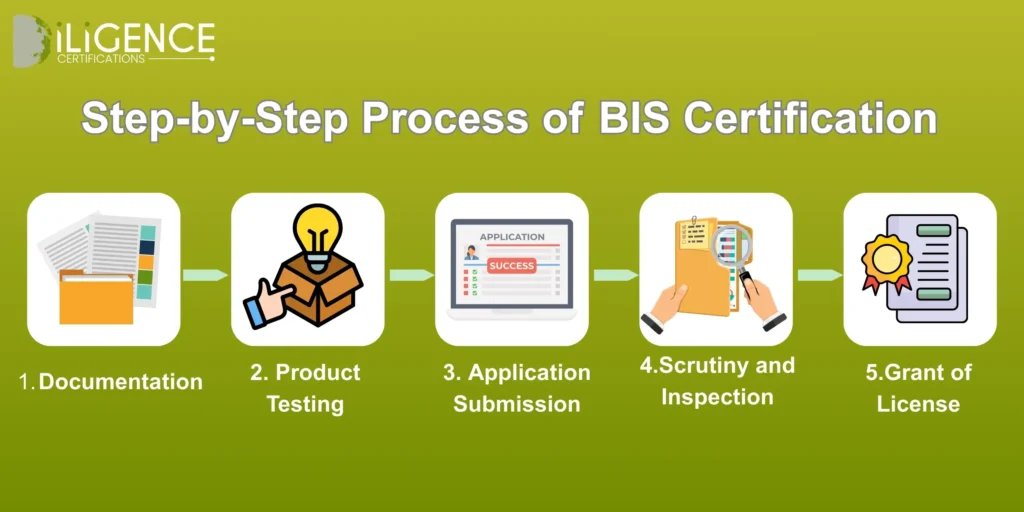
Step-by-Step Process of BIS Certification
Step1:Documentation
- Collect required technical documents
- Prepare product specifications
- Gather company registration details
- Ensure documents follow BIS format
Step2:Product Testing
- Send samples to a BIS-approved lab
- Conduct safety and quality tests
- Receive test reports
- Confirm compliance with BIS standards
Step3:Application Submission
- Fill out the BIS application form
- Upload all required documents
- Attach valid test reports
- Pay the necessary BIS fees
Step4:Scrutiny and Inspection
- BIS reviews submitted documents
- Authority verifies test results
- Factory/product inspection may occur
- Clarifications requested if needed
Step5:Grant of License
- BIS approves the application
- License number is issued
- Product can carry BIS mark
- Renewal required before expiry
Documents Required for BIS Certification
| Category | Documents Required |
| Business Documents | Business license/registration, ISO certificate, organizational details |
| Manufacturer Details | Factory layout, process flow chart, machinery list, production details |
| Product Documents | Product specifications, component list, user manual, model details |
| Testing Documents | Test report from BIS-recognized lab, sample details, test request form |
| Legal & Compliance | Authorization letter, brand ownership proof, trademark certificate (if any) |
| Import/Foreign Manufacturer (If applicable) | AIR (Authorized Indian Representative) details, contract agreement, overseas manufacturer documents |
Timelines, Costs, Validity & Renewal
- Timelines: Usually from 20 to 30 days, with only 7-15 days for the testing.
- Costs: The cost of the government and the test varies depending on the product. There can be some additional charges though.
- Validity: The validity period is 2 years in most situations.
- Renewal: The renewal is done before the expiration; there should be updated documents/tests; the renewal
Why Choose Diligence Certifications
Diligence Certification is an established consulting solution that offers a comprehensive range of support services to obtain BIS certification on Lauric Acid as per IS 10931:1984. With vast experience and a holistic understanding of BIS statutes and certification directives, Diligence offers comprehensive support for performing the certification process successfully. The highly experienced team at Diligence Certification assists manufacturers, importers, and suppliers in successfully completing the certification process.
Conclusion
The BIS certification of Lauric Acid is of great value for maintaining the quality, purity, and safer aspects of Lauric Acid. The certification of Lauric Acid shows that the product meets the specifications given by the Bureau of Indian Standards. The BIS certification of Lauric Acid is useful for maintaining the quality of the product, thereby making its performance safer. The BIS certification of Lauric Acid helps maintain its quality and is useful for industrial uses.
Frequently Asked Questions (FAQs)
What is BIS certification for Lauric Acid?
The BIS certification ensures the quality and safety of the lauric acid as per the specifications of the IS 10931:1984.
What is IS 10931:1984?
It is the Indian Standard that outlines the quality, purity, and testing requirements of lauric acid.
Who issues BIS certification in India?
The certification is issued by the Bureau of Indian Standards (BIS).
Is BIS certification necessary for lauric acid?
It may be mandatory depending on the requirements and usage of the product in India.
What industries use BIS certified lauric acid?
It is used in the soap, detergent, cosmetics, pharmaceutical, and chemical industries.
What is the main purpose of BIS certification?
Mainly, the purpose of these checks is product quality, safety, and compliance with Indian standards.
Does BIS certification involve testing the product?
Yes, lauric acid has to be tested in BIS-approved laboratories.
Can importers apply for BIS certification?
Yes, both manufacturers and importers may apply for BIS certification.
How long does BIS certification take?
The duration of the process depends on the documentation procedure, testing procedures, and BIS approval procedures.
What are the benefits of BIS certification?
It enhances product credibility and compliance, and promotes market acceptance.