BIS Certification
 CDSCO
CDSCO
 PESO
PESO
 CPCB
CPCB
 LMPC
LMPC
 WPC Approval
 Global Approvals
 TEC
TEC
 ARAI
ARAI
 BEE
BEE
 ISO Certification
 DGCA Certification
 NOC For Steel
 APEDA Registration























 Business Registration
 FSSAI Mark Certification












 (32).jpg)
 Legal Services
 Trademark Registration
 Copyright Registration
 Patent Registration
 By
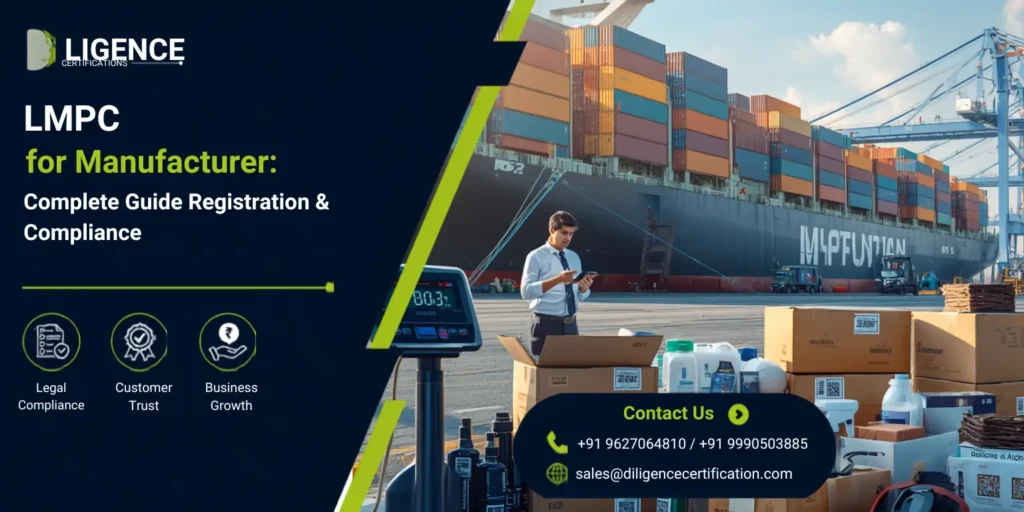
By - Legal metrology package compliance (LMPC) for manufacturers is a mandatory requirement for manufacturers supplying pre-packaged products in India, as per the Legal Metrology Act and Packaged Commodities Rules.
- Manufacturers need to ensure that products are labelled and declared correctly prior to making packaged products available in the market.
- Diligence Certifications helps manufacturers register for LMPC, document and assist in compliance.
Introduction: LMPC for manufacturer
A food manufacturing company had to face issues with the product labels after a distributor questioned it while performing a routine compliance check. While the products were manufactured in India, were properly packed and were ready to ship, however, some of the declarations mandated under the Legal Metrology guidelines were missing or were incorrectly labeled. While the production process was timely done by the business, it could not deliver the products to the retailers till the issue of non-compliance was sorted out.
This is much more frequent than what many manufacturing companies think of. Manufacturers spend a great deal of effort into producing, controlling quality, packaging and marketing their products; however, they overlook the requirements of regulatory bodies concerning packaged commodities. Even small mistakes on the label can end up leading to inspection, notices and disruption in sales.
What is LMPC for Manufacturer
LMPC for Manufacturer refers to the registration and compliance processes that apply to the manufacturers involved in packaging and marketing of their products within the ambit of the Legal Metrology Act, 2009, and Legal Metrology (Packaged Commodities) Rules, 2011.
Manufacturers are accountable to ensure that all the declarations are present on the packaged products prior to making them available for sale within the Indian market. This provides consumers with information about the product purchased.
LMPC compliance is relevant in various industries, which include food processing industry, cosmetic industry, household products, chemical industry, electrical industry, consumer products, healthcare products, and industrial packaged products.
Non-compliance with LMPC can lead to various repercussions.
Why is LMPC Important for Manufacturers
A lot of manufacturers feel that meeting the standards through the quality of the products is sufficient. However, this is not true because compliance also entails proper packaging and labeling of the product.
The LMPC compliant product indicates that the manufacturer has met some important legal obligations even before the product is introduced in the market. Advantages of being compliant are:
- Legal compliance
- Consumer trust
- Smooth product distribution
- Improved retailer confidence
- Reduced compliance risks
- Better market reputation
- Easier regulatory inspections
- Stronger business credibility
For growing manufacturers, maintaining compliance from the beginning is generally far less expensive than correcting regulatory issues later.
Which Manufacturers Need LMPC Registration
The requirement applies to manufacturers producing pre-packaged commodities intended for sale in India.
Examples include:
Manufacturers of Food Products
Companies manufacturing packaged food products.
Manufacturers of Cosmetics
Firms manufacturing creams, lotions, perfumes, shampoos, and other cosmetics.
Manufacturers of Household Products
Manufacturers producing detergents, cleansers, disinfectants, and other similar products.
Manufacturers of Electrical Products
Companies manufacturing packaged electrical items.
Manufacturers of Industrial Products
Manufacturers supplying industrial products in packaged form.
Chemical Manufacturers
Companies manufacturing packaged chemicals.
Consumer Goods Manufacturers
Manufacturers of packaged consumer goods.
Eligibility for LMPC for Manufacturer
A business generally becomes eligible if it:
- Manufactures packaged commodities
- Sells products in packaged form
- Supplies products through distributors or retailers
- Follows Legal Metrology requirements
- Maintains valid business registrations
- Has a manufacturing facility
- Complies with packaging regulations
The exact requirements may vary depending on the product category and applicable regulations.
Products Covered Under LMPC
The Legal Metrology framework covers a wide range of packaged products.
Some common examples include:
- Packaged food
- Spices
- Tea and coffee
- Cosmetics
- Personal care products
- Electrical accessories
- Kitchen appliances
- Paints
- Lubricants
- Cleaning products
- Hardware items
- Consumer electronics
- Healthcare products
- Stationery
- Plastic products
- Industrial supplies
Manufacturers should verify whether their products fall within the scope of the applicable Legal Metrology provisions.
Benefits of LMPC for Manufacturer
Obtaining and maintaining LMPC compliance offers long-term advantages beyond regulatory approval.
Boosts Customer Trust
Customers tend to favor products that provide all the information.
Promotes Market Growth
Compliant companies are generally favored by retailers, wholesalers, and distributors due to reduced regulatory risk.
Prevents Regulatory Risks
A good compliance record lowers chances of inspections, warnings, and penalties.
Enhances Company Image
Companies with good regulatory records can develop strong relations with their customers and partners.
Documents Required for LMPC for Manufacturer
The exact documentation may differ depending on the State Legal Metrology Authority and the nature of the business. However, manufacturers are generally required to submit updated business and compliance documents.
Typical documents include:
- Manufacturing licence (where applicable)
- GST Registration Certificate
- PAN Card of the business
- Certificate of Incorporation, Partnership Deed, or LLP Agreement
- Factory address proof
- Identity proof of the authorised signatory
- Board Resolution or Authorisation Letter
- Product list
- Packaging label samples
- Trademark Certificate (if available)
- Factory layout or manufacturing details (if required)
- Passport-size photograph of the authorised signatory
- Mobile number and email ID
Before submission, verify that all documents contain consistent business details to avoid delays during scrutiny.
Step-by-Step LMPC Registration Process for Manufacturers
Obtaining LMPC for manufacturer involves more than filling out an application. Proper documentation and label compliance play a significant role in the approval process.
Step 1: Determining Applicability
Check whether your commodities are covered by the provisions of Legal Metrology (Packaged Commodities) Rules, 2011.
Step 2: Preparation of Business Documents
Gather all the statutory registrations, manufacturing information, and identity documents.
Step 3: Examination of the Packaged Commodity Labels
Make sure all your packaged commodities have compulsory declarations such as MRP, net quantity, manufacturer’s details, and customer care information.
Step 4: Filling up the Application Form
Fill up the required application form with updated information about your business.
Step 5: Submission of the Application
Submit the application and other required documents to the competent Legal Metrology Authority.
Step 6: Verification
The Legal Metrology Authority verifies the records furnished by you and seeks further clarifications if necessary.
Step 7: Issue of Registration
Upon successful verification, your registration is made through which you will be able to sell your commodities in packed form.
Common Mistakes Manufacturers Should Avoid
During compliance reviews, Diligence Certifications frequently observes recurring issues that delay approvals or lead to regulatory notices.
Incomplete Product Labels
Missing mandatory declarations remain one of the most common compliance failures.
Incorrect Manufacturer Details
The manufacturer’s name and address should exactly match official business records.
Wrong Net Quantity Declaration
Incorrect quantity declarations can attract regulatory action.
Missing Customer Care Information
Consumer grievance details must be clearly displayed wherever required.
Delayed Registration
Some businesses complete production before applying for LMPC registration, resulting in avoidable delays.
Ignoring Label Updates
Whenever product packaging changes, manufacturers should verify that all statutory declarations remain compliant.
Why Choose Diligence Certifications
Regulatory compliance is often viewed as paperwork, but in practice it directly affects business continuity and market access. Manufacturers need accurate documentation, compliant labels, and timely coordination with the appropriate authorities.
Diligence Certifications offers complete assistance with:
- LMPC registration for manufacturers
- Document verification
- Label compliance review
- Application preparation
- Regulatory guidance
- End-to-end filing support
- Renewal assistance
- Ongoing compliance consultation
Our team works with manufacturers across multiple industries, helping them complete registrations efficiently while reducing the risk of avoidable delays.
Conclusion
Getting the LMPC for manufacturer is a crucial step in order to comply with the relevant regulations for businesses manufacturing pre-packaged goods in India. Not only will compliance allow companies to fulfill their legal requirements, but also help manufacturers establish trust with customers, distributors, and retailers.
A proper compliance framework, proper labeling, and timely registration will minimize risks associated with conducting business and ensure further business growth. Manufacturing companies that consider Legal Metrology compliance as an integral part of their quality management process will find themselves well equipped for future growth.
Should your business need professional assistance with LMPC for manufacturer, Diligence Certifications is here to help you with document verification, labeling compliance, application filing, etc.
Frequently Asked Questions
What is LMPC for Manufacturer?
"LMPC for Manufacturer" means the compliance of the requirements of the Legal Metrology Act as well as the rules governing Packaged Commodities in relation to any manufacturer engaged in sale of pre-packed commodities in India
Is LMPC registration mandatory for Manufacturers?
In general, manufacturers engaged in the business of sale of any pre-packed commodity that falls under the purview of the Legal Metrology Act need to get themselves registered.
What Products require LMPC compliance?
Such commodities include food products, cosmetic products, household goods, electric goods, chemical substances, personal care goods, and numerous other packaged commodities
What documents are required for LMPC registration?
The common documents include GST Registration, PAN, business registration documents, factory address proof, product details, packaging labels, etc.
What is the duration of the LMPC Registration process?
The time taken for registration varies according to the accuracy and completeness of the documents provided.
Can manufacturers of MSMEs apply for LMPC registration?
Yes, if the manufacturers satisfy all the relevant criteria as per Legal Metrology.
Can product labels be modified after registration?
Yes, but it must be made sure that the revised label complies with all the relevant Legal Metrology.
What would happen in case of non-compliance?
It might lead to inspection, notice, penalty, or restriction on the sale of packed commodities.
Is the procedure same in every state?
The basic procedure is more or less same in all the states; however, there may be slight variations in documents and procedure.
Can Diligence Certifications assist in obtaining LMPC registration?
Yes, Diligence Certifications offer complete assistance in documentation, filing applications, compliance check, and registration.