


 BIS Certification
 CDSCO
CDSCO
 CPCB
CPCB
 LMPC
LMPC
 WPC Approval
 Global Approvals
 TEC
TEC
 ARAI
ARAI
 BEE
BEE
 ISO Certification
 DGCA Certification
 NOC For Steel
 APEDA Registration

















 Business Registration
 FSSAI Mark Certification













 Legal Services
 Trademark Registration
 Copyright Registration
 Patent Registration
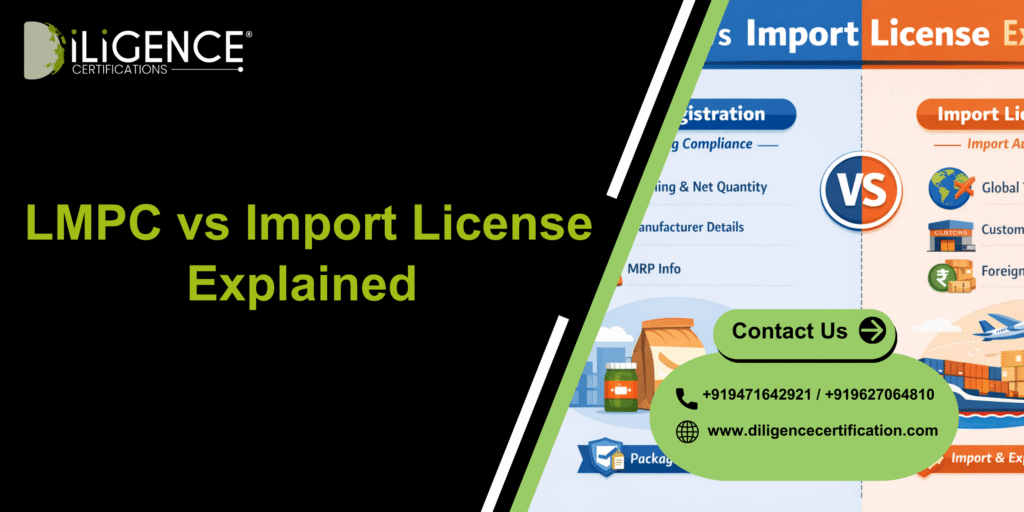
- LMPC vs Import License Explained helps businesses clearly understand the difference between packaging compliance requirements and import authorization regulations in India.
- LMPC focuses on packaging compliance, while IEC focuses on trade authorization.
- Importers of packaged goods usually require both LMPC and IEC registration.
- Proper compliance ensures smooth customs clearance and legal product sales.
- Understanding regulatory differences helps businesses avoid penalties and operational risks.

Introduction
India is one of the swift- growing import requests encyclopedically, with businesses importing packaged consumer goods, electronics, food particulars, health supplements, cosmetics, and artificial products. Importers must misbehave with multiple nonsupervisory conditions before dealing imported products in India. Two of the most generally confused compliance conditions are LMPC vs Import License Explained . Legal Metrology Packaged Commodities
While both are obligatory for certain import conditioning, they serve different purposes. LMPC vs Import License Explained packaging and labeling compliance forpre-packaged goods, whereas the Import License or IEC allows businesses to fairly import goods into India. Understanding the difference helps importers maintain nonsupervisory compliance and avoid legal complications.
What Is LMPC Registration?
LMPC( Legal Metrology Packaged Commodity) Registration is an obligatory instrument issued by the Legal Metrology Department for businesses importing or dealing pre-packaged goods in India.
LMPC compliance ensures that imported products
- Display accurate net weight, volume, or volume
- citation manufacturer, importer, or packer details
- Show Maximum Retail Price( MRP) inclusive of levies
- Follow standardized packaging and labeling rules
- Maintain translucency and consumer protection
LMPC regulations are executed under
- Legal Metrology Act, 2009
- Legal Metrology( Packaged Goods) Rules, 2011
- Consumer Protection Laws
Without LMPC enrollment ,pre-packaged imported goods can not be fairly vended or distributed in India.
What Is an Import License( IEC)?
An Import License, generally known as the Import Export Code( IEC), is an obligatory enrolment issued by the Directorate General of Foreign Trade( DGFT). It allows businesses to fairly import and export goods in India.
IEC is needed for
- Importing goods from foreign countries
- Clearing shipments through customs
- Conducting transnational trade deals
- entering foreign payments related to import/ import
IEC acts as a primary authorization for businesses to share in global trade but does n’t cover packaging or labeling compliance conditions.
Crucial Differences Between LMPC vs Import License Explained
| Parameter | LMPC Registration | Import License (IEC) |
| Purpose | Regulates packaging and labeling compliance | Authorizes import and export operations |
| Governing Authority | Legal Metrology Department | Directorate General of Foreign Trade (DGFT) |
| Legal Framework | Legal Metrology Act, 2009 | Foreign Trade (Development and Regulation) Act, 1992 |
| Applicability | Pre-packaged goods importers and sellers | All import and export businesses |
| Focus Area | Packaging transparency and consumer protection | International trade authorization |
| Mandatory For | Importers of packaged commodities | All businesses involved in import/export |
| Compliance Type | Product packaging compliance | Trade licensing compliance |
Why Businesses Need Both LMPC vs Import License Explained
Importers dealing with packaged goods frequently bear both LMPC enrollment and IEC because each serves a different nonsupervisory function.
Failure to gain either instrument can affect in
- Payload rejection at customs
- Product seizure or recall
- Heavy penalties and nonsupervisory forfeitures
- Import or distribution restrictions
- Loss of business credibility
Proper compliance ensures
- Smooth customs concurrence
- Legal authorization to import and vend products
- Accurate product labeling and packaging translucency
- Advanced consumer trust and request acceptance
Who Needs LMPC vs Import License Explained in India?
These instruments are obligatory for
- Importers of packaged consumer goods
- E-commerce businesses importing products
- FMCG and retail product importers
- Food, ornamental, and supplement importers
- Private marker product importers
- Distributors and wholesalers of imported packaged goods
Benefits of Understanding LMPC vs Import License Explained
| Importance | Benefits |
| Regulatory Compliance | Ensures adherence to import and packaging laws |
| Smooth Trade Operations | Prevents customs and shipment delays |
| Consumer Protection | Maintains transparent product information |
| Risk Reduction | Avoids penalties, seizures, and legal disputes |
| Business Credibility | Builds trust with regulators and customers |
Step- by- Step Compliance Process for Importers
Step 1 Obtain Import License( IEC)
Businesses must first apply for IEC enrollment through DGFT to fairly import goods.
Step 2 Identify LMPC Applicability
Importers must determine whether their products fall under packaged commodity regulations.
Step 3 Prepare Compliance Attestation
Collect business enrollment documents, packaging artwork, and product specifications.
Step 4 Apply for LMPC Registration
Submit LMPC operation to the Legal Metrology Department of the separate state.
Step 5 Packaging and Marker Verification
ensure imported products meet obligatory labeling conditions.
Step 6 Maintain Compliance Records
Businesses must maintain enrollment instruments, packaging records, and product details for examinations.
Documents Needed for LMPC vs Import License Explained
- For Import License( IEC)
- visage Card of Business
- Business Registration Certificate
- Address evidence
- Bank Details
For LMPC Registration
- LMPC operation Form
- Import Export Code( IEC)
- GST Registration Certificate
- Business Registration Certificate
- Product Packaging and Marker Artwork
- Product Specification Details
- Authorization Letter
- storehouse or Business Address evidence
Timeline, Validity & Renewal
IEC Registration Processing Time 5 – 10 working days
IEC Validity Lifetime validity( subject to updates)
LMPC Registration Processing Time 20 – 30 working days
LMPC Validity generally long- term validity( subject to nonsupervisory updates)
Renewal Requirement Needed if product, packaging, or business details change
Conclusion
Understanding the difference between LMPC vs Import License Explained is essential for businesses involved in importing packaged goods in India. While the Import License( IEC) authorizes businesses to conduct transnational trade, LMPC enrollment ensures packaging and labeling compliance under Legal Metrology laws. LMPC Certification
Businesses that gain both instruments can operate easily, avoid nonsupervisory penalties, and maintain consumer trust. Proper compliance with LMPC vs Import License Explained conditions is not only a legal obligation but also a strategic step toward sustainable growth in India’s competitive import request.
Frequently Asked for Questions
Is LMPC enrollment obligatory for all importers?
No, LMPC is obligatory only for importers dealing with pre-packaged goods.
Is IEC needed for LMPC enrollment ?
Yes, IEC is generally needed before applying for LMPC enrollment .
Can I import goods without IEC?
No, IEC is obligatory for legal import and import conditioning in India.
Does LMPC cover customs concurrence?
LMPC supports compliance but IEC primarily enables customs concurrence.
Who issues LMPC enrollment in India?
LMPC enrollment is issued by the Legal Metrology Department.
Who issues the Import Export Code( IEC)?
IEC is issued by the Directorate General of Foreign Trade( DGFT).
Doe-commerce importers need LMPC enrollment ?
Yes, if they import and vend pre-packaged goods.
Is IEC valid for continuance?
Yes, IEC generally has continuance validity subject to updates.
Can LMPC enrollment help product seizure?
Yes, proper LMPC compliance helps help nonsupervisory penalties and seizures.
Do private marker importers bear both LMPC and IEC?
Yes, utmost private marker importers need both enrollments for legal operations.