BIS Certification
 CDSCO
 PESO
 CPCB
 LMPC
 WPC Approval
 Global Approvals
 TEC
 ARAI
 BEE
 ISO Certification
 DGCA Certification
 NOC For Steel
 APEDA Registration























 Business Registration
 FSSAI Mark Certification












 (32).jpg)
 Legal Services
 Trademark Registration
 Copyright Registration
 Patent Registration
 By
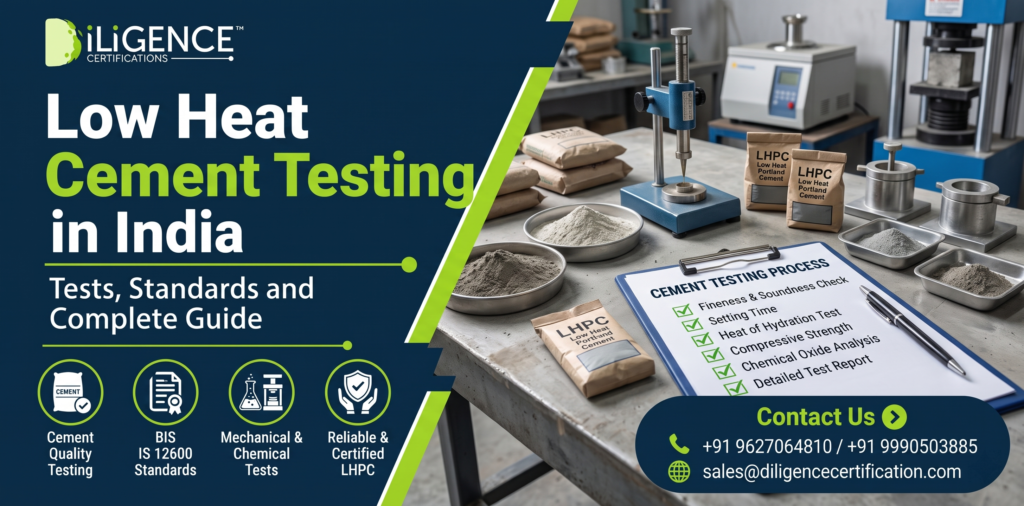
- Low heat cement testing checks if the cement releases less heat while it hardens, which protects big concrete pours from cracking.
- The main standard is IS 12600, and the cement falls under the Cement Quality Control Order.
- Heat of hydration is the star test. Fineness, setting time, soundness and strength are also checked.
- Low heat cement gains strength slowly, so early strength numbers will look lower than ordinary cement.
- Testing happens in the factory lab daily, and in a recognised lab for outside proof.
- Calibrated equipment and honest records matter more than anything else during BIS inspection.
Introductione
Now imagine a pressure cooker with a blocked whistle. The inside gets hot, the outside stays cool, and the pot cracks. Concrete behaves in a similar way. The hot centre and cool surface pull against each other, and cracks appear.
Low heat cement is made to avoid this. But how do we know a bag truly gives less heat? Only through testing. In this blog, we’ll go through the tests, the standard, the process and the common mistakes in simple words.
What Is Low Heat Cement?
Low heat cement (also called low heat Portland cement) is a Portland cement designed to release heat slowly during hydration.
How is it made? The raw mix is adjusted so that the clinker has lower amounts of the compounds that give out heat quickly, like tricalcium aluminate and tricalcium silicate. It has more of the slow-reacting compounds.
The trade-off is simple. It gives less heat, but it also gains strength slowly in the early days. That is fine for mass concrete, where heat is the bigger problem than early strength.
It is used in dams, thick raft foundations, large bridge abutments and other mass concrete works.
What Is Low Heat Cement Testing?
It is the process of checking cement samples against the limits of the Indian Standard. The lab checks chemistry, physical properties, strength and, most importantly, the heat released during hydration.
If every result is inside the limit, the cement passes. If even one result is outside, the lot fails.
There are two main purposes. One is daily quality control in the plant. The other is certification, where a recognised lab report is needed for the BIS licence.
Which Standard Applies?
| Standard | What it covers |
| IS 12600 | Specification for low heat Portland cement |
| IS 4031 (series) | Methods of physical tests on hydraulic cement |
| IS 4032 | Method of chemical analysis of hydraulic cement |
| IS 11262 | Calorimeter used for heat of hydration testing |
| IS 269 | Ordinary Portland cement (useful for comparison) |
Simple example: A project team is planning a large dam foundation. The consultant asks the supplier for low heat cement. The supplier shows the ISI mark with the IS 12600 reference. The team can then ask for batch test results, including heat of hydration, before approving the supply.
Important note: IS 12600 is listed under the Cement (Quality Control) Order. The standard was published in 1989 and has been reaffirmed and amended several times. Some websites talk about newer editions, so please check the BIS website for the current version and the latest notifications before you plan.
Why Is Low Heat Cement Testing Important?
- A cement labelled low heat but not actually low heat can cause thermal cracks in big structures.
- Cracks in dams and thick foundations are very costly and difficult to repair.
- Consultants and government projects often demand test reports with heat of hydration values.
- It protects your brand. One bad batch in a mega project can hurt your name for years.
- It helps the plant find problems in clinker and grinding early.
- It proves that the label on the bag matches what is inside.
What Tests Are Conducted?
The tests fall in four groups. Chemical, physical, strength and heat of hydration.
Chemical tests
| Test | What the lab checks | In simple words |
| Lime saturation factor | Lime against silica, alumina and iron | Is the raw mix balanced? |
| Alumina to iron ratio | Ratio of two oxides | Is the oxide mix right? |
| Insoluble residue | Part that does not dissolve in acid | Is the cement clean? |
| Magnesia | Magnesium oxide content | Will it expand later? |
| Sulphuric anhydride | Sulphate content | Is gypsum added in the right amount? |
| Loss on ignition | Weight lost on heating | Has the cement absorbed moisture? |
Physical tests
| Test | What the lab checks | In simple words |
| Fineness | Surface area of the powder | How fine is the cement? |
| Soundness | Le Chatelier and autoclave expansion | Will it swell or crack after setting? |
| Setting time | Initial and final setting | When does it start and finish hardening? |
| Standard consistency | Water needed for a standard paste | Base value for other tests |
Strength tests
Mortar cubes are made, cured in water and crushed at fixed ages like 3, 7 and 28 days. The standard also refers to transverse strength. The cement must reach the minimum value at each age.
Heat of hydration test
This is the test that makes low heat cement special. We’ll explain it next.
The Special Test: Heat of Hydration
Heat of hydration is the heat released when cement reacts with water. For low heat cement, the standard puts a maximum limit at 7 days and at 28 days. As per the BIS document, the limits are about 272 kJ/kg at 7 days and 314 kJ/kg at 28 days. Please confirm the exact figures in the current edition of the standard.
How does the lab do it? It uses the heat of solution method. In simple words, the lab dissolves a dry cement sample and a hydrated sample (aged for 7 or 28 days) in acid, inside a calorimeter. The difference in the heat released tells us the heat of hydration.
The calorimeter needs very good insulation and a precise thermometer, because the temperature change is tiny. A small error here can pass a high heat cement as low heat.
Tip before sending samples: Make sure your calorimeter is checked and calibrated. Also remember that the 28-day heat result needs 28 days of curing, so plan the timeline early.
Two Kinds of Testing: Factory Lab and Recognised Lab
Factory lab (in-house testing). This is your own plant lab. You test samples regularly, record the results and keep them ready. BIS looks at this lab closely during factory inspection.
Recognised lab (outside testing). This is an independent lab accepted by BIS. It tests samples and gives a report. During surveillance, BIS may also draw samples from your plant or the market and send them for testing.
One gives daily control. The other gives outside proof. You need both.
Step-by-Step Process
- Confirm the standard. Check IS 12600 and the latest notification on cement.
- Check your plant set-up. Kiln, grinding, storage and packing should suit this cement.
- Prepare the in-house lab. Arrange chemical and physical test equipment and trained staff.
- Make a quality plan. Write checks for raw material, clinker, cement and packing.
- Make a trial lot. Produce the cement under regular conditions.
- Test in-house. Run the tests and record every result honestly.
- Send samples to a recognised lab. Pack them airtight and label them clearly.
- Apply to BIS. File the application with documents, test report and factory details.
- Inspection and grant. BIS officers visit, check the set-up and may draw samples. If all is fine, the licence is granted.
Which BIS Route Is Needed?
| Your business | Usual route |
| Indian cement manufacturer | ISI Mark licence under Scheme-I |
| Foreign cement manufacturer | BIS licence under the Foreign Manufacturers Certification Scheme |
| Importer or trader | Deals only in certified cement and keeps proper records |
| Export-only plant | May be outside the order, but confirm in the latest notification |
A licence is linked to a product, a standard and a plant. If you change the plant or add a new brand, talk to BIS first.
Documents Required
Company documents
- Company registration or partnership deed
- Factory licence and address proof
- Authorised person details
Product and plant documents
- Product details and brand names
- Process flow chart from raw material to packing
- Plant and lab layout
- Raw material and fuel details
- Environment and safety permissions, as applicable
Testing records
- Calibration certificates of equipment, including the calorimeter
- In-house test records of recent lots
- Recognised lab test report
- Quality control staff details
How Long Does It Take?
Lab testing takes time mainly because of curing. Strength needs up to 28 days, and the 28-day heat of hydration also needs 28 days of curing.
The full licence process takes longer. Even if your papers and plant are ready, it can take a couple of months. Foreign manufacturers usually need more time.
Delays mostly come from missing documents, calibration gaps and failed samples.
What Decides the Cost?
No fixed number can be given here, because every plant is different. These things decide the cost:
- Number of tests in the standard
- Lab charges, especially for the heat of hydration test
- BIS application and licence fees
- Equipment and lab upgrades needed in the plant
- Number of brands or products you want covered
- Consultant support, if you take it
Share your plant details and ask for a clear breakup before you begin.
Common Failures and Easy Fixes
| Problem | Likely reason | Easy fix |
| Heat of hydration above limit | Clinker not designed for low heat | Adjust raw mix and check clinker daily |
| Low strength at 28 days | Poor grinding or wrong gypsum | Review grinding and gypsum dosage |
| High loss on ignition | Moisture entered the cement | Improve storage and packing |
| Soundness failure | Free lime or high magnesia | Control kiln burning and raw material |
| Fineness out of range | Mill settings off | Recheck mill and sieve calibration |
Common Mistakes to Avoid
- Accepting a low heat label without actually running the heat of hydration test.
- Judging this cement by early strength, like you would for ordinary cement.
- Using an uncalibrated calorimeter or thermometer.
- Sending old or half-open sample bags that have absorbed moisture.
- Testing only the final cement and skipping clinker checks.
- Keeping incomplete or backdated records.
- Not marking bags as the standard requires.
- Not tracking changes in the Cement Quality Control Order and standard revisions.
Who Needs This?
- Cement manufacturers making low heat cement.
- Importers bringing cement from other countries.
- Private label brands whose cement is made by another plant.
- Overseas manufacturers selling into India.
- Dam, bridge and infrastructure contractors who want proof before bulk buying.
Why Choose Diligence Certifications for low heat cement testing Certification?
Cement rules and test methods can feel heavy, especially for a first-time applicant. Practical guidance saves time and avoids mistakes.
Diligence Certifications supports manufacturers and importers with standard selection, document preparation, sample planning and application follow-up. You can visit the Diligence Certification website to know more, or check the low heat Portland cement certification service page for details.
We explain each step in plain language and tell you clearly what is needed. We do not promise approvals, because approval depends on your product, your plant and BIS review.
Quick Checklist Before Sending Samples
- Standard and product confirmed
- Fresh sample drawn properly from a regular lot
- Sample packed airtight and labelled
- Clinker and raw mix records ready
- Calorimeter and other equipment calibrated
- 28-day curing time planned in the schedule
- In-house test records ready
- Bag marking checked
Conclusion
Low heat cement testing is not just paperwork. It proves that your cement will stay cool enough to protect the biggest structures from cracking.
Know your standard, run the heat of hydration test properly, test honestly in your own lab and keep clean records. Do these things and most of the trouble goes away.
If you are unsure where to start, talk to an expert before you make a big batch.
Frequently Asked Questions
1. What is low heat cement testing?
It is checking cement samples against IS 12600 for chemistry, physical properties, strength and heat of hydration.
2. Which standard applies to low heat cement?
IS 12600 is the main standard. Test methods come from the IS 4031 and IS 4032 series.
3. Is BIS certification mandatory for low heat cement?
IS 12600 is listed under the Cement Quality Control Order. Please confirm the latest notification on the BIS website.
4. What is heat of hydration?
It is the heat released when cement reacts with water and starts to harden.
5. Why does low heat cement have lower early strength?
It contains more slow-reacting compounds, so it gains strength slowly on purpose.
6. Where is low heat cement used?
In dams, thick raft foundations, large bridge abutments and other mass concrete works.
7. How is heat of hydration measured?
By the heat of solution method, using a calorimeter, on samples at 7 and 28 days.