BIS Certification
 CDSCO
 PESO
 CPCB
 LMPC
 WPC Approval
 Global Approvals
 TEC
 ARAI
 BEE
 ISO Certification
 DGCA Certification
 NOC For Steel
 APEDA Registration























 Business Registration
 FSSAI Mark Certification












 (32).jpg)
 Legal Services
 Trademark Registration
 Copyright Registration
 Patent Registration
 By
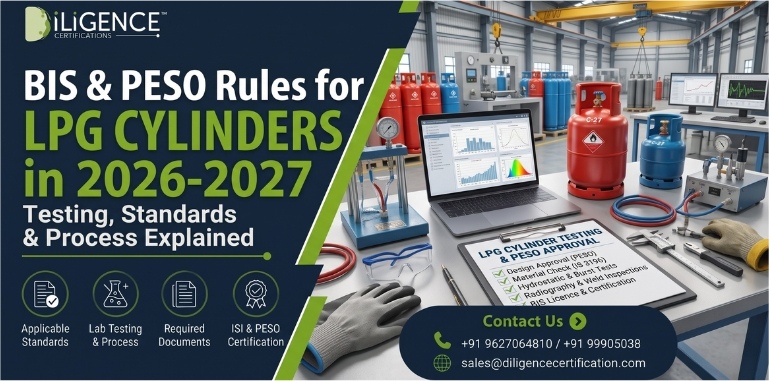
- LPG cylinder testing has two parts: testing at the time of making (BIS) and periodic retesting during use (PESO rules).
- Welded steel LPG cylinders follow IS 3196 (Part 1). The test methods are in IS 3196 (Part 3).
- Main tests are radiography, water capacity, hydrostatic, burst, fatigue and pneumatic leak test.
- The code on the cylinder (like C-27) is a test due date. It is not an expiry date.
- Manufacturers need PESO approval and a BIS licence before they make and sell cylinders.
- Skipping or faking a test can put lives at risk. Always use proper, recognised labs.
Introduction
LPG Cylinder Testing in India: Complete Guide for Manufacturers
Think of it like your car’s pollution check and service. Car runs fine for months, but one day you must test it, right? Same with an LPG cylinder. It holds gas under pressure, so it can’t be “just trusted”. It has to be tested again and again.
In this blog, we’ll explain LPG cylinder testing in very simple words. What it is, which standards apply, what tests are done, and how the process works for manufacturers and others in the business.
An LPG cylinder is one of the most commonly used products in Indian homes, restaurants, hotels and industries. We use LPG every day for cooking and other applications, but we rarely think about how much safety checking goes into making these cylinders. Since LPG is stored under pressure, even a small defect in the cylinder body, welding joint or valve connection can create serious safety risks.
This is why LPG cylinder testing in India is an important requirement for manufacturers, importers and businesses involved in the gas cylinder industry. Before a new cylinder reaches the market, it must meet the applicable Indian safety standards and certification requirements. Even after years of use, cylinders need periodic inspection and retesting to check whether they are still safe for further use.
What Is LPG Cylinder Testing?
LPG cylinder testing means checking a cylinder for strength, leak-proofing and quality. The aim is simple. The cylinder should hold gas under pressure safely, for its full working life.
It happens at two stages:
- At manufacturing. New cylinders are tested in the factory and by BIS-recognised labs, as per the Indian standard.
- During use. Cylinders in the market come back to the plant after some years for statutory retesting, as per PESO rules.
In India, making, keeping and using gas in cylinders above 500 ml water capacity is regulated by the Gas Cylinders Rules, 2016, under PESO (Petroleum and Explosives Safety Organisation).
Two Kinds of Testing: Factory vs Periodic
| Point | Testing at manufacturing | Periodic retesting |
|---|---|---|
| Who does it | Cylinder manufacturer, BIS lab | Authorised testing and refilling set-up |
| Cylinder status | Brand new | Already used in the market |
| Governing rules | BIS standard IS 3196, PESO approval | PESO rules, IS 16054 |
| Result | ISI-marked cylinder, allowed to be sold | New test due date stamped, cylinder goes back to use |
| If it fails | Batch is rejected | Cylinder is scrapped or repaired as per rules |
Which Standards Apply?
| Standard | What it covers |
|---|---|
| IS 3196 (Part 1) | Welded low carbon steel cylinders for LPG, above 5 litre water capacity |
| IS 3196 (Part 2) | Similar cylinders for other low pressure liquefiable gases, not LPG |
| IS 3196 (Part 3) | Methods of test, like burst, hydrostatic and pneumatic leak tests |
| IS 16054 | Periodic (statutory) testing of LPG cylinders |
| Gas Cylinders Rules, 2016 | Legal rules for making, filling, storing and testing, by PESO |
Simple example: A company makes 14.2 kg domestic cylinders. It needs PESO approval for the design, a BIS licence under IS 3196 (Part 1), and then it follows lot inspection and test rules for every batch.LPG Cylinder Testing in India
Why LPG Cylinder Testing Is Important
- Safety first. A weak weld or thin wall can cause leaks or even a blast.
- Legal need. No testing means no BIS licence and no PESO approval.
- Brand trust. Oil companies and dealers buy only from approved makers.
- Longer life. Regular tests catch rust, dents and valve problems early.
- Lower risk. Fewer accidents, fewer recalls, fewer legal troubles.
What Tests Are Conducted?
| Test | What the lab checks | In simple words |
|---|---|---|
| Radiographic examination | Weld quality using X-ray | Is there any hidden crack inside the weld? |
| Water capacity check | Actual volume of the cylinder | Does it hold the declared size? |
| Hydrostatic test | Cylinder filled with water and pressurised | Does it stay strong under test pressure? |
| Hydrostatic stretch test | How much the cylinder expands under pressure | Does it go back properly, without permanent damage? |
| Burst test | Pressure at which the cylinder finally fails | How much extra strength is there in reserve? |
| Fatigue (cycle) test | Repeated filling and emptying of pressure | Will it survive years of refilling? |
| Pneumatic leak test | Air pressure test, checking for bubbles | Is there any leak, even a tiny one? |
| Tare weight check | Empty weight of the cylinder | Is the marked weight correct? |
| Material tests | Strength and impact of steel | Is the steel good enough? |
| Marking and colour check | Stamps, label and paint | Is all information correct and readable? |
On top of these, BIS asks for lot inspection. Heat treatment, hydrostatic test, tare weight and pneumatic leak test records must be ready before a batch is offered for inspection.
How to Read the Test Due Date on Your Cylinder
Many people think the code on the cylinder is an expiry date. It’s not. It’s the test due date.
Look at the metal collar (shroud) near the top. You’ll see something like C-27.
- A means January to March
- B means April to June
- C means July to September
- D means October to December
- The number is the year
So C-27 means the cylinder is due for retesting in July to September 2027. As per commonly published oil company information, a new cylinder gets its first test after around 10 years, and then every 5 years. Please confirm the current rule with your oil company or PESO.
Step-by-Step Process for Manufacturers
- Check the product and standard. Confirm that IS 3196 (Part 1) applies to your cylinder.
- Get PESO design approval. Cylinder design and drawings need approval under the Gas Cylinders Rules.
- Arrange raw material. Steel must match the standard. Keep mill test certificates.
- Build the in-house lab. You’ll need hydrostatic, burst, pneumatic and other test set-ups.
- Train your people. You need competent quality control staff.
- Apply for a BIS licence. Submit the application with documents on the BIS portal.
- Factory inspection and sampling. BIS officers visit, check your process and draw samples.
- Independent lab testing. Samples go to a BIS-recognised lab for tests.
- Licence and follow-up. After the licence, you keep testing every batch. BIS keeps checking through surveillance.
Which Approval Do You Need?
| Business type | What is usually needed |
|---|---|
| Indian cylinder manufacturer | PESO approval and BIS licence under IS 3196 (Part 1) |
| Foreign manufacturer exporting to India | BIS licence under the foreign manufacturers scheme, plus Indian compliance |
| Importer | Cylinders must come from a licensed source and follow PESO rules |
| Refilling and testing plant | PESO licence and periodic testing set-up as per rules |
| Valve or regulator maker | Separate BIS standards for those products |
A new design, new capacity or new factory location can change what you need. Always recheck before you begin.
Documents Required
Company documents
- Business registration and GST details
- Factory address proof
- Authorised person details
Product documents
- PESO approved drawing and approval number
- Cylinder specifications and capacity
- Raw material details
Testing records
- Raw material test reports
- In-house lab list and calibration certificates
- Batch-wise test records
How Long Does It Take?
There’s no fixed number of days. Time depends on how ready your factory is. If PESO approval, lab set-up and documents are in place, things move faster. Missing items cause delay. The BIS scheme gives standard timeframes for Indian and foreign manufacturers, but actual time can differ.
What Decides the Cost?
We’re not quoting numbers here, because cost changes case to case. These are the main factors:
- BIS licence and marking fees
- Sample testing charges at the lab
- Setting up or upgrading your in-house lab
- Calibration of equipment
- Consultancy or support charges
- Size and number of cylinder models
If you want a clear breakup for your case, ask your consultant for a written estimate.
Common Mistakes to Avoid
- Starting BIS work before PESO approval is ready.
- Weak in-house lab with no calibration records.
- Poor welding, which fails radiography.
- Wrong or unclear markings and colour.
- Not keeping batch-wise test records.
- Offering a batch for inspection before all internal tests are done.
- Ignoring revised standards.
- Assuming the test due code is an expiry date and hiding or changing it.
Who Needs This?
- Manufacturers of LPG cylinders in India
- Importers bringing cylinders into the country
- Private label brands selling under their own name
- Overseas factories supplying to India
- Testing and refilling plants handling periodic retests
Why Choose Diligence Certifications for LPG Cylinder Testing Certification?
Getting an LPG cylinder approved is not a one-day job. There’s PESO, BIS, lab testing and lots of paperwork. One small mistake can send you back to square one.
At Diligence Certifications, our team helps you understand the rules in simple language, plan the documents and prepare for inspection. You can see our BIS certification service page for more details.
We don’t promise any approval, because decisions are taken by the authorities. What we do is guide you step by step so your file is complete and clean.
Conclusion
LPG cylinder testing exists for one reason: safety. Whether you’re making new cylinders or running a retesting plant, the rules protect families, workers and your business.
Start with the right standard, get PESO and BIS approvals in order, keep strong test records and stay updated on revisions. Do this, and your process becomes much smoother.
LPG cylinder testing is not just a technical requirement or a formality for obtaining certification. It is an important safety process that helps ensure every cylinder can handle the pressure and conditions it is designed for. From selecting the right steel material to checking welding quality, conducting hydrostatic tests and performing pneumatic leak tests, every stage plays an important role in maintaining cylinder quality.
For businesses planning to manufacture LPG cylinders in India, understanding the applicable BIS standards and PESO regulations is the first step towards establishing a compliant manufacturing process. Requirements such as IS 3196, the Gas Cylinders Rules, 2016, factory inspection, product testing and proper documentation must be considered before starting commercial production.
Frequently Asked Questions (FAQs
1. What is LPG cylinder testing?
It's the checking of a cylinder for strength, leaks and quality, both when it is made and during its life.
2. Which standard applies to LPG cylinders in India?
Welded steel LPG cylinders follow IS 3196 (Part 1). Test methods are given in Part 3.
3. Who regulates LPG cylinders?
PESO regulates them under the Gas Cylinders Rules, 2016. BIS handles product certification.
4. Is the code on an LPG cylinder an expiry date?
No. It's the test due date, shown as a quarter letter and year, for example D-27.
5. What does the hydrostatic test do?
The cylinder is filled with water and pressurised to check that it stays strong without damage.
6. What is a burst test?
A sample cylinder is pressurised until it fails, to measure its safety margin.
7. Why is radiographic examination needed?
It shows hidden weld defects that your eyes can't see.