 BIS Certification
 CDSCO
CDSCO
 PESO
PESO
 CPCB
CPCB
 LMPC
LMPC
 WPC Approval
 Global Approvals
 TEC
TEC
 ARAI
ARAI
 BEE
BEE
 ISO Certification
 DGCA Certification
 NOC For Steel
 APEDA Registration























 Business Registration
 FSSAI Mark Certification












 (32).jpg)
 Legal Services
 Trademark Registration
 Copyright Registration
 Patent Registration
Master Service Agreement
A Master Service Agreement (MSA) is the umbrella contract that fixes the legal, commercial and operational terms between a service...
Get expert consultation
Trusted by 25,000+ leading enterprises worldwide








Key takeaways
- A Master Service Agreement (MSA) is an umbrella contract that sets the common terms governing an ongoing relationship between a service provider and a client.
- Individual assignments are added under the MSA through Statements of Work (SOWs), so you negotiate the heavy terms only once.
- It is a private commercial contract governed by the Indian Contract Act, 1872, not a government registration.
- Core clauses cover scope, payment, IP ownership, confidentiality, liability, indemnity, term and termination.
- A well-drafted MSA reduces disputes, speeds up new projects and protects both parties on risk and IP.
- Cross-border MSAs need careful attention to governing law, jurisdiction, tax and dispute-resolution clauses.
What is a Master Service Agreement?
A Master Service Agreement is a single contract that establishes the standing terms and conditions under which a service provider will deliver services to a client over time. Instead of negotiating a fresh contract for every engagement, both parties agree the foundational legal and commercial terms once, then layer specific projects on top through short, focused Statements of Work.
As a private commercial contract, an MSA derives its force from the Indian Contract Act, 1872, which requires a lawful offer, acceptance, consideration and the intention to create legal relations. A clear MSA makes the relationship predictable, allocates risk fairly and gives both sides a reliable framework to resolve issues if they arise.
Common situations where an MSA is used
- IT, software development and managed-services engagements
- Marketing, design and creative agency retainers
- Outsourcing, BPO and staff-augmentation arrangements
- Consulting and professional-services relationships
- Manufacturing, logistics and supply contracts
- Recurring vendor and subcontractor relationships
Who should put an MSA in place?
Any business that expects to work with the same counterparty more than once, or across multiple projects, benefits from an MSA. It is especially valuable where the work is ongoing, the commercials are significant, or sensitive data and intellectual property change hands.
Service providers
IT firms, agencies and consultancies that take on repeat or multi-phase work for the same client.
Enterprises & buyers
Companies engaging vendors regularly who want consistent, controlled procurement terms.
Outsourcing partners
BPO, KPO and managed-services providers running long-term delivery relationships.
Cross-border parties
Businesses contracting overseas who need clear governing-law and dispute clauses.
Startups scaling up
Founders standardising how they onboard clients or vendors as deal volume grows.
Subcontracting chains
Prime contractors flowing down consistent terms to subcontractors and suppliers.
What goes into a strong MSA
The MSA holds the terms that rarely change, while each Statement of Work carries the project-specific detail. These are the clauses that do most of the work.
| Clause | What it governs |
|---|---|
| Scope & SOWs | How services are defined and how individual projects are added |
| Payment & invoicing | Fees, billing cycle, taxes, late-payment interest |
| Intellectual property | Who owns deliverables, pre-existing IP and licences |
| Confidentiality | Protection of trade secrets and sensitive information |
| Clause | What it governs |
|---|---|
| Liability & indemnity | Caps, exclusions and who covers third-party claims |
| Term & termination | Duration, notice periods and exit rights |
| Warranties | Standard of service and compliance commitments |
| Governing law & disputes | Applicable law, jurisdiction and arbitration |
MSA vs Statement of Work
The two documents work as a pair. The MSA is the constant; the SOW is the variable. Getting the split right keeps your contracting fast without sacrificing protection.
Master Service Agreement
- Signed once, governs the whole relationship
- Holds legal and risk terms: IP, liability, confidentiality
- Rarely renegotiated after execution
- Prevails over an SOW where the two conflict, unless stated otherwise
Statement of Work
- Created for each individual project or phase
- Holds scope, deliverables, timelines and pricing
- Quick to negotiate because the MSA already covers the heavy terms
- Incorporates the MSA by reference
Our drafting process, step by step
Whether you are issuing your own MSA or responding to a counterparty’s draft, we run a structured process so nothing important is missed.
Drafting a new MSA
Discovery
We understand your business model, the services involved, commercials and the risks you most need to control.
Draft
We prepare a tailored MSA with clear clauses on scope, payment, IP, confidentiality, liability and termination.
Review & refine
We walk you through every clause, explain the trade-offs and adjust the position to suit your strategy.
Finalise & sign
We prepare the execution version, advise on stamping and signatures, and hand over an SOW template.
Reviewing a counterparty’s MSA
Assess
We read the draft against your interests and flag onerous, one-sided or missing terms.
Risk report
You receive a plain-English summary of the key risks and our recommended changes.
Mark-up
We prepare a tracked-changes redline and negotiation notes for the counterparty.
Negotiate
We support the negotiation through to a balanced, signable final version.
Information we need
- Details of both parties (legal name, constitution, registered address)
- A description of the services and likely projects
- Commercial terms: pricing model, payment cycle and currency
- Your position on IP ownership and licensing
- Confidentiality and data-protection expectations
- Preferred liability cap, indemnity and insurance position
- Term, notice period and any exclusivity requirement
- Preferred governing law, jurisdiction and dispute mechanism
Validity & stamping
- An MSA takes effect on signature by both parties and runs for the agreed term.
- It is governed by the Indian Contract Act, 1872 and any sector-specific law.
- Stamp duty applies as per the relevant State Stamp Act; it varies by state.
- Electronic execution is valid under the Information Technology Act, 2000 for most commercial contracts.
Need related drafting? See our Non-Disclosure Agreement, Memorandum of Understanding and Commercial Agreement services.
Benefits of a well-drafted MSA
Faster deals
New projects start under a short SOW because the heavy terms are already agreed.
Balanced risk
Liability caps, indemnities and warranties allocate risk clearly between the parties.
Protected IP
Ownership of deliverables and pre-existing IP is settled up front, avoiding disputes.
Confidentiality
Sensitive information and trade secrets are safeguarded throughout the relationship.
Fewer disputes
Clear terms and a defined dispute mechanism reduce the chance of costly litigation.
Consistency
Every engagement runs on the same trusted framework, simplifying compliance.
Drafting you can rely on
An MSA is only as good as the thinking behind it. Our commercial-contracts team drafts and negotiates agreements that are precise, enforceable and genuinely tailored to how your business works, rather than recycled templates that leave gaps.
- Specialist drafting grounded in the Indian Contract Act and current commercial practice.
- Plain-English advice so you understand every clause before you sign.
- Negotiation support to secure a fair, balanced final position.
- Cross-border experience on governing law, tax and dispute clauses.
- SOW templates so you can launch new projects quickly and safely.
- End-to-end handling from first draft through to execution.
Need an MSA drafted or reviewed?
Tell us whether you are issuing your own agreement or responding to a counterparty’s draft, and our team will handle it end to end.
Frequently asked questions
What is a Master Service Agreement?
A Master Service Agreement is an umbrella contract that fixes the common legal and commercial terms governing an ongoing relationship between a service provider and a client. Individual projects are then added through Statements of Work without renegotiating the core terms.
What is the difference between an MSA and an SOW?
The MSA holds the standing terms that rarely change, such as IP, liability and confidentiality. A Statement of Work sits under the MSA and carries the project-specific detail like scope, deliverables, timelines and pricing. The SOW incorporates the MSA by reference.
Is an MSA legally binding in India?
Yes. An MSA is a private commercial contract enforceable under the Indian Contract Act, 1872, provided it meets the essentials of a valid contract such as lawful consideration and free consent. It does not require any government registration.
Does an MSA need to be stamped?
Stamp duty applies under the relevant State Stamp Act and varies from state to state. Proper stamping ensures the agreement is admissible as evidence, so we advise on the correct value and method for your state.
Can an MSA be signed electronically?
For most commercial contracts, electronic execution is valid under the Information Technology Act, 2000. We confirm the right signing method for your situation, including any cross-border considerations.
How long does it take to draft an MSA?
A tailored draft is typically ready within a few working days, depending on the complexity of the services and how quickly your commercial terms are confirmed. Reviewing a counterparty’s draft is usually faster.
Why choose Diligence Certification?
For compliance and credibility, Diligence is much more than a checklist - we give you real confidence in your business. We examine your legal, financial and operational status, so you are not just certified, but trusted.
Stronger risk protection
Spot hidden legal, financial or operational risks early - fix problems before they become threats.
Earn stakeholder trust
From investors to customers, people want to work with businesses that play by the rules.
Stay legally aligned
Compliant not just on products but on labour, environmental and tax laws too.
Enhance brand reputation
Show the world you operate with integrity and transparency.
Stand out from competitors
In a crowded market, credibility is your biggest edge.
24×7 expert support
A 100+ strong service team guiding you at every step, free first consultation.
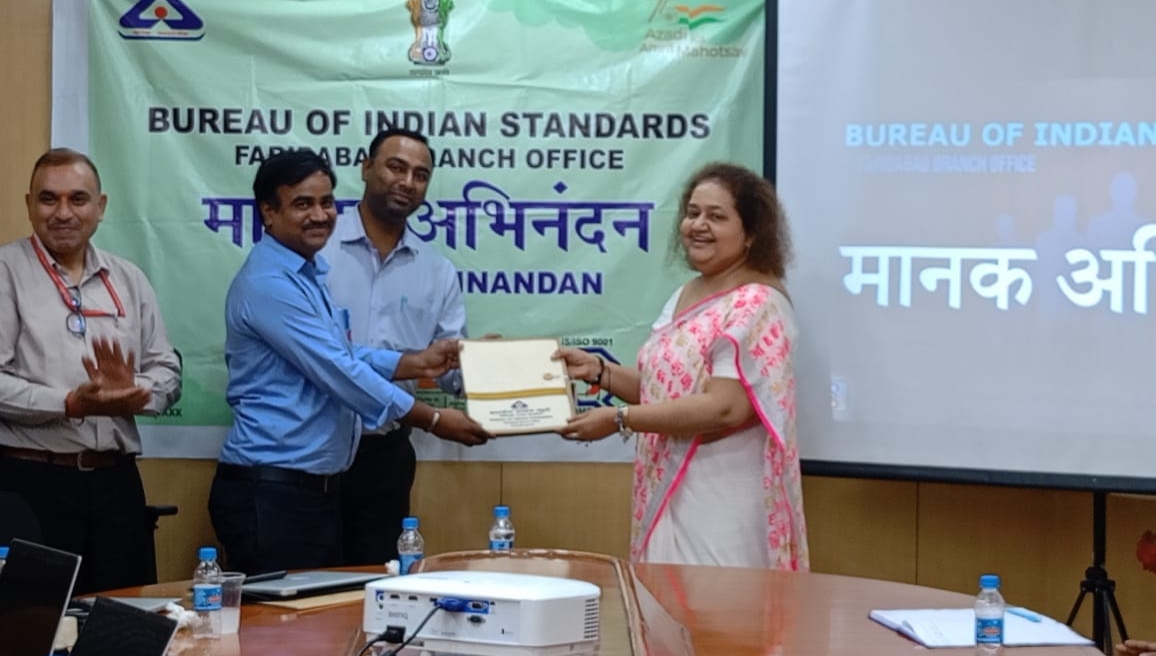
Real sites, real certifications
Our teams work inside factories and plants across India and abroad - inspections, audits and certification milestones spanning BIS, global schemes and the full compliance stack you see on this site.






What our clients say
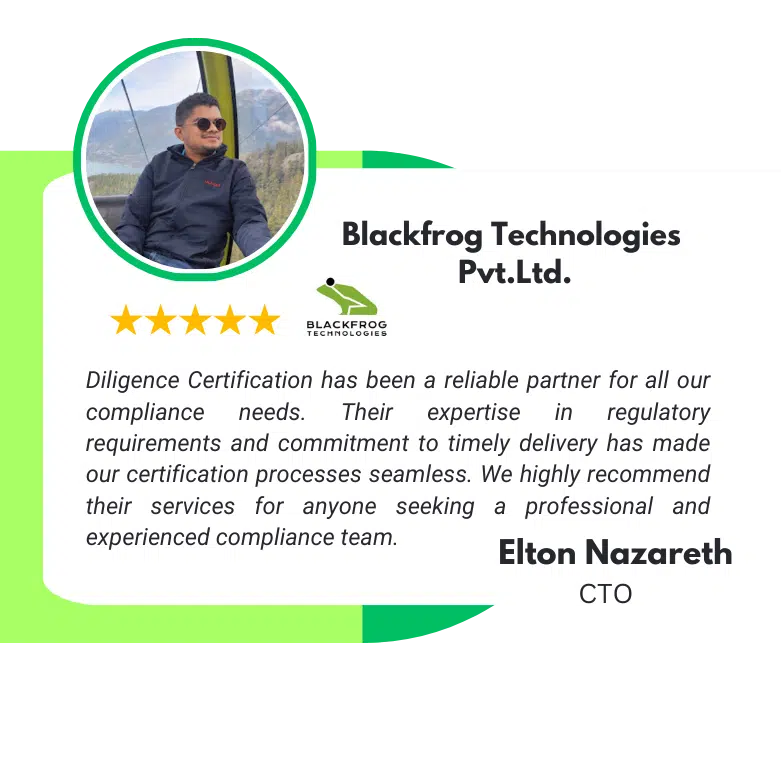
Reviews and feedback from businesses that have worked with Diligence Certifications.









Related BIS & Standards services
BIS Certification
Get your products BIS certified to ensure compliance with Indian standards.
View details →ISI Mark Certification
ISI Mark Certification for your products with expert guidance.
View details →CRS Mark Certification
BIS CRS Registration for electronics & IT products.
View details →Hallmarking
BIS Hallmarking Certification for gold & jewellery.
View details →FMCS Mark Certification
For foreign manufacturers entering the Indian market.
View details →ECO Mark Certification
Showcase your eco-friendly products with ECO Mark.
View details →Ready to get Master Service Agreement?
Talk to our experts for a clear, fixed-scope plan - most clients get a roadmap the same day.