


 BIS Certification
 CDSCO
CDSCO
 CPCB
CPCB
 LMPC
LMPC
 WPC Approval
 Global Approvals
 TEC
TEC
 ARAI
ARAI
 BEE
BEE
 ISO Certification
 DGCA Certification
 NOC For Steel
 APEDA Registration










 Business Registration
 FSSAI Mark Certification










 Legal Services
 Trademark Registration
 Copyright Registration
 Patent Registration
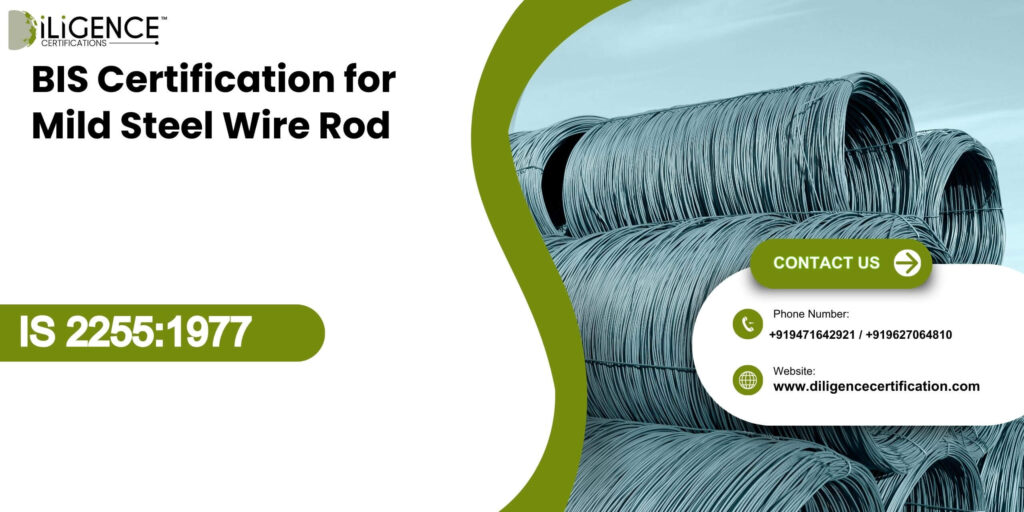
- BIS Certification for IS 2255:1977 ensures compliant mild steel wire rods for cold-heading machine screws in India
- Mandatory for manufacturers supplying to regulated sectors or using wire rods in fastener production
- The testing concentrates on the diameter accuracy, chemical composition, mechanical strength, and surface finish.
- The certification is a great tool for quality assurance, it lowers the rejection rates and makes it easier for OEMs to accept the product.
- It is an enabler for producers to gain access to wider markets through compliance with BIS and industry-specific standards.
Introduction
A Pune-based fastener manufacturer came to us after a long time of being rejected by an automotive client. The reason for these rejections was their mild steel wire rods, which failed the cold-heading performance tests. At first, their material appeared to be okay, but small variations in tensile strength and surface finish resulted in cracked screw heads during the production process. After we checked their samples, it was clear that they did not comply with IS 2255:1977, and the lack of BIS Certification worried OEM approval even more. This is a typical case of producers who depend only on their internal testing. Bureau of Indian Standards
What is IS 2255:1977?
IS 2255:1977 describes a product feature for a certain series of wire rods made from mild steel to be used for making machine screws by cold-heading; the specification was developed by the Bureau of Indian Standards. It stipulates the quality, chemical composition and mechanical properties of the wire rod so that it has the ability of the heavy deformation without fracture and without the damage of the tooling. The standard is a kind of insurance for producers who require stable and excellent quality of the material as the basis for the manufacturing of precision fasteners.

Key points
• Covers mild steel wire rods made specifically for cold-heading applications
• Specifies permissible chemical composition ranges
• Lays down mechanical property requirements such as tensile strength and elongation
• Focuses on dimensional accuracy and clean surface finish. ISI MARK
• Intended to reduce rejections and improve manufacturing reliability
Why is BIS Certification Mandatory
BIS Certification is required as a measure to ascertain that the mild steel wire rods for cold-heading are in compliance with the tough mechanical and surface specifications of IS 2255:1977. By doing so, it safeguards the producers against the occurrence of faulty productions, and at the same time, it provides Original Equipment Manufacturers a trust that the materials are of good quality.
Keypoints
- Ensures consistent mechanical performance during cold-heading
- Prevents defects such as cracked screw heads or tool damage
- Required by many automotive and electrical OEMs for approval
- Provides traceability and uniformity across wire-rod suppliers
- Improves market acceptance for compliant manufacturers
Importance and Benefits of BIS Certification
| Importance | Benefits |
| Confirms compliance with IS 2255:1977 for cold-heading applications | Reduces rejections, cracking, and tool failures during screw production |
| Ensures predictable material quality for OEM acceptance | Strengthens credibility in automotive, electrical, and machinery sectors |
| Provides traceability and accountability for raw material sourcing | Eases approval for tenders and regulated procurement |
| Supports standardisation across the wire-rod industry | Improves production consistency and lowers overall manufacturing cost |
| Protects end-user safety and product reliability | Enhances domestic and export market access |
Step-by-Step Process of BIS Certification

Step1:Documentation
- Collect required technical documents
- Prepare product specifications
- Gather company registration details
- Ensure documents follow BIS format
Step2:Product Testing
- Send samples to a BIS-approved lab
- Conduct safety and quality tests
- Receive test reports
- Confirm compliance with BIS standards
Step3:Application Submission
- Fill out the BIS application form
- Upload all required documents
- Attach valid test reports
- Pay the necessary BIS fees
Step4:Scrutiny and Inspection
- BIS reviews submitted documents
- Authority verifies test results
- Factory/product inspection may occur
- Clarifications requested if needed
Step5:Grant of License
- BIS approves the application
- License number is issued
- Product can carry BIS mark
- Renewal required before expiry
Documents Required for BIS Certification
| Category | Documents Required |
| Business Documents | Business license/registration, ISO certificate, organizational details |
| Manufacturer Details | Factory layout, process flow chart, machinery list, production details |
| Product Documents | Product specifications, component list, user manual, model details |
| Testing Documents | Test report from BIS-recognized lab, sample details, test request form |
| Legal & Compliance | Authorization letter, brand ownership proof, trademark certificate (if any) |
| Import/Foreign Manufacturer (If applicable) | AIR (Authorized Indian Representative) details, contract agreement, overseas manufacturer documents |
Timelines, Costs, Validity & Renewal
- Timelines: Usually from 20 to 30 days, with only 7-15 days for the testing.
- Costs: The cost of the government and the test varies depending on the product. There can be some additional charges though.
- Validity: The validity period is 2 years in most situations.
- Renewal: The renewal is done before the expiration; there should be updated documents/tests; the renewal
Why Choose Diligence Certifications
- Expert team with strong BIS and regulatory knowledge
- Fast, streamlined processing to reduce approval delays
- Accurate documentation and testing coordination
- Transparent guidance with clear communication
- High success rate and complete end-to-end support
Conclusion
BIS Certification of mild steel wire rods as per IS 2255:1977 is not only a regulatory necessity, but also a wise step that leads to stable production, fewer rejections, and a higher acceptance level by OEMs. Those manufacturers that convert their raw material supply from uncertified to BIS-approved sources, in a very short time, experience the positive changes in cold-heading performance and customer trust. As scrutiny increases in automotive, electrical, and hardware segments, compliance has become the main differentiating factor rather than just a formality. Diligence Certifications keeps on offering support to manufacturers in documentation preparation, testing coordination, and non-conformity closing processes that result in approval facilitation.
Frequently Ask Questions
Under what circumstances is BIS certification required for IS 2255:1977?
BIS Certification for IS 2255:1977 is a kind of acknowledgment that the Bureau of Indian Standards gives when a product meets all the standards as per the specifications mentioned in the set standard. In the area, new steel wire rods are those products meant for the cold-head machine screws carrying operations.
Who requires BIS Certification for the given standard?
In case manufacturers of metal wire rods are not involved in fraudulent practices, fasteners producer companies that manufacture products for the automotive, electrical, hardware, and other regulated industries must obtain BIS certification to be standard compliant.
Why is the certification necessary in cold-heading?
The cold-heading operations are very hard on the material and therefore strongly require that it has a strong structure. BIS Certification is the guarantee that one kilogram of wire rod is in line with the predetermined composition, showcases proper ductility, and has such surface finishing that can be used without the fear of cracking or machinery failures.
Is BIS Certification mandatory for wire rods under IS 2255:1977?
The ones that have to get BIS Certification are the manufacturers that supply safety-oriented, dimensionally stable, and material traceability sectors.
What tests are conducted for approval?
The product tests encompass a lot of areas such as metal composition, tensile strength, elongation, hardness, diameter precision, surface inspection, as well as other mechanical properties.
How long is the BIS Certification process?
The certification process duration is usually twenty to thirty days. The top three reasons which influence the length of time for this process includes the time taken to carry out the tests, preparation of documents and the workload at the BIS office.
What documents are necessary for the application?
Among the documents are registered business, production line in the factory, list of machinery in the factory, product specifications, the laboratory test report from a BIS-recognized lab, and the brand or trademark information, if any.
Is the foreign manufacturer allowed to apply for BIS Certification?
A foreign manufacturer can file a BIS Certification application through an Authorized Indian Representative (AIR) if it's in agreement with the rules laid down by BIS.
How long can the license be used?
The BIS license most of the time can be used for two years, and it may be extended if the user submits the updated documents and test certificates of good quality.
In what way can Diligence Certifications be of help to a manufacturer?
With the help of Diligence Certifications, a manufacturer can easily come through the following activities: documentation, laboratory coordination, technical guidance, application process implementation, and non-conformity resolution for faster approval.