 BIS Certification
 CDSCO
CDSCO
 PESO
PESO
 CPCB
CPCB
 LMPC
LMPC
 WPC Approval
 Global Approvals
 TEC
TEC
 ARAI
ARAI
 BEE
BEE
 ISO Certification
 DGCA Certification
 NOC For Steel
 APEDA Registration













 Business Registration
 FSSAI Mark Certification










 (32).jpg)
 Legal Services
 Trademark Registration
 Copyright Registration
 Patent Registration
 By
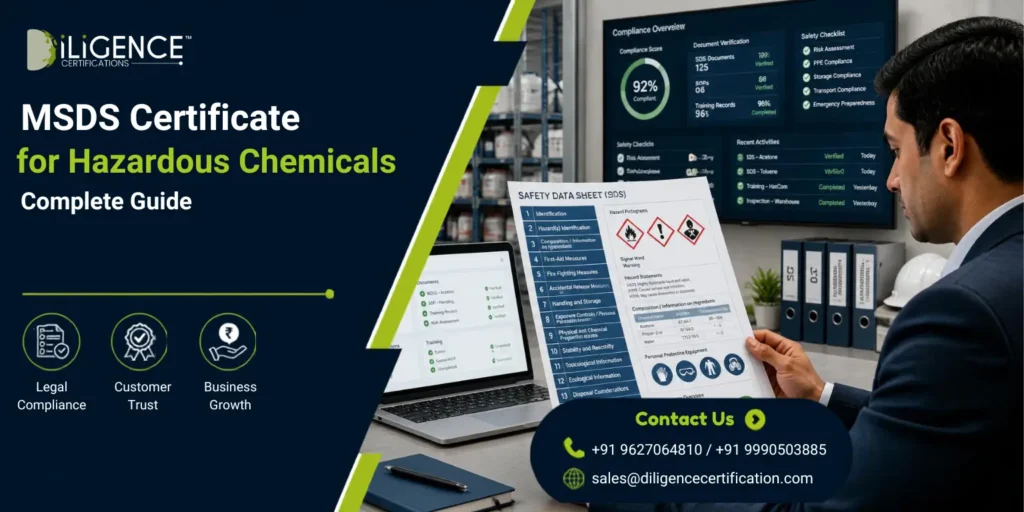
By - The term “MSDS certificate for hazardous chemicals” usually means safety data related to the hazards associated with the chemical, its ingredients, handling measures, emergency procedures and all other safety aspects.
- From a technical point of view, MSDS is normally the abbreviation for Material Safety Data Sheets which are now known as Safety Data Sheets (SDS). This is a safety document rather than a governmental product certificate.
- Manufacturers, importers, exporters and users of Indian chemicals must create the document based on correct product information, hazards classification and destination market requirements.
Introduction
An Indian chemical manufacturer can have all its products in compliance with regulations, proper packaging, an export sale order and be prepared for shipment, but it may still run into difficulty with documentation due to a question asked by the buyer: “Where is the MSDS?”
It happens often with chemical manufacturers, traders and exporters. The customer may ask for it before placing the order, the freight forwarder needs the information for transportation, and the warehouse department will also need it for safe handling.
The misunderstanding may start from the name itself, as many companies believe that the MSDS certificate for hazardous materials is a government certificate obtained through a certain approval process. On the contrary, the MSDS or SDS is rather a document of safety information. It is intended to convey the information about the hazards of the chemical and about its safe use.
According to the Bureau of Indian Standards, the Material Safety Data Sheet is a medium to convey information regarding hazardous properties to users, workers, handlers of the material in transit, governments and other authorities. Moreover, BIS material provides a 16 section format of MSDS.
Thus, for an Indian company, the real question is not whether the MSDS is there. It is rather whether it is accurate, up-to-date, relevant to the specific product and its market.
What Is an MSDS Certificate for Hazardous Chemicals?
MSDS Certification for Hazardous Chemicals typically relates to the documentation that provides information on the hazards associated with a chemical compound or mixture, its composition and the necessary measures for handling it safely.
Traditionally, it was referred to as Material Safety Data Sheet (MSDS), but now a more common term is Safety Data Sheet (SDS).
This is important since an SDS on its own does not represent an authorization or any other kind of license or certificate.
The United Nations’ Globally Harmonized System of Classification and Labelling of Chemicals (GHS) provides international guidance for hazard classification of chemicals, labeling and safety data sheets.
Therefore, it would be better to prepare a good MSDS/SDS based on trustworthy technical data rather than copying one for a similar product available online.
Why Is an MSDS Important for Hazardous Chemicals?
The MSDS explains the nature of the chemical, its handling procedure, and what should be done if an accident occurs.
A warehouse staff member will want to know if a product is flammable, corrosive, poisonous, or reactive. A transport driver will require some hazard information before loading the product. An employee who has to clean up a spill requires instructions on what to do, not just what the product is.
The document can support:
- Hazard identification
- Safe handling and storage
- Worker awareness
- Emergency response
- First-aid decisions
- Fire-fighting precautions
- Spill and accidental-release response
- Personal protective equipment selection
- Waste-disposal planning
- Transport-related hazard communication
- Customer and supplier communication
- Regulatory compliance documentation
The GHS specifically aims to make information about physical hazards and toxicity available to improve protection of human health and the environment during handling, transport and use.
Is an MSDS a Certificate or a Safety Document?
This is one of the most crucial aspects for companies looking for an MSDS certificate for dangerous chemicals.
MSDS/SDS stands for safety data sheet. The phrase “MSDS certificate” is common in commerce but should not necessarily imply a government certificate.
Whether there is a need for another certificate, registration, approval, testing or license depends on the chemical, its use, quantity, the activity and the target market.
For instance, SDS may be among the compliance documents required for export of a certain chemical, but it does not mean that SDS is enough in place of all other requirements for that chemical.
Diligence Certifications has adopted the commercial term MSDS Certificate for their service while the underlying document is the safety data sheet.
What Information Is Included in an MSDS?
A properly structured Safety Data Sheet (SDS) normally contains 16 sections, with each section providing important information about the safe use and handling of hazardous chemicals.
Section 1: Identification
Provides the product name, supplier details, recommended use and emergency contact information.
Section 2: Hazard Identification
Describes chemical hazards, classifications, signal words, hazard statements and safety pictograms.
Section 3: Composition / Information on Ingredients
Provides information about the chemical composition and hazardous ingredients.
Section 4: First-Aid Measures
Explains appropriate first-aid procedures for inhalation, skin, eye or ingestion exposure.
Section 5: Fire-Fighting Measures
Lists suitable extinguishing methods and precautions during a chemical fire.
Section 6: Accidental Release Measures
Provides guidance for controlling, containing and cleaning up chemical spills.
Section 7: Handling and Storage
Explains safe handling practices, storage conditions and precautions.
Section 8: Exposure Controls / Personal Protection
Specifies exposure limits, engineering controls and recommended protective equipment.
Section 9: Physical and Chemical Properties
Covers properties such as appearance, odour, flash point, flammability and solubility.
Section 10: Stability and Reactivity
Describes stability, hazardous reactions, incompatible materials and conditions to avoid.
Section 11: Toxicological Information
Provides information about health effects and routes of exposure.
Section 12: Ecological Information
Covers potential environmental effects and relevant ecological data.
Section 13: Disposal Considerations
Provides guidance on safe disposal of chemicals and contaminated materials.
Section 14: Transport Information
Includes applicable transport classification and identification details.
Section 15: Regulatory Information
Lists relevant safety, health and environmental regulations.
Section 16: Other Information
Includes revision dates, references, abbreviations and additional information.
MSDS vs SDS Is There a Difference?
While both terms refer to the same concept, the latter term SDS is the contemporary terminology used when hazard communication is done using GHS.
MSDS refers to Material Safety Data Sheets, while SDS refers to Safety Data Sheets.
While older documents use the term MSDS, newer ones use the term SDS.
When it comes to an Indian exporter, what really matters is not the term that appears on the top of the document; what really matters is the accuracy of the hazard information contained in the document.
In this case, when a buyer requests an “MSDS certificate,” he or she may actually be requesting an SDS.
Which Chemicals Need an MSDS?
An SDS is particularly relevant where a chemical or mixture presents hazards that need to be communicated to people who manufacture, import, store, transport, supply or use it.
Examples can include:
- Industrial solvents
- Acids and alkalis
- Flammable chemicals
- Toxic substances
- Corrosive chemicals
- Oxidising substances
- Reactive chemicals
- Industrial cleaning chemicals
- Paints and coatings
- Adhesives
- Resins
- Chemical intermediates
- Laboratory chemicals
- Certain pesticides and industrial formulations
However, the exact documentation obligation depends on the jurisdiction, product classification, concentration, intended use and regulatory framework A chemical should not be classified merely from its trade name.
What Are the Requirements for an MSDS Certificate for Hazardous Chemicals?
Preparing an MSDS starts with identifying the product correctly.
A consultant or manufacturer normally needs reliable technical and commercial information such as:
- Product name
- Chemical name
- CAS number, where applicable
- Chemical composition
- Concentration of ingredients
- Product specification
- Physical and chemical properties
- Toxicological information
- Existing test data
- Hazard classification
- Intended use
- Storage conditions
- Handling precautions
- Emergency information
- Transport information
- Manufacturer or supplier details
- Existing regulatory information
The quality of the final document depends heavily on the quality of the underlying data If the composition changes but the SDS is not updated, the document can become unreliable even though the product name remains unchanged.
How Is an MSDS Prepared for Hazardous Chemicals?
An effective preparation method is normally characterized by product identification and assessment.
The manufacturer begins with identifying the components that form the product. They proceed to determine the hazards associated with the ingredients and categorize them.
Information regarding the physical, chemical, toxicity and environmental data follows. Finally, the information is organized into the different sections of the SDS.
The last step involves reviewing the SDS for consistency.
For example, there should be no inconsistencies between the hazard classification in section 2 and the transportation information in section 14. The product composition in section 3 should match the actual formula used in the product. Emergency procedures should also make sense considering the hazards identified.
Role of GHS in Safety Data Sheets
GHS is a globally accepted system of classification and labeling of hazardous chemicals.
This includes hazard communication and classification such as the use of labels and safety data sheets.
GHS is important for companies trading internationally because buyers of chemicals and government authorities from other countries may require hazard communication using classification principles.
However, there are differences in the way the GHS is implemented in different nations. Hence, any business exporting its chemicals must verify the regulations in the foreign nation and cannot just assume that the SDS will be sufficient everywhere.
Indian Standards and Hazardous Chemical Safety
There are standards in India regarding chemical safety and hazardous substances.
The BIS has standards concerning the classification, safety, storage, handling, and transportation of hazardous substances. The published material at the organization notes that the Material Safety Data Sheets form part of the standards activity concerning safety and hazards in the process industry.
The BIS offers a Know Your Standard service whereby companies can look for Indian Standards based on their standard numbers or keywords.
This is important for companies handling hazardous substances because there may be a requirement for an MSDS in addition to other Indian Standards.
MSDS for Chemical Importers and Exporters
For exporters, MSDS could form part of the document package accompanying the shipment.
The overseas buyer could ask for the SDS prior to making the purchase. Even a freight forwarder or logistics firm could require details on the classification of the chemical prior to shipping the consignment.
For instance, take the case of an Indian company which is exporting an industrial solvent.
The commercial invoice represents the transaction while the packing list represents the shipment. The SDS is not part of either of them.
It has a completely different function. Commercial documents represent the transaction, but the SDS represents the properties of the chemical.
Documents Required for MSDS Preparation
The exact documents depend on the chemical and the purpose for which the SDS is being prepared.
Common supporting information may include:
Product Formulation
The formulation or composition is one of the most important inputs because hazard classification can depend on the identity and concentration of ingredients.
Product Specification
A technical specification helps confirm the product’s intended characteristics and composition.
Test Reports
Available laboratory or technical reports may support physical, chemical or toxicological information.
Existing SDS
If the manufacturer already has an SDS from another jurisdiction, it can be used as reference material, subject to technical review.
Manufacturer Details
The legal name, address and contact information of the manufacturer or supplier should be accurate.
Intended Use
Knowing whether the product is intended for industrial, laboratory, commercial or another use helps in preparing appropriate safety information.
Common Mistakes in MSDS Documents
This is probably the most serious mistake
Mimicking SDS from Other Product
There can be two chemicals with similar names yet completely different composition and hazards. Therefore, it is wrong to copy and use SDS without checking its formula first.
Mentioning Outdated Composition
It is necessary to review SDS when there is any change in the composition of the product.
Otherwise, using outdated documents will cause inconsistency between actual composition of the product and the information provided.
Inaccurate Hazard Classification
Hazard classification may be important when preparing labels, instructions and documents for transportation.
Lack of Transport Information
Chemicals that need special consideration during transportation shall be carefully classified.
Misunderstanding MSDS as a General License or Registration
An MSDS/SDS cannot always be used in place of an official government document, license or product registration.
Use of the Same Document to All Countries Without Review
Some countries have their requirements concerning chemical product safety and hazard communication Therefore, the same technical product can be subject to jurisdiction-specific review.
MSDS Certificate for Hazardous Chemicals: Practical Example
Let’s say there is an Indian company producing a solvent-based industrial coating.
The company has a formulation sheet, lab test results and a demand for an export from a client from abroad. The customer needs an MSDS before accepting the delivery.
The company sends a product brochure on two pages It is rejected by the buyer as a brochure does not contain enough information about hazards.
Then the company prepares a correct SDS that contains information about product identification, composition, classification of hazards, first aid measures, firefighting measures, accidental release measures, handling and storage, exposure controls, physical properties, stability and reactivity, toxicological information, disposal and transport.
The distinction is clear: marketing material tells the consumer why he/she needs the product; SDS tells how to deal with the product safely.
MSDS Certificate Cost in India
There is no fixed cost of MSDS certification for hazardous materials.
The cost of professional preparation may be determined by various criteria, including:
- Kind of material
- Number of materials
- Complexity of composition
- Access to technical data
- Presence of test reports
- Number of SDSs needed
- Requirements of the destination country
- Required language
- Need for technical evaluation
- Involvement of additional compliance paperwork
A simple substance with full technical data may demand less effort than a complicated mixture requiring classification and evaluation of the data It is thus important to receive the product-specific quote.
How Long Does MSDS Preparation Take?
The timeline depends primarily on the availability and quality of technical information.
Where the manufacturer provides complete formulation, product specifications and supporting data, preparation can generally proceed more efficiently.
Delays are more likely when:
- Composition information is incomplete
- CAS numbers are unavailable
- Test data is missing
- Product classifications are unclear
- Several formulations are involved
- Destination-market requirements are not identified
A useful approach is to prepare the technical information before starting the documentation exercise.
How to Keep an MSDS Updated
An SDS should not be treated as a document that is prepared once and forgotten.
Review may become necessary when there is:
- A formulation change
- A change in raw materials
- New hazard information
- New toxicological information
- A change in classification
- A change in applicable regulation
- A change in supplier information
- A change in intended use
- A significant change in transport classification
The revision date should also be maintained properly so users can identify the current version and The GHS framework includes revision information within Section 16 of the SDS.
MSDS vs Other Chemical Compliance Documents
It is useful to distinguish an SDS from other documents.
| Document | Main purpose |
| MSDS / SDS | Communicates chemical hazards and safe handling information |
| Test Report | Provides results from specified testing |
| Certificate of Analysis | Confirms analytical or batch-related product characteristics |
| Certificate of Origin | Establishes origin for trade purposes |
| Product Licence | Provides regulatory permission where applicable |
| Transport Document | Supports movement of goods under applicable transport rules |
One document does not automatically replace another For hazardous chemicals, the compliance package should be mapped according to the product, activity and destination.
Why Accurate MSDS Documentation Matters for Exporters
An individual receiving a delivery of chemicals may not accept a shipment due to inadequate safety documentation.
In cases where there is no issue with the product itself, inaccurate SDS can lead to unnecessary complications regarding composition, classification, transportation, or handling.
In terms of exporting, the best practice would be to make sure that all of the following match:
Product formulation → hazard classification → SDS → label → packaging → transport details
When there is a contradiction between the documents stating whether the chemical is hazardous or not, then it can become a problem for both businesses and compliance.
That is the reason why it is better to treat MSDS development as part of product compliance.
How Diligence Certifications Helps With MSDS Certification
Diligence Certifications provides MSDS-related compliance assistance for manufacturers and exporters dealing with hazardous chemicals and products. Its MSDS service covers documentation preparation, submission support and compliance assistance.
Diligence Certifications - MSDS Certificate Service
The practical value of professional assistance is not simply preparing a document. The more important task is making sure that the product information, composition, hazard classification and intended application are properly reflected.
For businesses with several chemical formulations, this becomes particularly relevant. A company may have multiple grades of the same product, different concentrations or different packaging configurations. Each variation should be reviewed rather than assuming that one generic document can cover everything.
Diligence Certifications also provides broader certification and compliance services for Indian and international markets.
Diligence Certifications - Compliance & Certification Services
For businesses dealing with chemical storage, MSDS documentation may also need to be considered alongside storage and hazardous-chemical compliance. Diligence Certifications separately provide guidance on hazardous chemical storage approval.
Conclusion
The term ‘MSDS certificate for hazardous chemicals’ may be defined as the safety document which conveys the hazards and safe handling details of a chemical. This commonly used term of ‘MSDS certificate’ shouldn’t confuse you about its regulatory nature because SDS is not a global replacement for all kinds of licenses, approvals and registrations related to the chemicals.
For Indian manufacturers and exporters, accuracy is the key concern here. The chemical composition, hazards, safe handling and emergency procedures, transport details and regulatory citations must carry the same message.
A properly prepared SDS can help to promote safe handling, improve communication with the staff and customers, chemical logistics process, and compliance documentation.
If your business deals with manufacturing, importing or exporting of the hazardous chemicals, and you have any concerns regarding the adequacy of your existing MSDS, then Diligence Certifications can assist you in reviewing the chemical product documentation and advising on the right MSDS/SDS compliance path.
CTA: Get Your MSDS Certificate Services from Diligence Certifications