



 BIS Certification
 CDSCO
CDSCO
 CPCB
CPCB
 LMPC
LMPC
 WPC Approval
 Global Approvals
 TEC
TEC
 ARAI
ARAI
 BEE
BEE
 ISO Certification
 DGCA Certification
 NOC For Steel
 APEDA Registration











 Business Registration
 FSSAI Mark Certification










 Legal Services
 Trademark Registration
 Copyright Registration
 Patent Registration
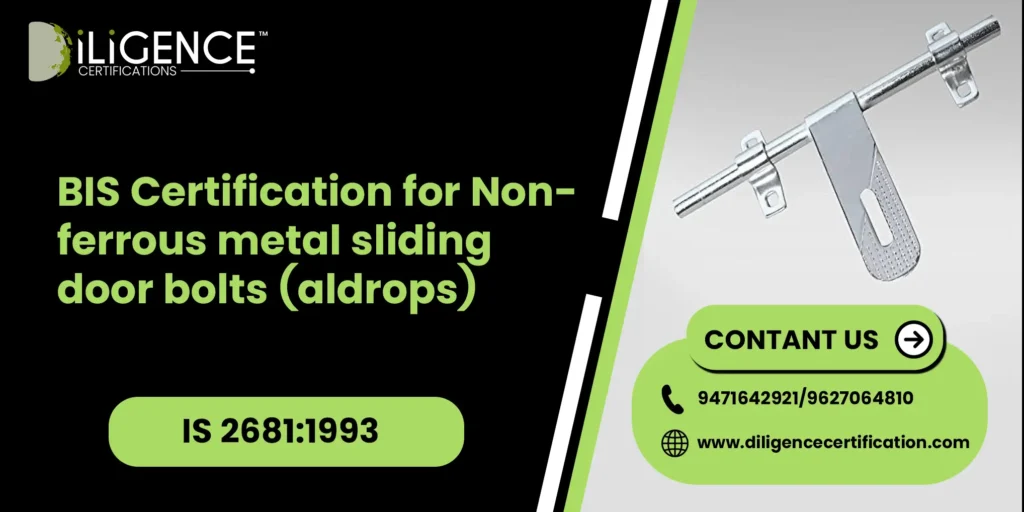
- Indian Mandatory Standard: The equivalent Indian standard that specifies Non-ferrous metal sliding door bolts aldrops is “IS 2681:1993”, defined by the Bureau of Indian Standards.
- Material & Finish Requirements: Specifies the accepted type of non-ferrous material like brass and/or aluminum, along with material and finish requirements.
- Dimensional Accuracy: Outlines the criteria, tolerances, orientation, and fits necessary for functional capabilities.
- Performance and Durability Tests:The strength, durability, and performance of the products against general usage are also carried out.
- ISI Mark Certification: The use of the ISI mark is restricted to those manufacturers who possess BIS licenses and symbolizes quality assurance and acceptance in the market.
Introduction
BIS Certification of non-ferrous metal sliding door bolts Aldrops as per IS 2681:1993 ensures that the hardware items for doors and shutters meet the required Indian Quality and Performance Standards. BIS Certification is provided by the Bureau of Indian Standards, and it is a necessary piece of evidence showing satisfaction of requirements related to quality of material, size, finish, strength, and durability to help the manufacturer deliver sound and long-lasting door fittings to the market in India.
What is IS 2681:1993?
IS 2681:1993 is an Indian Standard specification issued by the Bureau of Indian Standards, which describes the requirements of quality, material, dimensions, finish, and performance of non-ferrous metal sliding door bolts (aldrops) to make them durable and functional and to provide a uniform standard to the products in the country.
Key Points:
- Published by the Bureau of Indian Standards (BIS) as a standardizing document for non-ferrous metal aldrops.
- Detailed specifications of approved materials, including brass or aluminum, as well as workmanship and finish specifications.
- Establishes standard dimensions, tolerances, and fitting accuracy requirements for proper use.
- Contains performance tests, as well as endurance tests, to make the item strong.
- It ensures standardized quality, safety, and reliability of sliding door bolts available in the Indian market.
Why is BIS Certification Mandatory
BIS Certification is an essential factor to guarantee the standard of the product being sold in India as per the standards of quality and performance set by the Bureau of Indian Standards. BIS Certification also guards the consumer from the sale of poor or unsafe products and enables only those manufacturers to mark their product with ISI only after they have been BIS Certified.
Key Reasons:
- Makes sure that products meet standards of quality and safety established by the Bureau of Indian Standards.
- It safeguards the consumers against poor quality, unsafe, and unreliable goods..
- It makes it mandatory for the manufacturer to sell the notified products in India.
- Encourages standardization in production and product quality.
- Permits use of the ISI mark, which increases consumer trust and market acceptance.
Importance and Benefits of BIS Certification
| Importance | Benefits |
| Regulatory Compliance: The certification according to IS: 2681:1993 is provided by the ‘Bureau of Indian Standards (BIS)’ for the regulatory compliance of non-ferrous metal ‘aldrops’ sold in India. | Assured Product Quality: It helps to ensure the standardization of the strength and qualities of the materials in the production of aldrops. |
| Material Quality Control: Describes approved materials like brass or aluminium, as well as surface detail and anti-corrosion qualities. | Consumer Safety & Reliability: Resistant to Failure, Corrosion, or Poor Performance under Normal Usage. |
| Dimensional and Design Accuracy: It determines size and accuracy on which the part should fit and slide properly into its design. | Legal Market Access: Enables companies to lawfully produce and distribute aldrops in India. |
| Performance & Durability Testing: Various products are tested to check power, performance, & durability to withstand daily use. | Elevated Brand Trust: The ISI certification given by the Bureau of Indian Standards translates to increased consumer trust and credibility. |
| ISI Mark Authorization:It is only possible to use the ISI mark after BIS licensing. The ISI mark indicates guaranteed quality and acceptance in the market. Only BIS-licensed companies | Competitive Advantage: Certified products are more accepted in the government, institutional, and retail sectors. |
Step-by-Step Process of BIS Certification
Step1:Documentation
- Collect required technical documents
- Prepare product specifications
- Gather company registration details
- Ensure documents follow BIS format
Step2:Product Testing
- Send samples to a BIS-approved lab
- Conduct safety and quality tests
- Receive test reports
- Confirm compliance with BIS standards
Step3:Application Submission
- Fill out the BIS application form
- Upload all required documents
- Attach valid test reports
- Pay the necessary BIS fees
Step4:Scrutiny and Inspection
- BIS reviews submitted documents
- Authority verifies test results
- Factory/product inspection may occur
- Clarifications requested if needed
Step5:Grant of License
- BIS approves the application
- License number is issued
- Product can carry BIS mark
- Renewal required before expiry
Documents Required for BIS Certification
| Category | Documents Required |
| Business Documents | Business license/registration, ISO certificate, organizational details |
| Manufacturer Details | Factory layout, process flow chart, machinery list, production details |
| Product Documents | Product specifications, component list, user manual, model details |
| Testing Documents | Test report from BIS-recognized lab, sample details, test request form |
| Legal & Compliance | Authorization letter, brand ownership proof, trademark certificate (if any) |
| Import/Foreign Manufacturer (If applicable) | AIR (Authorized Indian Representative) details, contract agreement, overseas manufacturer documents |
Timelines, Costs, Validity & Renewal
- Timelines: Usually from 20 to 30 days, with only 7-15 days for the testing.
- Costs: The cost of the government and the test varies depending on the product. There can be some additional charges though.
- Validity: The validity period is 2 years in most situations.
- Renewal: The renewal is done before the expiration; there should be updated documents/tests; the renewal
Why Choose Diligence Certifications
Diligence Certifications is a professional certification and compliance consultancy to assist manufacturers and importers in acquiring BIS, ISI, CDSCO, and other regulatory approvals smoothly and efficiently. With strong regulatory expertise at Diligence Certifications, one gets end-to-end support right from documentation and testing coordination to liaison with the concerned authorities for faster approvals, reduced compliance risk, and complete adherence to Indian regulatory standards. Their client-oriented approach, combined with transparency and technical expertise, has earned them a reputation as a valuable partner in getting hassle-free certification and market entry in India.
Conclusion
Choosing a right consultant for certification ensures a smooth and efficient procedure for approval. With apt regulatory guidance, from beginning to end, along with adequate documentation and active cooperation from the authority, delay in doing business and consequent risks of non-compliance can easily be averted to experience immediate entry into the market. Appropriateness in consultant servicing ensures clarity, transparency, and full compliance with all existing standards in India, and thus allows a whole focus on development while being completely compliant.