 BIS Certification
 CDSCO
CDSCO
 PESO
PESO
 CPCB
CPCB
 LMPC
LMPC
 WPC Approval
 Global Approvals
 TEC
TEC
 ARAI
ARAI
 BEE
BEE
 ISO Certification
 DGCA Certification
 NOC For Steel
 APEDA Registration























 Business Registration
 FSSAI Mark Certification












 (32).jpg)
 Legal Services
 Trademark Registration
 Copyright Registration
 Patent Registration
 By
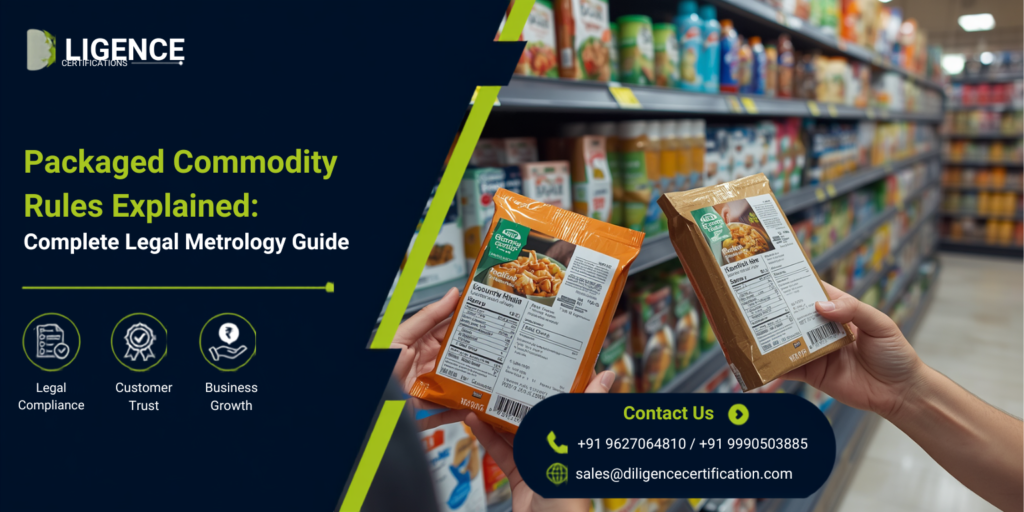
By - Explanation of Packaged Commodity Rules will help businesses know the requirements that they have to fulfill regarding packaging, labeling, and declarations as per India’s Legal Metrology system.
- The manufacturers, importers, and packers need to make sure that the products have accurate information like MRP, net weight, manufacturer’s details, etc.
- Diligence Certifications is here to help businesses comply with Legal Metrology regulations, label their products, and manage registrations.
Introduction:Packaged Commodity Rules Explained
A manufacturer of consumer goods getting an observation for non-compliance during a market inspection. The company had spent much on ensuring product quality, manufacturing processes, and even distribution but had neglected the packing of one particular range of products which required a mandatory declaration under the provisions of Legal Metrology laws.
In this case, the problem wasn’t in the product. The problem was that the declaration made on the package didn’t fully meet the requirements applicable to the pre-packed products sold in India. The company needed to stop distributing this product and correct the packing problem.
This example illustrates the problem that many manufacturers, importers, and brand owners face. While spending enough efforts on the manufacturing and promotion of their products, the business neglects the requirements for the product package. In India, the product package is not just its marketing aspect but also a legal requirement for providing certain information to the consumers.
With Packaged Commodity Rules Explained, businesses can easily understand what requirements should be met prior to selling packaged products in India.
What Are Packaged Commodity Rules
Explanation for Packaged Commodity Rules: The knowledge of the Legal Metrology (Packaged Commodities) Rules, 2011, which lay down the regulations on packaging and marketing of goods in India.
The above rules are formulated under the Legal Metrology Act, 2009, to prevent misleading of the consumers about quantity, price and other details of the product.
A packaged commodity is one, which is packed in absence of the consumer and contains a predetermined amount of the product.
Examples include:
- Food products
- Cosmetics
- Electronics
- Household goods
- Personal care products
- Industrial products
- Consumer goods
The rules apply to businesses involved in manufacturing, importing, packing, or selling such products.
Why Are Packaged Commodity Rules Important
The issue of packaging is very important in consumer decision-making. But organizations need to make sure that the information on the products is correct and legal.
Objectives of Packaged Commodity Rules include:
- Protection of the consumer interest
- Avoidance of misleading of product information
- Transparency in quantity and price
- Standardization of product declaration
- Fair play in the market
Compliance for organizations is not only to avoid being penalized but also building consumer confidence.
Who Needs to Follow Packaged Commodity Rules
The rules apply to businesses involved in the supply chain of pre-packaged goods.
Manufacturers
Manufacturers producing packaged commodities must ensure that products carry all mandatory declarations before sale.
They are responsible for:
- Correct product information
- Accurate quantity declaration
- Proper packaging labels
- Compliance with applicable rules
Importers
Importers bringing packaged products into India must ensure that imported goods comply with Indian labelling requirements.
Imported products often require additional declarations such as:
- Importer name and address
- Country of origin
- Indian consumer information
Packers
Businesses involved in packing products for sale must follow packaging and declaration requirements.
Brand Owners
Companies selling products under their brand name must ensure that packaging information complies with Legal Metrology requirements.
E-commerce Sellers
Online sellers should ensure that listed products comply with applicable packaging declarations before offering them for sale.
Packaged Commodity Rules for Manufacturers
Manufacturers play a primary role in ensuring that packaged products comply with Legal Metrology requirements before reaching the market.
A manufacturer must ensure:
- Correct product information is printed
- Quantity declarations are accurate
- Packaging does not contain misleading claims
- Mandatory declarations are visible
- Measurement units follow approved standards
- Records are maintained properly
A common mistake among manufacturers is treating packaging approval as a marketing activity only. In reality, packaging compliance is part of the product’s legal responsibility.
For example, a food manufacturer may have excellent product quality and certifications, but an incorrect net quantity declaration or missing consumer information can still create regulatory issues.
Packaged Commodity Rules for Importers
Importers have additional responsibilities because products manufactured outside India must meet Indian packaging requirements before being sold.
Imported packages generally need details such as:
- Name and address of importer
- Country of origin
- Product description
- Net quantity
- Maximum Retail Price (MRP)
- Consumer care details
Foreign suppliers may follow international packaging standards, but Indian requirements must be considered separately.
At Diligence Certifications, we often advise importers to review labels before shipment dispatch. Correcting packaging after goods arrive in India can increase logistics costs and delay product launches.
Important Label Requirements Under Packaged Commodity Rules
A compliant label should provide consumers with clear and accurate information.
1. Product Name
The package should clearly mention the common or generic name of the product.
The information should allow consumers to understand what they are purchasing.
2. Net Quantity Declaration
The net quantity should be displayed using standard measurement units.
Examples:
- Weight
- Volume
- Number of units
The declared quantity should match the actual contents of the package.
3. Maximum Retail Price (MRP)
The MRP declaration informs consumers about the maximum amount they should pay for the product.
The displayed MRP should follow applicable Legal Metrology requirements.
4. Manufacturer Details
Packages should mention relevant manufacturer information, including:
- Name
- Address
- Contact details where applicable
5. Importer Details
For imported products, importer details are essential for identifying the responsible business entity in India.
6. Date Information
Depending on product category, packages may require manufacturing, packing, or expiry-related information.
7. Consumer Care Information
Customer support details help consumers contact the responsible business for complaints or queries.
Benefits of Packaged Commodity Rules
Compliance provides advantages beyond avoiding penalties.
Builds Consumer Trust
Transparent product information creates confidence among customers.
Supports Business Growth
Retailers and distributors prefer businesses with proper regulatory documentation.
Reduces Operational Risk
Correct compliance reduces the possibility of product delays and regulatory interruptions.
Improves Brand Reputation
A professionally managed compliance system reflects positively on the business.
Why Choose Diligence Certifications
Understanding Legal Metrology requirements can be challenging, especially for businesses managing multiple products, suppliers, and markets.
Diligence Certifications helps manufacturers, importers, and brand owners manage Packaged Commodity Rules Explained requirements through:
- Legal Metrology consultation
- LMPC registration support
- Product label verification
- Documentation assistance
- Compliance review
- Regulatory guidance
- End-to-end support
Our team helps businesses identify compliance gaps before they become costly problems.
Whether you are launching a new product, importing goods, or updating packaging, professional compliance support can make the process smoother.
Conclusion
Comprehending Packaged Commodity Rules explains how important it is for Indian companies to comply with Legal Metrology rules. It’s not enough to only go through the packaging process. Consumers must have complete information on the amount of the commodity, pricing, manufacture, and other relevant details provided by the pack declaration.
By following these rules since the very start of operations, manufacturers, importers, and brand owners will be able to avoid extra fees, product delays, and other problems associated with legal compliance. An accurate label evaluation before production or import could save you a lot of time and money.
We, at Diligence Certifications, assist our clients in complying with Legal Metrology requirements by reviewing packing declarations and managing LMPC registration support services.
If your company manufactures, imports or trades packaged commodities in India, you should definitely get in touch with Diligence Certifications.
Frequently Asked Questions
What are Packaged Commodity Rules?
Packaged Commodity Rules are Legal Metrology laws that specify the labeling standards of pre-packed goods prior to selling them in India.
Which entities should adhere to Packaged Commodity Rules?
Manufacturers, importers, packers, and brand owners involved in packaging commodities need to abide by these rules.
What kind of information is necessary for packed goods?
Mandatory declarations usually comprise the commodity name, net quantity, MRP, manufacturer/importer details, and customer information.
Are Packaged Commodity Rules applicable to imported goods?
Yes. It is the responsibility of importers to see that the imported packed goods meet Indian Legal Metrology standards.
What is LMPC registration?
LMPC registration is a Legal Metrology registration process which primarily affects importers of packed commodities.
What consequences will there be if packaging is not in accordance with the Legal Metrology Rules?
Notices, fines, seizure, or restrictions can happen for non-compliant products based on their violation.
Is it allowed to change product labels after the product has been registered?
Yes, but new labels should still conform to the Legal Metrology rules.
Why are Packaged Commodity Rules needed?
It is needed for consumer protection through accurate information regarding the quantity, cost, and description of the product.
Does the MSMEs have to follow the Packaged Commodity Rules?
Yes, because it is required for MSMEs who manufacture and sell applicable packaged commodities.
Is it possible to get assistance from Diligence Certifications for Legal Metrology compliance?
Yes, Diligence Certifications assists in LMPC registration, packaging checking, documentations, and Legal Metrology compliance.