BIS Certification
 CDSCO
CDSCO
 PESO
PESO
 CPCB
CPCB
 LMPC
LMPC
 WPC Approval
 Global Approvals
 TEC
TEC
 ARAI
ARAI
 BEE
BEE
 ISO Certification
 DGCA Certification
 NOC For Steel
 APEDA Registration























 Business Registration
 FSSAI Mark Certification












 (32).jpg)
 Legal Services
 Trademark Registration
 Copyright Registration
 Patent Registration
 By
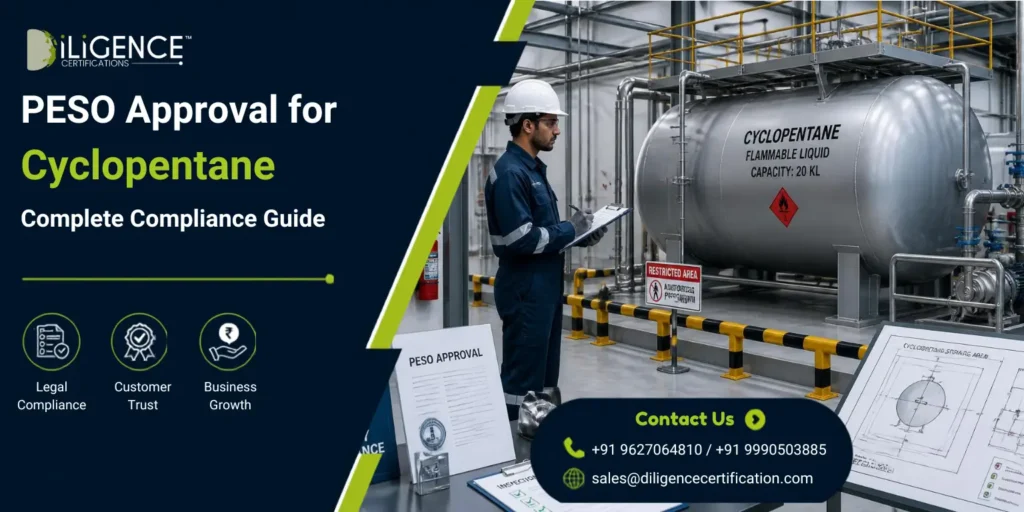
By - PESO Approval for Cyclopentane depends on the storage, handling, transportation, and use of cyclopentane at the proposed premises.
- Due to its nature of being a highly flammable liquid hydrocarbon, storage of cyclopentane may be required to comply with the Petroleum Rules 2002 and other PESO guidelines.
- The Diligence Certifications help businesses in complying with the regulations, documentations, layouts, and PESO approvals.
Introduction
A company that produces polyurethane insulation may simply require that cyclopentane should be stored on the site prior to its use in the production process. But the problem emerges when the project team tries to answer a very basic question - “Do we need PESO approval for cyclopentane storage?”
The answer cannot be found just by reviewing the name of the chemical.
It is necessary to review the storage capacity, type of tank(s), premises, distribution or transfer system, location and other safety issues. Cyclopentane is a highly flammable hydrocarbon and storage of it demands special consideration rather than common chemical storage.
Here comes the significance of PESO Approval for Cyclopentane.
PESO is an acronym for Petroleum and Explosives Safety Organisation. It operates under the Department for Promotion of Industry and Internal Trade and enforces several legislations related to petroleum, explosives, compressed gases and other dangerous materials. The official functions of PESO include licensing storage sites under Petroleum Rules, 2002.
Thus, the right strategy for a company planning cyclopentane storage will be to define the applicable legislation first and then adapt the premises and the application to it.
What Is PESO Approval for Cyclopentane?
PESO stands for Petroleum and Explosives Safety Organisation. PESO Approval for Cyclopentane implies all approvals, licences, inspections and compliance requirements that are applicable to storage or handling of cyclopentane in an industrial facility under the pertinent regulations.
Cyclopentane is a liquid hydrocarbon with very low flash point and thus safety measures including absence of sources of ignition, ventilation, electrical safety, earthing and safe handling and transport are essential.
According to the Petroleum Rules, 2002, the term petroleum encompasses all liquid hydrocarbons as well as mixture comprising liquid hydrocarbons. As per the pertinent petroleum classification, petroleum is classified into Petroleum Class A, Petroleum Class B and Petroleum Class C depending on their flash points. Petroleum Class A refers to petroleum having flash point less than 23°C.
Consequently, the actual storage method of cyclopentane should be considered in relation to the applicable provisions of PESO instead of simply making an assumption that all sites go through the same licensing procedure.
The important point to note for the business is that:
There is no universal “cyclopentane certificate” applicable to all sites. The appropriate PESO approval or license will depend on the actual storage quantity, storage method, premises, handling method and purpose of cyclopentane usage.
Why Is PESO Approval Important for Cyclopentane Storage?
Cyclopentane poses a significant risk of fire and vapour explosion if not handled properly.
A storage tank might be technically fit from a mechanical standpoint, but the regulatory process also takes into account the installation around it. The classification of hazardous area, electrical equipment, fire precautions, safety distances, transfer and emergency control are some things that could impact the decision-making process.
The PESO’s mandate under the Petroleum Rules is to license the storage installations and conduct inspections to ensure compliance with safety standards.
At an industrial level, proper regulatory assessment will help determine:
- What type of storage is proposed?
- What quantity will be stored?
- Is a PESO licence applicable?
- Which Petroleum Rules provisions apply?
- What site layout is required?
- What safety distances must be maintained?
- What fire protection arrangements are necessary?
- What documents should accompany the application?
- What inspections will be required?
- What changes need approval before commissioning?
These questions should be addressed before the storage tank is installed, not after the facility is ready for production.
PESO Approval for Cyclopentane: Applicable Regulatory Framework
The applicable framework should be identified from the actual storage arrangement.
Petroleum Rules, 2002
The Petroleum Rules, 2002 come into play if the material in question falls under the petroleum category and if there is regulated storage/handling of the material.
Official material from PESO shows that petroleum is categorized on the basis of flashpoint and that the storage of petroleum falling under the scope of Petroleum Act, 1934 may need a license.
Static and Mobile Pressure Vessels (Unfired) Rules, 2016
This regulation may be applicable in case when the compressed gas or liquefied gas is stored in the pressure vessels.
The SMPV (U) Rules, 2016 regulates the static and mobile pressure vessels for the compressed gas. The application of this regulation in particular depends on the storage condition of the gas.
This is important as some companies often refer to PESO approval in general terms but do not indicate what regulation applies to their installation.
How Is Cyclopentane Stored in Industrial Facilities?
Cyclopentane storage can vary significantly between facilities.
A business may use:
- Fixed storage tanks
- Above-ground storage systems
- Bulk storage arrangements
- Drums or approved containers
- Transfer pipelines
- Pumps
- Loading and unloading systems
- Day tanks
- Process-connected storage
- Specialised chemical storage arrangements
Regulatory compliance depends on the entire system and not just the storage tank.
For instance, a plant that has cyclopentane delivered in bulk and then transferred to a storage tank through a pipe is different from another plant that holds small amounts in approved containers.
Safety Requirements for Cyclopentane Storage
1. Safe Storage Area
The recommended storage location will have to be chosen based on the buildings around, ignition points, access ways, drainage, processing areas, and emergency preparedness.
The storage system must also conform to the safety-distance requirements stipulated in the concerned regulations.
PESO’s SMPV(U) SOP highlights the significance of safety-distance evaluation through classification of storage facilities based on the properties of the stored goods.
2. Fire Safety
Considering the flammable nature of cyclopentane, a proper fire safety system will be one of the considerations during installation of the facility.
It will depend on the type of installation but will include:
- Fire extinguishers
- Fire hydrants
- Fire water system
- Fire detection system
- Emergency facilities
- Emergency access
- Emergency shutdown system
And other requirements that will be specified by the storage and installation.
3. Electrical Safety
Electrical equipment installed in areas where flammable vapours may be present requires careful assessment.
The design should consider:
- Hazardous-area classification
- Suitable electrical equipment
- Wiring systems
- Switchgear
- Motors
- Lighting
- Earthing
- Bonding
PESO’s current competent-person syllabus specifically includes hazardous-area classification for flammable gases and vapours and explosion-protection concepts.
4. Earthing and Bonding
- The static electrical charge may result in ignition of flammable liquid in transfer.
- Thus, the storage and transfer facilities must have suitable earthing and bonding provisions.
- This becomes especially important while unloading and transferring from tankers.
5. Ventilation
- The vapours of cyclopentane may build up in poorly ventilated areas.
- Thus, the storage and handling areas must be analyzed for natural and mechanical ventilation systems, based on the facility design.
- Low-level vapour accumulation deserves special consideration.
Who May Need PESO Approval for Cyclopentane?
Businesses that use or store cyclopentane may include:
- Polyurethane foam manufacturers
- Insulation manufacturers
- Refrigeration equipment manufacturers
- Chemical manufacturers
- Polymer processing units
- Industrial chemical plants
- Research facilities
- Specialty chemical companies
- Bulk chemical storage facilities
- Manufacturing plants using cyclopentane as a process material
However, just because a company uses cyclopentane, it does not necessarily imply what kind of licensing is needed.
Factors such as amount, mode of storage, packaging, design of installation, and purpose need to be assessed This is the reason why a regulatory review prior to purchase is more effective than post-installation approval.
Documents Required for PESO Approval for Cyclopentane
The documents required for PESO Approval for Cyclopentane depend on the storage quantity, storage method, tank configuration and applicable regulatory category. A typical application may require:
- Company registration, PAN and GST details
- Land ownership or lease documents
- Site plan and detailed storage layout
- Storage tank drawings, capacity and specifications
- Piping and equipment details
- Fire-protection and safety arrangements
- Earthing and hazardous-area classification details
- Cyclopentane SDS and relevant technical documents
- Competent-person documents, where applicable
- NOCs, declarations and prescribed PESO application forms
The documentation must properly depict the installation. Specifically, the tank size, position, pipe layout, safety distances, and fire protection measures indicated in the application must be consistent with the plans and existing site conditions.
Should there be any discrepancies noted by PESO when scrutinizing or inspecting the application, it could ask for clarification or even corrective actions. Hence, the documentation must be verified prior to its submission.
Step-by-Step Process for PESO Approval for Cyclopentane
Step 1: Identify the Storage Configuration
Start by defining exactly how cyclopentane will enter, be stored and leave the facility.
Record:
- Storage quantity
- Tank or container type
- Number of tanks
- Tank capacity
- Transfer method
- Loading and unloading arrangement
- Process connection
- Location of the storage area
This becomes the foundation for the regulatory assessment.
Step 2: Determine the Relevant Rules
The next step involves identifying the rules administered by PESO that are relevant.
Petroleum storage is covered by the Petroleum Rules, 2002. Another set of rules may be relevant in case the physical state or pressure vessel arrangement renders the existing rule inapplicable.
PESO publishes the latest Petroleum Rules and SMPV(U) Rules through its official website
Step 3: Prepare the Site Layout
Prepare an engineering layout showing the proposed storage installation.
The drawing should clearly identify:
- Storage tank
- Tanker unloading area
- Pumps
- Pipelines
- Valves
- Fire protection
- Access routes
- Buildings
- Boundary
- Electrical equipment
- Safety zones
- Emergency arrangements
The layout should be prepared with regulatory requirements in mind.
Step 4: Determine Safety Distances
Safety distances need to be determined prior to construction.
Don’t first determine where the tank will go and then try to make it work with the safety distance requirement after This may cause costly changes to your property.
Step 5: Construct the Storage System
Once you have all of the information regarding your design and regulations, you may proceed with the installation of the storage system based on the approved design.
The construction shall still be consistent with the documents submitted.
Step 6: Fill Out the Application
The correct PESO application should be filled out with correct information.
PESO has forms online for many different types of regulated activities. One of their forms is for storage of compressed gas under SMPV(U).
Step 7: PESO Inspection
Where inspection is applicable, the authority may verify the premises and installation.
The inspection can consider:
- Layout
- Storage tank
- Safety distances
- Fire protection
- Electrical safety
- Earthing
- Transfer systems
- Safety equipment
- Documentation
Step 8: Respond to the Observations
Corrective actions should be undertaken where there are any observations.
For instance, where there are differences between the installed system and the one shown on the drawings, the differences should be responded to, not ignored.
Step 9: Issue the Required License or Approval
Once the requirements of the regulations have been met, the license or approval can be granted.
The firm should then operate in accordance with the approved scope.
PESO Approval for Cyclopentane: Site Inspection
Before inspection, businesses should conduct an internal review.
| Area | What to Check |
| Storage | Tank/container specifications match documents |
| Layout | Physical installation matches approved drawing |
| Safety Distance | Required distances are maintained |
| Fire Safety | Applicable fire protection is available |
| Electrical | Suitable equipment is installed |
| Earthing | Earthing and bonding arrangements are complete |
| Piping | Transfer lines and valves are properly installed |
| Signage | Hazard and safety signs are clearly displayed |
| Emergency | Emergency procedures and access are available |
| Documentation | Technical and regulatory records are organised |
A practical internal inspection can identify issues before the official inspection.
Common Mistakes in Cyclopentane Storage Approval
Considering Cyclopentane as Just Another Chemical
That is perhaps the most serious blunder.
In view of the use of cyclopentane as a feedstock, it is likely that teams will take care of the production criteria but miss out on the storage risk aspect.
Completing the Tank Prior to Regulatory Review
A tank may be mechanically ready but physically unfeasible to locate at the desired site and still meet all safety requirements.
Improper Layout
A diagram drawn purely for engineering purposes may lack some details for regulatory review.
Neglecting the Hazardous Area Requirements
There is a need for caution where electrical devices are installed near flammable liquid storage tanks.
Lack of Proper Documentation
Incomplete documentation, such as tank specifications and safety calculations, can hinder the regulatory approval process.
Misconception of Multiple Use under One PESO License
Each type of license is specific to a task and set of rules.
Timeline, Cost & Validity of PESO Approval for Cyclopentane
There is no responsible universal timeline or cost for PESO Approval for Cyclopentane.
The actual effort can depend on the storage capacity, installation design, site readiness, documentation, inspection requirements and applicable licence category.
| Factor | What Influences It |
| Processing time | Application quality, inspection and regulatory observations |
| Project cost | Engineering, safety systems, equipment and professional support |
| Validity | Depends on the specific licence and applicable rules |
| Additional expense | Site modifications, testing or corrective measures |
PESO’s official FAQ states that licences under the SMPV(U) Rules are granted or renewed for a maximum period of three years ending on 31 March. This should not be assumed to apply automatically to a Petroleum Rules licence for every cyclopentane installation.
The exact validity should therefore be checked against the licence category actually issued.
Benefits of Proper PESO Compliance for Cyclopentane
Regulatory compliance provides more than an approval document.
Better Fire Risk Management
The installation is assessed against applicable safety requirements.
Fewer Project Delays
Regulatory requirements are identified before the facility becomes operational.
Better Corporate Documentation
A properly organised compliance file helps during audits and inspections.
Improved Client Confidence
Large industrial customers often expect suppliers and contractors to demonstrate regulatory preparedness.
Easier Regulatory Maintenance
When drawings, equipment records and licences are organised from the beginning, future amendments become easier to manage.
Why Professional Assistance Matters
A cyclopentane storage project often involves engineering, safety and regulatory teams The challenge is making sure all three are aligned.
Suppose the engineering team designs a tank installation based purely on production requirements. The safety team then identifies hazardous-area concerns, while the compliance team later finds that the layout does not meet a regulatory requirement.
Changing the project at that stage can be expensive A better approach is to conduct the regulatory assessment during the planning stage.
Professional assistance can cover:
- Regulatory applicability assessment
- Storage configuration review
- Document preparation
- Layout review
- Safety requirement assessment
- Application support
- Inspection preparation
- Regulatory query handling
- Amendment assistance
- Post-approval compliance guidance
How Diligence Certifications Can Help
Diligence Certifications can assist businesses in understanding the applicable PESO requirements for hazardous-material storage and related regulatory approvals.
For PESO Approval for Cyclopentane, the support can be structured around the actual installation rather than selling a generic “PESO certificate”.
The process may involve:
- Understanding the proposed activity
- Reviewing the storage arrangement
- Identifying the applicable regulatory route
- Reviewing technical documents
- Assisting with application preparation
- Coordinating regulatory requirements
- Supporting inspection readiness
- Addressing observations
- Providing post-approval compliance guidance
This approach is particularly useful when a company is setting up a new plant and needs to coordinate regulatory requirements with its engineering schedule.
For related regulatory requirements, businesses can also review the broader
Conclusion
Approval for Cyclopentane should be seen as a regulatory and engineering task, and not just a request for a certificate.
Since cyclopentane is a flammable liquid hydrocarbon, the process of storage requires proper attention to the relevant Petroleum Rules, storage capacity, configuration of tanks or containers, safety distances, fire safety, dangerous areas and transportation.
The initial action should always be the determination of the precise regulatory category. After that, the company will be able to arrange the site layout, technical data and safety provision in accordance with the requirement.
PESO is continuously updating its regulations and online system. The latest circulars by PESO include modifications in connection with petroleum, gas cylinder and SMPV(U) process, which only underlines the importance of finding out the current position before making an application.
Should your company plan storing cyclopentane for manufacturing or processing purposes, Diligence Certifications can help determine the appropriate PESO procedure and compliance approach before the installation starts operating.