BIS Certification
 CDSCO
CDSCO
 PESO
PESO
 CPCB
CPCB
 LMPC
LMPC
 WPC Approval
 Global Approvals
 TEC
TEC
 ARAI
ARAI
 BEE
BEE
 ISO Certification
 DGCA Certification
 NOC For Steel
 APEDA Registration























 Business Registration
 FSSAI Mark Certification












 (32).jpg)
 Legal Services
 Trademark Registration
 Copyright Registration
 Patent Registration
 By
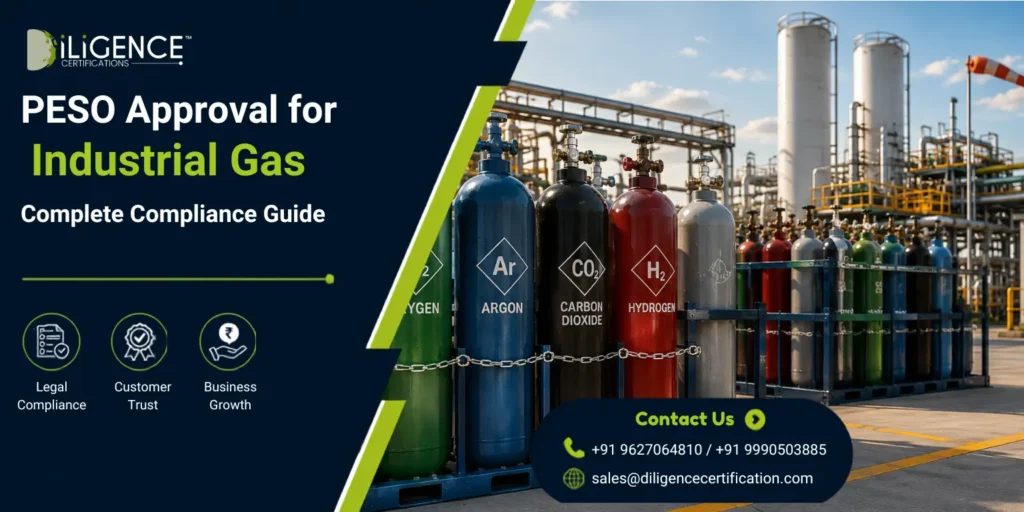
By - PESO Approval of Industrial Gas Cylinders is an obligatory certificate that ensures compliance of industrial gas cylinders with certain standards of safety, design, and quality before manufacturing, importing, and supplying in India.
- In case you are involved in the import, manufacture, and supply of industrial gas cylinders, you must follow the regulations of PESO.
- This guide contains all the information about PESO Approval of Industrial Gas Cylinders procedure, requirements, documents, tests, and regulations in easy-to-understand language.
Introduction
An importer of gas equipment approached us in our compliance department as an import cargo of industrial gas cylinders was detained in an Indian port due to non-compliance with certain important requirements. Although all commercial requirements had been met by the supplier, the process of customs clearance could not begin owing to the non-compliance with one of the important conditions - PESO Approval for Industrial Gas Cylinders.
Until the additional documentation and verification of the compliance requirements was conducted, the cargo lay in the port facing storage costs as well as delivery delays. Moreover, the importer ran the risk of losing a long term client as a result of untimely delivery.
Such cases happen often enough. Industrial gas cylinders are used widely in the following industries: manufacturing, health care, oil and gas, welding, chemical industry, pharmaceutics, and engineering. Being gas vessels which store gases under high pressure, they have strict safety requirements to be complied with prior to manufacture, import, sale, and use of the cylinders in India.
This is where PESO Approval for Industrial Gas Cylinders becomes crucial since it ensures that cylinders comply with relevant technical, safety and quality requirements.
What is PESO Approval for Industrial Gas Cylinders?
PESO Approval for Industrial Gas Cylinders is an approval by the Petroleum and Explosives Safety Organisation (PESO), which is a body functioning under the Department for Promotion of Industry and Internal Trade (DPIIT) in the Government of India.
The purpose of the PESO approval is to ensure that the industrial gas cylinders meet certain standards regarding their design, manufacture, testing, and safety before entering into the Indian market.
Use of industrial gas cylinders is accompanied by the storage of gases such as oxygen, nitrogen, argon, helium, hydrogen, carbon dioxide, and others. Since the gases are stored under pressure, any defect during their manufacture may cause hazards.
Therefore, during their approval, PESO considers various technical specifications, which are:
- Product design
- Material specifications
- Manufacturing quality
- Pressure resistance
- Safety performance
- Inspection procedures
- Quality management systems
The approval process ensures that industrial gas cylinders are capable of performing safely under their intended operating conditions.
Why is PESO Approval Important?
Industrial cylinders are created to hold compressed gases at high pressures. Unlike other containers, industrial gas cylinders have to endure tough operating conditions all through their life cycles.
The absence of appropriate engineering controls and quality controls during cylinder production can lead to structural defects, leaks, and other pressure-related problems.
PESO approval reduces such risks because the PESO-approved cylinders meet certain criteria, including:
- Engineered according to recognised engineering standards.
- Made from approved raw materials.
- Passed obligatory tests for safety.
- Produced under quality control systems.
- Compliance with Indian regulations.
- Regulatory approval is beneficial for importers and suppliers of cylinders since it increases their reputation among industrial clients, government bodies, and procurement agencies, who value compliance.
- Large buyers tend to check statutory compliance before considering new suppliers.
Who Needs PESO Approval for Industrial Gas Cylinders?
Several companies in the industrial gas value chain could require approval based on their operations.
Manufacturers
The manufacturers of industrial gas cylinders for commercial sale need to meet all PESO regulations before the sale of their products.
Importers
The importers of industrial gas cylinders in India need to ensure compliance with applicable regulations prior to their sale.
Suppliers/Distributors
The suppliers/distributors of approved industrial gas cylinders to factories, hospitals, laboratories, and engineering firms need to ensure that the cylinders meet all safety regulations.
Gas Filling Firms
The filling of compressed industrial gases into cylinders needs to be done using cylinders that meet regulatory standards.
Equipment Manufacturers/Suppliers
The manufacturers/suppliers of complete gas systems make use of approved cylinders.
Types of Industrial Gas Cylinders Covered
Depending on their construction, application, and operating pressure, different categories of cylinders may require technical evaluation.
Common examples include:
- Oxygen cylinders
- Nitrogen cylinders
- Hydrogen cylinders
- Helium cylinders
- Argon cylinders
- Carbon dioxide cylinders
- Medical gas cylinders
- Specialty gas cylinders
- High-pressure steel cylinders
- Composite industrial gas cylinders
Each category may be subject to different testing procedures, design standards, and regulatory requirements depending on its intended application.
Industries That Commonly Use Industrial Gas Cylinders
Industrial gas cylinders support a wide range of sectors across India.
Some major industries include:
- Manufacturing
- Oil and gas
- Healthcare
- Pharmaceuticals
- Food processing
- Automotive manufacturing
- Metal fabrication
- Chemical processing
- Research laboratories
- Aerospace and defence
As industrial demand grows, regulatory compliance becomes increasingly important for maintaining uninterrupted operations and ensuring workplace safety.
Eligibility Criteria for PESO Approval for Industrial Gas Cylinders
PESO Approval for Industrial Gas Cylinders requires a demonstration of compliance of the product as well as the manufacturing process to the appropriate safety and technical guidelines. As the cylinders contain gases at very high pressure, all the stages of design, manufacturing, testing, and quality control are reviewed by the authorities before issuing an approval.
Though different cylinders will have their own set of requirements for PESO Approval, generally an organization will have to meet the following criteria:
- The application needs to be filed by a duly registered manufacturer/importer/supplier.
- The design of the industrial gas cylinder should conform to either the Indian Standards or internationally recognized standard approved by PESO.
- There should be adequate infrastructure for manufacturing and testing of the products.
- The company should have quality management and inspection systems.
- The cylinder should be able to successfully complete the safety tests.
- There should be consistency between engineering drawings and technical specifications with respect to the manufactured cylinder
Importers may also need to submit documents relating to the overseas manufacturing facility, product conformity, and inspection reports before approval is granted.
Documents Required for PESO Approval for Industrial Gas Cylinders
Documentation becomes a very important factor during the application process itself. Many application procedures experience delay owing to insufficient documentation.
The basic documents required are:
Business Documents
- Certificate of Incorporation or Registration
- G S T Registration Certificate
- Pan Card
- Factory Licence (in case of manufacture)
- I E C Certificate (Import Export Code) for importers
- Authorisation letter, if any
Technical Documents
- Specification of product
- Engineering drawings
- Calculations
- Specification of material
- Process of manufacturing
- Welding procedure specifications
- Quality assurance manual
Testing Documents
- Hydrostatic pressure test report
- Burst pressure test report
- Material test certificates
- N D T (Non-destructive testing) report
- Inspection report
- Calibration certificate of testing equipment
Compliance Documents
- Applicable Indian standard certificate of compliance
- Approval history, if any
- Catalogue
- Technical brochures
- Factory quality record
- Prior examination of documentation before submission helps in avoiding any query from the regulatory authority.
Step-by-Step PESO Approval Process for Industrial Gas Cylinders
Knowledge about how to obtain an approval helps manufacturers, importers, and suppliers to make a more effective application.
Step 1: Product Evaluation
In this step, the regulations applicable to the cylinder under consideration depending on its design, usage, pressure rating and construction materials are identified.
Technical evaluation is carried out to understand which technical and testing requirements are to be satisfied by the product.
Step 2: Preparation of Technical Files
The manufacturer produces all technical data files that are necessary for the application, such as:
- Drawings
- Technical specifications
- Manufacturing processes
- Quality management systems
- Material certificates
- Test reports
- Complete technical files eliminate any delays during processing.
Step 3: Product Testing
Tests are compulsory in order to verify structural strength and safety characteristics of industrial gas cylinders.
Tests typically performed are:
- Hydrostatic test
- Burst test
- Leak test
- Mechanical strength test
- Material check
- Dimensional measurement
- Visual test
- Only products that satisfy all technical requirements move forward to the next step.
Step 4: Application Submission
Application along with the supporting documents, technical reports, and the required government fees is sent to the PESO.
Filing of the complete details in the first attempt will increase the chances of speedy processing.
Step 5: Technical Assessment
The submitted application, technical data, engineering drawings, and test reports are assessed by PESO.
In case the clarification and further information is required from the applicant, the same should be supplied within the stipulated period.
Step 6: Factory Examination
If the need be, the PESO inspects the manufacturing factory, if applicable, to determine:
- Production capability
- Manufacturing equipment
- Test facilities
- Quality system
- Safety procedures
- Product traceability
- It is done to ascertain that production process meets the approved specifications.
Step 7: Issue of Approval
After satisfying all the technical requirements and assessments, PESO Approval for Industrial Gas Cylinders is issued.
Now the manufacturer/importer can market the product according to the issued approval.
Testing and Inspection Requirements
Testing is an essential requirement since the cylinders work under high pressure in demanding conditions.
Below are the different tests carried out before certification.
Hydrostatic Pressure Test
It checks if the cylinder is able to withstand the required pressure without bursting and leaking.
Burst Pressure Test
This is done by applying pressure to the cylinder beyond its normal level.
Leak Test
Inspections are done to make sure that there is no leakage of gas from the cylinder or any of its parts while working.
Material Test
Tests on the materials are carried out to check their mechanical and chemical requirements.
Weld Test
Approved non-destructive tests are conducted on welds to check the integrity of the welds.
Dimensional Test
Dimensions like wall thickness, neck threads and many others are checked against approved engineering drawings.
Applicable Rules and Standards
PESO Approval for Industrial Gas Cylinders is governed by various statutory provisions and technical standards.
Key regulations include:
- Petroleum Act, 1934
- Petroleum Rules, 2002
- Gas Cylinders Rules, 2016
- Applicable Indian Standards (IS)
- PESO technical guidelines
- Government notifications issued from time to time
Manufacturers and importers should regularly review the latest regulatory updates to ensure ongoing compliance with revised standards.
Common Reasons for Application Rejection
Many approval delays arise from issues that could have been avoided during the preparation stage.
Some common reasons include:
- Incomplete documentation
- Incorrect engineering drawings
- Missing or invalid test reports
- Non-compliance with applicable standards
- Inadequate quality control systems
- Deficiencies observed during factory inspection
- Incorrect material specifications
- Delayed responses to regulatory observations
- Submission of outdated compliance records
Conducting an internal technical review before submitting the application helps identify these issues early and improves the likelihood of first-time approval.
Processing Time for PESO Approval for Industrial Gas Cylinders
The time required to obtain PESO Approval for Industrial Gas Cylinders depends on factors such as the product category, completeness of the application, testing requirements, and whether PESO requests additional technical clarifications.
Applications supported by complete documentation and valid test reports are generally processed more efficiently. Delays usually occur when engineering drawings, material certificates, or inspection reports are incomplete or inconsistent.
To improve processing time, businesses should:
- Verify all technical documents before submission.
- Ensure testing is carried out by recognised laboratories.
- Respond promptly to regulatory observations.
- Keep engineering drawings and specifications updated.
- Maintain complete quality control and inspection records.
Starting the approval process before manufacturing or importing industrial gas cylinders helps prevent shipment delays and supply chain disruptions.
Government Fees for PESO Approval
There is no fixed government fee applicable to every application for PESO Approval for Industrial Gas Cylinders. The applicable fee depends on several factors, including:
- Type of industrial gas cylinder
- Product category
- Number of cylinder models
- Testing requirements
- Inspection requirements
- Applicable statutory charges
Apart from government fees, applicants should also budget for expenses related to laboratory testing, technical documentation, engineering evaluations, factory inspections, and professional consultancy, where required.
Obtaining a project-specific estimate before submitting the application helps businesses plan their compliance costs effectively.
Validity and Renewal of PESO Approval
The validity of PESO Approval for Industrial Gas Cylinders will depend upon the kind of approval that was granted as well as the relevant regulatory provisions.
Getting an approval is just the first step in the compliance process. It is important to continuously manufacture cylinders based on the approved design, materials, and manufacturing procedures.
In case of any change in the product design, the manufacturing location, raw materials, manufacturing procedure, or the quality assurance system, further evaluation or a new approval might be necessary.
It is essential that companies keep track of the validity of their approvals and initiate the process of renewing their approvals in time before the due date.
Benefits of PESO Approval for Industrial Gas Cylinders
PESO Approval for Industrial Gas Cylinders brings many benefits apart from complying with regulatory norms.
1. Compliance with Indian Legalities
Approval assists businesses in ensuring compliance with laws such as Petroleum Act, Petroleum Rules, Gas Cylinders Rules and so forth.
2. Increased Customer Trust
Buyers including industrial organizations, engineering firms, hospitals, gas companies, government bodies and others will prefer to purchase cylinders that have been approved and certified.
3. Ease in Entry into Markets
There are a lot of public sector enterprises, manufacturing companies and international organizations which demand regulatory approvals to bring in suppliers.
4. Enhanced Safety of the Product
As the cylinder undergoes mandatory tests and inspections, it is guaranteed that they will be able to function under high pressure without any risk.
5. Reduced Risks for Businesses
The risks of shipping problems, legal issues, product recall, penalties and so forth get minimized by compliance.
6. Competitive Edge
Approved products create an edge for business organizations while making tenders, registering as suppliers and entering into business deals.
Common Compliance Challenges
Many importers and suppliers underestimate the technical complexity of PESO Approval for Industrial Gas Cylinders. Although the regulatory framework is well established, businesses frequently encounter challenges such as:
- Difficulty interpreting technical standards.
- Delays in obtaining test reports.
- Incomplete engineering documentation.
- Repeated revisions after regulatory observations.
- Lack of familiarity with current compliance requirements.
- Coordination challenges between overseas manufacturers, laboratories, and regulatory authorities.
Addressing these issues early helps businesses reduce approval timelines and avoid unnecessary compliance costs.
Why Choose Diligence Certifications?
PESO Approval for Industrial Gas Cylinders entails technical expertise, understanding of regulations, and comprehensive documentation. Even one missing report or specification could hamper the entire process of approval.
Diligence Certifications offers end to end help in the process of approval, which includes:
- Guidance on applicable PESO regulations.
- Preparation and review of technical documentation.
- Coordination with recognised testing laboratories.
- Support during inspections and regulatory reviews.
- Assistance in responding to technical observations.
- Renewal and ongoing compliance support.
Our team works closely with manufacturers, importers, and suppliers to simplify the approval process while ensuring that applications meet regulatory expectations.
Conclusion
As industries become increasingly dependent on compressed gases in their processes of manufacturing, healthcare, engineering, research, and construction, PESO Approval for Industrial Gas Cylinders becomes a highly important compliance criterion to satisfy. It ensures that the cylinder satisfies all the required safety, quality, and technical parameters before being supplied to the Indian market.
The acquisition of PESO Approval for Industrial Gas Cylinders not only becomes a necessary legal procedure but also an effective means of minimizing operational risks, increasing client trust, and maintaining business continuity.
In case your company is going to manufacture, import, or supply industrial gas cylinders in India, then PESO Approval for Industrial Gas Cylinders must become a part of your compliance agenda.
Need help?
Diligence Certifications provides full assistance with documentation, testing arrangements, and application filing.
Frequently Asked Questions
What is PESO Approval for Industrial Gas Cylinders?
It is a regulatory approval issued by the Petroleum and Explosives Safety Organisation (PESO) to ensure industrial gas cylinders comply with applicable safety, design, and technical standards before manufacture, import, or supply in India.
Who needs PESO Approval for Industrial Gas Cylinders?
Manufacturers, importers, suppliers, distributors, and businesses dealing with industrial gas cylinders may require approval depending on their activities and the applicable regulations.
Which documents are required for the approval process?
Typical documents include business registration certificates, engineering drawings, product specifications, material test certificates, quality manuals, inspection reports, and compliance records.
How long does the approval process take?
The timeline depends on the completeness of the application, testing requirements, inspections, and the complexity of the product.
Is product testing mandatory?
Yes. Industrial gas cylinders generally undergo prescribed safety and performance tests before approval is granted.
Can imported industrial gas cylinders be sold without PESO approval?
No. Imported industrial gas cylinders must comply with applicable Indian regulations and obtain the required approvals before they can be supplied in the Indian market.
What are the common reasons for application rejection?
Common reasons include incomplete documentation, incorrect engineering drawings, missing test reports, non-compliance with standards, and deficiencies identified during inspections.
Can PESO approval be renewed?
Yes. Where renewal is applicable, businesses should apply before expiry and continue complying with all approval conditions.
Why are factory inspections conducted?
Factory inspections verify the manufacturer's production capability, testing facilities, quality management system, and ability to consistently produce compliant industrial gas cylinders.
How can Diligence Certifications help?
Diligence Certifications provides complete assistance with documentation, technical reviews, testing coordination, application filing, regulatory follow-up, and ongoing compliance support.