BIS Certification
 CDSCO
CDSCO
 PESO
PESO
 CPCB
CPCB
 LMPC
LMPC
 WPC Approval
 Global Approvals
 TEC
TEC
 ARAI
ARAI
 BEE
BEE
 ISO Certification
 DGCA Certification
 NOC For Steel
 APEDA Registration























 Business Registration
 FSSAI Mark Certification












 (32).jpg)
 Legal Services
 Trademark Registration
 Copyright Registration
 Patent Registration
 By
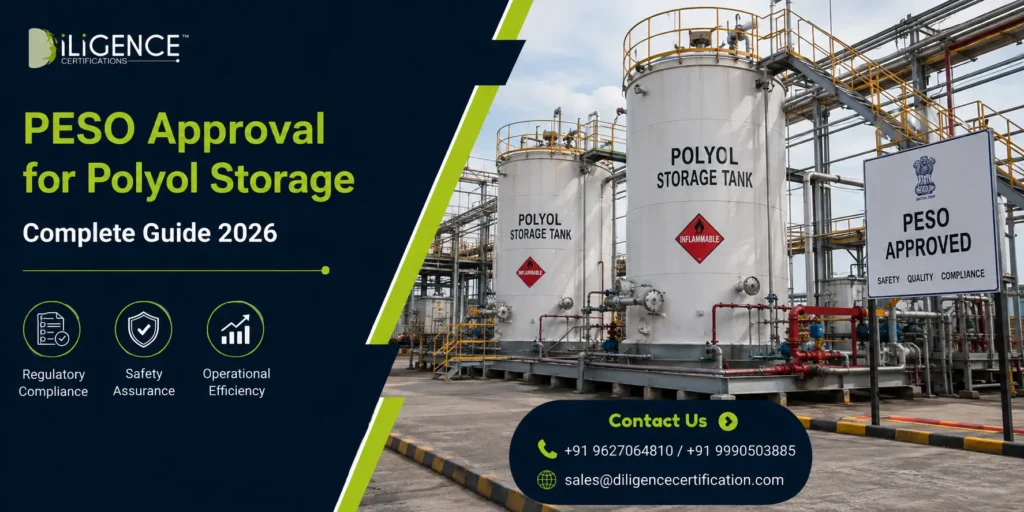
By - PESO Approval for Polyol Storage depends on the chemical’s actual properties, particularly its composition, flash point, quantity and storage configuration.
- Businesses should verify the product classification and applicable PESO rules before installing tanks or applying for a licence.
- Proper SDS review, site-layout planning, safety-distance assessment and documentation can prevent costly compliance delays and redesigns.
Introduction
A polyurethane manufacturer recently planned a new bulk-storage area for polyol at its production facility. The company had already finalised the tank size, foundation and unloading arrangement. The assumption was straightforward: because polyol is an industrial chemical, a standard chemical-storage setup would be sufficient.
During the compliance review, however, one question changed the entire discussion: What exactly is the flash point and composition of the polyol being stored?
That question matters.
Under India’s petroleum regulatory framework, the classification of a material is not decided simply by its commercial name. The Petroleum Act, 1934 defines petroleum in terms of liquid hydrocarbons or inflammable mixtures containing liquid hydrocarbons, while petroleum classes are differentiated by flash point.
This is why a business searching for PESO Approval for Polyol Storage should not begin by downloading a licence form. The first step should be determining whether the particular polyol product and proposed storage arrangement actually fall within PESO’s jurisdiction.
For a plant manager, this is more than a regulatory technicality. Getting the classification wrong can affect tank design, electrical installations, fire protection, site layout, documentation and project timelines.
What Is PESO Approval for Polyol Storage?
PESO Approval for Polyol Storage refers to the regulatory permission, approval or licence that may become applicable when the characteristics and storage conditions of a polyol or polyol-containing material bring the installation within a framework administered by the Petroleum and Explosives Safety Organisation (PESO).
PESO operates under the Department for Promotion of Industry and Internal Trade and administers safety requirements relating to petroleum, explosives, compressed gases and other regulated hazardous installations.
However, there is an important distinction.
Is PESO Approval Mandatory for Every Polyol?
No. Not every polyol automatically requires a PESO licence.
Polyol is a broad family of chemicals. Products can have different formulations, additives, impurities, flash points and physical properties. Some grades may have relatively high flash.Materials with a flash point of 93°C or above are treated differently under the Petroleum Rules framework.
Therefore, a company should not label its product simply as “polyol” and assume that PESO approval is either mandatory or unnecessary.
The correct approach is to assess the specific product.
Why Flash Point Matters in Polyol Storage
Flash point is one of the first technical details a compliance professional will examine.
It represents the lowest temperature at which a material produces vapour capable of producing a momentary flash when ignited. Indian petroleum legislation uses flash point as a basis for classifying petroleum into Classes A, B and C.
For polyol storage, this means the Safety Data Sheet (SDS) becomes an important starting document.
A proper assessment should review:
- Product name and grade
- Chemical composition
- Flash point
- Auto-ignition temperature
- Flammability information
- Vapour characteristics
- Storage temperature
- Recommended storage conditions
- Hazard classification
- Compatibility with tank materials
- Fire-fighting recommendations
The SDS alone does not automatically determine whether a PESO licence is required. But it gives the technical information needed for the initial regulatory assessment.
Which Industries Commonly Store Polyol?
Polyols are widely used in polyurethane-related manufacturing and other industrial applications.
Typical users may include:
Polyurethane Manufacturers
Polyol is a principal raw material in polyurethane production. Plants may receive it in drums, IBCs, tankers or bulk storage tanks.
Foam Manufacturers
Flexible and rigid foam manufacturers often maintain dedicated raw-material storage areas for polyols and related chemicals.
Insulation Manufacturers
Polyurethane insulation systems may involve polyol-based components and other chemicals requiring controlled storage.
Automotive Component Manufacturers
Polyurethane systems are used in various automotive applications, including seating, insulation and other components.
Construction Material Manufacturers
Polyurethane-based products are used in insulation, sealants, coatings and construction-related applications.
Chemical Importers and Distributors
Importers may store polyol in warehouses or bulk tanks before supplying it to downstream manufacturers.
For these businesses, regulatory classification should ideally be completed before finalising the storage infrastructure.
What Determines PESO Applicability for Polyol Storage?
Several factors should be assessed together rather than independently.
1. Product Composition
The first question is what the material actually contains.
A trade name is not enough. Two products sold under similar commercial descriptions may have significantly different compositions and hazard profiles.
2. Flash Point
Flash point is a key parameter under the Petroleum Act and Petroleum Rules framework.
If the product contains petroleum or an inflammable hydrocarbon mixture within the statutory definition, its classification may become relevant to PESO requirements.
3. Storage Quantity
Quantity matters because regulatory requirements can change according to the amount stored and whether storage is bulk or non-bulk.
PESO defines bulk storage as storage in a container or tank having a capacity exceeding 1,000 litres.
4. Storage Method
A drum warehouse is not the same as a fixed bulk tank farm.
The assessment may consider:
- Tank capacity
- Number of tanks
- Tank arrangement
- Filling points
- Unloading points
- Pipelines
- Pumps
- Venting arrangements
- Dyke or containment arrangements
- Fire protection
- Electrical equipment
5. Site Layout
Even when the material is regulated, the physical installation becomes an important part of compliance.
The proposed tank should not be treated as an isolated piece of equipment. Its relationship with buildings, roads, process equipment, boundaries, ignition sources and emergency systems needs to be evaluated.
PESO Rules Relevant to Storage Installations
The Petroleum Rules, 2002 contain provisions governing storage of petroleum requiring a licence. Rule 116 states that petroleum cannot generally be stored except under and in accordance with a licence, subject to specified exceptions.
PESO’s current licensing SOP also identifies different forms and approval pathways depending on the petroleum class, quantity and activity. These include licences for storage in installations and certain categories of bulk or non-bulk storage.
This is where businesses sometimes make a costly mistake.
They identify a product as “chemical”, find a generic chemical-storage checklist and proceed with construction. Later, the regulatory assessment reveals that the product characteristics or storage arrangement require a different approval pathway.
A regulatory assessment before construction is usually far cheaper than modifying a completed tank farm.
PESO Approval for Polyol Storage: Step-by-Step Process
The exact process depends on the classification and licence category. A practical compliance workflow generally looks like this.
Step 1: Collect the Product Information
Start with the latest manufacturer-issued SDS and technical data sheet.
Check the flash point, composition, hazard classification and recommended storage conditions.
If the material is imported, ensure the documentation corresponds to the actual grade being received in India.
Step 2: Determine Regulatory Applicability
The next step is to determine whether the product falls under the Petroleum Act/Petroleum Rules or another regulatory framework.
This is the stage where expert review can save substantial time.
Do not select a PESO licence form simply because the facility is storing a chemical.
Step 3: Assess Storage Quantity
Calculate the maximum quantity that will actually be present at the premises.
Do not consider only normal operating stock.
The assessment should account for the proposed maximum storage capacity, including multiple tanks or storage vessels where relevant.
Step 4: Review the Site
The proposed storage area should be reviewed for:
- Site boundaries
- Nearby buildings
- Process areas
- Roads
- Electrical installations
- Ignition sources
- Tanker movement
- Fire access
- Emergency exits
- Drainage
- Containment
- Fire-fighting facilities
Step 5: Prepare Technical Drawings
Where PESO approval is applicable, technical drawings become a major part of the application.
Depending on the installation, drawings and technical information may cover:
- Site layout
- Tank arrangement
- Storage area
- Filling and unloading points
- Pipelines
- Pumps
- Fire protection
- Safety distances
- Venting
- Electrical arrangements
- Access and emergency provisions
PESO’s own competency syllabus highlights tank design, dykes, fabrication, testing, maintenance, safety devices, plant layouts, hazardous-area classification and fire-water systems as important areas of petroleum safety.
Step 6: Prepare Supporting Documents
Common documentation may include:
- Company incorporation or registration documents
- PAN and GST details
- Land ownership or lease documents
- Site plan
- Layout drawings
- Product SDS
- Technical specifications
- Tank details
- Storage capacity details
- Fire-safety documentation
- NOCs where applicable
- Equipment details
- Safety arrangements
- Application forms
- Fee payment records
The exact list varies according to the approval category.
Step 7: Submit the Application
Where a PESO licence or approval is required, the application is submitted through the applicable PESO process.
PESO provides official guidance, forms, FAQs and licensing information through its website.
Step 8: Respond to Technical Queries
This stage is often underestimated.
A query concerning a tank distance, drawing dimension, product classification or safety arrangement should be answered using technical evidence rather than generic statements.
A revised drawing may be required in some cases.
Step 9: Site Inspection
Where inspection is required, the physical installation should correspond with the approved documents.
That means a change made during construction can become a compliance issue if it materially differs from the submitted plan.
Step 10: Approval and Ongoing Compliance
After satisfactory scrutiny and inspection, the applicable approval or licence can be issued.
Compliance does not end when the document is received. Storage conditions, equipment, safety systems and licence conditions need to remain aligned with the approval.
Documents Required for PESO Approval for Polyol Storage
There is no universal document list that applies to every polyol installation. The exact requirement depends on the regulatory category.
Still, businesses should generally prepare the following information before beginning the application:
| Document | Why It Matters |
| Product SDS | Establishes chemical properties and hazards |
| Technical Data Sheet | Confirms product-specific characteristics |
| Flash Point Data | Important for regulatory classification |
| Storage Quantity | Determines applicability and category |
| Site Layout | Shows overall installation arrangement |
| Tank Drawing | Establishes tank construction and capacity |
| Fire Safety Details | Demonstrates emergency preparedness |
| Land Documents | Establishes site possession |
| Company Documents | Identifies the applicant |
| Equipment Details | Supports technical assessment |
| Piping Layout | Shows transfer arrangement |
| Electrical Details | Supports hazardous-area assessment where applicable |
| NOCs | May be required depending on site and approval |
The most important point is consistency.
The product description in the SDS, application, drawings and technical documents should not contradict one another.
Mistakes Commonly Made by Companies
All Polyols Require PESO
This one may sound quite obvious.The type of product is very general, and regulatory application needs to be verified on the basis of product characteristics and legal framework.
No PESO Required as the Product is Named Polyol
The reverse assumption might be equally misleading.Should any relevant hydrocarbons or petroleum be present in the product, despite its commercial name.
Designing the Tanks before Compliance Assessment
It is a common problem when companies are expanding their facilities.The design team designs tanks first, while compliance comes after.If regulatory requirements are different, the company will incur additional costs for the changes in design.
Using an Old SDS
Chemicals and specifications change with time.Make sure you have SDS that refers specifically to the grade in question.
Neglecting the Maximum Capacity
A facility may need to store 50 tons of chemicals but has tanks with a bigger capacity.The maximum quantity should be assessed.
Considering Fire NOC as Substitution of PESO Compliance
Fire safety and PESO approval do not substitute each other.PESO manages its own legislative framework for regulated petroleum and other hazardous operations.
Consequences for Non-Compliance to Obtain Required PESO Approval
Where a particular installation needs a PESO license and the company goes ahead without getting that approval, the business could experience several problems.
Some of these consequences might include:
- Regulatory action
- Objections during inspection
- Suspension of operations
- Commissioning delays
- Expanding problems
- Modification of installations that do not meet the requirements
- Safety hazard
- Disruption in business
The exact problem will depend on the situation and laws in place.
What you should be doing is easy; simply establish your compliance status before you build or commercially store anything.
How Diligence Certifications Can Help
While it may not be hard for a business looking to store polyols to fill an online form, the challenging part lies in figuring out the relevant regulatory pathway.
Diligence Certifications will help businesses with:
- Assessment of product and regulatory applicability
- Identifying PESO licence category
- Compilation of documents list
- Site and layout assessment
- Coordination of technical drawings
- Preparation of application
- Filing to PESO
- Addressing queries and objections
- Coordination of inspection
- Guidance after approval
The company’s general guidelines on PESO include licence category, documentation, technical drawings, inspections and approval.
If the business deals with several chemicals, then this process becomes extremely helpful since all of them can have different regulatory requirements at the same site.
Polyol Storage: A Pre-Application Checklist
Before submitting the relevant PESO application or installation of the storage, consider the following:
Product
- Do we have the latest SDS?
- Is the product grade specified?
- What is the flash point?
- Is it a hydrocarbon based product?
- What is the hazard class of the material?
Quantity
- What is the maximum storage quantity?
- Is it stored in drums, IBC’s or tanks?
- Is it bulk storage?
- Is there a connection between the tanks?
Site
- Is the intended tank location appropriate?
- Are the safety distances considered?
- Are the ignition sources identified?
- Is there sufficient access for the tankers?
- Is there emergency access?
Safety
- Is the fire protection adequate?
- Is there any containment if necessary?
- Are the electrical installations appropriate for the identified hazard?
- Are the transfer operations controlled?
- Are emergency procedures documented?
Documentation
- Is the SDS information consistent with the application details?
- Do we have tank drawings?
- Do we have current land documents?
- Are all required NOCs provided?
- Are the drawings technically correct?
If you can answer these questions prior to filing an application, the likelihood of avoidable objections is greatly diminished.
Frequently Asked Questions About PESO Approval for Polyol Storage
1. Is PESO approval mandatory for polyol storage in India?
Not necessarily. Applicability depends on the specific polyol’s composition, flash point, quantity, storage arrangement and whether it falls within the petroleum or another PESO-regulated category.
2. What is the first document required to assess polyol storage?
The latest product SDS is one of the most important starting documents. It provides information such as composition, flash point and hazard characteristics needed for the initial assessment.
3. Does a high flash-point polyol automatically need PESO approval?
No. A high flash point does not by itself answer every regulatory question. The complete product characteristics, statutory definition, quantity and storage conditions should be reviewed.
4. Can polyol be stored in bulk tanks?
Yes, polyol can be stored in bulk tanks where the product and process design permit it. However, the tank design, materials, heating requirements, transfer system, safety arrangements and applicable regulations must be assessed before installation.
5. Is Fire NOC enough for polyol storage?
Not automatically. Fire approval and PESO approval serve different regulatory purposes. If the installation falls within PESO’s jurisdiction, the applicable PESO requirement must also be satisfied.
6. What causes delays in PESO applications?
Common causes include incorrect licence selection, inconsistent technical information, incomplete drawings, inadequate safety-distance information, missing documents and differences between the submitted plans and actual site conditions.
7. Can Diligence Certifications help determine whether PESO approval is required?
Yes. A compliance consultant can review the product information, storage quantity, proposed installation and applicable regulatory framework before advising on the appropriate approval route.
8. Does PESO approval need renewal
Where a particular PESO licence has a validity period, renewal or revalidation should be handled according to the conditions and procedure applicable to that licence.
Conclusion
When it comes to PESO Approval for Polyol Storage you should not think that it is the same for everyone.The Polyol Storage product is what matters first: what it is made of its flash point, the hazards it poses and how much of it you will store.
From there the company can figure out if the Petroleum Rules, 2002 or some other rules that PESO is in charge of apply to the Polyol Storage.
For a plant the timing is very important.The company should check with the regulators before they buy the tanks, lay the foundation and finalize the storage plan, not after everything is already built.
If you are planning to store Polyol or add tanks to an existing site or import Polyol or if you are just not sure if you need PESO approval, for your storage plan Diligence Certifications can help you understand what you need to do and show you how to follow the rules before you make a mistake with your design.
Frequently Asked Questions
Does PESO approval need renewal?
Where a particular PESO licence has a validity period, renewal or revalidation should be handled according to the conditions and procedure applicable to that licence.
Can Diligence Certifications help determine whether PESO approval is required?
Yes. A compliance consultant can review the product information, storage quantity, proposed installation and applicable regulatory framework before advising on the appropriate approval route.
What causes delays in PESO applications?
Common causes include incorrect licence selection, inconsistent technical information, incomplete drawings, inadequate safety-distance information, missing documents and differences between the submitted plans and actual site conditions.
Is Fire NOC enough for polyol storage?
Not automatically. Fire approval and PESO approval serve different regulatory purposes. If the installation falls within PESO's jurisdiction, the applicable PESO requirement must also be satisfied.
Can polyol be stored in bulk tanks?
Yes, polyol can be stored in bulk tanks where the product and process design permit it. However, the tank design, materials, heating requirements, transfer system, safety arrangements and applicable regulations must be assessed before installation.
Does a high flash-point polyol automatically need PESO approval?
No. A high flash point does not by itself answer every regulatory question. The complete product characteristics, statutory definition, quantity and storage conditions should be reviewed.
What is the first document required to assess polyol storage?
The latest product SDS is one of the most important starting documents. It provides information such as composition, flash point and hazard characteristics needed for the initial assessment.
Is PESO approval mandatory for polyol storage in India?
Not necessarily. Applicability depends on the specific polyol's composition, flash point, quantity, storage arrangement and whether it falls within the petroleum or another PESO-regulated category.