BIS Certification
 CDSCO
CDSCO
 PESO
PESO
 CPCB
CPCB
 LMPC
LMPC
 WPC Approval
 Global Approvals
 TEC
TEC
 ARAI
ARAI
 BEE
BEE
 ISO Certification
 DGCA Certification
 NOC For Steel
 APEDA Registration























 Business Registration
 FSSAI Mark Certification












 (32).jpg)
 Legal Services
 Trademark Registration
 Copyright Registration
 Patent Registration
 By
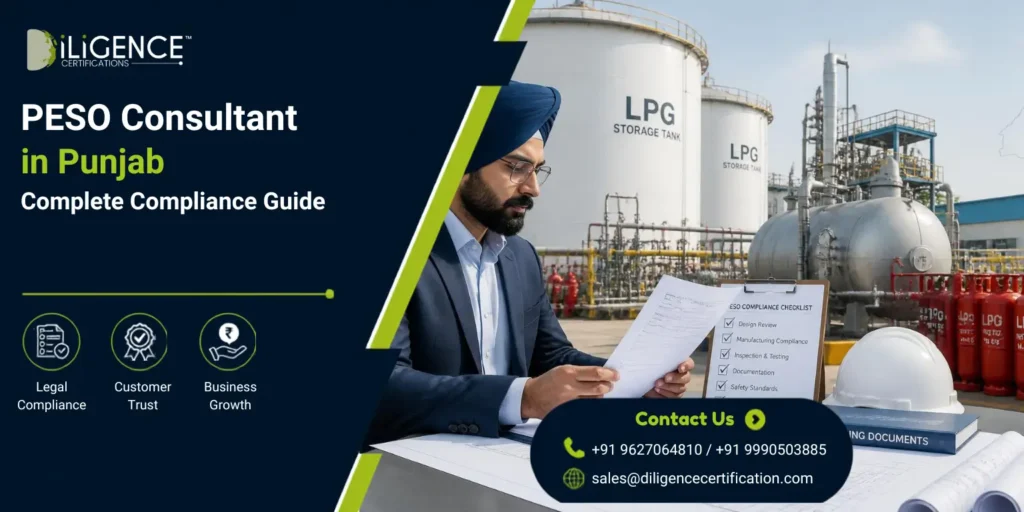
By - PESO Consultant Punjab assists companies to determine the appropriate approval requirement, provide documentation, arrange inspections, and handle licensing requirements.
- PESO certification is generally required by businesses involved in the manufacturing and storage of petroleum, LPG, CNG, gases under pressure, pressure vessels, explosives, and other regulated hazardous materials.
- Diligence Certifications offers full PESO compliance services, including documentation, applications, inspection preparation, renewals, modifications, and objections handling.
Introduction
An industrial organization in Punjab could have a plant equipped with the best technical know-how, a team of experts in engineering and all the necessary machines, but not be able to start work due to some approval that was missed out when planning the project.
This problem occurs especially often for organizations dealing with LPG, petroleum products, compressed gases, gas cylinders, pressure vessels or any other hazardous substances. It is not always a question of inadequate technical knowledge. It is more likely a case of not having compared the activities of the company with the right PESO regulation.
This is where a PESO Consultant in Punjab becomes relevant.
PESO, which stands for Petroleum and Explosives Safety Organisation, is an organisation that functions as per the rules made by the Department for Promotion of Industry and Internal Trade. Regulatory areas under PESO include the areas that are covered under the Explosives Act, Petroleum Act, and its Rules, i.e., petroleum installation, explosives, gas cylinders, and pressure vessels.
In the context of a business in Punjab, the key factor is: compliance with PESO regulations needs to be considered during the design and planning phase rather than the construction phase.
Diligence Certifications helps organisations in understanding their needs and preparing the paperwork to be prepared for regulatory inspection. Its PESO Service offers licensing and compliance assistance in petroleum and explosives related activities.
What Is a PESO Consultant in Punjab?
A PESO Consultant in Punjab refers to a person trained in compliance that will assist a company in understanding and meeting the regulations set by the Petroleum and Explosives Safety Organisation (PESO). PESO regulates safety requirements with regard to petroleum products, LPG, CNG, compressed gases, gas cylinders, pressure vessels and explosives.
Companies that are involved in storing, handling, filling, manufacturing or use of these regulated substances may be required to have particular licences or approvals from the PESO based on their activity and installation.
The consultant helps the company to identify which licence applies, evaluate the layout, technical drawings and safety arrangements, prepares the documents and assists in the process of applying for the license. The consultant can also assist in the process of inspection, addressing objections, licensing and renewal or amendment of a licence.
One should understand that the consultant does not grant the licence. The PESO is the regulatory body which provides the particular licence upon meeting the technical and safety conditions.
For companies operating in Punjab, it can be useful to work with a qualified consultant in order to determine the compliance requirements and save some time on getting the approval.
Why Do Businesses in Punjab Need PESO Compliance?
Punjab has a substantial base of manufacturing, engineering, chemical, pharmaceutical, food-processing, automotive and industrial businesses. Many of these operations use gases, petroleum products, pressure equipment or other materials that can fall within PESO’s regulatory scope.
A facility may therefore encounter PESO requirements during:
- Plant establishment
- Capacity expansion
- Installation of gas storage systems
- LPG storage or handling
- CNG-related operations
- Petroleum storage
- Gas cylinder filling
- Pressure vessel installation
- Import of regulated equipment
- Manufacturing of regulated equipment
- Modification of an existing installation
- Licence renewal or amendment
This difference is important since PESO application is not just a process of filling forms. The facility itself, equipment, storage system, and safety measures could affect the process.
Diligence Certifications says about its methodology that it covers site feasibility, documentations, inspections, and final approval.
A practical example
Suppose we take an example of a manufacturing plant in Punjab setting up a large compressed gas storage facility.
In this case, the project management may start off by concentrating on civil construction and machinery installation and capacity. In later stages, however, during compliance assessment, it becomes obvious that the pressure vessel and the compressed gas storage facility are covered under the Static and Mobile Pressure Vessels (Unfired), 2016, known popularly as SMPV(U) Rules.
At this stage, making any change to the existing configuration is costly But the consultant can help by assessing the need for compliance at the time of the initial design itself This is what distinguishes compliance from correction.
Which Activities May Require PESO Approval in Punjab?
There is no single PESO licence applicable to every business. The requirement depends on the material, equipment, activity, quantity, storage arrangement and applicable rules.
Common areas include petroleum, compressed gases, cylinders, pressure vessels and explosives.
Petroleum Storage and Handling
Entities that store or handle regulated petroleum products may fall under the scope of Petroleum Rules, 2002.
According to PESO, petroleum storage facilities, refineries, petrochemicals and oil/gas plants, petroleum transport and safety equipment fall within the purview of its duties.
Technical design, storage tanks, safety distances, fire fighting provision, etc., could be significant aspects in case of such facilities.
LPG Installations
Businesses related to LPG may include bottling plants, LPG storage facilities, industries and LPG dispensing stations.
Since LPG is very flammable in nature, the storage and handling of LPG may demand the careful consideration of applicable rules and safety aspects at the site.
A consultant may help you identify the appropriate approval route, rather than considering all LPG facilities as similar.
CNG & Compressed Gases
The compliance requirement for compressed gases is different from normal industrial storage.
Rules pertaining to cylinders and compressed gas operations are mentioned in Gas Cylinder Rules, 2016 whereas SMPV(U) Rules, 2016 are for static & mobile pressure vessels carrying compressed gases and cryogenic liquid cargoes.
Pressure Vessels and Cryogenic Storage
The SMPV(U) Rules, 2016 cover storage and transportation of compressed gases in pressure vessels, including cryogenic liquids. PESO’s published SOP explains that the rules cover both static and mobile pressure vessels.
This can become relevant for facilities using gases such as:
- LNG
- LPG
- Liquid carbon dioxide
- Cryogenic gases
- Industrial gases
- Toxic or corrosive gases
- Flammable gases
The technical design of the vessel, fittings, safety relief arrangements and installation can therefore be important parts of the compliance assessment.
Explosives and Fireworks
Companies producing, storing, transporting or in any way handling explosives can find themselves subject to the Explosives Rules, 2008 and its attendant obligations.
Functions of PESO include licensing and approvals in connection with the manufacture, storage, transportation, import/export and other controlled activities involving explosives.
Projects like these usually involve more rigorous planning from the regulatory perspective due to the seriousness of having the wrong site/installation.
Which PESO Rules Are Important for Punjab Businesses?
The applicable rules depend on the specific business activity. Some of the principal regulatory frameworks administered by PESO include:
| Regulatory framework | Typical relevance |
| Petroleum Rules, 2002 | Petroleum storage, handling and related installations |
| Gas Cylinders Rules, 2016 | Gas cylinders and compressed-gas activities |
| SMPV(U) Rules, 2016 | Static/mobile pressure vessels and cryogenic storage |
| Explosives Rules, 2008 | Manufacture, storage and handling of explosives |
| Ammonium Nitrate Rules, 2012 | Regulated ammonium nitrate activities |
| IPESS Rules, 2021 | Petroleum and explosives safety-related equipment and systems |
PESO publishes the applicable rules and regulatory material through its official website Businesses should verify the current applicable provisions rather than relying on an old checklist prepared for a different project.
What Documents Are Usually Required for PESO Approval?
The exact documentation depends on the approval category. However, a typical application may require a combination of corporate, technical, site and safety documents.
Common documents can include:
- Company incorporation or registration documents
- PAN and GST details where applicable
- Ownership or lease documents
- Site and location information
- Plant layout
- Engineering drawings
- Equipment specifications
- Storage tank or pressure vessel details
- Gas or petroleum product details
- Safety arrangements
- Fire protection details
- Test certificates
- Manufacturer documents
- Inspection reports where applicable
- Previous licence or approval details
- Undertakings and declarations
- Application forms prescribed under the relevant rules
The documents repository of PESO serves as an example that the type of documentation depends on the applicable legislation. For instance, Form-C of the Gas Cylinder Rules 2016 is used for making an application for licensing in relation to the filling or storage of compressed gas in cylinders. There are also forms related to petroleum for activities like importation and storage of petroleum.
This is among the reasons why organizations should not simply download a general list of documents.
What Is the PESO Approval Process in Punjab?
Although the exact procedure varies by licence category, the process can generally be understood through several stages.
Requirement Assessment
The initial step is to determine precisely what the business is about.
The consultant should check the nature of the materials, the storage capability, the machinery, the process, the proposed site, and the intended operation.
This helps avoid the typical problem of picking a licence first and then fitting the business to that licence.
Technical and Site Assessment
An assessment of the proposed site and technical arrangement against the relevant requirements is conducted.
It may involve assessing:
Site layout
- Storage layout
- Machinery placement
- Safety distances
- Access
- Fire protection
- Electrical and safety systems
- Pressure equipment
- Product properties
For a new venture, this step is especially useful since design corrections will usually be simpler at this point than afterwards.
Documentation and Licensing
Upon identification of the requirement, the necessary documentation is prepared by the regulator.
The application is then made using the PESO licensing procedure.
Inspection and Queries
Inspection and queries may come from regulatory authorities with respect to technical documents, drawings, or site arrangements.
The consultant can manage this process for the applicant to ensure consistency in all aspects.
Inspection
If inspection is applicable, the plant must be ready before it takes place.
The physical installation must match the drawings and documents submitted.
Licensing/Approvals
Once the required regulatory procedures are completed, the relevant PESO approval or license will be granted.
This is not always the end of the process, since changes in the installation, ownership, etc. could necessitate further actions.
How a PESO Consultant Helps During Inspection
Inspection is frequently where such discrepancies become apparent.
For instance, there might be a particular position marked in the drawings, but the equipment installed at the site is elsewhere. There may have been changes made to the safety arrangements while constructing the site, which may not have been updated in the submitted documents.
Such discrepancies cause unnecessary objections.
A PESO Consultant from Punjab may be able to assist in pre-inspection scrutiny of the application documents, site layout, equipment, safety arrangements, and related documents.
It is not intended to guess what the inspector has to say.
The purpose is to ensure that the applicant has complied with the requirements concerning the facilities. The Diligence Certifications specifically says that their PESO services include inspection preparations, objection resolution, amendment, and renewals.
What Happens If PESO Requirements Are Ignored?
Operating a regulated installation without the required approval can expose a business to regulatory and operational risk.
The consequences depend on the activity and circumstances, but may include:
- Regulatory objections
- Delayed commissioning
- Suspension of operations
- Licence-related action
- Additional compliance expenditure
- Difficulty during inspections
- Business disruption
- Safety risks
- Reputational damage
PESO’s annual reporting also demonstrates that enforcement actions are not merely theoretical. Its 2024-25 annual report records cancellations, suspensions, revocations and show-cause notices across the Explosives Rules, Gas Cylinder Rules, SMPV(U) Rules and Petroleum Rules.
For a business, this reinforces an important point: obtaining approval is only one part of compliance. Maintaining the conditions under which the approval was granted matters as well.
How Much Does PESO Consultancy Cost in Punjab?
There is no sensible single consultancy price for every PESO project.
The cost depends on factors such as:
- Type of approval
- Nature of material
- Quantity and storage capacity
- Number of equipment items
- Site complexity
- Technical documentation
- Inspection requirements
- Existing compliance status
- Renewal or fresh application
- Amendments required
- Whether drawings need technical revision
Government fees and professional consultancy charges should also be considered separately.
A company asking for a quote should therefore provide sufficient technical information first. A responsible consultant should understand the project before presenting a commercial proposal.
How Long Does PESO Approval Take?
The timeframe varies according to the approval category, documentation quality, technical complexity, inspection requirements and regulatory queries and There is no universal timeline that can accurately be promised for every application.
In practice, incomplete documentation or discrepancies between drawings and the actual facility can add unnecessary delays.
For this reason, businesses should start the compliance process during project planning rather than waiting until the plant is ready for commissioning.
Common Mistakes Businesses Make With PESO Applications
Choosing the Licence Before Understanding the Activity
The first question should be, “What does this facility actually do?”
The appropriate regulatory route should follow from the answer.
Use of Outdated Documents
Regulatory rules are subject to change. The PESO continues to release rules, amendments, SOPs and other regulatory documents. For instance, PESO releases the SMPV(U) Rules, 2016 and the relevant SOP through their website.
Considering Drawings Only As Formalities
Technical drawings can turn out to be a significant factor for regulatory assessment.
In case the drawings do not reflect properly on the existing or proposed installation, it would make defending the application quite challenging.
Starting Compliance After Installation
It is certainly the costliest mistake.
Post-installation relocation of equipment, changes in storage or safety systems can impact the budget and time schedule of the project.
Neglecting Renewals and Amendments
The licence cannot be considered a one-time document which is needed only at the time of expiry.
Any modification in capacity, equipment, owner, facility arrangement or business activity is required to undergo regulatory review.
Why Choose Diligence Certifications for PESO Compliance in Punjab?
Diligence Certifications approaches PESO work as a compliance project rather than simply an application submission.
Its published PESO service information covers requirement assessment, documentation, inspection facilitation, objection handling, renewal and amendment support.
For businesses in Punjab, this can be useful when several departments are involved in a project and the management team needs one compliance partner to coordinate the PESO portion.
The broader Diligence Certifications service portfolio also includes BIS, CDSCO, CPCB, EPR and other regulatory services.
Conclusion
Compliance with PESO regulations should not be addressed by a company when it is too late and the plant construction, machinery installation has already taken place.
In case if a company operates with petroleum products, LPG, CNG, compressed gas, pressure vessels or explosives, the proper regulation process should be taken into consideration along with engineering, procurement and project development.
The competent PESO consultant in Punjab can assist in connecting these two aspects - the objectives of the company and requirements of safety regulations.
Diligence Certifications assists businesses with PESO requirement assessment, documentation, applications submission, preparation to inspections, objections handling, renewals and amendments. The services offered by Diligence Certifications are designed to offer comprehensive support instead of application only.
If you are operating with a plant in Punjab that is going to be planned, developed or started, it is preferable to assess the PESO requirement prior to the stage when any changes will be costly. Please contact Diligence Certifications for the PESO requirement assessment specific to your project.
Frequently Asked Questions
What is a PESO Consultant in Punjab?
A PESO Consultant in Punjab helps businesses understand PESO requirements, prepare documents, apply for approvals and manage inspection or compliance-related processes.
Who needs PESO approval in Punjab?
Businesses handling petroleum products, LPG, CNG, compressed gases, gas cylinders, pressure vessels or explosives may require PESO approval depending on their activities.
What documents are required for PESO approval?
Documents may include site layouts, technical drawings, equipment details, ownership documents, safety arrangements and other records required under the applicable rules.
How does a PESO Consultant in Punjab help with licensing?
A consultant identifies the applicable licence, prepares documentation, assists with submission and supports the business during inspection, queries and objections.
How long does PESO approval take in Punjab?
The timeline depends on the licence category, documentation, technical requirements, inspection and regulatory queries. There is no fixed timeline for every project.
What is the cost of PESO consultancy in Punjab?
Consultancy costs vary based on the type of approval, project complexity, equipment, documentation and inspection requirements.
Is PESO approval required for LPG storage?
LPG storage and handling can require PESO approval depending on the quantity, installation and applicable regulatory requirements.
Is PESO approval required for pressure vessels?
Certain pressure vessels used for storing or transporting compressed gases and cryogenic liquids are regulated under the applicable PESO requirements.
Can a PESO licence be renewed or amended?
Yes. Applicable PESO licences can be renewed or amended when required, subject to the relevant rules and regulatory procedure.
How can I choose the right PESO Consultant in Punjab?
Choose a consultant with experience in your specific PESO category and the ability to support documentation, technical review, inspection and post-approval compliance.