 BIS Certification
 CDSCO
CDSCO
 PESO
PESO
 CPCB
CPCB
 LMPC
LMPC
 WPC Approval
 Global Approvals
 TEC
TEC
 ARAI
ARAI
 BEE
BEE
 ISO Certification
 DGCA Certification
 NOC For Steel
 APEDA Registration

















 Business Registration
 FSSAI Mark Certification












 (32).jpg)
 Legal Services
 Trademark Registration
 Copyright Registration
 Patent Registration
 By
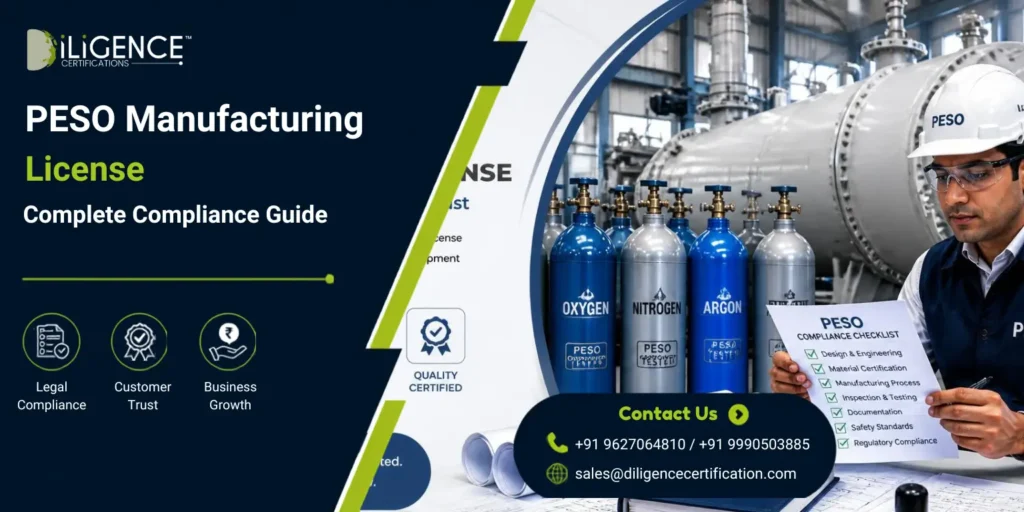
By - PESO Manufacturing License is a mandatory approval required for businesses involved in manufacturing petroleum products, explosives, gas cylinders, pressure vessels, and other regulated hazardous materials in India.
- The license ensures that manufacturing facilities follow safety standards, approved designs, and operational requirements prescribed by the Petroleum and Explosives Safety Organisation (PESO).
- Businesses must submit technical documents, safety plans, factory details, and compliance records before receiving PESO approval for manufacturing activities.
Introduction
Some months back, a company intending to increase its production capacity for industrial gas cylinders contacted us at Diligence Certifications seeking advice on the regulatory procedure. The company had already invested money in buying land, machinery, and production infrastructure, but could not start production due to lack of PESO approval.
From our analysis, it was established that the manufacturing unit needed a PESO approval prior to commencing any commercial production. There was a need for evaluation of the plant layout, safety provisions, technical drawings, and manufacturing process.
This problem is typical of companies trying to venture into regulated industries. Most companies tend to focus on installation of machinery and manufacturing process, yet they overlook the issue of necessary safety approvals prior to production.
A PESO Manufacturing License is a statutory document indicating that the products manufactured fall under the category of petroleum products, explosives, compressed gases, and others. This is evidence that the company has complied with safety regulations.
At Diligence Certifications, we assist businesses comply with PESO regulations.
What is a PESO Manufacturing LiceWhat is PESO Manufacturing License?
PESO Manufacturing License is a legal clearance granted by the Petroleum and Explosives Safety Organisation (PESO), a regulatory body under the Government of India, for manufacturers of products which fall under safety-related categories.
It shows that the manufacturing unit has gone through safety-related evaluations regarding technical, infrastructural, and regulatory requirements before beginning its operations.
The Petroleum and Explosives Safety Organisation (PESO) regulates the manufacture, storage, transport, handling, and usage of the following products which involve safety hazards like:
- Explosives
- Petroleum-based products
- Gas cylinders
- Compressed gases
- Pressure vessels
- Cryogenic storage systems
- Other hazardous materials and systems
The manufacturers of the above products have to ensure that their plant layout, manufacturing process, machinery, testing setup, safety measures, and process operations comply with the requirements of PESO.
A PESO Manufacturing License is not just a permit to manufacture the products but a safety clearance certificate, showing the concern of the company for regulatory compliance, risk management, and protection of workers and environment.
Why is PESO Manufacturing License Required?
Industries dealing with hazardous products involve higher safety risks compared to general manufacturing activities.
The manufacturing process may involve:
- High-pressure systems
- Flammable materials
- Explosive substances
- Hazardous chemicals
- Special storage requirements
Due to these risks, regulatory authorities require businesses to demonstrate that their facilities are designed and operated safely.
Ensures Legal Manufacturing Operations
- Manufacturing regulated products without proper approval can result in legal action, operational restrictions, and penalties.
- A valid PESO Manufacturing License allows businesses to conduct manufacturing activities according to approved safety conditions.
Confirms Facility Safety Standards
Before granting approval, PESO reviews various aspects of the facility, including:
- Plant layout
- Safety equipment
- Manufacturing process
- Storage arrangements
- Emergency response systems
This ensures that the manufacturing unit follows appropriate safety practices.
Supports Business Expansion
- Many industrial buyers and project developers prefer working with manufacturers who have required regulatory approvals.
- A valid PESO license improves business credibility and supports participation in regulated supply chains.
Reduces Operational Risks
- Proper licensing helps businesses identify safety gaps before production begins.
- This proactive approach reduces the possibility of accidents, compliance failures, and business interruptions.
Which Industries Require PESO Manufacturing License?
The requirement depends on the product category and manufacturing activity.
Some major industries requiring PESO approval include:
Explosives Manufacturing Units
Manufacturers producing explosives, fireworks, and related materials require PESO approval before starting operations.
The approval process focuses on:
- Manufacturing premises
- Storage facilities
- Safety distances
- Handling procedures
- Emergency arrangements
Explosive manufacturing requires strict controls because even minor safety failures can create significant risks.
Gas Cylinder Manufacturing Units
Companies manufacturing LPG cylinders, industrial gas cylinders, and medical gas cylinders generally require PESO approval.
The evaluation may include:
- Cylinder design
- Manufacturing process
- Testing facilities
- Quality control systems
- Inspection procedures
Manufacturers must demonstrate that their cylinders can safely withstand operational conditions.
Pressure Vessel Manufacturing Facilities
Pressure vessels used for storing compressed gases or hazardous substances require careful technical evaluation.
PESO may review:
- Design specifications
- Material selection
- Welding procedures
- Testing methods
- Safety devices
Petroleum Equipment Manufacturers
Manufacturers producing petroleum handling equipment may require PESO approval depending on the product and application.
Examples include:
- Storage equipment
- Dispensing systems
- Petroleum containers
- Safety-related components
Cryogenic Equipment Manufacturers
Cryogenic equipment used for storing gases at extremely low temperatures may also fall under PESO regulations.
Manufacturers need to ensure:
- Proper insulation systems
- Pressure control mechanisms
- Safety features
- Approved manufacturing methods
Difference Between Normal Manufacturing Approval and PESO Manufacturing License
Many businesses confuse factory registration with PESO approval.
A general manufacturing setup approval does not automatically allow production of hazardous or regulated products.
| Normal Manufacturing Approval | PESO Manufacturing License |
| Covers general factory operations | Covers safety-regulated products |
| Focuses on industrial permissions | Focuses on hazardous material safety |
| Applicable to regular manufacturing | Required for PESO-controlled products |
| May involve local authorities | Issued under PESO regulations |
For regulated industries, businesses need both general business approvals and specific safety permissions.
Role of PESO in Manufacturing Safety
The Petroleum and Explosives Safety Organisation functions under the Government of India and plays an important role in regulating hazardous material safety.
PESO ensures that industries involved in manufacturing and handling dangerous substances follow established safety standards.
Its responsibilities include:
- Approving manufacturing facilities
- Inspecting safety arrangements
- Evaluating technical documents
- Monitoring compliance conditions
- Issuing relevant licenses
Businesses can refer to official regulatory information through the PESO website:
Eligibility Requirements for PESO Manufacturing License
Before applying for a PESO Manufacturing License, businesses must ensure that their manufacturing facility meets the required technical and safety conditions.
PESO approval is not based only on company registration. The authority evaluates whether the complete manufacturing setup is suitable for handling regulated products.
Key eligibility factors include:
- Appropriate manufacturing premises
- Approved plant layout
- Qualified technical personnel
- Suitable safety arrangements
- Required testing facilities
- Compliance with applicable PESO rules
The exact requirements depend on the product category being manufactured.
For example, an explosive manufacturing unit and a gas cylinder manufacturing facility will have different safety requirements and approval conditions.
PESO Manufacturing License Process in India
The PESO Manufacturing License process involves technical evaluation, document submission, safety verification, and approval from the concerned PESO authority.
A properly planned application reduces delays and avoids repeated clarification requests.
Step 1: Identify Applicable PESO Approval Category
The first step is understanding which PESO approval applies to the manufacturing activity.
Businesses should evaluate:
- Product type
- Manufacturing process
- Raw materials used
- Storage requirements
- Production capacity
- Applicable safety rules
Incorrect classification is one of the common reasons applications require additional review.
A professional compliance assessment before filing helps determine the correct licensing requirement.
Step 2: Prepare Manufacturing Facility Layout
Facility planning is an important part of PESO evaluation.
The layout generally includes details related to:
- Production areas
- Storage locations
- Safety zones
- Equipment placement
- Emergency exits
- Fire protection systems
- PESO reviews whether the proposed setup provides adequate safety arrangements for the manufacturing activity.
- For hazardous industries, facility design is not only about production efficiency. It must also control potential risks.
Step 3: Collect Required Technical Documents
The applicant must prepare technical documents supporting the manufacturing activity.
These documents help PESO understand:
- Product specifications
- Manufacturing methods
- Safety controls
- Quality systems
- Testing arrangements
Incomplete technical information can lead to application queries and processing delays.
Step 4: Submit PESO Manufacturing License Application
After preparing all required documents, the application is submitted through the applicable PESO online platform.
The application generally includes:
- Applicant details
- Manufacturing facility information
- Product details
- Technical drawings
- Supporting certificates
- Safety documentation
All information should match the actual manufacturing facility.
Any difference between submitted documents and site conditions may create compliance concerns.
Step 5: PESO Document Review
After submission, PESO officials review the application and supporting documents.
The review may include verification of:
- Technical specifications
- Safety measures
- Manufacturing capability
- Facility suitability
- Regulatory compliance
If additional information is required, the applicant must respond with accurate clarification.
Step 6: Site Inspection by PESO Officials
For many manufacturing approvals, site inspection is an important stage.
During inspection, authorities may verify:
- Manufacturing equipment
- Safety systems
- Storage conditions
- Testing facilities
- Fire protection arrangements
- Emergency response systems
Businesses should ensure that the facility is ready before inspection.
A manufacturing unit may have excellent documentation, but actual site conditions must also meet approval requirements.
Step 7: Grant of PESO Manufacturing License
After successful evaluation and inspection, PESO issues the manufacturing license subject to applicable conditions.
The applicant should carefully review:
- Approved products
- Manufacturing capacity
- Validity period
- Operating conditions
- Compliance requirements
Any future changes in facility design, machinery, or production activity may require additional approval.
Documents Required for PESO Manufacturing License
The document requirement depends on the product category and type of manufacturing activity.
However, businesses generally require the following documents:
Company Documents
Common business documents include:
- Certificate of Incorporation
- Company registration details
- GST registration certificate
- PAN details
- Address proof
- Authorisation letter
These documents establish the legal identity of the applicant.
Manufacturing Facility Documents
Facility-related documents may include:
- Site ownership or lease documents
- Factory layout plan
- Building drawings
- Manufacturing area details
- Storage area details
- Safety arrangements
The facility details should accurately represent the proposed manufacturing setup.
Technical Documents
Technical documentation is one of the most important parts of the application.
It may include:
- Product specifications
- Engineering drawings
- Manufacturing process details
- Equipment details
- Quality control procedures
- Testing methods
- Material specifications
Technical documents help PESO assess whether the product can be manufactured safely.
Safety Documents
Safety-related documents may include:
- Fire safety arrangements
- Emergency response plan
- Risk assessment reports
- Safety equipment details
- Maintenance procedures
Industries handling hazardous materials must demonstrate proper risk management systems.
Manufacturing License Requirements for Different Products
PESO License for Gas Cylinder Manufacturing
Gas cylinder manufacturing requires strict quality and safety controls because cylinders operate under high pressure.
Manufacturers may need to maintain:
- Approved manufacturing processes
- Testing facilities
- Inspection procedures
- Quality records
- Safety controls
Cylinder failures can create serious hazards, making regulatory compliance essential.
PESO License for Explosive Manufacturing
Explosive manufacturing requires one of the highest levels of safety control.
The evaluation may focus on:
- Manufacturing location
- Safety distances
- Storage arrangements
- Handling procedures
- Security measures
Businesses must follow strict operational conditions throughout the manufacturing lifecycle.
PESO License for Pressure Vessel Manufacturing
Pressure vessel manufacturers must demonstrate that their products can withstand operational pressure safely.
Important evaluation areas include:
- Design calculations
- Welding quality
- Material traceability
- Pressure testing
- Inspection records
Common Reasons for PESO Manufacturing License Rejection or Delay
Many applications face delays because of avoidable compliance gaps.
Incomplete Documentation
- Missing certificates, outdated drawings, or incomplete technical information can delay application processing.
- Before submission, businesses should verify every document carefully.
Incorrect Facility Information
The information provided in the application must match the actual manufacturing site.
Differences in:
- Plant layout
- Equipment location
- Storage capacity
- Production process
may require correction.
Lack of Safety Arrangements
PESO focuses strongly on safety because regulated products involve significant risks.
Insufficient:
- Fire protection systems
- Emergency procedures
- Safety equipment
can affect approval decisions.
Starting Manufacturing Before Approval
- Some businesses begin production activities before obtaining the required license.
- This can create legal and operational issues.
- The correct approach is to complete regulatory approvals before starting commercial manufacturing.
Benefits of Obtaining PESO Manufacturing License
PESO Manufacturing License gives businesses a legal stamp of approval when making products subject to safety regulations involving petroleum, explosives, gas, and pressures.
For business industries working with dangerous materials, a PESO Manufacturing License is not just necessary but a critical step for good business practice.
Legal Permission for Production of Controlled Products
Firstly, a PESO Manufacturing License is needed for manufacturers to be able to legally produce controlled products.
Manufacturing without the needed permission leads to:
- Regulatory action
- Restrictions on production
- Disruptions in business
- Penalties for failure to comply
- The presence of a license proves that the production facilities have undergone assessment based on all necessary requirements.
Boosts Customer and Industry Confidence
Organisations always prefer suppliers who possess necessary regulatory approvals.
Approval from PESO proves that the production facility:
- Is committed to safety
- Understands regulatory needs
- Is quality focused
- Professional manufacturing facility
- This is particularly relevant to production facilities supplying products to the energy, chemicals, pharmaceuticals, and infrastructure industries.
Enables Business Growth
Businesses that are intending to expand their production facilities and venture into other regions will need a solid compliance base.
Having a PESO Manufacturing License is an asset that enables business to have:
- Investment confidence
- Confidence among industrial buyers
- Project consultant confidence
- Business partner confidence
Ensures Workplace Safety
Manufacture of dangerous products needs an effective safety management system.
PESO accreditation motivates businesses to have:
- Effective equipment handling
- Effective emergency plan
- Effective safety system
- Inspection processes
Validity of PESO Manufacturing License
The validity period of a PESO Manufacturing License depends on the category of approval, product type, and conditions specified by PESO.
Businesses should regularly monitor:
- License expiry date
- Approved activities
- Manufacturing capacity
- Regulatory conditions
Continuing operations after expiry without renewal may create compliance issues.
Maintaining timely renewal records helps businesses avoid unnecessary interruptions.
Renewal of PESO Manufacturing License
Renewal of a PESO Manufacturing License involves extending the validity of an existing approval after verifying continued compliance.
During renewal, businesses may need to provide:
- Existing PESO license copy
- Updated company details
- Safety compliance records
- Inspection reports
- Updated technical information
The renewal process may also require verification of whether there have been any changes in:
- Plant layout
- Manufacturing process
- Equipment
- Ownership
- Production capacity
Businesses should begin renewal planning before the license expiry date.
Factors Affecting PESO Manufacturing License Cost
The cost of acquiring a PESO Manufacturing License varies due to a number of factors.
There isn’t a fixed price for the whole procedure since it changes from one business to another depending on the type of product and level of manufacture involved.
Type of Product Manufactured
Every kind of product has its unique requirement of safety evaluation.
Some products include:
- Manufacture of explosives would require a thorough evaluation of safety
- Manufacture of gas cylinders would require technical and test evaluation
- Manufacture of pressure vessels would require engineering documentation
Size and Complexity of the Facility
Facilities which manufacture in many production units will need more extensive evaluation than smaller facilities.
It includes:
- Production capacity
- Storage needs
- Installation of equipment
- Safety systems
Documentation and Technical Preparation
- Technical documentation preparation quality can determine the whole process of license acquisition.
- Incomplete documentation can result in additional time spent.
Testing and Inspection Requirements
Testing and technical evaluations can be required for other kinds of inspections.
PESO Manufacturing License vs PESO Import Approval
Businesses often confuse manufacturing approval with import approval.
Both are related to PESO regulations but apply to different activities.
| PESO Manufacturing License | PESO Import Approval |
| Required for manufacturing regulated products | Required for importing regulated products |
| Focuses on manufacturing facility safety | Focuses on imported product compliance |
| Evaluates production processes | Evaluates imported equipment/product details |
| Requires facility assessment | Requires technical import documentation |
Choosing the correct approval pathway helps businesses avoid unnecessary compliance complications.
How Diligence Certifications Helps in PESO Manufacturing License
To get the PESO Manufacturing License, one needs to plan well, be technically aware of various aspects of this process, document everything in a proper manner, and comply with various safety rules. Diligence Certifications guides the manufacturers to get the license through structured assistance.
First of all, our experts study the product category, manufacturing process, and facility needs to identify the relevant PESO regulations. This helps the businesses to understand their compliance requirements in advance.
We guide the manufacturers in compiling all relevant documents which include technical specifications, manufacturing process details, safety guidelines, facility data, diagrams, certificates etc. Correct documentations increase efficiency of the licensing process.
We conduct a compliance check prior to inspection for identifying potential non-compliance areas in manufacturing set up. It enables businesses to resolve all safety, documentation or manufacturing issues before the actual compliance checking process.
We guide the businesses in preparing and submitting applications to the regulatory authority. Our experts take care of all communications with PESO authority regarding technical issues etc.
Conclusion
PESO Manufacturing License is a crucial license for companies involved in the manufacturing of hazardous and safety-critical products in India.
The process of licensing involves proper planning, proper documentation, technical expertise, and adherence to the safety norms laid down by PESO.
Companies that do proper planning and preparation can minimize delays in approvals and lay proper foundations from a regulatory perspective.
Diligence Certifications will help manufacturers comply with PESO through expert consultation, documentation, and full-fledged compliance services.
If your company needs assistance in getting a PESO Manufacturing License, get in touch with Diligence Certifications
Frequently Asked Questions
What is a PESO Manufacturing License?
A PESO Manufacturing License is an approval issued by the Petroleum and Explosives Safety Organisation for manufacturing regulated petroleum, explosive, and gas-related products.
Who needs a PESO Manufacturing License?
Manufacturers involved in producing petroleum equipment, gas cylinders, pressure vessels, explosives, or other regulated products may require a PESO license.
How to apply for a PESO Manufacturing License?
Businesses need to submit technical documents, facility details, safety records, and complete the required PESO application and inspection process.
What documents are required for a PESO Manufacturing License?
Required documents generally include company details, manufacturing drawings, technical specifications, safety documents, facility plans, and compliance certificates.
How long does it take to get a PESO Manufacturing License?
The timeline depends on product category, documentation accuracy, facility readiness, and completion of PESO evaluation requirements.
Is PESO Manufacturing License mandatory in India?
Yes, businesses manufacturing products covered under PESO regulations must obtain the required license before starting regulated operations.
What products require PESO Manufacturing License?
Products such as gas cylinders, pressure vessels, petroleum equipment, explosive-related items, and safety fittings may require PESO approval.
Can foreign companies obtain a PESO Manufacturing License?
Foreign companies can obtain approval for eligible products by fulfilling Indian regulatory requirements and submitting required technical documents.
Why do PESO Manufacturing License applications get delayed?
Delays usually occur due to incomplete documentation, compliance gaps, incorrect technical information, or pending inspection requirements.
How can Diligence Certifications help with PESO Manufacturing License?
Diligence Certifications assists with documentation, compliance review, application support, and regulatory coordination for a smoother approval process.