



 BIS Certification
 CDSCO
CDSCO
 CPCB
CPCB
 LMPC
LMPC
 WPC Approval
 Global Approvals
 TEC
TEC
 ARAI
ARAI
 BEE
BEE
 ISO Certification
 DGCA Certification
 NOC For Steel
 APEDA Registration











 Business Registration
 FSSAI Mark Certification










 Legal Services
 Trademark Registration
 Copyright Registration
 Patent Registration
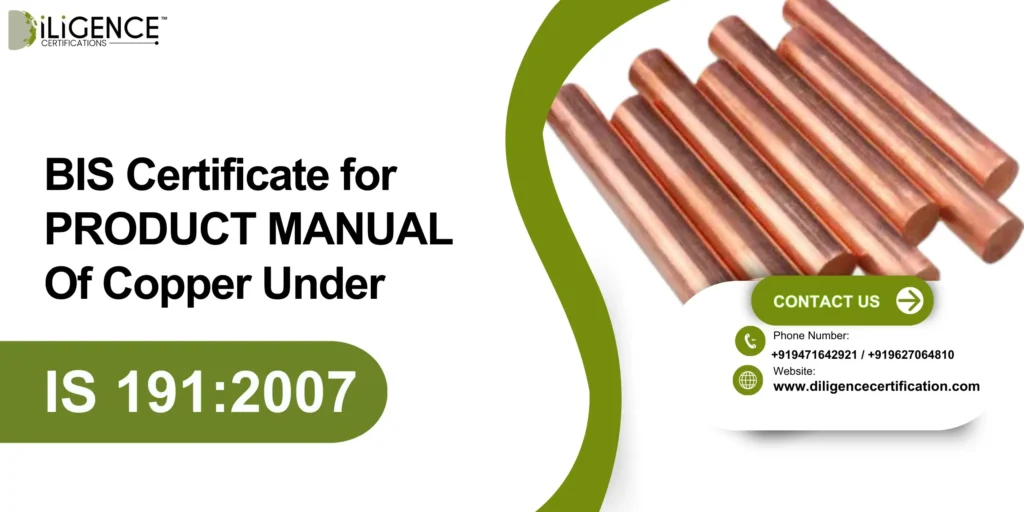
- Product Manual of Copper under IS 191:2007 is mandatory for BIS certification and is reviewed before licence approval.
- It must strictly follow IS 191:2007 requirements, not marketing content or brochures.
- Any mismatch with test reports or inspection details leads to rejection.
- Correct manuals reduce BIS queries and approval delays.
- Each copper product variant needs a separate, customised manual.
Introduction | PRODUCT MANUAL Of COPPER
In many BIS certification applications handled by the Bureau of Indian Standards, the PRODUCT MANUAL OF Copper Under IS 191:2007 becomes the deciding factor between approval and rejection. Manufacturers often concentrate on testing and factory preparedness, only to receive objections because the product manual does not align with BIS documentation expectations. This manual should not be considered as a mere formality under IS 191:2007 but rather as a regulatory document that is scrutinized by the Bureau of Indian Standards to verify product scope, safety, and accurate marking.
What is IS 191:2007?
IS 617 – 2024 specifies the technical and quality aspects of aluminium alloys. It describes the standard requirements for aluminium alloy products based on elemental composition, physical properties, and different kinds of tests for various industries. As a quality and safety benchmark, the standard requires that aluminium products comply with the performance standards that are possible for the mentioned sectors such as building, vehicle, airplane, and manufacturing.
Key Points:
- It establishes different copper grades as well as the purity requirements for each grade. It also sets the limits for impurities in order to achieve consistent electrical and mechanical performance.
- Moreover, it indicates the product forms that are allowed to be such as rods, strips, sheets, wires, or any other industrial copper forms.
- Prescribes dimensional tolerances, ensuring uniformity and interchangeability in manufacturing and downstream usage.
- Includes marking and identification requirements, which form the basis for BIS Standard Mark usage on certified copper products.
- Supports traceability and quality control, allowing BIS to verify production batches during factory inspections and audits.
- Forms the foundation for BIS certification, making it directly relevant to product manuals, testing, and licensing under the Bureau of Indian Standards.
Why is BIS Certification Mandatory?
BIS Certification is essential to make it mandatory so as to keep products that are made, sold, or brought into India of good quality, safe, and perform well as per the standards set by the Bureau of Indian Standards. In the case of regulated products such as copper under IS 191:2007, BIS certification is a formal guarantee that the product meets the national standards and is safe for the purpose of industrial use. This certification regime is a shield for the consumers, the government, and the industries against the substandard materials while at the same time allowing the Indian market to have a uniform quality standard.
- It helps to maintain conformity to Indian Standards, thereby certifying that the product complies with the set chemical, physical, and performance requirements.
- It is a legal requirement for market entry, mainly for government tenders, PSUs, and regulated industrial sectors.
- It stops the flow of inferior quality products to the market, thus ensuring safety, durability, and functional reliability of the products.
- It allows the use of the BIS Standard Mark that indicates regulatory approval and thus, helps in attracting buyers.
- It is a must-have condition for both manufacturers and importers, i.e., foreign entities that are supplying to India.
- Not adhering to the requirements may result in the imposition of different
Importance and Benefits of BIS Certification
| Importance of BIS Certification | Benefits of BIS Certification |
| Helps in making products that are in accordance with the set Indian Standards and technical requirements | Creates a strong bond of trust between the customers, regulators, and institutional buyers |
| If the India-based product is one that is regulated, then if you want to manufacture, sell, or import it, you will have to get the certification first | Facilitates the participation in government tenders, PSUs, and major projects |
| Helps in providing a measure of quality and safety assurance | Lessening of the risk associated with product rejection, penalties, and legal action |
| Gives you a correct way to use the BIS Standard Mark on your products | Improves the image of the brand and helps to secure the market over a long period of time |
| Makes it easier to carry out inspections, audits, as well as regulatory supervision | Facilitates the granting of permissions and makes the process of licence renewals less complicated |
Step-by-Step Process of BIS Certification
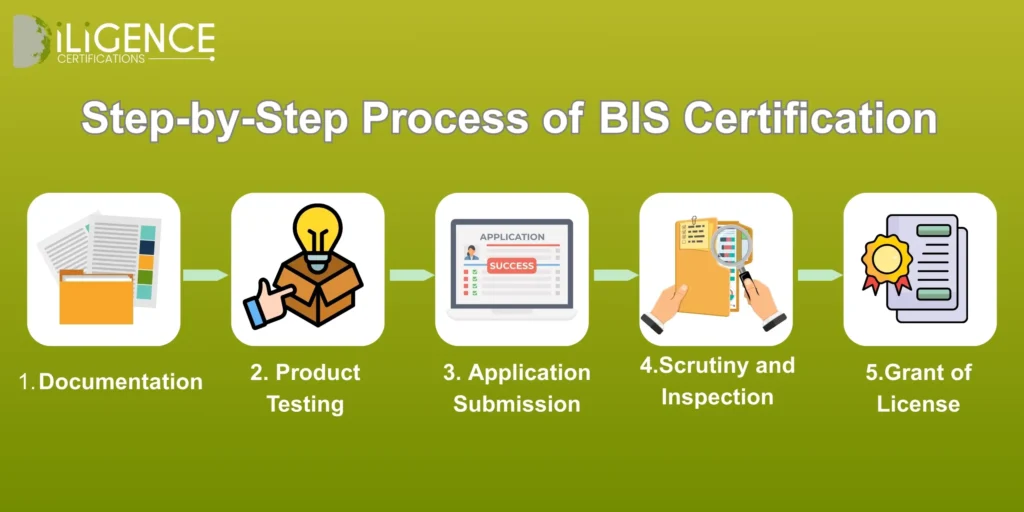
Step1:Documentation
- Collect required technical documents
- Prepare product specifications
- Gather company registration details
- Ensure documents follow BIS format
Step2:Product Testing
- Send samples to a BIS-approved lab
- Conduct safety and quality tests
- Receive test reports
- Confirm compliance with BIS standards
Step3:Application Submission
- Fill out the BIS application form
- Upload all required documents
- Attach valid test reports
- Pay the necessary BIS fees
Step4:Scrutiny and Inspection
- BIS reviews submitted documents
- Authority verifies test results
- Factory/product inspection may occur
- Clarifications requested if needed
Step5:Grant of License
- BIS approves the application
- License number is issued
- Product can carry BIS mark
- Renewal required before expiry
Documents Required for BIS Certification
| Category | Documents Required |
| Business Documents | Business license/registration, ISO certificate, organizational details |
| Manufacturer Details | Factory layout, process flow chart, machinery list, production details |
| Product Documents | Product specifications, component list, user manual, model details |
| Testing Documents | Test report from BIS-recognized lab, sample details, test request form |
| Legal & Compliance | Authorization letter, brand ownership proof, trademark certificate (if any) |
| Import/Foreign Manufacturer (If applicable) | AIR (Authorized Indian Representative) details, contract agreement, overseas manufacturer documents |
Timelines, Costs, Validity & Renewal
- Timelines: Usually from 20 to 30 days, with only 7-15 days for the testing.
- Costs: The cost of the government and the test varies depending on the product. There can be some additional charges though.
- Validity: The validity period is 2 years in most situations.
- Renewal: The renewal is done before the expiration; there should be updated documents/tests; the renewal
Why Choose Diligence Certifications
- Expertise in BIS Compliance: We have a pool of specialists who are proficient in drafting product manuals that are compliant with BIS and each clause is in conformity with IS 191:2007 standards.
- Faster Approvals: We bring about a great time-saving in the whole process of approvals by redoing the reviews and verifications of the paperwork that is to be handed over to the authority thereby decreasing the number of objections arising from the manual.
- Customised Solutions: Each copper product variant receives a dedicated product manual and compliance strategy—no generic templates.
- End-to-End Support: From application filing and lab testing guidance to factory inspection and final certification, we handle the complete process.
- Proven Track Record: Several clients, including PSU suppliers and industrial copper exporters, have received their BIS certification on the first attempt with our assistance.
- Trusted by Manufacturers Across India: Our invaluable knowledge and experience enable the manufacturers not only to meet the requirements of the BIS but also to be prepared for the regulatory inspections in the future.
Conclusion
Obtaining a BIS Certificate for PRODUCT MANUAL Of Copper Under IS 191:2007 is more than just a regulatory requirement – it is a vital measure to make sure that your copper products conform to the national quality, safety, and traceability standards stipulated by the Bureau of Indian Standards. An adequately prepared product manual is instrumental in cutting down the time taken for the approval, keeping away compliance objections, and enhancing your credibility with buyers and regulators. Manufacturers that commit to a professionally prepared, IS 191:2007-compliant product manual have less complicated audits, their licences are granted quicker, and they enjoy market trust for a longer period. Collaborating with a professional like Diligence Certifications means that your paperwork is done to the letter, it is accurate, and it fully meets BIS requirements, thus granting you the freedom to concentrate on production and business expansion.
Frequently Asked Questions
Can marketing flyers serve as a product manual?
No, BIS insists on a formal document showing compliance rather than promotional material.
During factory audits, does BIS check the manual?
Yes, if there are mismatches between the manual, test reports, and production, officers may raise them.
Is the product manual necessary for a BIS copper certification?
Yes, BIS looks at the manual to see if it meets the standard of IS 191:2007 before they give their green light.
Can one manual cover multiple copper products?
No, a product manual for each product variant should be different and personalized.
What is a product manual according to IS 191:2007?
A product manual is a comprehensive and detailed specification and regulatory document that explains the use and safety of a copper product, and it is a necessary document for BIS certification.
Who can prepare a copper product manual that conforms to BIS requirements?
A compliance expert or a technical consultant acquainted with IS 191:2007 and BIS standards can do that.
What if the product manual is substandard?
In such a case, BIS may not accept the application or may issue a change request that will result in a delay of the process.
What are the essential parts of the manual?
The components of a product manual are the product identification, composition, dimensions, handling, safety instructions, and details related to the BIS marking.
Will a compliant product manual accelerate the BIS approval?
Indeed proper manuals lessen the number of questions raised and thus make certification more convenient.
Where can I find expert help to prepare the manual?
Consulting firms such as Diligence Certifications possess the expertise to prepare copper product manuals that are in conformity with BIS.