


 BIS Certification
 CDSCO
CDSCO
 PESO
PESO
 CPCB
CPCB
 LMPC
LMPC
 WPC Approval
 Global Approvals
 TEC
TEC
 ARAI
ARAI
 BEE
BEE
 ISO Certification
 DGCA Certification
 NOC For Steel
 APEDA Registration










 Business Registration
 FSSAI Mark Certification


 (32).jpg)
 Legal Services
 Trademark Registration
 Copyright Registration
 Patent Registration
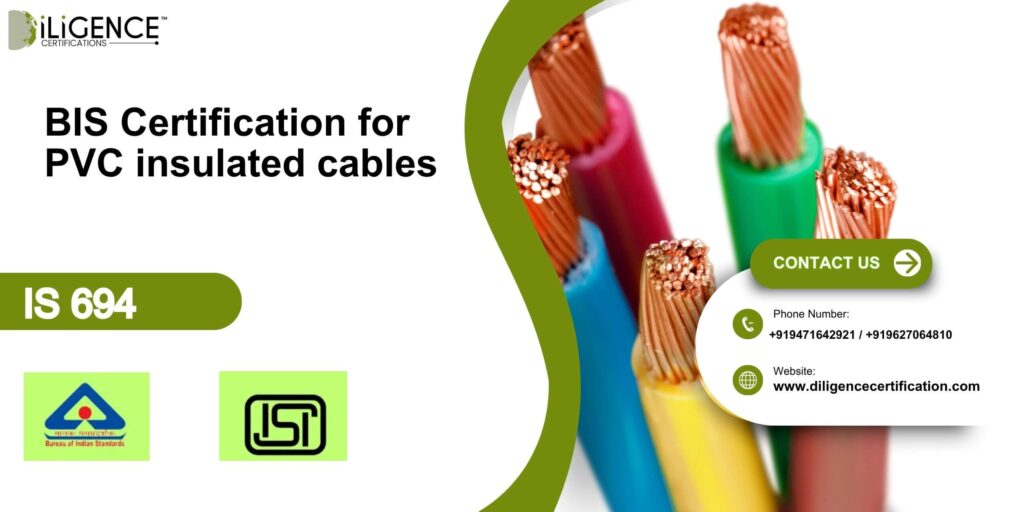
- PVC insulated cables for working voltages up to 1100V used under IS 694 must have BIS approval to ensure compliance and safety.
- IS 694 is the standard for both single and multicore PVC insulated cables for residential, commercial, and industrial wiring.
- The process for BIS approval consists of a series of steps, including applying, testing, factory inspection and BIS license issuance.
- Testing and associated documentation involve electrical tests, mechanical tests, flammability tests and other detailed quality documentation.
- Diligence Certifications can assist with getting the BIS approval as well as provide ongoing certification support.
Introduction
Cables with PVC insulation intended for voltages up to 1100V are used extensively in residential, commercial, and industrial applications in India. Safety of these cables and then the quality of the cables is all-important to protect the end-user from any hazards and also to avert delays in projects. BIS Certification is issued under IS 694 for the assurance of cable quality standards regarding insulation, conductor type, life under voltage, flammability, etc. Running a manufacturing business, or at least supplying one, assumes there is a BIS certification re-evaluating their justification. Without Bureau of Indian Standards certification, companies may risk rejection on tenders and limited or restricted access to certain markets.
What is BIS Certification for PVC insulated cables IS 694
The BIS certification for PVC insulated cables under IS 694 is a necessary certification provided by Bureau of Indian Standards confirming that cables for voltages up to 1100V, comply with Indian safety, quality and performance requirements. BIS certification is also required for the manufacturers and suppliers to sell PVC insulated cables and to bid for government or private work.
Key points:
- Provides proof that cables are approved for IS 694 standard insulation, conductor and voltage rating.
- Requires testing in BIS approved laboratories and inspections in the factory.
- Provides assurance to buyers that the cables are safe, reliable, and ready for sale.
- Increases trust from the public back to buyers and contractors.
- Signifies to manufacturers that they can participate in regulated projects and tenders.
What is IS 694?

IS 694 is a standard used in India covering PVC insulated cables rated at 1100 V or less. IS 694 provides requirements for the construction and insulation of cables, conductor material, and safety of single-core and multicore cables for residential, commercial and industrial use. Cables that comply with IS 694 standard identifies that a cable is safe, reliable and appropriate in accordance with India’s electrical system. ISI MARK
Key points:
- Covers single-core or multicore cables for use at 1100 V or less.
- Defines requirements for the insulation (and sheath) and conductors in cables.
- Specifies the electrical and safety testing.
- Provides the basis for BIS certification.
Why BIS Certification is Mandatory for PVC insulated cables IS 694
BIS Certification is mandatory for PVC insulated cables under IS 694 to ensure that all cables in India are safe, sound, and meet the highest standards of quality and performance. Cables sold, supplied, or used in government tenders must have the appropriate certification. If a manufacturer supplies tender enclosed cables that are unregistered with the appropriate certification, they risk rejections of their tender, possible fines/legalities, and even damage to their manufacturer’s credibility.
Key points:
- That all cables have been approved for domestic, commercial, and industrial use.
- Cables with a BIS certification indicate that they are compliant with IS 694 standards, including insulation, conductor ratings, and voltage ratings.
- BIS Certification is a requirement for cables to be sold in India and to engage in joint government tenders.
- BIS certification provides safety to customers from electrical hazards, fire hazards, and other failures that come from using inferior or unreliable cables.
- BIS certified PVC insulated cables, further aiding manufacturers/suppliers market trust and credibility.
Key features of BIS Certification
- Applicability: Refers to single and multicore PVC insulated cables for residential, commercial, and industrial purposes up to 1100V.
- Conductor: Uses bare or aluminum conductors as per IS 8130 specifications.
- Insulation and Sheath: PVC insulation (Type A or C) based on application as well as PVC sheathing (ST1, ST2).
- Testing: Must include the following tests: high voltage, insulation resistance, conductor resistance, flammability, and mechanical tests.
- Quality Control: Manufacturers are required to maintain records, assess quality, and receive periodic inspection by BIS.

Step-by-Step Process of BIS Certification for PVC insulated cables
Step 1: Application
- The first step consists of completing an application online via the BIS website.
- You will enter manufacturer and product details, and upload documents such as factory registration, quality manuals, process flow diagrams and raw material specification documents.
Step 2: Document Review
- Secondly, BIS reviews what was submitted by the manufacturer and determines if documentation meets the requirements for IS 694.
Step 3: Product Samples testing
- BIS will take some samples of the product and send them to an accredited BIS testing laboratory.
- Testing is conducted on electrical, mechanical, non-destructive insulation testing and flammability testing will be performed.
Step 4: Factory Inspection
- BIS will then carry out a factory inspection of the manufacturer’s factory to determine how and where the product was manufactured.
- The basis of the inspection is to substantiate which process is utilized to manufacture these wires, what quality controls are put in place, and whether the manufacturer is testing the final product.
Step 5: Licence Issued
- Once the testing of the product samples is completed and the factory inspections are carried out
- BIS will issue a licence to the manufacturer that gives their manufacturer permission to use the BIS Standard Mark when applicable on their wires.
Step 6: Post-Certification Surveillance
- Periodic inspections and samples taken every so often.
Benefits of receiving BIS Certification for PVC insulated cables
Securing BIS Certification for PVC insulated cables under IS 694 provides legal compliance to manufacturers, approval to the market as a recognized cable standard, and assurance of good product quality. BIS certification confirms that the cables comply with the relevant safety and performance standards and provides a development opportunity for government projects and approved regulated markets.
Benefits Include:
- Provides legal compliance in regard to the ability to sell and supply cables in India.
- Demonstrates cable safety and reliability for domestic, commercial, and industrial applications.
- Provides more brand trust and customer confidence.
- Provides opportunity to work on government tenders and regulated projects.
- Reduces risk of product failures, accidents, and fire hazard.
Timelines, Costs, Validity & Renewal
Timelines: 4-6 weeks to apply for and test inspection and receive a license.
Costs: Fees for application, testing, inspection and optional consultants.
Validity: Licence valid for 3 years.
Renewal: Must be retested, have updated documentation, and factory inspection.
Why choose Diligence Certification
- Expert Guidance: Knowledgeable in BIS Certification for electrical products and IS694.
- End-to-End Support: Helps with all documentation and testing arrangements, as well as factory inspection.
- Time Efficient: Helps manufacturers get certified quickly and without unnecessary delays.
- Assure Compliance: Offers effective quality control that supports not getting rejected.
- Market Access: Helps to meet eligibility requirements for government tenders and regulated projects.
Conclusion
BIS certification has become a necessary step for PVC insulated cables for working voltages not exceeding 1100V under IS 694. Some of the key benefits of certification include legal compliance, assurance of product safety and reliability, enhanced market reputation, ensuring the compliance of cables to India’s stringent standards, reduced likelihood of electrical safety disasters, and considerations for risk of rejection of tender due to specification violation. When collaborating with an expert like Diligence Certifications, we can assist with documentation and submissions for testing, inspections of the manufacturing facility, and issuance of license with certificate, so that you can focus on running your business and continue producing your products.
Frequently Ask Questions
What does the BIS Certification involve for PVC insulated cables following IS 694?
It is an accreditation from the Bureau of Indian Standards that an PVC insulated cable is of safe quality to be used for applications up to 1100V.
Why do I need BIS Certification for my PVC insulated cables?
Wherever you are wholesaling or supplying your cables, or using them in India for any purpose, or for government or regulated projects, BIS Certification is required.
What is IS 694?
IS 694 is a description of the construction or materials of PVC insulated cables, safe handling or use of the cables, insulations requirements, the cable voltage rating, safety and testing.
Who must be BIS Certified to sell or supply PVC insulated cables?
Whether a manufacturer or importer, or for the private labeled PVC insulated cable you bought, you must demonstrate evidence of conformity of IS694 through the BIS certification in order to sell or use your cable in India.
What is the process for BIS Certification of PVC insulated cables?
The process includes application submission, document verification, sample testing, factory inspection, licence grant, and post-certification surveillance.
What is the duration of the BIS Certification?
The duration is typically estimated to last 4-6 weeks which involves testing, inspection, and certification approval.
What type of documentation is needed for BIS Certification?
The documentation needed can include... i.e., factory license, quality manual, process flowchart, raw manufacturing information, and materials for testing or calibration.
What is the advantage of a BIS Certification?
The advantages are legal compliance to standards, safety of consumer product, market and credibility, eligibility to be a government tender, and a lower likelihood of an acceptance failure or hazards.
How long is the BIS Certification good for? How does it get renewed?
BIS Certification is good for a period of 3 years and can be renewed by distraining, updating plastic, and inspection of factory documents.
Why Diligence Certifications for BIS Certification?
Diligence Certifications will help from the end to end to ensure you get quicker approval, update documents, compliance assurance, and access to regulated markets.