BIS Certification
 CDSCO
 PESO
 CPCB
 LMPC
 WPC Approval
 Global Approvals
 TEC
 ARAI
 BEE
 ISO Certification
 DGCA Certification
 NOC For Steel
 APEDA Registration























 Business Registration
 FSSAI Mark Certification












 (32).jpg)
 Legal Services
 Trademark Registration
 Copyright Registration
 Patent Registration
 By
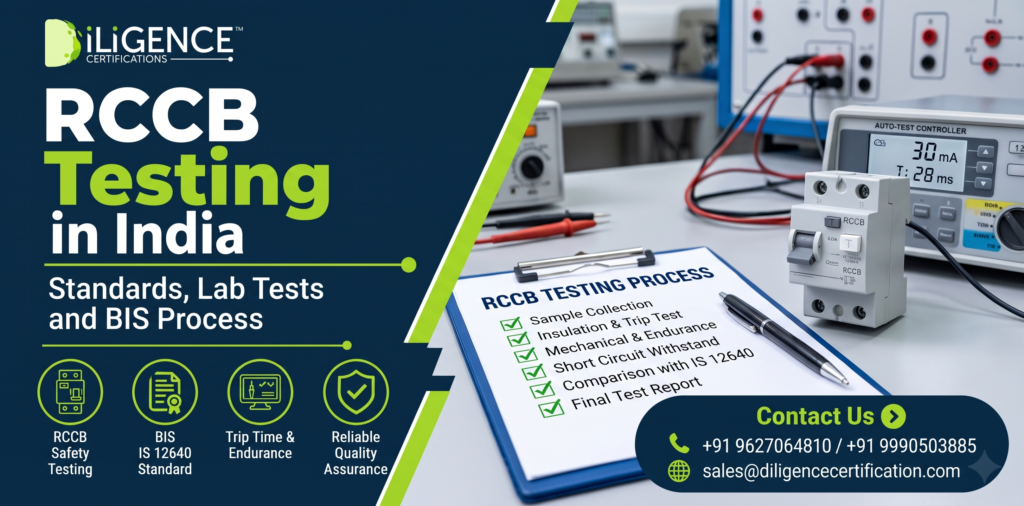
- RCCB testing checks whether the device trips fast enough when current leaks to earth, and whether it stays safe and durable in daily use.
- In India, RCCBs are tested against IS 12640 (Part 1), which follows IEC 61008-1. The latest version is the 2024 revision.
- RCCBs come under the mandatory ISI mark route, so testing is needed before you manufacture, import or sell them.
- Testing is done in two places: your own factory lab and a BIS-recognised lab.
- Most failures come from small things like wrong marking, weak terminals or slow tripping at the edge values.
- Always check the latest BIS circulars for transition dates before you plan your samples.
Introduction
That small box is the RCCB. Think of it like a security guard at the gate of your house. If even a tiny bit of current starts leaking where it shouldn’t, he shuts the gate in a fraction of a second.
But a guard is useful only if he is trained and tested. Same with an RCCB. You can’t just trust the label. That’s why RCCB testing exists.
In this blog, we’ll understand RCCB testing in very simple words: what it is, which standard applies, which tests are done, how the process works and what mistakes you should avoid.
What Is RCCB Testing?
RCCB means Residual Current Circuit Breaker. Some people also call it a residual current device (RCD). Its job is simple. It compares the current going into a circuit with the current coming back. If there is a difference, it means some current is leaking, maybe through a person’s body or a damaged wire. The RCCB trips and cuts the supply.
RCCB testing means checking all this in a proper laboratory. The lab verifies things like:
- Does it trip at the right leakage current?
- Does it trip fast enough?
- Does it survive heat, short circuits and years of switching?
- Is the plastic body safe against fire and heat?
- Is the marking on the product correct and clear?
It’s not just one test. It’s a full set of checks, done in a fixed order, on a fixed number of samples.
RCCB vs MCB vs RCBO: Simple Difference
People mix these up all the time, so here’s the quick table.
| Device | What it protects against | Can it protect from electric shock? |
|---|---|---|
| MCB | Overload and short circuit | No |
| RCCB | Earth leakage (residual current) | Yes |
| RCBO | Earth leakage plus overload and short circuit | Yes |
An RCCB alone does not protect against overload or short circuit. It needs an MCB or fuse along with it. This point matters because the testing standard for a plain RCCB (circuit breakers without integral overcurrent protection) is different from the one for RCBOs.
Which Standard Applies to RCCB Testing in India?
The main standard is IS 12640 (Part 1). It covers residual current operated circuit-breakers without integral overcurrent protection for household and similar uses. It is based on IEC 61008-1.
| Version | What to know |
|---|---|
| IS 12640 (Part 1): 2016 | Older version, based on IEC 61008-1:2012. Many existing licences were issued on this. |
| IS 12640 (Part 1): 2024 | Latest third revision, aligned with IEC 61008-1:2013. BIS has issued guidelines for moving to this version. |
A simple example: suppose you make a 2-pole, 40 A, 30 mA RCCB. Your product is tested against the requirements of this standard. The same standard decides the marking, the test sequence and the number of samples.
Important note: BIS has issued circulars on how existing licence holders should shift to the revised standard, and the Electrical Equipment Quality Control Order has seen deferment notifications for some phases. Dates keep changing, so always confirm the latest position on the BIS website before you start.
Why Is RCCB Testing Important?
- Life safety: A faulty RCCB can fail to trip during a leakage. That can be fatal.
- Fire prevention: Earth leakage is a common reason behind electrical fires.
- Legal need: RCCBs fall under mandatory certification, so selling without ISI mark can bring action.
- Brand trust: Electricians and buyers remember the brand that failed, not the lab that tested it.
- Fewer returns: A product that passes proper tests gives fewer complaints in the field.
- Export and tender needs: Many buyers ask for test reports before placing an order.
What Tests Are Conducted in RCCB Testing?
The lab doesn’t test randomly. IS 12640 gives a series of test sequences, and each sequence is done on a set of samples. Here is the simple version.
| Test group | What the lab checks | In simple words |
|---|---|---|
| Marking | Rating, type, model, manufacturer name, symbols, test button marking | Is everything clearly and permanently written? |
| Construction and dimensions | Mechanical design, terminals, clearances and creepage distances | Is it built safely and with enough gaps between live parts? |
| Protection against electric shock | Live parts should not be touchable | Can a finger touch anything dangerous? |
| Dielectric properties | Insulation strength, including after humidity | Does insulation hold under high voltage? |
| Temperature rise | Heating at rated current | Does it stay cool enough while carrying full load? |
| Tripping characteristics | Operation at different residual currents | Does it trip at the right leakage value and time? |
| Mechanical and electrical endurance | Thousands of switching operations | Will it survive years of ON and OFF? |
| Short circuit withstand | Behaviour during short circuit | Does it stay safe when a big fault current passes? |
| Resistance to mechanical shock | Impact and shock tests | Does it survive rough handling? |
| Resistance to heat and fire | Heat test and glow wire test on plastic | Will the body catch fire or melt? |
| Surge current and DC component behaviour | Surge withstand and operation with DC content, depending on type | Will it nuisance trip or fail under real world disturbances? |
| Test device check | Working of the test button | Does the test button actually test the unit? |
Tripping Test, the Heart of RCCB Testing
This is the most important part. A 30 mA RCCB, for example, must not trip below half of its rated residual operating current, and it must trip at or before its rated value, within the time limits given in the standard. If the product trips too late, it fails. If it trips too early, it will cause nuisance tripping and customers will complain.
The lab checks tripping at different points: at rated value, at higher multiples, and with the current applied in different ways (suddenly or slowly rising). That’s why the equipment used must be calibrated properly.
Types of RCCB and How They Affect Testing
Not all RCCBs are the same. The type decides which tests apply.
| Type | What it detects | Where it is used |
|---|---|---|
| Type AC | Sinusoidal AC residual current | Basic homes and offices |
| Type A | AC plus pulsating DC residual current | Places with electronic loads like inverters, drives, LED drivers |
| Higher types (for special DC cases) | Smooth DC residual current | Special installations; check the separate standard that applies |
Other factors that change the test plan are number of poles (2-pole or 4-pole), rated current, and rated sensitivity such as 30 mA, 100 mA or 300 mA. If you have many models in one family, ask your lab how samples can be grouped, because this saves time and sample cost.
Two Kinds of Testing: Factory Lab vs Recognised Lab
People often get confused here, so let’s keep it simple.
| Point | Factory lab | BIS-recognised lab |
|---|---|---|
| Who runs it | Your own team | An independent lab |
| Purpose | Routine checks on production | Type testing for licence and surveillance |
| Needed for licence | Yes, you must have the facility | Yes, for tests you cannot do in-house |
| Records | You maintain daily records | Lab issues the test report |
BIS looks at both. During factory inspection, the officer checks whether you have the required test equipment and whether records are properly maintained. Some tests can be sub-contracted to a recognised lab, but routine tests are expected in-house. Keep your product manual handy, because BIS publishes the product manual for IS 12640 which lists the tests, frequency and equipment.
Step-by-Step RCCB Testing and Certification Process
- Check the applicable standard and scheme. Confirm the latest IS 12640 version and any transition rules on the BIS website.
- Decide your models. List poles, ratings, sensitivity and type for each model you plan to certify.
- Set up the factory. Arrange production line, quality control plan and in-house test equipment.
- Prepare documents. Keep company and product papers ready (see list below).
- Select a recognised lab. Choose a BIS-recognised lab that has RCCB testing scope for your standard version.
- Send samples. Give the exact number and type of samples as asked in the test sequence.
- Get the test report. The lab issues the report after completing all sequences.
- Apply to BIS. Submit application with test report and documents on the BIS portal.
- Factory inspection and grant. BIS inspects the factory, draws samples if needed and then decides on the licence.
After the licence, regular surveillance continues. So testing is not a one-time thing.
Documents Required for RCCB Testing and Registration
Company documents
- Proof of business registration
- Factory address and layout plan
- Authorised signatory details
Product documents
- Product drawings and specifications
- Bill of materials
- Marking details and sample label
- Declaration of conformity to the standard
Testing and quality records
- Quality control plan
- Calibration certificates of test equipment
- In-house test records
- Test report from a recognised lab
A small tip: keep every calibration certificate valid. Expired calibration is one of the easiest ways to get a remark during inspection.
How Long Does RCCB Testing Take?
There is no fixed number of days that fits everyone. It depends on how ready your product is, how many models you have, the lab’s queue and how fast you answer queries. Testing itself involves multiple sequences, and endurance tests alone take time. If a sample fails, you fix the design, send fresh samples and the clock restarts for that part.
So plan early. Don’t wait till your dispatch date is near.
Cost of RCCB Testing
We are not giving any amounts here because the cost changes from lab to lab and from model to model. What decides the cost is:
- Number of models and variants
- Rated current, poles and sensitivity
- Number of samples required
- Whether you need re-testing after a failure
- Whether all tests are done at one lab or split across labs
- Application and licence related fees
Best way is to ask the lab for a clear breakup before you send samples.
Common Failures in RCCB Testing and Easy Fixes
| Failure | Likely reason | Easy fix |
|---|---|---|
| Slow tripping | Weak sensing coil or poor magnet setup | Tune the design and check component quality |
| Nuisance tripping | Too sensitive at low values | Recheck calibration of trip point |
| Temperature rise too high | Poor contact or thin conductor | Improve contacts and terminal design |
| Endurance failure | Weak spring or mechanism wear | Use better mechanism material |
| Glow wire failure | Wrong plastic grade | Switch to correct flame-retardant grade |
| Marking remarks | Missing symbols or fading print | Follow the marking clause word by word |
| Dielectric failure | Low creepage or clearance | Redesign spacing between live parts |
Common Mistakes to Avoid
- Testing against an old version of the standard when a newer one applies.
- Sending too few samples or the wrong type of samples.
- Ignoring marking requirements until the last day.
- Using test equipment with expired calibration.
- Changing a component after the sample test and not telling anyone.
- Assuming one model’s report covers all models without checking the grouping rules.
- Not keeping routine test records in the factory.
- Believing that RCCB testing ends once the licence is granted.
Who Needs RCCB Testing?
- Manufacturers: You need testing and an ISI mark licence for your products.
- Importers: Imported RCCBs also need to meet the Indian rules, so check the route that applies to you.
- Private label brands: If your name is on the box, you carry the responsibility. Check how the licence works with your manufacturer.
- Overseas manufacturers: You may need to apply through the foreign manufacturer certification route.
- Traders and sellers: You can’t legally sell products that don’t meet the rules, so ask for valid licence details from your supplier.
Why Choose Diligence Certifications for RCCB testing Certification?
RCCB testing can look confusing the first time. Standards, test sequences, circulars, factory readiness, so many moving parts. That’s where a guide helps.
At Diligence Certifications, the focus is on making the process clear and practical. Here’s how the team supports you:
- Helping you understand the right standard and the current transition position
- Checking your documents before submission so basic mistakes are caught early
- Guiding you on samples, test planning and lab coordination
- Supporting you during application and BIS queries
- Helping you prepare for factory inspection
You can read more about the support available on the BIS registration service page. Please note that final approval always depends on BIS and the recognised lab, and no consultant can promise a result.
After the Licence: Market Checks and Surveillance
Getting the licence is not the finish line. BIS can pick samples from the factory or from the market and test them again. If a product fails, there can be action on the licence. So keep production quality steady, maintain records and don’t cut corners on materials after approval.
Tips to Pass RCCB Testing in the First Attempt
- Do your own pre-testing in the factory before sending samples.
- Read the standard clause by clause, especially marking and tripping.
- Use quality plastic and proven components.
- Keep calibration of in-house equipment up to date.
- Send production samples, not specially hand-made ones.
- Talk to the lab about the sample count and grouping beforehand.
- Keep a record of every design change.
- Ask for feedback if anything fails and fix the root cause, not just the symptom.
Quick Checklist Before Sending Samples
- Latest applicable standard version confirmed
- Model list finalised
- Marking and labels checked against the standard
- Pre-testing done in-house
- Correct number of samples packed
- Lab scope matches your standard version
- Documents and drawings ready
- Calibration certificates valid
Conclusion
RCCB testing is not just paperwork. It decides whether a small device can really protect a person from a dangerous shock. The standard is clear, the tests are tough, and the process needs planning.
If you remember only a few things, remember these. Use the right version of IS 12640, test properly in both your own lab and a recognised lab, keep your records clean and don’t take shortcuts. Do that and the process becomes much smoother.
Frequently Asked Questions
1. What is RCCB testing?
It is the set of lab tests that check whether an RCCB trips correctly on earth leakage and stays safe and durable in use.
2. Which standard is used for RCCB testing in India?
Your own lab is needed for routine checks. For BIS, samples are also tested in a recognised lab.
3. Is BIS certification mandatory for RCCBs?
RCCBs come under the mandatory ISI mark route. Please check the latest BIS notifications for exact dates and phases.
4. What is the difference between RCCB and MCB?
An MCB protects from overload and short circuit. An RCCB protects from earth leakage and electric shock.
5. What is the difference between RCCB and RCBO?
An RCBO has leakage protection plus overload and short circuit protection in one device. A plain RCCB has only leakage protection.
6. What does 30 mA mean on an RCCB?
It is the rated residual operating current. It means the RCCB is designed to trip when leakage reaches that level, within the time limits of the standard.
7. Which tests are the most important?
Tripping characteristics, temperature rise, endurance, short circuit and resistance to heat are among the key ones.