BIS Certification
 CDSCO
CDSCO
 PESO
PESO
 CPCB
CPCB
 LMPC
LMPC
 WPC Approval
 Global Approvals
 TEC
TEC
 ARAI
ARAI
 BEE
BEE
 ISO Certification
 DGCA Certification
 NOC For Steel
 APEDA Registration























 Business Registration
 FSSAI Mark Certification












 (32).jpg)
 Legal Services
 Trademark Registration
 Copyright Registration
 Patent Registration
 By
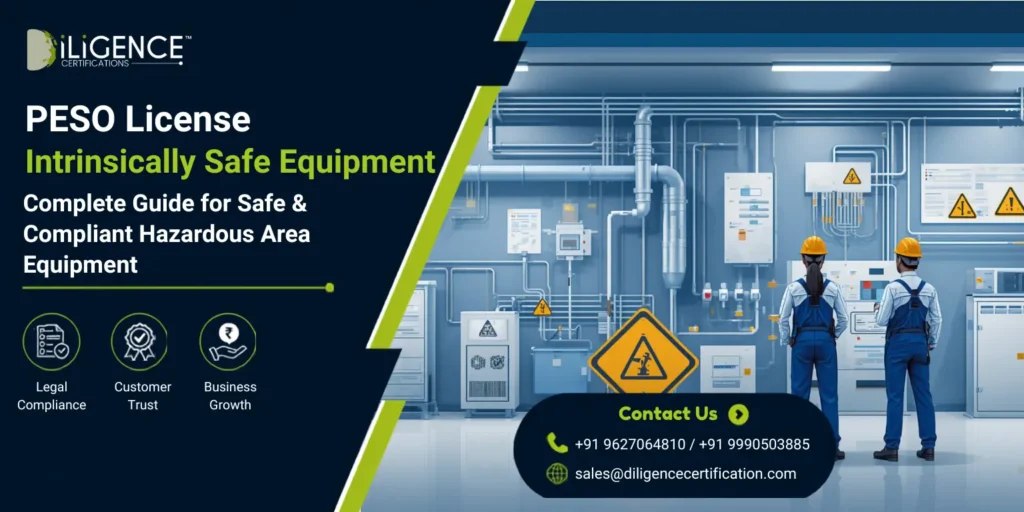
By - Intrinsically Safe Equipment Approval is a significant aspect of compliance for industries that use electrical and electronic devices in hazardous locations with the possibility of presence of flammable gases, vapors, or combustible dust.
- This certification makes sure that equipment is safe by controlling levels of energy (electrical and thermal) to avoid sparks, overheating, and any ignition hazard.
- Intrinsically Safe Equipment Approval facilitates the compliance of businesses to safety regulations and helps equipment work effectively in various industries including oil & gas, chemical, pharmaceutical, mining, petrochemical, and manufacturing industries.
Introduction
Industries with hazardous substances need specially designed equipment that can run safely and do not create the risk of any kind of ignition.
Conventional electrical equipment produces sparks or heat; the same can turn out to be very dangerous in an explosive atmosphere.
Intrinsically Safe Equipment is the equipment designed to minimize the electrical energy from producing any kind of ignition in places where the presence of flammable gas, vapor, or dust is possible. The equipment is widely used in hazardous areas including refineries, chemical industries, fuel storage units, and industrial processing units.
In India, the safety requirements for hazardous area equipment are regulated through relevant standards and procedures.
Petroleum & Explosives Safety Organization (PESO) plays an important part in providing safety requirements for the equipment to be used in hazardous areas.
Approval of Intrinsically Safe Equipment indicates that the equipment has been evaluated for safety and satisfies the required technical standards for hazardous areas.
The approval assists industries in reducing their fire hazard, explosion, and other risks.
What is Intrinsically Safe Equipment Approval?
Approval of Intrinsically Safe Equipment involves the testing and approval of electrical or electronic equipment in order to allow safe operation in hazardous conditions without the risk of forming a spark.
The Petroleum & Explosives Safety Organization (PESO) approval ensures that the equipment meets all the necessary criteria according to the safety standards set.
The mechanism of Intrinsically Safe equipment involves the control of electrical and thermal energies to prevent sparks or high temperatures that may ignite hazardous materials.
Before the approval, the equipment undergoes evaluation considering the following safety criteria:
- Equipment design
- Electrical safety
- Ignition protection
- Temperature classification
- Technical documentation
- Safety performance
Approval of Intrinsically Safe Equipment is necessary for equipment working in industries where there are chances of explosions, such as sensors, transmitters, communication equipment, control systems, and industrial equipment.
Who Needs Intrinsically Safe Equipment Approval?
The Intrinsically Safe Equipment Approval could be mandatory for manufacturers, suppliers, or industrial firms associated with equipment production, installation, or usage in hazardous areas.
Approval would be dependent on the type of equipment, area of application, classification of the hazardous environment, and safety legislation.
They include:
- Manufacturers of Hazardous Area Equipment
- Oil & Gas Industries
- Chemical & Petrochemical Industries
- Pharmaceutical Industries
- Mining Companies
- Fuel Refineries & Storages
- Automation Firms
- Electrical Equipment Suppliers
- Process Industries
- Explosive Atmospheres Equipment Users
Manufacturers require approval in order to make sure that the equipment manufactured meets safety regulations prior to supply.
The industries utilizing the equipment should make sure that equipment used is appropriate for their hazardous environment.
Types of Compliance Under Intrinsically Safe Equipment Approval
Compliance requirements for Intrinsically Safe Equipment Approval depend on equipment design, hazardous area classification, protection method, operating conditions, and applicable standards.
Businesses need to fulfill different technical requirements to ensure safe operation in hazardous environments.
Hazardous Area Equipment Design Compliance
Safe operation should be assured through the equipment design, which controls energy and prevents any possibility of ignition.
Design assessment covers issues related to electrical safety, quality of construction, protection, and use in explosive environments.
For Use In:
- Sensors
- Industrial Instruments
- Control Equipment
- Communications
- Monitoring Equipment
A good design assures safe operation of the equipment in locations with presence of flammable gas, vapor, or dust.
Electrical Safety and Energy Limitation Compliance
For an intrinsically safe device to qualify as such, it must limit the energy level in the system to prevent sparking and overheating.
This is made possible by ensuring that the energy level of the voltage, current, and energy storage is kept low enough.
Applications:
- Measuring Equipment
- Process Control Equipment
- Field Equipment
- Industrial Monitoring Systems
Temperature and Ignition Protection Compliance
Devices that are used in the area of risk have to be at such temperatures which do not create any risk of ignition.
It includes:
- Surface temperature control
- Thermal safety assessment
- Prevention from overheating
- Safe working conditions
Temperature management is vital for ensuring safe operation of devices.
Testing and Certification Compliance
Testing is performed to verify that equipment meets required safety and performance requirements.
The assessment may include:
- Electrical Testing
- Safety Performance Testing
- Environmental Testing
- Technical Document Review
Testing confirms that intrinsically safe equipment is suitable for use in hazardous areas.
Importance & Benefits of Intrinsically Safe Equipment Approval
| Importance | Benefits |
| Ensures compliance with applicable safety regulations governing the design, testing, installation, and use of intrinsically safe equipment in hazardous areas. | Helps build trust among regulatory authorities, customers, suppliers, and business partners through proper hazardous area equipment compliance. |
| Provides technical approval for using intrinsically safe equipment according to prescribed safety standards and regulatory requirements. | Enhances the credibility and professional reputation of manufacturers and organizations involved in hazardous area operations. |
| Promotes safe equipment operation through proper design evaluation, testing procedures, inspection requirements, and safety measures. | Supports uninterrupted business operations by reducing compliance issues, approval delays, and equipment-related safety risks. |
| Helps maintain approved equipment standards, technical documentation, certification records, and operational procedures. | Reduces the risk of equipment rejection, legal complications, operational restrictions, or compliance issues due to non-conformance. |
Documents Required for Intrinsically Safe Equipment Approval
The documents required for Intrinsically Safe Equipment Approval depend on the type of equipment, design specifications, intended application, hazardous area classification, and applicable safety requirements.
Generally, the required documents may include:
- Applicant identity proof
- Business registration documents
- Company incorporation documents, wherever applicable
- Product technical specifications
- Equipment design drawings
- Electrical circuit diagrams
- Component details and specifications
- Product operation manual
- Safety assessment documents
- Hazardous area suitability details
- Testing reports
- Quality control documents
- Manufacturing process details
- Technical datasheets
- Previous certification documents, wherever applicable
- Declaration of conformity
- Details of safety protection methods
- Any additional documents required by the concerned authority
Proper documentation helps reduce approval delays and supports a smooth evaluation process for Intrinsically Safe Equipment Approval.
Step-by-Step Process Under Intrinsically Safe Equipment Approval
It is necessary to have the right technical evaluation, documentation preparation, testing, and compliance to be able to get Intrinsically Safe Equipment Approval.
Step 1: Applicable Requirements Determination
In this step, you need to determine which safety requirements are applicable depending on the equipment being used, area where the equipment will be applied, its operation conditions, and desired protection level.
Businesses need to know which technical and approval standards apply to their equipment.
Step 2: Technical Documents Preparation
Full technical documentation is ready before the submission of approval application.
Documentation includes product specifications, design, safety, electrical drawings, and test data.
Right documentation will prevent any unnecessary delays in the evaluation process.
Step 3: Submission of Application
The application form of Intrinsically Safe Equipment Approval is submitted along with the documents and technical data required.
The submitted data must provide an accurate representation of the design and hazards posed by the equipment.
Step 4: Evaluation of Documentation
The submitted documentation is analyzed to determine whether the equipment satisfies the safety criteria.
In this process, further information may be requested in case any requirement exists.
Step 5: Technical Assessment and Testing
The equipment is subjected to technical assessment and testing to determine its compliance with safety requirements.
Some of the assessments performed include:
- Testing of electrical safety
- Ignition protection assessment
- Temperature assessment
- Assessment of equipment performance
- Safety parameters verification.
Step 6: Approval and Certification
Following a successful evaluation process and the compliance verification process, the approval is granted.
This approval means that the equipment complies with all safety requirements and can be used in dangerous environments.
Compliance - Step 7
Following the granting of the approval, the manufacturer/user should comply with all safety requirements.
Timeline, Cost & Validity of Intrinsically Safe Equipment Approval
The timeline, cost, and validity related to Intrinsically Safe Equipment Approval depend on factors such as equipment type, technical evaluation requirements, testing procedures, documentation review, and applicable compliance requirements.
| Timeline | Cost | Validity |
| The approval timeline depends on document verification, technical assessment, testing requirements, and evaluation of equipment safety features. | The cost depends on equipment category, testing requirements, certification charges, technical evaluation expenses, and professional consultancy charges. | The validity depends on applicable certification requirements, approval conditions, and regulatory guidelines. |
| Complex equipment designs and additional testing requirements may influence the overall processing period. | Additional expenses may vary depending on technical documentation, testing obligations, and compliance requirements. | Renewal or extension may be required according to applicable approval conditions. |
| Complete documentation and proper compliance preparation help avoid unnecessary delays. | Proper planning helps businesses manage approval-related expenses efficiently. | Maintaining updated records and continued compliance supports smooth renewal and approval management. |
Why is Intrinsically Safe Equipment Approval Important?
Importance of Intrinsically Safe Equipment Approval is due to the fact that the equipment used in hazardous zones has to be engineered and tested to ensure that there will not be any possibilities for the equipment to ignite.
The use of the electrical equipment in hazardous zones where there are flammable gases, vapors or dust requires the application of necessary protection methods.
Why is Intrinsically Safe Equipment Approval extremely necessary?
- Guarantees safe functioning of electrical equipment in hazardous zones.
- Assists in meeting technical and safety requirements for explosion zones.
- Eliminates dangers associated with sparks, overheating, fires, malfunctions.
- Increases confidence among customers, employees and regulatory bodies.
Consequences of Non-Compliance with Intrinsically Safe Equipment Approval
Failure to obtain or maintain Intrinsically Safe Equipment Approval is likely to pose many challenges on different levels for organizations using equipment in hazardous areas.
Organizations operating in environments where there are flammable gases, vapors, or combustible dust need to ensure compliance with all safety requirements. Not complying with requirements of using approved equipment increases chances of fire hazards, equipment failure, and accidents at workplaces.
Some of the potential implications of not obtaining or maintaining Intrinsically Safe Equipment Approval include the following:
- Action from the concerned authorities in relation to regulations.
- Installation and use of such equipment not being allowed in hazardous areas.
- Higher chances of fire outbreaks, explosions, and other safety-related incidents.
- Non-compliance with the relevant safety requirements of hazardous areas.
- Future approval and certification difficulties.
- Operational disruptions due to unsafe conditions of the equipment.
- Damage to business reputation due to the loss of customer confidence.
- Liability for safety and compliance problems.
Obtaining proper approval makes it easy for organizations to conduct their operations safely.
Renewal of Intrinsically Safe Equipment Approval
Organizations that have obtained Intrinsically Safe Equipment Approval should ensure continuous compliance with updated safety requirements and applicable regulations.
The renewal or continuation of approval may involve reviewing equipment performance, technical documents, safety records, and compliance status.
During renewal, different aspects may be evaluated, including:
- Current hazardous area equipment requirements.
- Compliance with applicable safety standards.
- Validity of technical documents and certification records.
- Changes made in equipment design or manufacturing process.
- Quality control procedures.
- Testing and inspection records.
- Safety performance of approved equipment.
- Updates in applicable regulatory requirements.
Maintaining updated documentation, conducting regular quality checks, and following safety procedures help businesses continue using and supplying intrinsically safe equipment without compliance issues.
How Professional Assistance Helps in Intrinsically Safe Equipment Approval?
Intrinsically Safe Equipment Approval entails a number of technical aspects such as knowledge, documentation, testing, and information about the hazardous area safety regulations.
Professional consultancy services assist companies in completing the procedure in a more efficient way without mistakes and undue delays.
Professional services generally include:
- Advice on the relevant hazardous area safety regulations.
- Preparation of technical documents and compliance reports.
- Help in gathering all necessary documentation.
- Support in application preparation and submission.
- Help in technical assessment and testing procedures.
- Support in certificate modification, renewal, and update.
- Advice on changing safety regulations and compliance requirements.
Professional services enable companies to concentrate on business while technical and regulatory issues connected with Intrinsically Safe Equipment Approval are being managed by professionals.
Why Choose Diligence Certifications for Intrinsically Safe Equipment Approval?
The procedure of Intrinsically Safe Equipment Approval involves technical evaluation, safety documentation, testing, and other processes related to this approval.
Taking the Diligence Certifications makes it easy for businesses to go through the procedure while making sure that all the requirements have been met successfully.
The benefits of professional consulting can be summarized as follows:
- Avoidance of errors in the process of technical documentation and approval.
- Complete assistance in providing necessary compliance documents.
- Provision of an understanding of the safety requirements of hazardous area equipment.
- Coordination assistance in the process of testing, evaluation, and approval.
- Effective management of certification requirements by businesses.
- Professional consulting helps businesses to get Intrinsically Safe Equipment Approval.
Conclusion
One of the compliance requirements that need to be considered when purchasing equipment for your business is Intrinsically Safe Equipment Approval. It guarantees that electrical and electronic equipment that works in hazardous conditions operates properly without creating any ignition hazard.
If you have an industry that works with flammable gases, vapors, and combustible dust, you will need equipment evaluated in the right way to keep you safe from any accidents.
With the right testing and documentation, you can be sure that your business complies with the necessary safety standards of hazardous areas.
Being approved in intrinsically safe equipment means not only compliance with law but also operational safety and reliability.
If you prepare the equipment properly, you will be able to receive the approval easily.
Frequently Asked Questions
Intrinsically Safe Equipment Approval - Definition
Intrinsically Safe Equipment Approval refers to the process of certification that ensures electrical and electronic devices can be used safely in hazardous environments through proper management of electrical and thermal energies to reduce the risk of explosions.
Who Needs Intrinsically Safe Equipment Approval?
Intrinsically Safe Equipment Approval may be necessary for manufacturers, suppliers, and industries using electrical devices in hazardous environments including but not limited to oil and gas, chemicals, mining, pharmaceutical, and petrochemical sectors.
Regulation of Intrinsically Safe Equipment Approval
The process of certification for equipment used in hazardous environments is regulated in line with relevant safety regulations. An important body involved in regulating safety regulations in explosion risk environments is Petroleum & Explosives Safety Organization (PESO).
Why is Inherently Safe Equipment Certification necessary?
It is necessary in order to ensure that the electrical devices used in hazardous environments work safely without causing sparks, overheating or sources of ignition.
What type of documents are needed for Inherently Safe Equipment Certification?
Documents include technical specifications, device drawings, electrical documentation, test results, technical information, safety documents and other compliance documents.
Is testing necessary for Inherently Safe Equipment Certification?
Yes, testing and technical assessment of the devices are the key aspects of the certification process.
Are changes allowed after gaining approvals?
Yes, changes in the design or specifications of approved equipment could need further evaluation or approval in accordance with relevant requirements.
Is renewing of approval necessary for Intrinsically Safe Equipment Approval?
Renewing or maintaining compliance depends on the terms of approval, certification requirements, and related safety regulations.
What will happen when using non-approved equipment in explosive atmospheres?
Use of non-approved equipment will lead to safety hazards, compliance problems, regulatory actions, and operational issues.
How do consultants help in gaining Intrinsically Safe Equipment Approval?
Consultants provide assistance to businesses with technical documents, compliance requirements, testing, applications, and certification process.