

 BIS Certification
 CDSCO
CDSCO
 CPCB
CPCB
 LMPC
LMPC
 WPC Approval
 Global Approvals
 TEC
TEC
 ARAI
ARAI
 BEE
BEE
 ISO Certification
 DGCA Certification
 NOC For Steel
 APEDA Registration








 Business Registration
 FSSAI Mark Certification

 Legal Services
 Trademark Registration
 Copyright Registration
 Patent Registration
- BIS Scheme X Certification in India 2025 is a critical requirement for electronics, automotive, and telecom sectors.
- It ensures mandatory product safety, quality compliance, and market access under BIS OTR regulations.
- The process includes testing, factory audits, and documentation aligned with updated BIS norms.
- This guide demystifies BIS Certification, its scope, procedure, and pitfalls to avoid in 2025.
Introduction
In January 2024, a European smart home manufacturer hit a wall.
They had shipped over 5,000 connected thermostats to India, expecting smooth clearance. But at Mumbai Customs, all units were held back. Why? Non-compliance with BIS Scheme X Certification.
The cost: ₹5 crore in demurrage, re-export logistics, and lost retail shelf space.
This wasn’t an isolated case. In the past 18 months, the Bureau of Indian Standards (BIS) has cracked down on imports lacking Scheme X certification, especially in high-risk categories like electronics, batteries, lighting systems, and automotive components.
If your business is planning to manufacture, import, or sell regulated products in India, understanding the BIS Scheme X Certification in India 2025 is not optional—it’s a regulatory imperative.
To ensure the safety and quality of machinery and electrical equipment in the Indian market, the Bureau of Indian Standards (BIS) introduced Scheme X Certification in India under its authority of the Conformity Assessment Regulations, 2018. This scheme was further improved by the BIS Conformity Assessment (Amendment) Regulations, 2022.
What is BIS Scheme X Certification in India?
The Ministry of Heavy Industries in India has released the order entitled “Machinery and Electrical Equipment Safety (Omnibus Technical Regulation) Order, 2024,” which will have major effects on the manufacture and import of a huge variety of essential machinery. The order, implemented by the Bureau of Indian Standards (BIS), requires to improve safety standards and build quality in the sector, with a commencement date of August 28, 2025.
The new regulations cover a wide variety of mechanical and electrical equipment that are essential parts of various companies. The rule includes essential equipment such as liquid-handling pumps, various compressors, construction and lifting cranes, rotating electrical machines of all kinds, transformers for power distribution, and crucial switchgear for electrical systems.
The order also recognizes the Ministry of Road Transport and Highways‘ (MoRTH) pre-existing “Scheme X,” a unique compliance analysis scheme for construction-oriented equipment that was maintained under the CMVR, 1989. This suggests that the government understood the necessity for specific rules for some industries that have high technical and safety requirements. “Scheme X” will always fall within the scope of the MoRTH to guarantee that construction equipment complies with established safety regulations.
“Machinery and Electrical Equipment Safety (Omnibus Technical Regulation) Order, 2024” is a major step in improving safety and quality standards in the Indian machinery and electrical equipment industry. This great order’s implementation would only help to guarantee a better, safer, and more competitive industry on a global scale.
Understanding Scheme X Certification in India
On March 16, 2022, the Bureau of Indian Standards (BIS) introduced Scheme-X, an important certification program for electrical equipment, machinery, and low voltage switchgear and control gear by the Omnibus Technical Regulation. For the concerned industries, this plan will significantly raise safety and quality requirements. Although Scheme-X covers a wide range of product categories, machine tools used in the assembly of mineral glass, stone, ceramic, concrete, asbestos cement, and other materials are crucial. Manufacturers of these machine tools are now required to keep up with safety regulations through BIS Scheme-X certification.
Under the Omnibus Technical Regulation, the BIS Scheme X Certification incorporates standards and guidelines for the security of electrical and mechanical equipment. According to these rules, any such equipment that wants to be sold in India must be certified to meet the required safety, performance, and reliability criteria.
Domestic and foreign manufacturers are now required to make sure that the electrical and mechanical goods meet the technical requirements established by BIS.
Scheme X Certification in India Key Objectives:
- Consumer safety is ensured by preventing all electrical risks and mechanical failures.
- improvement in the products’ reliability and life.
- removing all machinery and electrical equipment of poor grade and poor workmanship from the market.
- Facilitating international manufacturers in complying with the Indian standards.
Products Covered Under Scheme X Certification in India
The Omnibus Technical Regulation applicable under BIS Scheme-X covers a wide range of machinery and electrical equipment. Some of the products in key categories include:
| Sr No. | Indian Standards | Title of Standard | Product category | Specific Requirement |
|---|---|---|---|---|
| 1.1 (a) | IS/IEC 60947: Part 2:2016 | Low-Voltage switchgear and control gear: Part 2 circuit- Breaker (First Revision) | AC Circuit – Breakers (Category A) – All rating upto 630 A, upto 440V AC | All test as per IS/IEC 60947: Part 2: 2016 except the test listed below in Sr. No. 1.1.(b) of this table |
| 1.1 (b) | AC Circuit – Breakers (Category A) – All rating upto 630 A, upto 440V AC | Electromagnetic compatibility (EMC) mentioned in Anne J and All test specified for specific application as mentioned in the Annexure(s) of the IS/IEC 60947 : Part 2: 2016 | ||
| 1.2.(a) | AC Circuit – Breakers (Category A) – All rating above 630 A, upto 440V AC | All test as per IS/IEC 60947: Part 2: 2016 except the test listed below in Sr. No. 1.2.(b) of this table | ||
| 1.2.(b) | AC Circuit – Breakers (Category A) – All rating above 630 A, upto 440V AC | Electromagnetic compatibility (EMC) mentioned in Anne J and All test specified for specific application as mentioned in the Annexure(s) of the IS/IEC 60947 : Part 2: 2016 | ||
| 1.3.(a) | AC Circuit – Breakers (Category B)- All rating upto 2000 A, upto 440V AC | All test as per IS/IEC 60947: Part 2: 2016 except the test listed below in Sr. No. 1.3.(b) of this table | ||
| 1.3.(b) | AC Circuit – Breakers (Category B)- All rating upto 2000 A, upto 440V AC | Electromagnetic compatibility (EMC) mentioned in Anne J and All test specified for specific application as mentioned in the Annexure(s) of the IS/IEC 60947 : Part 2: 2016 | ||
| 1.4 | AC Circuit – Breakers (Category A) – All rating above 440V AC | All test as per IS/IEC 60947: Part 2: 2016 | ||
| 1.5 | AC Circuit – Breakers (Category B)- rating above 2000 A, upto 440V AC | |||
| 1.6 | AC Circuit – Breakers (Category B)- All rating above 440V AC | |||
| 1.7 | DC Circuit – Breaker (Category A) – All rating | |||
| 1.8 | AC Circuit – Breaker (Category B)- All rating | |||
| 2. | IS/IEC 60947: Part 3:2012 | Low-Voltage switchgear and control gear: Part 3 switches, disconnectors, switch disconnectors and fuse – Combination units | All types of product ratings | All test as per IS/IEC 60947: Part 3: 2012 |
| 3. | IS/IEC 60947: Part 4: Sec 1: 2012 | Low-Voltage switchgear and control gear: Part 4 contactors and motor – Starters: Sec 1 electromechanical contactors and motor – Starters (First Revision) | All test as per IS/IEC 60947: Part 4: Sec 1: 2012 | |
| 4. | IS/IEC 60947: Part 4: Sec 2: 2011 | Low-Voltage switchgear and control gear: Part 4 contactors and motor – Starters: Sec 2 a.c. semiconductor motor controllers and starters (First Revision) | All test as per IS/IEC 60947: Part 4: Sec 2: 2011 | |
| 5. | IS/IEC 60947: Part 4: Sec 3: 2014 | Low-Voltage switchgear and control gear: Part 4 contactors and motor – Starters: Sec 3 a.c. semiconductor motor controllers and contactors for non – Motor loads ( Second Revision) | All test as per IS/IEC 60947: Part 4: Sec 3: 2014 | |
| 6. | IS/IEC 60947: Part 5: Sec 1: 2009 | Low-Voltage switchgear and control gear: Part 5 control circuit devices and switching elements: Sec 1 electromechanical control circuit devices ( First Revision) | All test as per IS/IEC 60947: Part 5: Sec 1: 2009 | |
| 7. | IS/IEC 60947: Part 5: Sec 2: 2007 | Low-Voltage switchgear and control gear: Part 5 control circuit devices and switching elements: Sec 2 proximity switches | All test as per IS/IEC 60947: Part 5: Sec 2: 2007 | |
| 8. | IS/IEC 60947: Part 5: Sec 5: 2016 | Low-Voltage switchgear and control gear: Part 5 control circuit devices and switching elements: Sec 5 electrical emergency stop devices with mechanical latching function | All test as per IS/IEC 60947: Part 5: Sec 5: 2016 |
Machinery and Electrical Equipment covered under Omnibus Technical Regulation
Documents Required :
Here’s a comprehensive table summarizing the required documents and information necessary for registration:
| S. No. | Required Document/Information | Details |
| 1 | Name, Address (Factory & Office) | Manufacturer’s registered name and complete address of both the factory and office locations. Ensure accuracy and consistency. |
| 2 | PAN, GST details | Permanent Account Number (PAN) and Goods and Services Tax (GST) registration details. These are crucial for verification purposes. |
| 3 | Contact details | Email address, phone number, and office contact number of the manufacturer. Ensure these are active and regularly monitored. |
| 4 | Details of the management and authorized person | Names and designations of key management personnel and the authorized signatory who will represent the company during the certification process. |
| 5 | Details of the machinery and electrical equipment to be registered | Comprehensive equipment details as per the First Schedule of the OTR. Refer to the official OTR document for specific requirements. |
| 6 | Name/type and variety of products | Specific name, type, and variety of products for which BIS certification is being sought. Ensure alignment with the relevant Indian Standards. |
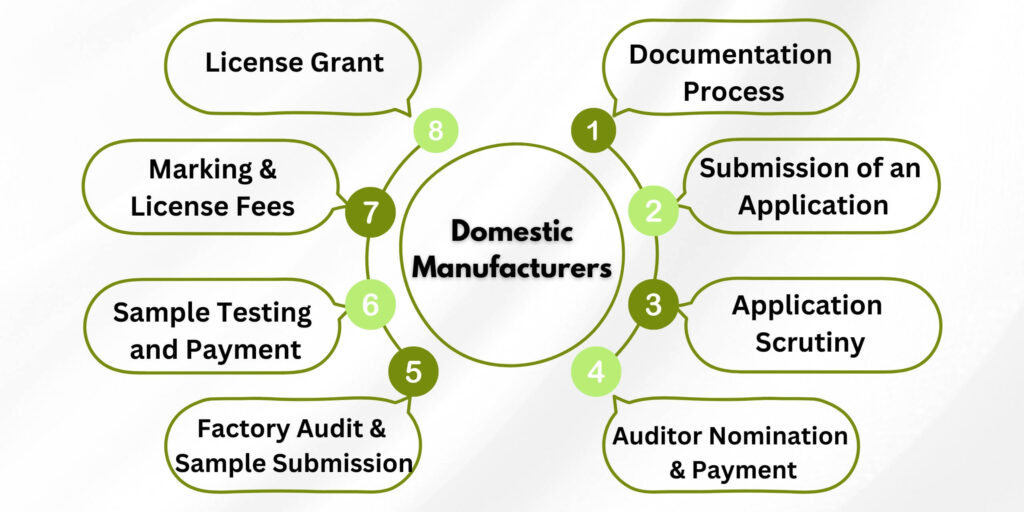
BIS Scheme X Certification Process for Domestic Manufacturers:
Domestic manufacturers applying for a BIS license under Scheme X have to follow a series of steps:
- Documentation Process: To apply for a BIS license, research and collect the necessary documentation.
- Submission of an Application: BIS must receive the completed application form and the required application fee.
- Application Scrutiny: BIS scrutinizes the application and seeks clarification or further information from the manufacturer.
- Auditor Nomination & Payment: BIS nominates an auditor for factory inspection for the manufacturer to make the required payment to BIS for audit charges.
- Factory Audit & Sample Submission: The auditor will thoroughly inspect the manufacturing premises and conduct sampling, which will be sent to the BIS-recognized laboratory for testing.
- Sample Testing and Payment: Product samples are tested according to the relevant Indian Standard in the assigned laboratory.
- Payment of Marking and License Fees: The manufacturer pays BIS the necessary marking charge and licensing fee after the successful completion of the audit and testing.
- Grant of License: BIS will then grant the license once the last requirement is met and the last payment is made, which allows the manufacturer to use the ISI Mark.
General Timeline (Domestic Manufacturers): The entire process generally takes about 90 working days according to prevailing practices in BIS.
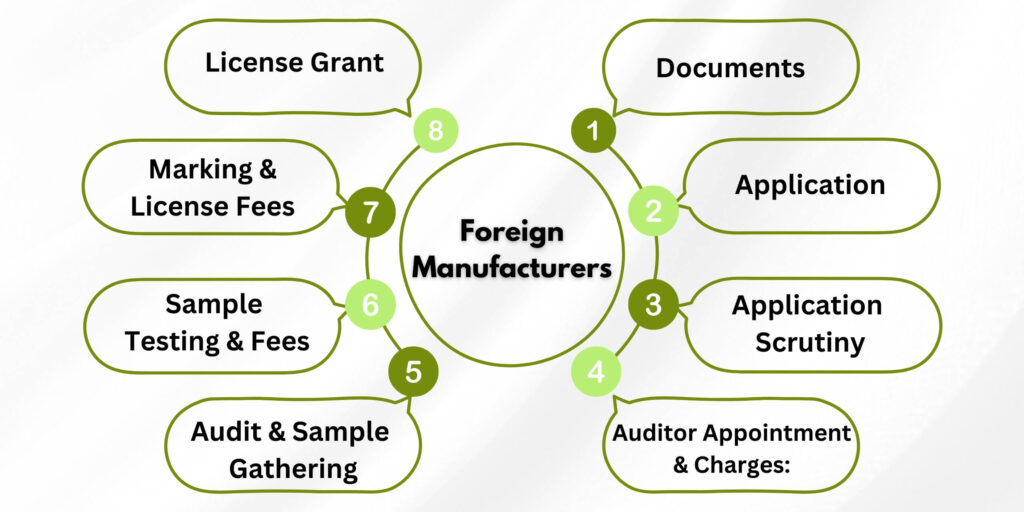
BIS Scheme X Certification Process for Foreign Manufacturers:
Foreign manufacturers adhere to a certification procedure similar to that of domestic manufacturers, yet crucial differences exist due to overseas logistical arrangements:
- Document: Making up all necessary documents as per BIS requirements.
- Application: Fill in the application form and submit it along with the necessary application fee to BIS.
- Application Scrutiny: The application gets scrutinized by the BIS where queries may be raised requiring clarification or further information from the manufacturer.
- Auditor Appointment & Charges: An auditor gets appointed by BIS for the factory inspection and the manufacturer pays the audit charge to BIS.
- Audit & Sample Gathering: Factory audit for the full inspection by the BIS auditor. After being sampled, the items are delivered to a BIS-approved facility for analysis.
- Sample Testing & Fees: The lab tests the samples according to the applicable Indian standard. For testing fees, the manufacturer is required to pay the laboratory directly. (Note: Certain tests may be outsourced to specific laboratories.)
- Marking & License Fees: After a successful audit and testing, marking and license fee payments are made to BIS.
- License Grant: Once all the requirements are fulfilled and payments made, BIS issues the license authorizing its use by the manufacturer.
General Timeline (Foreign Manufacturers): Because of the complications involved, the certification process for foreign manufacturers generally takes about 6-7 months, contingent on current BIS practices.
Advantages of BIS Scheme X Certification For The Manufacturers
BIS Scheme X certification provides various advantages like:
- Regulation: That means meeting the required Indian safety and performance standards.
- Entry into the market: It is mandatory to sell machinery and electrical equipment in India.
- Consumer confidence: Increases credibility and trustworthiness in the Indian market.
- Penalty prevention: Helps prevent legal issues and penalties related to violations.
- Global expansion: For a foreign manufacturer to ensure alignment between the products and regulations in India.
The Role of Diligence Certification in Compliance with BIS Scheme X
Obtaining BIS certification can be a lengthy process with lots of documentation, product testing, and compliance. Diligence Certification excels in offering consultancy services to manufacturers for a hassle-free BIS certification service.
Benefits of Choosing Diligence Certification
- Provide expert consultation for BIS rules and Omnibus Technical Regulation.
- All document preparation assistance for application filing.
- Interface with BIS and Laboratories for smooth product testing.
- Factory inspection and quality management process conformity assistance.
- Renewal and post-certification support services in maintenance.
Diligence Certification makes the whole hassle-free process smooth for manufacturers in obtaining BIS Scheme X Certification.
Conclusion
BIS Scheme X Certification is one of the mandatory compliance under the Omnibus Technical Regulation for machinery and electrical equipment. Certification guarantees that the product conforms to the Indian quality and safety standards and is thus fit for distribution in the Indian market.
Through Scheme X certification in the BIS testing and certification scheme, manufacturers will strengthen their credibility in the market, ensure the safety to their consumers, and avoid regulatory action.
Diligence Certification provides an A-Z consultancy service that guarantees business organizations will achieve and maintain BIS compliance with professional assistance.
Need BIS Scheme X Certification? Contact Diligence Certification now!
Frequently Asked Questions
What is BIS Scheme X Certification in India?
BIS Scheme X certificate is given as certification for products which are not covered under normal ISI or CRS schemes. These include machinery, electrical equipment, and components regulated under the Omnibus Technical Regulation (OTR).
Is BIS Scheme X Certification compulsory?
Yes, the BIS Scheme X Certification is compulsory for those products for which a Quality Control Order (QCO) has been notified by the Ministry of Commerce and Industry in India.
Who requires BIS Scheme X Certification?
Manufacturers, importers, and suppliers of machinery or electrical equipment or their assemblies/components as listed under the OTR and QCOs shall require a BIS Scheme X Certification to be able to sell in India.
How can one apply for obtaining BIS Scheme X Certification?
To take the case for obtaining BIS Scheme X Certification, one has to submit the application to BIS along with product particulars, test reports, and compliance certificates. The services of a BIS consultant such as Diligence Certification could assist in easing the procedure.
What kind of documentation is required for the BIS Scheme X Certification?
Majorly the technical specification of the product, test reports from the BIS approved labs, manufacturing license (if applicable), proof of address of the factory, and various QMS documents.
How much time does one take to get a BIS Scheme X Certification?
The procedure normally takes from 4 to 8 weeks, as it depends on the nature of the product and its test results.
What services does Diligence Certification provide for the BIS Scheme X?
Acting as a BIS Consultant in India , Diligence Certification helps manufacturers and importers through the complete process of compliance, documentation, filing of applications, and coordinating with laboratories for audits and inspections.