


 BIS Certification
 CDSCO
CDSCO
 CPCB
CPCB
 LMPC
LMPC
 WPC Approval
 Global Approvals
 TEC
TEC
 ARAI
ARAI
 BEE
BEE
 ISO Certification
 DGCA Certification
 NOC For Steel
 APEDA Registration









 Business Registration
 FSSAI Mark Certification










 Legal Services
 Trademark Registration
 Copyright Registration
 Patent Registration
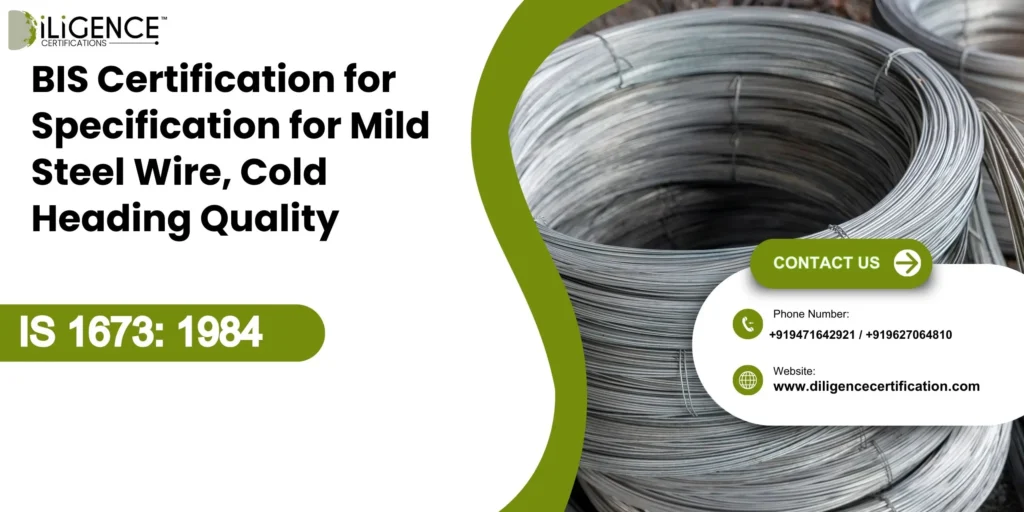
- BIS Certification for Specification for Mild Steel Wire as per IS 1673:1984( indicates the product is safe, reliable, and of a quality suitable for cold-heading operations.
- To get the green light, producers have to undergo tests in a laboratory approved by the BIS and pass a factory inspection.
- IS 1673:1984 specifies the aspects of the material including the chemical composition, the tensile properties, and the surface finish.
- Using certified wire helps in the reduction of the defects during the forming process and thus the wire can be used in the production of automotive and industrial fasteners.
- BIS certification improves credibility, export readiness, and tender eligibility.
Introduction
A fastener manufacturer from Ludhiana recently contacted us after repeatedly being rejected by an automotive buyer whose new supply norms required BIS Certification for the Specification for Mild Steel Wire, Cold Heading Quality, as per IS 1673:1984. Their wire behaved inconsistently during the forming process, and without certification, they were losing orders they had supplied for years. This is now common across fastener, electrical, and engineering sectors, where buyers want predictable, standard-compliant raw material. IS 1673:1984 acts as a filter for quality, covering chemistry, strength, and surface finish essential for cold-heading operations. For many manufacturers, the certification has shifted from optional to essential, especially when competing in regulated or export-driven markets. Bureau of Indian Standards
What is IS 1673:1984?
IS 1673:1984 outlines the characteristics of the material that a wire made of mild steel for the cold headed wire should meet. Such wire should be able to go through upsetting, forging, and forming operations without the appearance of cracks, therefore the requirement is mainly for a well-defined chemical composition, controlled mechanical properties, and a good surface finish. The producers who provide the product line of the fastening system, rivets, screws, and precision-formed components use this standard as a basis for a consistent performance of different batches.

Key points:
• Defines chemical composition limits for low-carbon steel suitable for deformation.
• Covers tensile strength, elongation, and reduction of area needed for cold heading.
• Specifies dimensional tolerances and surface finish requirements to reduce forming defects.
• Includes tests such as bend test, torsion test, and upset test to confirm ductility. ISI MARK
• Serves as the base requirement for BIS certification for cold-heading quality wire in India.
Why is BIS Certification Mandatory
BIS Certification is required for Mild Steel Wire under IS 1673:1984 mainly because the metal is the primary factor that determines the safety, the dependability, and the performance of the components that are cold-headed. The law serves as a gatekeeper that lets only those wires that meet the standards be manufactured, marketed, or brought into the country thereby the users and producers are guaranteed quality and are free from the risk of product failures.
Keypoints:
• Prevents the supply of sub-standard wire in critical fastener and engineering applications.
• Ensures consistent chemistry, ductility, and tensile properties required for cold heading.
• Reduces production defects, tool damage, and rejection rates for downstream manufacturers.
• Required by major OEMs and government tenders for traceability and quality assurance.
• Mandatory under BIS rules, making certification essential for market entry.
Importance and Benefits of BIS Certification
| Importance | Benefits |
| Ensures the wire meets IS 1673:1984 quality norms | Consistent performance during cold-heading operations |
| Protects manufacturers from defective or unsafe raw material | Lower rejection rates and reduced tool wear |
| Supports regulatory compliance for production and import | Approval to legally manufacture and sell in India |
| Builds trust with OEMs and large industrial buyers | Better tender eligibility and stronger market credibility |
| Maintains uniform mechanical and chemical properties | Fewer production delays and improved product reliability |
Step-by-Step Process of BIS Certification

Step1:Documentation
- Collect required technical documents
- Prepare product specifications
- Gather company registration details
- Ensure documents follow BIS format
Step2:Product Testing
- Send samples to a BIS-approved lab
- Conduct safety and quality tests
- Receive test reports
- Confirm compliance with BIS standards
Step3:Application Submission
- Fill out the BIS application form
- Upload all required documents
- Attach valid test reports
- Pay the necessary BIS fees
Step4:Scrutiny and Inspection
- BIS reviews submitted documents
- Authority verifies test results
- Factory/product inspection may occur
- Clarifications requested if needed
Step5:Grant of License
- BIS approves the application
- License number is issued
- Product can carry BIS mark
- Renewal required before expiry
Documents Required for BIS Certification
| Category | Documents Required |
| Business Documents | Business license/registration, ISO certificate, organizational details |
| Manufacturer Details | Factory layout, process flow chart, machinery list, production details |
| Product Documents | Product specifications, component list, user manual, model details |
| Testing Documents | Test report from BIS-recognized lab, sample details, test request form |
| Legal & Compliance | Authorization letter, brand ownership proof, trademark certificate (if any) |
| Import/Foreign Manufacturer (If applicable) | AIR (Authorized Indian Representative) details, contract agreement, overseas manufacturer documents |
Timelines, Costs, Validity & Renewal
- Timelines: Usually from 20 to 30 days, with only 7-15 days for the testing.
- Costs: The cost of the government and the test varies depending on the product. There can be some additional charges though.
- Validity: The validity period is 2 years in most situations.
- Renewal: The renewal is done before the expiration; there should be updated documents/tests; the renewal
Why Choose Diligence Certifications
- Expert team with strong BIS and regulatory knowledge
- Fast, streamlined processing to reduce approval delays
- Accurate documentation and testing coordination
- Transparent guidance with clear communication
- High success rate and complete end-to-end support
Conclusion
BIS Certification for Specification for Mild Steel Wire, Cold Heading Quality IS 1673:1984 as a baseline for entering organised supply chains. The certificate helps maintain uniform mechanical properties, reduces rejection levels and improves acceptance with automotive and engineering buyers. It also supports compliance for tenders and regulated sectors where traceability is essential. As quality expectations rise, aligning with IS 1673:1984 becomes critical for staying competitive. Diligence Certifications assists manufacturers with testing, documentation and the complete BIS approval process, making certification easier to achieve without disrupting production.
Frequently Ask Questions
What does IS 1673:1984 specify for Mild Steel Wire?
The Indian Standard specifies the chemical, mechanical, and surface characteristics of mild steel wire of a quality suitable for cold-heading.
Is BIS certification necessary for the IS 1673:1984 wire?
It is a requirement to have such certification if the production, selling, or importing of cold-heading quality mild steel wire take place in India.
Under this standard, who is obliged to obtain BIS certification?
Obtainers of the certificate are the manufacturers of mild steel wire, fastener producers from wire drawing by the in-house method, and importers of such wire into India.
What are the required tests for this certification?
The tests cover tensile strength, elongation, bend test, torsion test, upset test, and chemical composition analysis.
What is the duration of the BIS certification procedure?
It usually takes 20 to 30 days and is dependent on the time for testing and the scheduling of the BIS inspection.
Are foreign manufacturers eligible to apply for a BIS certification?
Certainly, but to manage the application and ensure compliance, they need to designate an Authorized Indian Representative (AIR).
Which documents must be submitted with the application?
The documents required are business registration, factory details, product specifications, test reports from a lab approved by the BIS, and compliance documents.
What is the duration of the BIS license?
Usually, the license is valid for two years, and the renewal official will issue a new license once updated documents and test reports have been submitted.
What if the wire does not meet BIS testing requirements?
The manufacturer should take steps to rectify the problem, set production parameters, and submit samples for retesting before filing a new application.
What are the means by which Diligence Certifications help producers?
They facilitate the whole process from documentation and local testing coordination to the actual BIS application, inspection, and renewal stages.