



 BIS Certification
 CDSCO
CDSCO
 CPCB
CPCB
 LMPC
LMPC
 WPC Approval
 Global Approvals
 TEC
TEC
 ARAI
ARAI
 BEE
BEE
 ISO Certification
 DGCA Certification
 NOC For Steel
 APEDA Registration















 Business Registration
 FSSAI Mark Certification











 Legal Services
 Trademark Registration
 Copyright Registration
 Patent Registration
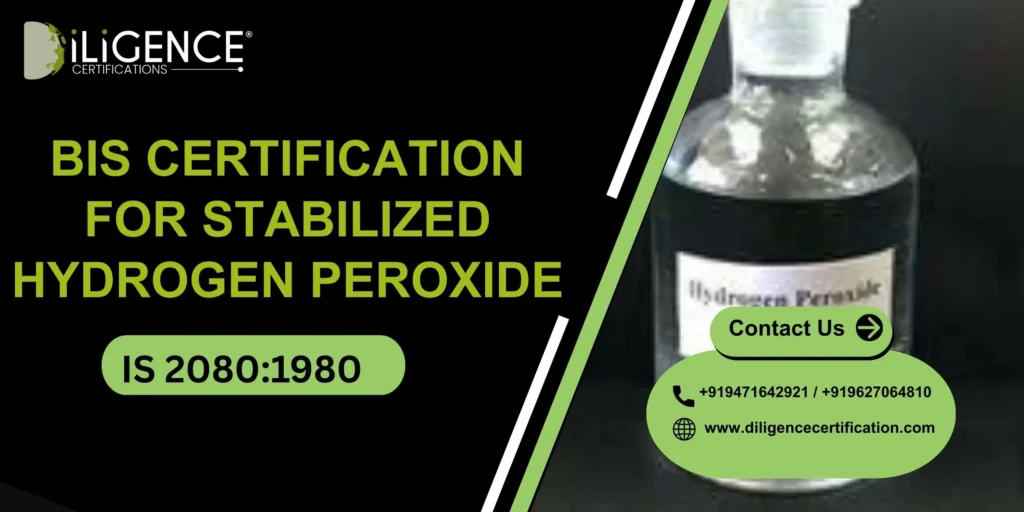
- Regulatory Authority: Certification is provided by the “Bureau of Indian Standards”(BIS).
- Justification: This ensures that there is legal production and sale of the product
- Quality Compliance: The requirements relating to purity standards, concentration levels, and stabilization have been outlined under IS 2080:1980.
- Mandatory Testing: Product samples are required to be tested in BIS-recognized laboratories in order to confirm their conformity to the required standards.
- Factory Inspection: Inspection is carried out by BIS to evaluate the manufacturing process and storage conditions.
- ISI Mark Licensing: Subject to compliance, industries are allowed to mark and use ISI, which implies reliability, safety, and conformity to standards.
Introduction
The BIS Certification Code: Stabilized Hydrogen Peroxide in Accordance with IS 2080 : 1980 is a statutory requirement that results in the chemical meeting specified norms in terms of quality, purity, and stability to make it safe and acceptable in industry and laboratories in the country. This certification is made available by the Bureau of Indian Standards (BIS) after ensuring the chemical meets specific established norms concerning its properties and packing. This certification is important to rule out any potential dangers concerning the improper strength or instability of hydrogen peroxide. For the manufacturer to have the BIS license, they have to test their products through special testing and factory audits.
What is IS 2080:1980?
IS 2080:1980 Title: Stabilised hydrogen peroxide (Industrial and laboratory grade) The Bureau of Indian Standards, after consulting some representatives of concerned interests and in conformity with the procedure laid down under the Bureau of Indian Standards Act, 1986, has prepared this standard. These Indian Standard lays down the quality requirements of stabilized hydrogen peroxide of industrial and laboratory grades. The standard specifies permissible concentration, purity, and limit of impurities for safe handling and reproducibility of performance characteristics of chemical substances. The standard specifies methods of test, packaging, marking, and storage with a view to avoiding risks associated with possible decomposition or contamination and misuse.
Key Points:
- Issuing Authority: IS 2080:1980 is an Indian Standard issued by the Bureau of Indian Standards (BIS).
- Product Scope: It is applicable for stabilized hydrogen peroxide solution that have industrial and laboratory use.
- Quality Specifications:The norm specifies the concentration, purity, and stability of hydrogen peroxide.
- Testing Methods: It specifies the testing methods to be adopted to check the compliance level for the parameters of chemicals and physical properties.
- Packaging & Marking: There are directions for safe packaging and packing as per the standard IS 2080:1980.
Why is BIS Certification Mandatory
The BIS Certification is compulsory to make sure the product maintains the laid-down “Indian Standards” regarding its “quality, safety, and performance” prior to its manufacture, sale, or distribution within the boundaries of the country. The certification is administered by the “Bureau of Indian Standards” to shield the “consumers, industries, and the environment” within the country against “substandard or unsafe” or “harmful” material. The compulsory “BIS Certification” is required to prevent “health hazards and risks,” as well as “ensure uniformity of product quality,” besides “enabling and promoting” “good and fair” “trade practices” and “regulatory compliance.” For “critical” or “chemical” substances, “misuse risks” and “national safety” “norms” are also further “alleviated.”
Key Reasons:
- Safety Assurance: For BIS certification, there is an obligatory process ensuring that the product meets set safety standards, hence with minimal safety and environmental concerns.
- Quality Assurance: This quality ensures quality, constitution, and performance to Indian Standards specifications.
- Legal Compliance: Certification is mandatory by law for the manufacture, import, or selling of notified products in India.
- Consumer Protection: It shields consumers from inferior, adulterated, or harmful products through certification provided by the BIS.
- Control and regulatory supervision: Because it enables the BIS to conduct testing, inspection, and surveillance to ensure there is adequate monitoring and control.
Importance and Benefits of BIS Certification
| Importance | Benefits |
| Safety Compliance: The criteria that ensures the product abides by the recommended safety standards and risk control guidelines | Consumer Confidence: It ensures the consumers of the soundness and safety of the products. |
| Standardized Quality: It preserves a standard quality as per the Indian Standards. | Reduced Risk: It reduces the possibility of failure and products recalled. |
| Legal Authorization: It gives the legal right to manufacture, import, and sell the product in the Indian market. | Competitive Advantage: The certified products shall be selected in tendering and contracting. |
| Market Credibility: It increases credibility in the market, as it is an approved listing company | Brand Value: Enhances brand value and acceptability in the domestic markets. |
| Regulatory Control: It helps in regulating control by the Bureau of Indian Standards (BIS). | Quality Improvement: This is an activity that engages quality management, with a main goal of improving |
Step-by-Step Process of BIS Certification
Step1:Documentation
- Collect required technical documents
- Prepare product specifications
- Gather company registration details
- Ensure documents follow BIS format
Step2:Product Testing
- Send samples to a BIS-approved lab
- Conduct safety and quality tests
- Receive test reports
- Confirm compliance with BIS standards
Step3:Application Submission
- Fill out the BIS application form
- Upload all required documents
- Attach valid test reports
- Pay the necessary BIS fees
Step4:Scrutiny and Inspection
- BIS reviews submitted documents
- Authority verifies test results
- Factory/product inspection may occur
- Clarifications requested if needed
Step5:Grant of License
- BIS approves the application
- License number is issued
- Product can carry BIS mark
- Renewal required before expiry
Documents Required for BIS Certification
| Category | Documents Required |
| Business Documents | Business license/registration, ISO certificate, organizational details |
| Manufacturer Details | Factory layout, process flow chart, machinery list, production details |
| Product Documents | Product specifications, component list, user manual, model details |
| Testing Documents | Test report from BIS-recognized lab, sample details, test request form |
| Legal & Compliance | Authorization letter, brand ownership proof, trademark certificate (if any) |
| Import/Foreign Manufacturer (If applicable) | AIR (Authorized Indian Representative) details, contract agreement, overseas manufacturer documents |
Timelines, Costs, Validity & Renewal
- Timelines: Usually from 20 to 30 days, with only 7-15 days for the testing.
- Costs: The cost of the government and the test varies depending on the product. There can be some additional charges though.
- Validity: The validity period is 2 years in most situations.
- Renewal: The renewal is done before the expiration; there should be updated documents/tests; the renewal
Why Choose Diligence Certifications
Diligence Certifications is an reliable compliance advisory consultancy, which offers complete assistance regarding BIS and other regulatory certification compliances and requirements in India. Because of its rich domain knowledge and thorough awareness of the law, the entire team works faithfully to get the right execution of documentation and formalities regarding timely approvals. Diligence Certifications is committed to make the complexity of compliance as less as possible and deliver the most affordable solutions to its every customer.
Conclusion
BIS Certification is very important for ensuring the safety, quality, and compliance of products in the Indian market. A company can follow certain standards to establish trust and ensure a safe growth of products. An efficiently guided process of certification can assure a company of easy compliance without any delay and can also ensure long-term compliance with government laws and policies, which is very important for the growth of a company.
Frequently Asked Questions (FAQs)
What does BIS Certification?
It is a conformity assessment certification, which is issued by the Bureau of Indian Standards, commonly known as the BIS.
Is BIS Certification mandatory for Stabilized Hydrogen Peroxide?
“Yes, as it is mandatory for legal production, sale, and distribution in India.”
What does IS 2080:1980 cover?
It comprises the criteria for quality, purity, concentration, testing, packaging, and storage.
Who needs to apply for BIS Certification?
Manufacturers and importers of stabilized hydrogen peroxide, where the product is to be used industrially or in a laboratory.
Which grades come under IS 2080:1980?
Industrial and laboratory use grades of stabilized hydrogen peroxide.
Does the product need to undergo testing?
Yes, samples need to be tested in laboratories recognized by BIS.
Does BIS conduct factory inspections?
Yes, BIS has entered the field of the inspection of manufacturing facilities and storage conditions.
What is the ISI mark?
A certification mark indicates that a product confirms to the Indian Standards.
What is the validity of a BIS license?
This will generally be valid, an operational license, for a period of up to 2 years, subject to renewal.
Is it possible to renew the BIS certification?
Yes, it is to be renewed before the date of expiry with updated documents and compliance.