

 BIS Certification
 CDSCO
CDSCO
 CPCB
CPCB
 LMPC
LMPC
 WPC Approval
 Global Approvals
 TEC
TEC
 ARAI
ARAI
 BEE
BEE
 ISO Certification
 DGCA Certification
 NOC For Steel
 APEDA Registration











 Business Registration
 FSSAI Mark Certification










 Legal Services
 Trademark Registration
 Copyright Registration
 Patent Registration
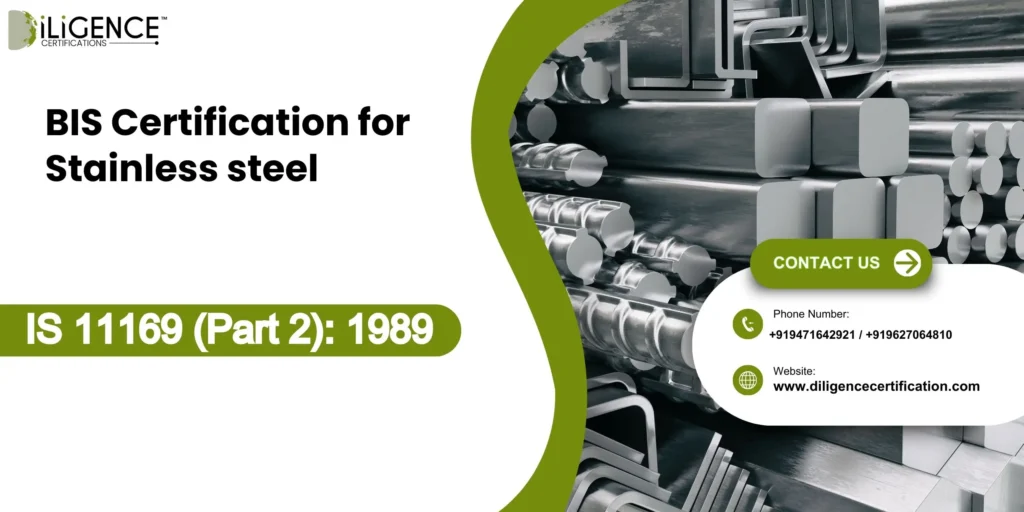
- BIS certification ensures stainless steel meets IS 11169 (Part 2): 1989 standards.
- Being certified facilitates the market acceptance of the product and the access to the government and industrial contracts.
- The steps are filing the application, submitting documents, plant inspection and laboratory testing.
- Typical problems are incorrect metal composition, insufficient documentation, and failure in laboratory tests.
- Advantages are alignment with the law, gaining consumer confidence, potential for exports, and increasing business.
Introduction
In 2020, a stainless steel producer from Ahmedabad had to forgo a couple of government orders even after making good-quality, steel. The cause was undeniable: their products didn’t have a BIS certification under IS 11169 (Part 2): 1989. A large number of Indian manufacturers concentrate mainly on the quality of their output while compliance with regulations, which is very important for getting credit and entering the market, is overlooked by them. BIS certification confirms that a product complies with national standards and is a source of trust for industrial, government, and export clients. Doing the right thing can be a stepping stone to getting more business and ensuring sustainable growth. Bureau of Indian Standards
What is IS 11169 (Part 2): 1989?
IS 11169 (Part 2): 1989 is the Indian Standard that provides the criteria for stainless steel used in construction and industry. In order to keep the metal of good quality, durable, and resistant to corrosion, the standard defines the chemical composition, mechanical properties, and the testing method. It is a must for the manufacturers intending to supply stainless steel products of industrial, architectural, or food-grade to the Indian market to be in conformity with this standard.
Key Points:

- The standard covers the grades of stainless steel for the structures and the industries.
- It determines the limits of the content of chromium, nickel, and other alloying elements in the steel.
- Besides that, the standard is specifying tensile strength, elongation, and hardness values as well.
- On top of that, it defines the procedures to be used for testing corrosion resistance and mechanical performance.
- The standard is a legal requirement for government and other industrial procurements. ISI MARK
- The standard serves as a product quality, safety, and acceptance in the market assurance.
Why is BIS Certification Mandatory
BIS certification is a must for stainless steel as per IS 11169 (Part 2): 1989 as it is the main instrument that ensures products comply with Indian safety, quality, and performance standards. In addition, it is the instrument that provides safety to buyers, it is binding on the law and is a must for government contracts, industrial, and large-scale procurement.
Key Points:
- Guarantees that the products meet Indian safety and quality standards.
- Creates trust with industrial, government, and export buyers.
- It is a must for government tenders and specific industrial projects.
- Helps to prevent the entry of substandard or unsafe products into the market
- Improves brand credibility and acceptance in the market.
- Enables business growth in line with regulatory requirements in the long run.
Importance and Benefits of BIS Certification
| Importance | Benefits |
| Ensures compliance with IS 11169 (Part 2): 1989 standards | Builds trust with buyers and clients |
| Mandatory for government and industrial contracts | Enhances market credibility and brand image |
| Guarantees product quality and safety | Opens export and industrial opportunities |
| Reduces risk of legal penalties | Improves consumer confidence and loyalty |
| Standardizes manufacturing and testing processes | Supports long-term business growth |
Step-by-Step Process of BIS Certification

Step1:Documentation
- Collect required technical documents
- Prepare product specifications
- Gather company registration details
- Ensure documents follow BIS format
Step2:Product Testing
- Send samples to a BIS-approved lab
- Conduct safety and quality tests
- Receive test reports
- Confirm compliance with BIS standards
Step3:Application Submission
- Fill out the BIS application form
- Upload all required documents
- Attach valid test reports
- Pay the necessary BIS fees
Step4:Scrutiny and Inspection
- BIS reviews submitted documents
- Authority verifies test results
- Factory/product inspection may occur
- Clarifications requested if needed
Step5:Grant of License
- BIS approves the application
- License number is issued
- Product can carry BIS mark
- Renewal required before expiry
Documents Required for BIS Certification
| Category | Documents Required |
| Business Documents | Business license/registration, ISO certificate, organizational details |
| Manufacturer Details | Factory layout, process flow chart, machinery list, production details |
| Product Documents | Product specifications, component list, user manual, model details |
| Testing Documents | Test report from BIS-recognized lab, sample details, test request form |
| Legal & Compliance | Authorization letter, brand ownership proof, trademark certificate (if any) |
| Import/Foreign Manufacturer (If applicable) | AIR (Authorized Indian Representative) details, contract agreement, overseas manufacturer documents |
Timelines, Costs, Validity & Renewal
- Timelines: Usually from 20 to 30 days, with only 7-15 days for the testing.
- Costs: The cost of the government and the test varies depending on the product. There can be some additional charges though.
- Validity: The validity period is 2 years in most situations.
- Renewal: The renewal is done before the expiration; there should be updated documents/tests; the renewal
Why Choose Diligence Certifications
- Expert team with strong BIS and regulatory knowledge
- Fast, streamlined processing to reduce approval delays
- Accurate documentation and testing coordination
- Transparent guidance with clear communication
- High success rate and complete end-to-end support
Conclusion
BIS Certification for Stainless Steel IS 11169 (Part 2): 1989 is a must to have for a manufacturer who wants to comply with regulations and win the trust of the market. In addition to BIS certification, a diligence certificate helps to confirm compliance by indicating that manufacturing processes, documentation, and quality checks have been thoroughly audited. The two certificates together raise the manufacturer’s credibility, guarantee the quality is consistent, and facilitate access to the government, industrial and export markets. Manufacturers who execute the right procedures and keep up with quality controls will be able to ensure their growth is sustainable and their products will be recognized as reliable and safe in the stainless steel industry competition.
Frequently Ask Questions
What is IS 11169 (Part 2): 1989?
This document determines stainless steel quality, the grades of stainless steel, and the methods for testing stainless steel which, are generally, pretty straightforward from the document.
Is BIS certification under this standard mandatory for stainless steel?
My point of view is that if BIS certification is mandatory then the first production unit of stainless steel that meets the requirements of IS 11169 (Part 2): 1989 should be made and then the finished products should be marketed.
Which company issues the BIS certification?
BIS or the Bureau of Indian Standards, is the one that issues the certificate.
How long is the entire duration of the BIS certification?
Usually the entire duration including the testing is somewhere between 20 and 30 days.
What are the main points in the process of getting BIS Certified?
Preparation of the file, product testing, application submission, factory audit, and license awarding.
What papers are the most important for BIS certification?
The main documents for the business are product specification, test report, factory information, and documents related to compliance.
How long is the BIS license valid?
The normal time for which the BIS license is valid is two years.
Are manufacturers required to have a factory inspection?
Definitely, a BIS factory inspection is something that can be anticipated.
Can a foreign manufacturer apply for a BIS certificate?
Yes foreign manufacturers can do that only if they have an Authorized Indian Representative (AIR).
What happens if the product fails the BIS test?
The manufacturer should fix the defects and then send the samples for testing again.