 BIS Certification
 CDSCO
CDSCO
 PESO
PESO
 CPCB
CPCB
 LMPC
LMPC
 WPC Approval
 Global Approvals
 TEC
TEC
 ARAI
ARAI
 BEE
BEE
 ISO Certification
 DGCA Certification
 NOC For Steel
 APEDA Registration










 Business Registration
 FSSAI Mark Certification









 (32).jpg)
 Legal Services
 Trademark Registration
 Copyright Registration
 Patent Registration
 By
By Key Highlights
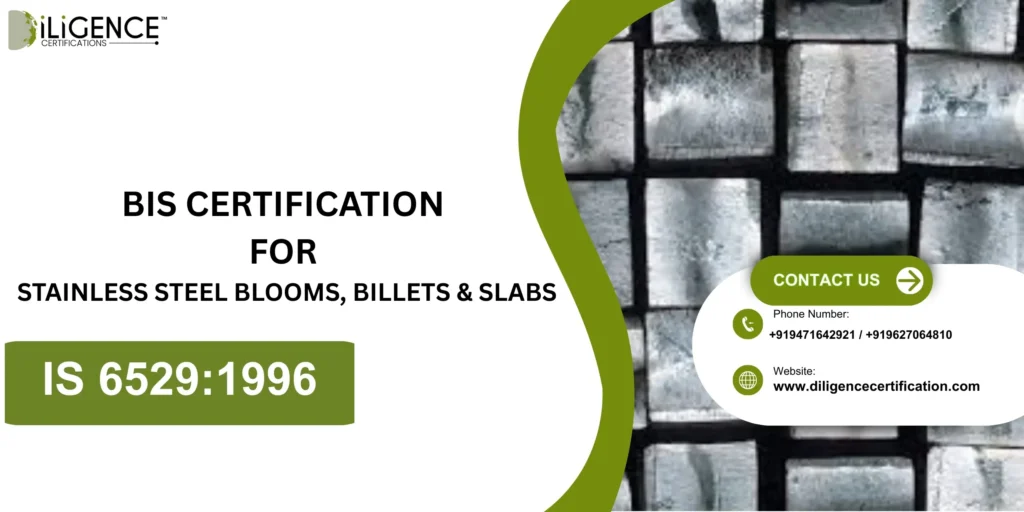
- Mandatory Certification: Manufacturers and suppliers of stainless steel blooms, billets, and slabs in India must be BIS certified under IS 6529:1996.
- Quality assurance: Provides customers with assurance that products conform to rigorous protective engineering and industrial use applications suited for service, in relation to chemical composition, mechanical properties, and dimensional tolerances.
- Safety & reliability: Provides protection for the customer, to ensure substandard or unsafe materials are not provided.
- Factory and sample testing: Approval requires inspection of the factory and testing representative samples against the BIS certification by a recognized testing laboratory.
- Traceability and marking: Manufacturers will maintain full traceability from the melt to the finished product and mark the products as required by BIS.
Introduction
A prominent manufacturer of stainless steel based in Jamshedpur took the time to talk with us about a common challenge they were facing: despite producing high-quality stainless steel blooms, billets, and slabs, they were losing significant business because buyers, particularly in critical sectors for engineering and defence applications, were unwilling to accept non-certified stainless steel. The missing link was BIS certification under IS 6529:1996, a guarantee that their product met India’s very stringent requirements for quality. IS 6529:1996 describes the chemical composition, mechanical properties, dimensional tolerances, and marking of stainless steel blooms, billets, and slabs. It confirms that these raw materials, the starting point for much of our fabrication work in heavy engineering, automotive, and industrial applications, are safe for use, and will perform to required standards.
Manufacturers without BIS Certification experience hardships: reduced access to markets, higher rejection rates, lack of brand agency. In contrast manufacturers that carry certification experience regulatory compliance, improved customer confidence, and capability to enter more lucrative markets.
In the highly competitive steel industry, the possession of BIS certification is more than a statutory requirement, it is a strategic asset that provides a guarantee of quality, traceability, and affirms the brand as reliable and trustworthy, in both domestic and international market sectors.
What is IS 6529:1996?
IS 6529:1996 is a Bureau of Indian Standards (BIS) specification for stainless steel blooms, billets, and slabs. It outlines the required qualities, chemical composition and mechanical properties, dimensional requirements, and marking requirements for stainless steel materials utilized in heavy engineering and industrial applications.
This specification applies to blooms, billets, and slabs of stainless steel manufactured for further processing or use in structurally engineered applications.
This specification ensures the material reliability for defence, aerospace, automotive, construction while applying and for the industrial machine industry.
Key Points
- Quality Assurance: Verifying the stainless steel blooms, billets and slabs meet strict chemical, mechanical and dimensional requirements.
- Safety and Reliability: Protecting the end user from getting non-compliant or unsafe stainless steel.
- Factory Inspection & Sample Testing: After getting BIS approval you will have a factory inspection of your manufacturing facility and sample testing will be performed at BIS approved laboratories.
- Traceability & Marking: Your products must be traceable from production to shipment and be marked in accordance with BIS requirements.
- Market Access & Credibility: Certified products gain higher acceptance, lower rejection rates, and entry into PSU, defence, and export markets.
- Compliance & Legal Requirement: Selling non-certified products can result in penalties under the BIS Act.
- Renewal & Validity: Certification is generally valid for 2 years, with renewal requiring updated documentation and re-verification.
Why is BIS Certification Mandatory
BIS Certification is mandatory for stainless steel blooms, billets, and slabs as these materials are widely used in critical construction, engineering, industrial, and infrastructural applications in which quality and safety are of utmost importance. As per the Quality Control Order (QCO) published by the Ministry of Steel, it is illegal to manufacture, sell, offer for sale, or import into India any one of these materials without BIS Certification.
- Ensures Product Safety: Ensures compliance of the stainless steel in regard to the necessary mechanical and chemical characteristics, ensuring an adequate safety factor against structural failure or unsafe uses.
- Protection of End Users: Protects against the use of inferior quality or counterfeit materials in defence, railway, automotive and heavy engineering sectors.
- Regulation Compliance: Ensures that manufacturers follow national standards, and eliminates any liabilities under the BIS Act requirements.
- Consistency of Product Quality Across the Manufacturer Base: All suppliers must meet the same requirements, thereby ensuring continuous performance and reliability.
- Market Access: Many government tenders, as well as PSUs/OEMs, require the steel supplier be BIS Certified for procurement.
- Traceability & Accountability: BIS Certification requires suitable marking and tracking identification of batches, thereby ensuring complete traceability.
Importance and Benefits of BIS Certification
| Importance | Benefits |
|---|---|
| Confirms that materials used in tool and die steels conform to the required BIS quality standards. | Lowers product rejection rates and establishes product consistency. |
| Essential for manufacturing, selling, or importing under the mandatory Quality Control Order (QCO). | Creates access to PSU, defence, and OEM supply chains where approval by BIS is required. |
| Protects end-users from unsafe, sub-standard, low-quality steel products. | Develops customer trust, loyalty, and increases brand value. |
| Ensures complete outgoing traceability from the melt stage to the finished product. | Reduces compliance risks during audits or inspections. |
| Assists Indian manufacturers in staying in-line with national regulatory and quality standards. | Improves manufacturer competitiveness in both domestic and export market. |
Step-by-Step Process of BIS Certification
Step 1: Documentation
- Assemble all the necessary technical documents
- Create detailed product specifications
- Collect company registration and legal documentation
- Verify that all documents conform to the required BIS format
Step 2: Product Evaluation
- Submit product samples for testing to a BIS-recognized laboratory
- Conduct required testing of the products for safety, mechanical, and quality
- Request the test reports from the laboratory
- Confirm that the product meets the appropriate BIS standards
Step 3: Application Process
- Complete the official BIS application
- Upload all technical and company documents
- Upload valid test reports from a BIS-recognized testing lab
- Pay the appropriate BIS certification application fee
Step 4: Review Process
- BIS officials will review all the documents provided
- Verification of product test results and technical information
- BIS may inspect the factory and products if required
- Request for additional clarifications as necessary
Step 5: License Issue
- The BIS will approve the certification application
- BIS will assign a unique license number to the product
- The product may now carry the BIS Standard Mark
- The license must be renewed prior to the date of expiry
Documents Required for BIS Certification
| Category | Documents Required |
|---|---|
| Business Documents | Business license/registration, ISO certificate, organizational details |
| Manufacturer Details | Factory layout, process flow chart, machinery list, production details |
| Product Documents | Product specifications, component list, user manual, model details |
| Testing Documents | Test report from BIS-recognized lab, sample details, test request form |
| Legal & Compliance | Authorization letter, brand ownership proof, trademark certificate (if any) |
| Import/Foreign Manufacturer (If applicable) | AIR (Authorized Indian Representative) details, contract agreement, overseas manufacturer documents |
Timelines, Costs, Validity & Renewal
Timelines
The complete BIS certification procedure typically takes between 20 and 30 days.
Product testing at a BIS-accredited laboratory takes about 7 to 15 days, depending on complexity and availability of the sample.
Costs
Certification costs consist of government fees and testing fees. These vary based on the product type and the number of samples.
Additional fees may apply based on any actual factory inspections, how documentation is handled, or how quickly the needs are completed.
Validity
A BIS license is usually valid for 2 years from the date it was issued.
Renewal
- Renewal must be applied for before the license expires.
- Renewal requires new documents, test reports, and evidence of compliance.
- Renewing in a timely manner will allow continued permission to use the BIS/ISI mark on the certified product.
Why Choose Diligence Certifications?
Navigating the BIS Certification process for stainless steel blooms, billets, and slabs can be complicated because of different chemical, mechanical, and dimensional requirements. Diligence Certifications provides expert guidance and fully supportive services while ensuring manufacturers become compliant.
Conclusion
For a manufacturer, being BIS Certified for Stainless Steel Blooms, Billets & Slabs to IS 6529:1996 is critical because, in the end, it gives the assurances of quality, safety, and adherence to the legal environmental requirements. Certification provides assurances that your product is a quality product with the appropriate chemical, mechanical, and dimensional properties providing protection for the end user’s safety and traceability throughout the supply chain.
Above and beyond legal environmental compliance, BIS Certification offers manufacturers measurable advantages in the marketplace such as lower product rejection rates, increased customer confidence, and participation in higher value markets including government projects, PSUs, defence sector components, and global sourcing from offshore buyers/companies.
Frequently Asked Questions
What is BIS Certification for stainless steel blooms?
It is a mandatory approval ensuring stainless steel blooms meet IS 6529:1996 quality and safety standards.
Is BIS Certification mandatory for blooms, billets, and slabs?
Yes, it is compulsory under the Quality Control Order issued by the Ministry of Steel.
Which standard applies to stainless steel blooms?
IS 6529:1996 specifies chemical, mechanical, and dimensional requirements.
Why is BIS Certification important?
It guarantees product safety, reliability, and compliance with Indian regulations.
Who needs BIS Certification?
Manufacturers, importers, and suppliers of stainless steel blooms, billets, and slabs.
What tests are required for certification?
Chemical analysis, mechanical testing, and dimensional verification at BIS-approved labs.
How long does BIS Certification take?
Typically 20 to 30 days, depending on testing and document review.
What documents are required?
Business license, factory details, product specs, test reports, and compliance documents.
How long is the BIS license valid?
The license is valid for 2 years and must be renewed before expiry.
Can foreign manufacturers apply?
Yes, but they must appoint an Authorized Indian Representative (AIR).


