

 BIS Certification
 CDSCO
CDSCO
 CPCB
CPCB
 LMPC
LMPC
 WPC Approval
 Global Approvals
 TEC
TEC
 ARAI
ARAI
 BEE
BEE
 ISO Certification
 DGCA Certification
 NOC For Steel
 APEDA Registration










 Business Registration
 FSSAI Mark Certification










 Legal Services
 Trademark Registration
 Copyright Registration
 Patent Registration

- ISI certification for stainless steel cookware is mandatory in India.
- Cookware must conform to IS 14756:2022.
- Certification ensures safety, durability, and hygiene.
- The BIS license allows manufacturers to put the ISI mark on their cookware.
- BIS certification applies to both foreign and Indian manufacturers and importers.
- The process consists of an online application, an audit of the manufacturer’s factory, and product testing.
- BIS certification is valid for up to 2 years, and is renewable.
Introduction
Increasingly aware of product safety and quality, the manufacturers and importers in India are now required to comply with Indian Standards set by the Bureau of Indian Standards (BIS). One of those essential certifications is for Stainless Steel Cookware under IS 14756:2022, a mandate to take care of ensuring the safety, durability, and quality of cookware for use within Indian households and commercial setups.
In this comprehensive guide, we will cover everything about BIS Certification for Stainless Steel Cookware, including IS 14756:2022 standard, benefits, testing requirements, as well as the certification process.
What is IS 14756:2022 – Stainless Steel Cookware?
IS 14756:2022 refers to an Indian Standard for stainless steel cookware for domestic and commercial use, as well as its physical, chemical, and mechanical properties, specifications for other utensils such as:
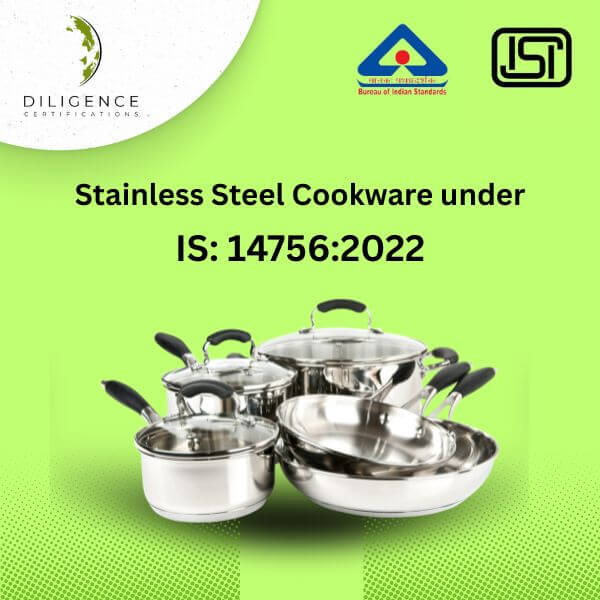
- Frying pans
- Sauce pans
- Pressure cookers (stainless parts)
- Bowls for serving
- Tawas etc
This has been proposed because these cookers are made of corrosion-resistant stainless steel, safe for food contact, and fulfill performance parameters of thermal stability, material strength, and ergonomic design.
The Quality Control Order (QCO) has made the IS 14756:2022 Mandatory, therefore, no products of such category can be sold in India without BIS certification.
Why is BIS Certification Mandatory for Stainless Steel Cookware?
According to the IS 14756:2022 standard, all stainless-steel cookware must have certification by the Bureau of Indian Standards. This document sets down certain requirements regarding the quality of materials, the durability of cookware, and its performance for the cookware to be considered reliable for daily cooking needs.
Providing certification to kitchenware according to this standard implies that its assessment was undertaken for corrosion resistance, thermal conductivity, structural stability, and safety for contact with food-all of which ultimately assure safety of the goods in the eyes of the customer. The conclusion of this standard is an endorsement of the manufacturer’s willingness to produce stainless steel cookware of the finest quality, guaranteeing the cookware a trouble-free working life, hygienic conditions, and good cooking results.
The Government of India found it necessary to make BIS certification mandatory for stainless steel cookware through the Cookware and Utensils (Quality Control) Order, to protect consumer health while ensuring the quality of the product.
This means:
- Manufacturers (domestic and foreign) must comply with IS 14756:2022.
- Cookware must be tested in BIS-recognized laboratories.
- Only certified products can bear the ISI Mark, a symbol of quality and safety.
- Import of non-certified cookware is strictly prohibited
Benefits of BIS Certification for Stainless Steel Cookware
1. The first and foremost benefit of getting BIS certification is legal compliance. To sell stainless steel utensils in India, it is necessary to follow the BIS norms.
Adhere to IS 14756:2022 standards and avoid penalties or confiscation of products.
2. The second reason is consumer trust.
3. Consumers prefer the ISI mark as it is synonymous with quality and food safety.
4. Accessibility in the market– BIS certification is a must for both retail and B2B cookware markets in India.
5. The brand value is enhanced by getting BIS certified. It builds credibility in the market and stands to differentiate your products from those of uncertified competitors.
6. Product Quality The rigorous test procedure by BIS ensures that your cookware is of the highest quality.
Key Highlights of IS 14756:2022 Standard
Here are some critical elements of the IS 14756:2022 standard:
| Feature | Details |
| Material | Austenitic or ferritic stainless steel is suitable for food contact |
| Corrosion Resistance | Mandatory salt spray test to ensure long-term durability |
| Thermal Shock Test | Checks for deformation due to heating and cooling |
| Ergonomics | Handles and lids must comply with user safety standards |
| Finishing | Polishing and welding must be smooth and free from defects |
| Marking | ISI mark, batch number, and manufacturer code must be engraved or printed |
BIS Certification Process for Stainless Steel Cookware

Whether you are a domestic manufacturer or a foreign exporter, here is a step-by-step process to obtain BIS Certification for Stainless Steel Cookware under IS 14756:2022:
Step 1: Application Filing on Manakonline Portal
Start your certification journey by submitting your application through the Manakonline Portal, selecting the appropriate route based on your manufacturer type:
- SPDM (Simplified Procedure for Domestic Manufacturers)
- FMCS (Foreign Manufacturers Certification Scheme) Your application must include:
- Manufacturer’s Details: Legal name, address, contact information.
- Product Specifications: Type of cookware, material grade, dimensions, etc.
- Factory Location: Exact address and layout of the manufacturing unit.
- Brand Name: The label or mark under which the product is sold.
- Test Reports (if available): From a BIS-recognized lab or in-house facility.
Step 2: Product Testing in BIS-Recognized Laboratory
After application submission, the stainless steel cookware must be tested as per IS 14756:2022 standards. The product is evaluated for:
- Corrosion Resistance: Durability against rust and chemical exposure.
- Handle Strength: Load-bearing and detachment resistance.
- Lid Fitting: Compatibility and sealing efficiency.
- Heat Resistance: Stability under prolonged heating.
BIS mandates testing in BIS-approved laboratories only.
Step 3: Factory Audit and Inspection
Next, BIS officials conduct a detailed on-site factory inspection to assess:
- Manufacturing Processes: Material sourcing, equipment, and procedures.
- Quality Control Systems: Inspection, testing, and monitoring protocols.
- Infrastructure & Documentation: Record-keeping, calibration logs, and traceability.
Step 4: Review and Grant of BIS License
Once both product testing and factory inspection are completed, BIS proceeds to review the documentation and test results.
- If all standards are met, a BIS license is issued to affix the ISI Mark on the product.
- The initial license is valid for 1 year, after which it can be renewed annually.
Step 5: Post-License Surveillance and Renewal
After receiving the license, manufacturers must maintain ongoing compliance, which includes:
- Periodic Product Testing: At BIS or independent labs.
- Surprise Inspections: Random audits by BIS officials.
- Timely Renewal: Apply before expiry with updated test reports and renewal fee.
BIS QCO for Stainless Steel Cookware, Utensils, and Cans
The Quality Control Order (QCO) under the Department for Promotion of Industry and Internal Trade (DPIIT) as part of the Ministry of Commerce and Industry, is directed at articles that come under the category of cookware, utensils, and cans that may be used for foods and beverages.
The Order provides that these articles should comply with of the Indian Standard IS 14756:2022 – Stainless Steel Utensils. As required under Scheme I of Schedule II of the Bureau of Indian Standards (Conformity Assessment) Regulations of 2018, the manufacturers must obtain a BIS license and mark their products with the Standard Mark (ISI Mark).
Key Provisions:
- The order is applicable to cookware, utensils, and food/beverage cans made of stainless steel for sale on the Indian market.
- The product must conform to IS 14756:2022 as the compliance standard.
- The product should bear the Standard Mark under a valid BIS license, according to Scheme I of the BIS regulations, as a certification requirement.
Exemption:
The QCO does not apply to goods manufactured in the country, which are subsequently exported.
The implementation schedule for MSME industries will be as follows:
- Small enterprises: From July 1, 2025, compliance is compulsory.
- Micro enterprises: From October 1, 2025, compliance is mandatory.
The classification of an enterprise under the Micro, Small, and Medium Enterprises Development Act, 2006, is a must for phased implementation.
Diligence Certification renders a full-scale consulting and support services package for those seeking expert advice for BIS certification for stainless steel kitchenware and utensils.
Testing Parameters for Stainless Steel Cookware
BIS mandates detailed testing under IS 14756:2022. Some important tests include:
| Test Name | Test Name |
| Chemical Composition Test | Verifies steel grade suitability for food contac |
| Salt Spray Test | Checks corrosion resistance over time |
| Thermal Conductivity Test | Assesses even heat distribution |
| Impact Resistance Test | Ensures product durability |
| Handle Strength Test | Confirms safe and stable handling |
| Dimensional Accuracy Test | Confirms consistency in size and fitting |
All tests must be conducted in BIS-approved labs and results submitted during the certification process.
Documents Required for BIS Certification
To apply for BIS certification under IS 14756:2022, you will need:
- Factory registration documents
- ISO 9001 certificate (if applicable)
- Product specifications and catalog
- Layout and process flow of the factory
- In-house testing facilities list
- Test reports from the BIS lab
- Trademark certificate
- Power of attorney (in case of an Authorized Indian Representative for foreign brands)
Timeline & Cost of BIS Certification
| Factor | Description |
| Timeline | Typically 30–60 days, including testing and inspection |
| BIS Application Fees | Depending on category |
| Inspection Charges | As per BIS norms (travel + inspection day charges) |
| Testing Charges | Varies based on the number and type of products |
| Consultancy Charges | If applying via a BIS consultant like Diligence Certification |
How Diligence Certification Helps You
As one of India’s leading compliance consultants, Diligence Certification provides complete support for BIS Certification for Stainless Steel Cookware, including:
- Eligibility check and documentation
- Coordination with BIS labs for testing
- End-to-end application support
- Liaison for factory inspection
- Fast-track license issuance
- Renewal and post-certification compliance
Contact Diligence Certification to ensure a smooth and hassle-free BIS certification journey.
Conclusion
There is a greater compulsion than getting BIS Certification for Stainless Steel Cookware under IS 14756:2022. Now, in a safety and quality marketplace that also emphasizes regulatory compliance, a BIS certification is nothing but a must-have even if the brand is Indian or foreign. For BIS compliance is your ticket to enter India’s giant consumer market.
It becomes simple, streamlined, and most of all, worry-free with Diligence Certification on-board. Contact one of our compliance experts today to begin your BIS certification journey!
Frequently Asked Questions [FAQs]
What do we understand from IS 14756:2022?
It is an Indian Standard for stainless steel cookware covering requirements for quality, safety, and performance.
Is the standard BIS certification necessary for stainless steel cookware?
Yes, the BIS certification is necessary to sell or import any stainless steel cookware in India.
Who can apply for BIS certification?
Domestic manufacturers or Authorized Indian Representative(AIR) for foreign manufacturers may apply.
How long does the BIS certification take?
Generally, it shall take about 4 to 6 weeks, depending on testing and inspection timelines.
What documents are required?
The manufacturing details, product specifications, test reports, and quality control documents will be required.
What is the fee structure for BIS certification?
The rates vary; these include application fees, testing charges, inspection fees, and licensing fees.
Can I use the ISI mark if I have applied for it?
No, the ISI mark can be used only after obtaining a BIS license.
What happens if my product fails the test?
You will have to rectify the issue, after which testing of your product will have to be repeated.
What is the validity of the license obtained from BIS?
The license is valid for one year, followed by annual renewals.
Does Diligence Certification assist in BIS certification?
Yes. Diligence Certification shall provide complete assistance from the application stage to approval.