 BIS Certification
 CDSCO
 PESO
 CPCB
 LMPC
 WPC Approval
 Global Approvals
 TEC
 ARAI
 BEE
 ISO Certification
 DGCA Certification
 NOC For Steel
 APEDA Registration









 Business Registration
 FSSAI Mark Certification











 (32).jpg)
 Legal Services
 Trademark Registration
 Copyright Registration
 Patent Registration
 By
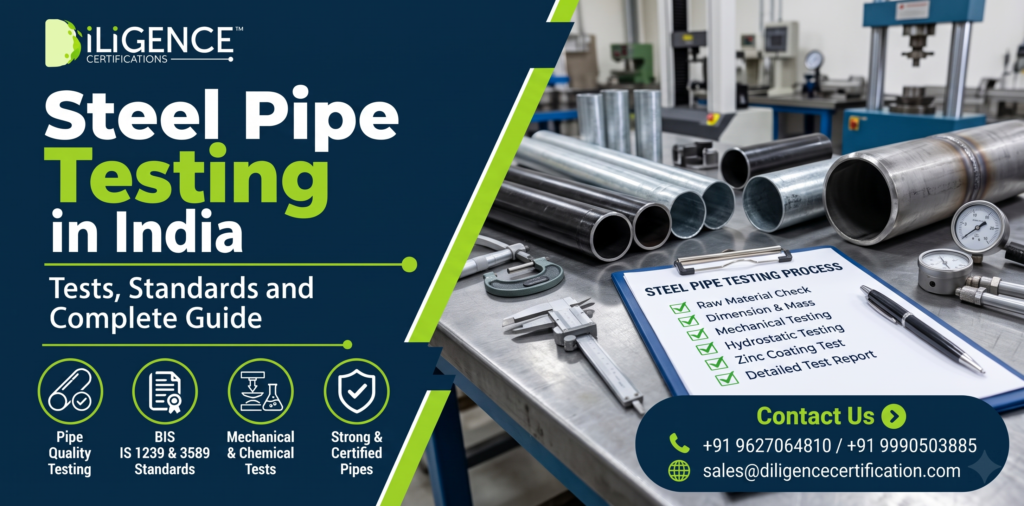
- Steel pipe testing checks strength, size, weight, coating and leak-tightness before pipes go to market.
- Different pipes follow different IS standards, like IS 1239 for tubes and IS 3589 for water and sewage pipes.
- Most tests are simple on paper, but one wrong sample or one missing record can fail the whole batch.
- Testing happens twice: in the factory lab for daily control, and in a recognised lab for outside proof.
- Rules for steel pipes have changed more than once, so always check the latest gazette before you plan.
- Good record keeping saves more time than any other single thing.
Introduction
Think of a doctor’s check-up. You feel fine, but the blood report tells the real story. Steel pipe testing is that blood report. The pipe may look perfect from outside, but only the lab can tell if it will crack, leak or bend under pressure.
In this blog, we’ll go step by step. What the tests are, which standards apply, how the process works and where people usually go wrong. Plain words, no jargon.
What Is Steel Pipe Testing?
Steel pipe testing means checking a pipe sample against the limits written in an Indian Standard. The lab checks the material, the size, the strength and the finish.
If the pipe meets every limit, it passes. If even one result is outside the limit, it fails.
There are two main reasons to test. First, quality control inside the factory. Second, certification, where a recognised lab gives a report that BIS or a buyer can trust.
Testing is done on pipes of many types. Welded pipes, seamless pipes, galvanised pipes, black pipes and large water pipes all go through their own set of checks.
Which Standards Apply to Steel Pipes?
There is no single standard for all pipes. The standard depends on the pipe type and where it will be used.
| Standard | What it covers |
|---|---|
| IS 1239 (Part 1) | Steel tubes for water, gas, air and general use |
| IS 1239 (Part 2) | Wrought steel fittings like elbows, tees and sockets |
| IS 3589 | Steel pipes for water and sewage (large diameter) |
| IS 1161 | Steel tubes for structural purposes |
| IS 3601 | Steel tubes for mechanical and general engineering |
| IS 4270 | Steel tubes for water wells |
Simple example: A plumbing contractor buying galvanised pipes for a building will usually look for IS 1239 Part 1. A pipeline company laying a big water line will look at IS 3589.
Important note: Quality Control Orders (QCOs) decide which standards are mandatory. The Steel and Steel Products QCO 2024 covers many steel items, and in November 2025 the Ministry of Steel suspended enforcement of some standards for one to three years. A separate draft order for iron and steel pipes, tubes and fittings was also issued in October 2025, and stainless steel pipes have their own order. So the position can differ pipe by pipe. Please check the latest gazette or BIS website before you decide.
Why Is Steel Pipe Testing Important?
- Weak pipes can burst under pressure and cause leaks, damage and accidents.
- Poor galvanising means early rust, and rusty water is a health problem.
- Wrong wall thickness gives you less strength than the buyer paid for.
- Buyers, tenders and government projects often ask for test reports.
- Testing protects your brand. One bad batch can cost you a long-term customer.
- It helps you find process problems early, before big stock is made.
What Tests Are Conducted on Steel Pipes?
The exact list depends on the standard. But most pipes face these checks.
| Test | What the lab checks | In simple words |
|---|---|---|
| Chemical analysis | Carbon, manganese, sulphur, phosphorus | Is the steel made of the right stuff? |
| Tensile test | Yield strength, tensile strength, elongation | How much pull can it take before it breaks? |
| Flattening test | Pipe is pressed flat till the walls touch | Does it crack when squashed? |
| Bend test | Pipe is bent around a fixed former | Can it bend without splitting? |
| Hydrostatic test | Water pressure inside the pipe | Does it leak under pressure? |
| Dimension check | Outside diameter, wall thickness, length | Is the size within tolerance? |
| Mass check | Weight per metre | Is the pipe too light? |
| Zinc coating test | Coating mass and uniformity | Is the galvanising thick and even? |
| Visual check | Surface, ends, weld seam, marking | Any cracks, dents or bad finish? |
For welded pipes, the weld seam gets extra attention. Labs may also use non-destructive checks, like eddy current or ultrasonic testing, to find hidden defects without cutting the pipe.
Galvanised Pipes: Extra Points to Know
Galvanised pipes carry a zinc layer over the steel. This layer is the pipe’s raincoat. If the coat is thin or patchy, rust shows up early.
What labs usually look at:
- Coating mass: how much zinc sits on each square metre of the pipe.
- Uniformity: the zinc should be even, with no bare spots.
- Adhesion: the zinc should not flake or peel when the pipe is handled or bent.
- Threading: threads should be clean and the coating should not crack at the threaded area.
Tip before sending samples: Check the pipe ends and threads yourself. Many failures start at the cut end, where the coating is damaged.
Two Kinds of Testing: Factory Lab and Recognised Lab
This part confuses a lot of people, so let’s keep it clear.
Factory lab (in-house testing). This is your own lab. You test every lot and keep records. For BIS licence, you need a lab with the required equipment and trained staff.
Recognised lab (outside testing). This is an independent lab that BIS accepts. It tests samples and issues a report. BIS also draws samples and sends them for testing during surveillance.
One is for daily control, the other is for outside proof. You need both.
Step-by-Step Process for Steel Pipe Testing and Certification
- Find your standard. Match your pipe type and end use with the right IS number.
- Check if it is mandatory. Look at the latest QCO and gazette for your product.
- Set up the in-house lab. Arrange the equipment, calibrated gauges and trained staff.
- Prepare the quality plan. Write down raw material checks, process checks and final checks.
- Make a trial lot. Produce pipes under normal conditions, not special ones.
- Test in-house. Run all the tests and record every result honestly.
- Send samples to a recognised lab. Pack them properly and label them clearly.
- Apply to BIS. File the application with test report, factory details and documents.
- Factory inspection and grant. BIS officers visit, check your set-up and may draw samples. If all is in order, the licence is granted.
Which BIS Licence or Route Is Needed?
| Your business | Usual route |
|---|---|
| Indian manufacturer | ISI Mark licence under Scheme-I |
| Foreign manufacturer | BIS licence under the Foreign Manufacturers Certification Scheme |
| Importer | Buys only from a licensed manufacturer, and keeps records |
| Trader or dealer | Sells only certified pipes with proper marking |
| Export-only manufacturer | Usually outside the order, but confirm in the latest notification |
A licence is usually for a specific product, standard and factory. If you add a new size range, change the process or move the plant, talk to BIS first.
Documents Required
Company documents
- Company registration or partnership deed
- Factory address proof
- Authorised person details
Product documents
- Product list with sizes and grades
- Manufacturing process flow chart
- Raw material details and supplier certificates
- Layout of the factory and lab
Testing records
- Calibration certificates of equipment
- In-house test records of recent lots
- Recognised lab test report
- Quality control staff details
How Long Does It Take?
It depends on your readiness. Testing itself is quick, usually a few days to a couple of weeks at the lab.
The longer part is the full licence process. Indian manufacturers often need around one to two months if everything is ready. Foreign manufacturers usually need much longer.
Missing documents and failed samples are the biggest cause of delay.
What Decides the Cost?
We can’t give a fixed number here, because every case is different. These things decide the cost:
- Number of tests in the standard
- Number of sizes and grades you want covered
- Lab charges for the selected lab
- BIS application and licence fees
- Equipment or lab upgrades needed in your factory
- Whether you take consultant support
Share your pipe type and sizes, and ask for a clear breakup before you start.
Common Failures and Easy Fixes
| Problem | Likely reason | Easy fix |
|---|---|---|
| Pipe cracks in flattening test | Weak weld or poor raw strip | Check strip quality and weld settings |
| Leak in hydrostatic test | Weld defect or pinhole | Tighten seam inspection before dispatch |
| Low zinc coating | Short dipping time or dirty surface | Fix pickling and dipping control |
| Weight per metre too low | Thin wall | Check wall thickness at several points |
| Size out of tolerance | Worn rollers or wrong setting | Recheck and recalibrate regularly |
Common Mistakes to Avoid
- Sending a hand-picked best piece as the sample instead of a random one.
- Using gauges that are not calibrated.
- Skipping raw material checks and testing only the final pipe.
- Keeping incomplete or backdated records.
- Ignoring marking rules on the pipe, like the standard number and brand.
- Assuming one standard covers all your sizes and types.
- Not tracking changes in the QCO and revised standards.
- Starting the application before the in-house lab is ready.
Who Needs Steel Pipe Testing?
- Manufacturers of welded, seamless or galvanised pipes.
- Importers who bring pipes from other countries.
- Private label brands that get pipes made by another factory.
- Overseas manufacturers selling into India.
- Contractors and buyers who want proof before they order in bulk.
Why Choose Diligence Certifications for steel pipe testing Certification?
Steel pipe rules are not simple, and they keep changing. That’s where practical guidance helps.
Diligence Certifications supports manufacturers and importers with standard selection, document preparation, sample planning and application follow-up. You can visit the Diligence Certification website to know more, or see the steel pipe certification service page for details.
We explain each step in plain language and tell you clearly what is needed. We do not promise approvals, because approval depends on your product, your factory and BIS review.
Quick Checklist Before Sending Samples
- Standard and pipe type confirmed
- Samples picked at random from a regular lot
- Pipe ends, threads and marking checked
- Wall thickness measured at multiple points
- Zinc coating checked, if galvanised
- In-house test records ready
- Calibration certificates updated
- Sample labels and packing done properly
Conclusion
Steel pipe testing is not just a formality. It’s the proof that your pipe can do the job it was made for.
Know your standard, check the latest QCO, test honestly in your own lab and keep clean records. Do these four things and most of the trouble goes away.
If you’re not sure where to start, talk to an expert before you make a big batch.