


 BIS Certification
 CDSCO
CDSCO
 CPCB
CPCB
 LMPC
LMPC
 WPC Approval
 Global Approvals
 TEC
TEC
 ARAI
ARAI
 BEE
BEE
 ISO Certification
 DGCA Certification
 NOC For Steel
 APEDA Registration











 Business Registration
 FSSAI Mark Certification



 Legal Services
 Trademark Registration
 Copyright Registration
 Patent Registration
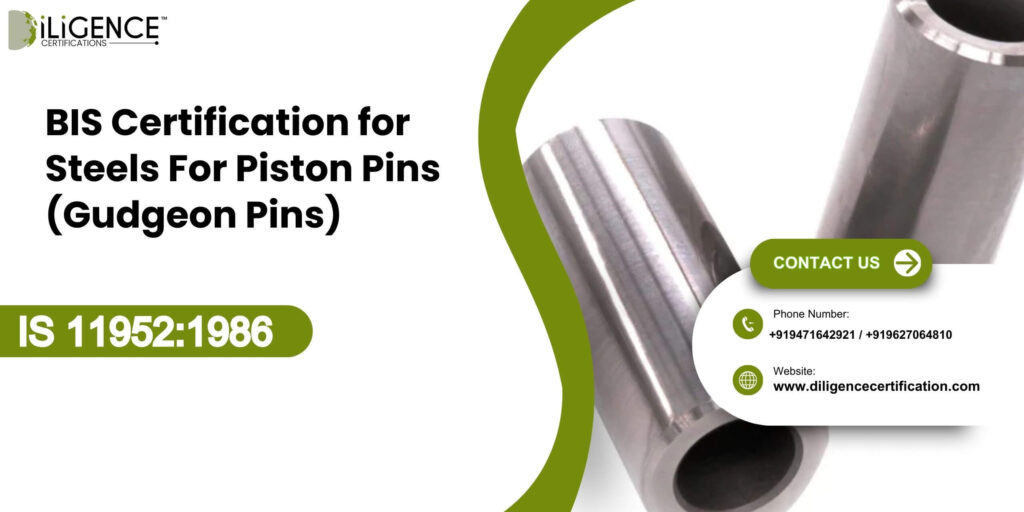
- BIS certification for steels utilized in Steels For Piston Pins implies conformity to the IS 11952:1986 standard.
- Quality of the material, reliability, and safety of the engine are assured by the certification.
- Producers of steels with a certificate become trusted by OEMs and customers.
- BIS certification is instrumental in the lowering of warranty claims and operational risks.
- Compliance with BIS standards allows for easier exports and acceptance in the market.
Introduction
A major motorcycle maker in Pune had to face the problem of their engines going bad all of a sudden in 2022. What was the reason? Piston pins that were breaking due to the devices’ normal operations, thus the company had to recall its products at a great cost and lose the trust of its clients. This instance from real life is a wake-up call for manufacturers and suppliers in India, saying that meeting the BIS Certification requirements for the steels that are going to be used in piston pins is not only a matter of compliance with the law but is also very important for the company’s reliability and business credibility in the long run. Bureau of Indian Standards
What is IS 11952:1986?
IS 11952:1986 is the Indian Standard that specifies the requirements for steels used in piston pins (gudgeon pins). It sets the standard for chemical composition, mechanical properties, and testing procedures so that these parts of the engine can be capable, long-lasting, and safe under situations of high pressure. Manufacturers are obliged to follow this standard if they want to keep up with the required quality, lower the failure rate, and be compatible with the demands of the automotive industry both at home and abroad.
Key Points:

- It provides for the elements of the chemical composition to be limited: carbon, manganese, sulfur, and phosphorus.
- It also specified the mechanical characteristics, tensile strength, hardness, elongation.
- There is a list of compulsory testing procedures like bend tests, impact tests, and metallographic examination.
- It is a quality assurance system all over the batches to avoid the problem of piston pin failure in the engines.
- Forms the basis for BIS Certification for steels used in piston pins. ISI MARK
Why is BIS Certification Mandatory
BIS Certification is a compulsory thing for the steels used in piston pins, as these are the parts that not only impact the engine’s performance but also its safety. It essentially verifies that the steel adheres to the standards laid out in IS 11952:1986 in terms of the chemical composition, the mechanical strength, and the testing procedures. A certification is a quality guarantee which is one of the main reasons that the risk of failure is lowered and the reliability at heavy load engine situations is elevated. Besides, it helps the manufacturers in acquiring the trust of OEMs and customers, reducing the probability of legal and financial risks, and making it easier to get local and foreign markets.
Key Points:
- Material quality is guaranteed, thus the risk of engine failures is minimized.
- Verification of conformity to standard IS 11952:1986.
- Establishing trust with OEMs and customers.
- Reduction of the probability of legal, financial, and reputational risks.
- Facilitating the occurrence of exports and broader market acceptance.
Importance and Benefits of BIS Certification
| Importance | Benefits |
| Ensures steels for piston pins meet IS 11952:1986 quality requirements | Reduces failures and warranty claims |
| Improves engine safety and reliability under high-stress conditions | Builds credibility with OEMs and large buyers |
| Supports compliance with Indian regulatory standards | Helps in domestic and export market acceptance |
| Maintains uniformity in chemical and mechanical properties | Lowers legal and reputational risks |
| Strengthens quality control across manufacturing processes | Enhances long-term product performance |
Step-by-Step Process of BIS Certification

Step1:Documentation
- Collect required technical documents
- Prepare product specifications
- Gather company registration details
- Ensure documents follow BIS format
Step2:Product Testing
- Send samples to a BIS-approved lab
- Conduct safety and quality tests
- Receive test reports
- Confirm compliance with BIS standards
Step3:Application Submission
- Fill out the BIS application form
- Upload all required documents
- Attach valid test reports
- Pay the necessary BIS fees
Step4:Scrutiny and Inspection
- BIS reviews submitted documents
- Authority verifies test results
- Factory/product inspection may occur
- Clarifications requested if needed
Step5:Grant of License
- BIS approves the application
- License number is issued
- Product can carry BIS mark
- Renewal required before expiry
Documents Required for BIS Certification
| Category | Documents Required |
| Business Documents | Business license/registration, ISO certificate, organizational details |
| Manufacturer Details | Factory layout, process flow chart, machinery list, production details |
| Product Documents | Product specifications, component list, user manual, model details |
| Testing Documents | Test report from BIS-recognized lab, sample details, test request form |
| Legal & Compliance | Authorization letter, brand ownership proof, trademark certificate (if any) |
| Import/Foreign Manufacturer (If applicable) | AIR (Authorized Indian Representative) details, contract agreement, overseas manufacturer documents |
Timelines, Costs, Validity & Renewal
- Timelines: Usually from 20 to 30 days, with only 7-15 days for the testing.
- Costs: The cost of the government and the test varies depending on the product. There can be some additional charges though.
- Validity: The validity period is 2 years in most situations.
- Renewal: The renewal is done before the expiration; there should be updated documents/tests; the renewal
Why Choose Diligence Certifications
- Expert team with strong BIS and regulatory knowledge
- Fast, streamlined processing to reduce approval delays
- Accurate documentation and testing coordination
- Transparent guidance with clear communication
- High success rate and complete end-to-end support
Conclusion
BIS Certification for Steels for Piston Pins (Gudgeon Pins) is essentially a tool that ensures that the material quality is kept at a consistent level, vehicle safety is maintained, and durability is achieved over time. As a matter of fact, conformity to IS 11952:1986 is essential from a competitive standpoint due to the increased performance requirements in the automotive industry. In their pursuit of BIS approval, several companies have handed over their files to Diligence Certifications, which they perform in an orderly and professional manner. Any company that desires to keep its quality and reputation will find it beneficial in the long run to take a necessary strategic step by investing in the right certification.
Frequently Ask Questions
What is IS 11952:1986?
It is an Indian standard that defines the quality norms for the steel that is used to make piston or the connecting rod pins.
Why is BIS certification necessary for piston pin steel?
Material strength, safety, durability, and adherence to mandatory regulations are the main reasons for that.
Who is obliged to have BIS certification under IS 11952:1986?
Manufacturers of the steel that is used in piston pins in the engines of automotive vehicles.
For this certification, what characteristics are tested?
Chemical composition, tensile strength, hardness, elongation, and impact resistance are the main ones.
How long is the BIS certification duration?
Usually from 20 to 30 days, of which 7 to 15 days are laboratory testing times.
Factory inspections are included in the BIS process, aren’t they?
Yes, BIS factory inspections are intended to check the manufacturing quality and stability of the process.
What are the documents necessary for getting the certificate?
Business, manufacturing, and product specification, test report, and legal compliance documents.
For how long is the BIS license valid?
Generally, it is valid for 2 years.
Is it possible for foreign manufacturers to get this certification?
Certainly, but they need to have an Authorized Indian Representative (AIR).
What are the advantages of BIS certification for piston pin steels?
It is instrumental in reducing the risk of engine failure, gaining the trust of OEMs, ensuring quality continuity, and facilitating the export of products.