



 BIS Certification
 CDSCO
CDSCO
 CPCB
CPCB
 LMPC
LMPC
 WPC Approval
 Global Approvals
 TEC
TEC
 ARAI
ARAI
 BEE
BEE
 ISO Certification
 DGCA Certification
 NOC For Steel
 APEDA Registration












 Business Registration
 FSSAI Mark Certification










 Legal Services
 Trademark Registration
 Copyright Registration
 Patent Registration

- Quality Standard Compliance – BIS certification guarantees that synthetic resin adhesives fulfill the quality and performance requirements as mentioned in IS 848:2006.
- Mandatory Certification – BIS certification is mandatory for manufacturers who want to legally manufacture and supply synthetic resin adhesives in the country according to the relevant standards.
- Product Testing – Adhesives are tested in BIS recognized laboratories to check the bonding strength, durability, and safety of the adhesives.
- ISI Mark Authorization – Once the product is certified by BIS, the manufacturers can use the ISI mark on the product.
- Consumer Safety and Reliability – BIS certification assures consumers that the synthetic resin adhesives are safe and reliable for bonding wood and plywood.
Introduction
The BIS Certification for synthetic resin adhesive for use in IS 848:2006 ensures that the adhesive used for wood and plywood is of high quality and meets the safety requirements according to the guidelines set by the Bureau of Indian Standards (BIS). BIS 848:2006 is a standard for synthetic resin adhesives for use in woodworking and furniture industries. BIS certification for adhesives helps the manufacturer in using the ISI mark on their products, which in turn ensures that the consumer is provided with high-quality products that are reliable and long-lasting.
What is IS 848:2006?
The Indian Standard IS 848:2006 is a standard published by the Bureau of Indian Standards, also known as BIS, and it outlines the requirements for synthetic resin adhesives used in the manufacture of plywood, particle boards, and wooden furniture. This standard is important because it ensures that adhesives used in woodworking are effective in bonding, durability, and resistance to environmental factors.
Key Points:
- Standard for Wood Adhesives – IS 848:2006 explains the quality requirements for synthetic resin adhesives to be used for plywood or wood-based products.
- Performance Classification – This standard classifies wood adhesives according to their resistance to moisture or environmental conditions.
- Testing Requirements – Requirements for bonding strength, durability, and resistance to water have been mentioned.
- Quality Assurance – This assures the quality bonding results for the products.
- BIS Certification Eligibility – This is required to be followed by the manufacturers to attain the BIS Certification for synthetic resin adhesives with ISI Mark as per IS 848:2006.
Products Covered Under IS 848 : 2006
The IS 848:2006 deals with synthetic resin adhesives used for bonding wood and wood products like plywood, particle boards, veneers, etc., along with woodwork items like furniture. The standard provides guidelines for quality requirements, performance parameters, test parameters for synthetic resin adhesives used for bonding wood and wood products. By adhering to this standard, manufacturers can make synthetic resin adhesives that can be relied upon for different woodwork needs.
Key Reasons:
- Plywood Adhesives – Adhesives applied during the manufacturing and adhesion of plywood sheets.
- Block Board and Flush Door Adhesives – Adhesives applied during the adhesion of wooden boards, block boards, and flush doors.
- Particle Board Adhesives – Adhesives applied during the manufacturing of particle boards.
- Wood Veneer Adhesives – Adhesives applied during the adhesion of wooden veneers on wooden surfaces and furniture.
- Furniture Manufacturing Adhesives – Adhesives applied during the manufacturing and adhesion of wooden furniture and wooden joints.
Importance and Benefits of BIS Certification
| Importance | Benefits |
| Ensures Quality Standards – The certification process ensures that adhesives meet the quality standards as defined in IS 848:2006. | Use of ISI Mark – Certified manufacturers are allowed to use the ISI mark on their products. |
| Regulatory Compliance – It helps in complying with the Indian government’s regulatory requirements for adhesive products. | Increased Consumer Trust – Consumers tend to buy products that are certified as they are assured of the quality. |
| Product Reliability – It ensures bonding strength and durability of adhesives for wood and plywood products. | Better Market Opportunities – BIS-certified products are more accepted in government and industry projects. |
| Market Credibility – Adhesives with BIS certification are more trusted in the market. | Improved Product Quality – Regular inspection results in better quality products. |
| Standardized Testing – Adhesives are tested in BIS-approved laboratories under rigorous standards. | Competitive Advantage – Certification provides businesses with a competitive advantage in the adhesive industry. |
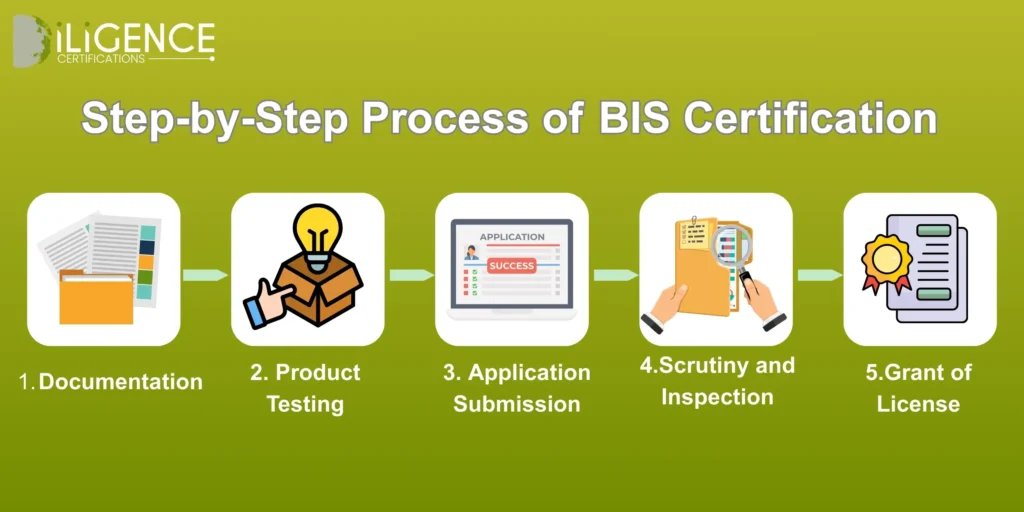
Step-by-Step Process of BIS Certification
Step1:Documentation
- Collect required technical documents
- Prepare product specifications
- Gather company registration details
- Ensure documents follow BIS format
Step2:Product Testing
- Send samples to a BIS-approved lab
- Conduct safety and quality tests
- Receive test reports
- Confirm compliance with BIS standards
Step3:Application Submission
- Fill out the BIS application form
- Upload all required documents
- Attach valid test reports
- Pay the necessary BIS fees
Step4:Scrutiny and Inspection
- BIS reviews submitted documents
- Authority verifies test results
- Factory/product inspection may occur
- Clarifications requested if needed
Step5:Grant of License
- BIS approves the application
- License number is issued
- Product can carry BIS mark
- Renewal required before expiry
Documents Required for BIS Certification
| Category | Documents Required |
| Business Documents | Business license/registration, ISO certificate, organizational details |
| Manufacturer Details | Factory layout, process flow chart, machinery list, production details |
| Product Documents | Product specifications, component list, user manual, model details |
| Testing Documents | Test report from BIS-recognized lab, sample details, test request form |
| Legal & Compliance | Authorization letter, brand ownership proof, trademark certificate (if any) |
| Import/Foreign Manufacturer (If applicable) | AIR (Authorized Indian Representative) details, contract agreement, overseas manufacturer documents |
Timelines, Costs, Validity & Renewal
- Timelines: Usually from 20 to 30 days, with only 7-15 days for the testing.
- Costs: The cost of the government and the test varies depending on the product. There can be some additional charges though.
- Validity: The validity period is 2 years in most situations.
- Renewal: The renewal is done before the expiration; there should be updated documents/tests; the renewal
Why Choose Diligence Certifications
Diligence Certifications is providing professional services for BIS certification in a hassle-free manner. Their experts are ready to assist manufacturers in documentation, product testing, filing of applications, and compliance with BIS standards such as IS 848:2006. Diligence Certifications is providing valuable guidance to businesses in the industry to save their precious time and obtain BIS certification for their products in a timely manner.
Conclusion
The BIS Certification for Synthetic Resin Adhesive as per IS 848:2006 is of significant importance in maintaining the quality, safety, and efficacy of adhesives used in woodworking and furniture industries. By adhering to this standard, manufacturers are able to prove their products’ bonding strength and longevity. BIS certification and ISI marking are of utmost importance in winning customers’ faith and also in expanding business by maintaining product quality.
Frequently Asked Questions (FAQs)
What is IS 848:2006?
Indian Standard IS 848:2006 is a set of requirements for synthetic resin adhesives for use in plywood and wood products.
Who issues BIS certification for adhesives?
The BIS certification for products complying with the requirements of IS 848:2006 is issued by the Bureau of Indian Standards (BIS).
Is BIS certification mandatory for synthetic resin adhesives?
In certain cases, BIS certification for synthetic resin adhesives is required for compliance with the quality standards in India.
What does ISI mark signify?
The ISI mark on the product signifies compliance with the BIS quality and safety standards.
What industries use synthetic resin adhesives as per the requirements of IS 848:2006?
The woodworking industry, plywood manufacturing industry, furniture industry, and construction industry use synthetic resin adhesives as per the requirements of IS 848:2006.
What are the tests performed for certification?
The tests performed are bonding strength, water resistance, durability, and quality.
Who should apply for BIS certification?
Manufacturing synthetic resin adhesives in India.
Can foreign manufacturers also apply for BIS certification?
Yes, foreign manufacturers can also apply for BIS certification under BIS Foreign Manufacturer Certification Scheme.
How long does it take to get BIS certification?
It takes a few weeks to get BIS certification.
Why is BIS certification important for adhesives?
BIS certification is important for adhesives as it ensures quality and safety of adhesives in India.