



 BIS Certification
 CDSCO
CDSCO
 CPCB
CPCB
 LMPC
LMPC
 WPC Approval
 Global Approvals
 TEC
TEC
 ARAI
ARAI
 BEE
BEE
 ISO Certification
 DGCA Certification
 NOC For Steel
 APEDA Registration















 Business Registration
 FSSAI Mark Certification












 Legal Services
 Trademark Registration
 Copyright Registration
 Patent Registration
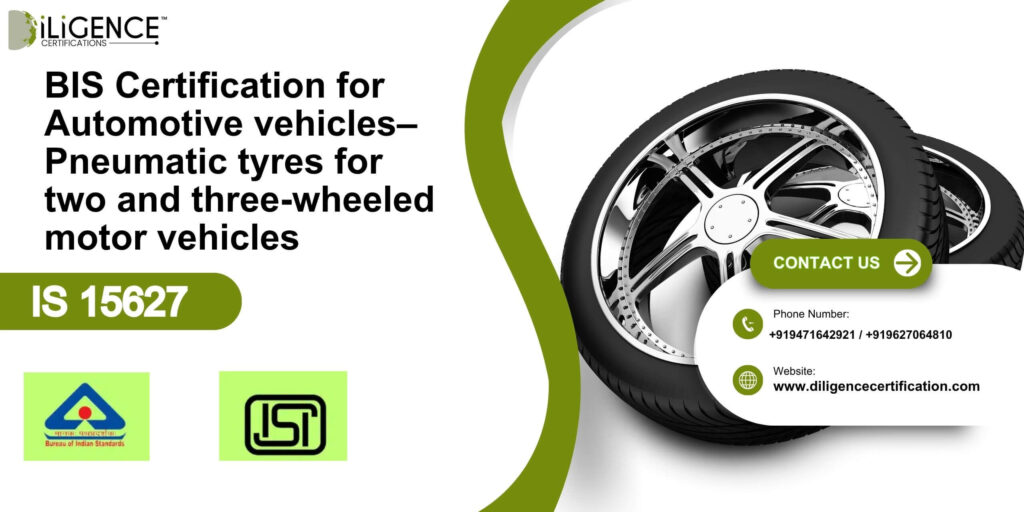
- India needs Bureau of Indian Standards (BIS) certification for three-wheeled motor vehicles have to have their pneumatic tires certified as per IS 15627 standard.
- The standard specifies the physical size of the tire, load/speed, endurance, and marking of the product with ISI.
- Scheme I involves type tests, factory audits, and QC systems for certification.
- If the product fails to meet the standards, it is exposed to risks such as seizures, fines, and restrictions in the market.
- The certification acts as an instrument of customer loyalty, brand strength, and conformity with the law.
Introduction
The Pune tyre manufacturer of the two-wheeler segment was hit by a reduction in the sales of their tyres due to the fact that their products were lacking an ISI mark which is a BIS certification (IS 15627) indication. In the absence of the certification, their products were not allowed to be sold in a number of markets, and the police were stopping the consignments due to non-compliance. This instance represents just the tip of the iceberg of a massive problem in India, which is figuring out and fulfilling the requirements of BIS Certification for Automotive Vehicles – Pneumatic Tyres for two and three-wheeled motor vehicles.
What is BIS Certification for Automotive vehicles– Pneumatic tyres for two and three-wheeled motor vehicles

BIS Certification for Automotive Vehicles–Pneumatic Tyres for Two- and Three-wheeled Motor Vehicles is a quality assurance process that ensures the compliance of products with mandatory requirements. The Bureau of Indian Standards (BIS) regulates this under IS 15627.
- Legal Compliance: The tyres must have the ISI mark under the BIS Scheme I to be sold or imported into India. If not, products may be seized, penalties may be imposed, or the market may be restricted.
- Technical Standards: The standard specifies the size of the tyre, the load carrying capacity, speed rating, endurance, dynamic growth, tread wear indicators, and the appropriate markings of the tyre.
- Certification Process: The manufacturer selects a sample from each production batch for type testing and submits it for conformity assessment. They have to implement a quality control system and factory inspection, after which the ISI mark license is issued.
- Consumer Protection: The foremost goal of the certification is to ensure that tyres are safe, dependable, and of the same quality, thus, it imparts that the occurrence of failures or accidents due to such products is eliminated.
- Market Credibility: BIS-certified tyres such as those from MRF, CEAT, or TVS are a quality indication to the customers and resellers which, in turn, helps to build brand trust.
What is IS 15627?

IS 15627 is an Indian standard that defines the specifications of pneumatic tires for 2- and 3-wheeled motor vehicles. The standard was published by the Bureau of Indian Standards (BIS) and is mainly concerned with safety. ISI MARK
- Scope: This standard applies to both diagonal and radial tyres for two-wheeled motor vehicles (motorcycles and scooters) as well as three-wheeled vehicles like autorickshaws, e-rickshaws, and the like.
- Dimensional Requirements: The dimensions indicated in the standard are the sizes of the tyres taken from different parts of the cross-section of the respective rims along with the tolerance values.
- Performance Tests: The load-carrying capacity, speed ratings, endurance, dynamic growth, and tire strength are among the tests conducted.
- Marking & Labelling: The ISI mark is the primary feature that must be exhibited on the tire together with the size, load index, speed symbol, and manufacturer details.
- Quality Control & Compliance: Manufacturers must ensure proper testing, factory audits, and documentation for them to be granted a certificate from BIS.
Why BIS Certification is Mandatory for Automotive vehicles– Pneumatic tyres for two and three-wheeled motor vehicles
- Legal Requirement: According to the Quality Control Order for Pneumatic Tyres and Tubes, 2009, the tyres for two- and three-wheelers should be in conformity with IS 15627. Selling of non-certified tyres may invite penalizing through fines, seizure, or prohibition of sale in the market.
- Consumer Safety: Vehicle tyres are the components that have a direct impact on the stability, braking, and durability of the vehicle. BIS certification confirms that the tyres meet the standards of load, speed, and endurance, thus, the risk of accidents caused by tyre blowouts is minimized.
- Market Credibility: The ISI marking on the tyres is the indication of the trust and dependability, which is communicated to dealers and customers thereby, facilitating brand reputation and acceptance in tough competitive markets.
- Standardization: Certification is the means by which uniform technical specifications of dimensions, strength, tread, and marking are maintained, thus, ensuring that there are no substandard or counterfeit products in the market.
- Liability Protection: The makers and importers of the product become less exposed to the risk of legal and monetary penalties since the certified tyres meet the quality standards set by the government.
Key features of BIS Certification
- Mandatory Compliance: It is a requirement as per the Quality Control Order for Pneumatic Tyres that all the two- and three-wheeler tyres that are sold or imported in India must comply with the standards.
- ISI Mark Authorization: The products that are certified can use the ISI mark that indicates the products meet the BIS standards.
- Technical Validation: This includes dimensions, load and speed ratings, endurance, dynamic growth, and strength tests to ensure safety and performance.
- Factory Audit & QC System: The manufacturers need to have a documented quality control system in place and they are required to undergo periodic factory inspections.
- Type Testing of Samples: The representative samples of tyres are tested in laboratories recognized by BIS to verify that they meet the required standards before the certification is issued.
- Surveillance & Renewal: Periodic audits and sample testing are done by BIS to retain the certification which is a guarantee of continuous compliance.

Step by Step process of BIS Certification for Automotive vehicles– Pneumatic tyres for two and three-wheeled motor vehicles
Step1: Preliminary Gap Assessment
- Examine your production machines, testing facilities, and the quality control systems that you have implemented.
- Ensure that the sources of raw materials, manufacturing methods, and design are in accordance with the standards of IS 15627.
- Discover the gaps in order to be able to have them fixed immediately when there is an audit or a test.
Step2: Application Submission
- BIS Product Certification application under Scheme I should be filed by you.
- Along with the application, submitting the documents such as the technical drawings, test reports, quality control procedures, and factory details is also required.
Step3: Sample Selection & Type Testing
- Tyres from your factory should be sampled and the samples should be submitted for testing in labs that are recognized by BIS.
- Tests include dimensions, load/speed rating, endurance, dynamic growth, and marking.
- Samples will only be taken if they meet all the criteria.
Step4: Factory Inspection / Audit
- By various means, BIS inspection is looking at the production facility for the quality control systems implementation, the calibration of lab equipment, and test/process record-keeping.
- All nonconformities if any should be resolved before the certification.
Step5: Grant of BIS License & ISI Mark Usage
- BIS grants a license only after positive test results and audit reports.
- The manufacturer is allowed to display the ISI mark along with the license number on the product after that.
Step6: Surveillance & Renewal
- BIS supervises the certified products through planned visits and sample tests.
- If there are any changes in the design, material, or size of the tyre, you will need to obtain permission for re-validation or extension of the scope.
Importance of BIS Certification
- It is necessary from the aspect of the law: In India, BIS certification is compulsory by law. The ISI mark lessened tyres are not allowed to be sold, imported, or distributed; thus, the manufacturers are safeguarded from paying fines, the seizure of goods, or getting into legal trouble.
- Consumer Security: It also ensures the tyres meet load, speed, endurance, and strength requirements, thus, accidents caused by tyre failures on roads are minimized.
- Quality Assurance & Standardization: This certification is the guarantee that products have the same dimensions, functionality, and tread, thus, there is no risk of poor-quality or counterfeit products.
- Market Credibility & Trust: The ISI marked product is the signal of the product’s safety and reliability, thus, the brand reputation among dealers, fleet operators, and consumers increases.
- Risk Mitigation & Liability Protection: If manufacturers only produce and sell certified products, they are in the process of reducing their legal and financial risks since their products comply with recognized safety standards.
- Make it easier to access the market: BIS-certified tyres are the ones accepted in government tenders, fleet contracts, and retail distributors. So, a person who owns those tires has unlimited business opportunities.
Benefits of BIS Certification
- Legal Market Access: With certifications, one can sell, import, and distribute the products that are free from the risk of any kind of legal action or seizure all over the country of India.
- Consumer Confidence: The ISI mark is a guarantee for the customer that the tyres are safe, high-performing, and long-lasting, thus giving confidence to the brand.
- Improved Quality & Performance: Meeting the requirements of IS 15627 ensures all aspects such as size, weight, and wear resistance are taken care of and are consistent for the product.
- Limited Liability & Risk: Certified tyres least legal exposure and may only cause a few compensation claims in case of defects or accidents.
- Competitive Advantage: With the help of BIS certification, your brand is distinguishable in the market and is mostly required by distributors, fleet operators, and government tenders.
- Facilitation of Development & Extension: You become eligible for projects, exports, and tenders that require products with BIS certification.
Timelines, Costs, Validity & Renewal
| Aspect | Details |
| Timelines | Typically 8–12 weeks from application to license grant, including sample testing and factory audit. |
| Costs | Covers application, type testing, and annual license fees. |
| Validity | Certification remains valid as long as compliance is maintained, with periodic surveillance audits. |
| Renewal & Scope Extension | Annual renewal required; adding new tyre sizes or variants requires approval and limited re-testing. |
Why choose Diligence Certification
- Expert Guidance: Knowledge and skills demonstrated through successful experience with BIS IS 15627 compliance.
- End-to-End Support: Facilitates documentation, testing, audits, and license application processes.
- Minimizes Delays: Pre-audit inspections help in reducing the situations of test failures and approval difficulties.
- Customized for the Tyres: Concentrated on the pneumatics of two- and three-wheeler tyres.
- Continuous Compliance: Provision of renewals, scope extensions, and surveillance audits support.
Conclusion
Obtaining a BIS certification for automotive vehicles – Pneumatic tyres for two- and three-wheeled motor vehicles as per IS 15627 is not just a matter of meeting a regulatory requirement; rather, it signifies a standard of safety, quality, and acceptance in the market. Manufacturers who take the initiative to conduct the right tests, maintain quality, and proper documentation not only are free from legal risks but, in addition, they consolidate their brand image. The cooperation with a proficient certification agency like Diligence Certification can make the route easy, shorten the waiting time, and ensure the continuity of the conformity with BIS standards.
Frequently Ask Questions
What is BIS certification for vehicle tires?
BIS certifications are given by the Bureau of Indian Standards to pneumatic tires of two and three-wheelers that comply with set standards. This certification acts like a seal of approval that the tires meet the relevant IS 15627 requirements in terms of safety, performance, and quality when they are marketed or distributed in India.
Are all the two- and three-wheeler tires required to have BIS certification?
Yes, definitely. The Pneumatic Tyres and Tubes Quality Control Order is a legal document that requires the tires to be in conformity with IS 15627 standards and bear the ISI mark to be allowed for sale or import in India.
What does IS 15627 cover?
The regulation also defines the sizes of tires with the associated load and speed ratings. Additionally, it incorporates endurance, dynamic growth, tread wear indicators, and correct markings for both diagonal and radial tires.
How long does BIS Certification take?
The whole process will typically take between 8 and 12 weeks. This period covers sample testing, a factory audit, and document verification.
What are the benefits of BIS Certification?
Permission for the ISI mark granting and legal market access
Consumer loyalty and brand reputation
Assured product quality, safety, and reliability
Lower compliance and regulatory risks
Can I add new tyre sizes or variants after certification?
Yes. An extension of the BIS license to include new sizes or lines usually means that only a small number of products are re-tested and approved.
How often is BIS Certification renewed?
It is only valid for a year. Moreover, one needs to renew it annually after the expiration date. Regular inspections and surveillance audits are conducted to ensure that the standard IS 15627 is being met.
Why choose Diligence Certification for BIS Compliance?
Diligence Certification offers full support throughout the pre-audit, possesses deep knowledge of IS 15627, and provides on-going assistance after the audit thus, helping a manufacturer to shorten the time and reduce the effort required for the certification process.