BIS Certification
 CDSCO
CDSCO
 PESO
PESO
 CPCB
CPCB
 LMPC
LMPC
 WPC Approval
 Global Approvals
 TEC
TEC
 ARAI
ARAI
 BEE
BEE
 ISO Certification
 DGCA Certification
 NOC For Steel
 APEDA Registration























 Business Registration
 FSSAI Mark Certification












 (32).jpg)
 Legal Services
 Trademark Registration
 Copyright Registration
 Patent Registration
 By
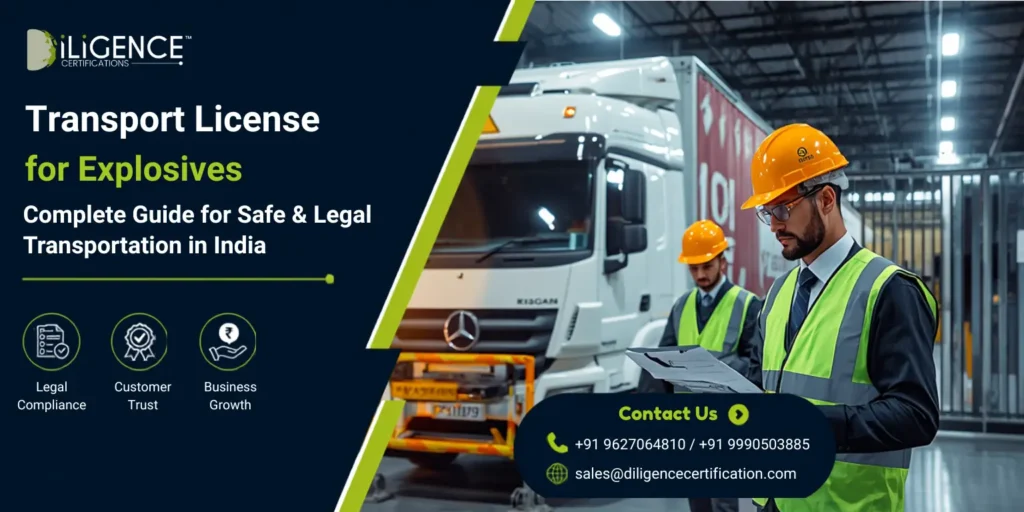
By - A Transport License for Explosives is essential for the legal and safe transport of notified explosive materials in India.
- Companies involved with explosives require adherence to licensing requirements, vehicle requirements, document requirements, and handling requirements prior to transporting.
- This compliance ensures that there are no legal hassles, delay in shipping, or any other problems.
Introduction
A few months back, there was an approach made to Diligence Certifications regarding a consignment of explosive products by a mining equipment provider whose consignment was detained due to certain logistical problems. The products were manufactured legally, the client was genuine and the delivery timeline was fixed. However, the consignment could not be moved forward due to lack of required Transport License for Explosives.
Cases like these happen more often than many organizations would realize. Transporting explosives in India is a more complicated matter than simply transporting goods from one place to another. As the explosives are dangerous in nature, therefore the Government of India has made stringent laws regarding their transportation which are governed by Petroleum and Explosives Safety Organisation (PESO).
If your organization manufactures industrial explosives or supplies blasting products to the mining industry, transports fireworks or even deals with defense products, then you need to get the required Transport License for Explosives.
What is a Transport License for Explosives?
Transport License for Explosives is a mandatory license granted by the Petroleum and Explosives Safety Organization (PESO) under Explosives Rules, 2008. This license allows for the safe and legal transportation of explosives within India, and confirms that all the requirements for the transporter, vehicle, packing, marking, documentation, and safety procedures have been complied with.
The main aim of the license is to reduce transportation hazards, ensure safety of people, the environment, and the proper handling of explosives during transportation. There can be additional requirements from PESO for certain types of explosives and modes of transportation (road, rail, air, or sea).
Why is a Transport License for Explosives Important?
Businesses often assume that having authorization to manufacture and/or store explosives is enough and there is no need to have an approval for transportation. Nevertheless, transport requires special compliance rules as explosives are subjected to new risks when transported.
A correctly authorized transport system will guarantee that all phases of transportation follow the required safety rules.
Protects Public Safety
Explosives can become hazardous due to overheating, impact, friction or improper handling.
Correctly licensed transport guarantees:
- Correct packaging
- Correct loading
- Correct transportation vehicles
- Correct emergency procedures
- Route safety precautions
- This significantly reduces risks of accidents.
Ensures Legal Compliance
Unauthorised transport of explosives can result in:
- Vehicles detention
- Explosives confiscation
- Penalties
- Criminal liability
- Licence revocation
- Getting the appropriate license avoids unnecessary legal problems for businesses.
Facilitates Business Continuity
- Mining industry, civil works construction, defence industry, etc., depend largely on delivery of explosives in time.
- Any disruptions during transportation can delay the whole project.
- Correct licensing provides a smooth logistics process.
Builds Customer Confidence
- Government bodies, EPC contractors, big industrial customers often prefer suppliers who keep full compliance with regulations.
- Having a Transport License for Explosives proves professionalism and reliability of the company.
Which Authority Regulates Transport of Explosives in India?
The primary authority responsible for regulating explosives is the Petroleum and Explosives Safety Organisation (PESO) operating under the Department for Promotion of Industry and Internal Trade (DPIIT), Government of India.
PESO oversees:
- Explosive manufacturing
- Storage approvals
- Transportation permissions
- Vehicle safety
- Packaging standards
- Inspection procedures
- Compliance monitoring
The applicable legal framework mainly includes the Explosives Act and Explosives Rules, along with other relevant transport regulations depending on the category of explosive materials.
Businesses That Require a Transport License for Explosives
Transportation approvals are needed by several industries since there are explosive items utilized as part of their everyday commercial operations.
Industries that frequently need such permits include the following:
- Mining Firms
- Transportation of industrial explosives from storage areas to blasting areas is part of mining processes.
Infrastructure Construction Projects
There are several construction projects that need blasting materials.
Firework Manufacturers
Fireworks manufacturers transporting completed goods through states must have proper permits.
Defense Contractors
Explosive materials utilized for defense projects require special transport licenses.
Oil and Gas Exploration Projects
Explosives utilized in explorations can need special transport permits.
Industrial Chemical Manufacturers
Some chemicals that are considered as explosive materials need transport permits.
Types of Explosives Covered
The applicable requirements depend upon the explosive category.
Examples include:
- Industrial explosives
- Detonators
- Blasting cartridges
- Safety fuse
- Detonating cord
- Fireworks
- Pyrotechnic materials
- Propellant explosives
- Military explosives (subject to additional controls)
Each category may have different transport conditions based on risk classification.
Basic Eligibility Criteria
Applicants generally need to satisfy several regulatory conditions before approval.
These include:
- Valid business registration
- Lawful handling authorisation
- Approved storage licence (where applicable)
- Safe transport vehicle
- Qualified personnel
- Compliance documentation
- Prescribed safety equipment
- Regulatory declarations
Authorities evaluate every application individually depending on the nature of the explosives involved.
Documents Required for Transport License for Explosives
Documentation forms an integral component in the process of attaining Transport License for Explosives. It is also worth noting that even though the business might have all the necessary infrastructure and staff members, lack of documentation or erroneous documents may cause delays in the license issuance.
However, the requirements differ depending on whether the explosives, method of transport, and activity carried out by the business are. Nonetheless, the following is usually expected from the applicants.
Business Documents
Businesses must establish their legal identity before applying.
Common documents include:
- Certificate of Incorporation / Business Registration
- PAN Card
- GST Registration Certificate
- Factory License (if applicable)
- Address Proof
- Authorization Letter
- ID proof of authorized signatory
Technical Documents
Technical records demonstrate that the explosives and transport arrangements comply with regulatory requirements.
These may include:
- Details of explosive materials
- Product classification
- Packaging specifications
- Quantity details
- Vehicle specifications
- Safety equipment details
- Route information (where applicable)
- Emergency response procedures
Vehicle Documents
Transport vehicles must satisfy prescribed safety requirements.
Typical documents include:
- Vehicle Registration Certificate (RC)
- Fitness Certificate
- Insurance Certificate
- Pollution Under Control (PUC) Certificate
- Driver’s Driving Licence
- Driver Training Records
- Vehicle Inspection Certificate
Safety Documents
Authorities also verify whether emergency preparedness measures are in place.
Examples include:
- Fire extinguisher certificates
- Emergency handling procedures
- Risk assessment reports
- Safety instructions
- Material Safety Data Sheet (MSDS), where applicable
Step-by-Step Process to Obtain a Transport License for Explosives
Most companies believe that the application process commences once the application has been submitted. The truth of the matter is that good approvals start way before the submission through effective planning and compliance.
Step 1: Determine the Relevant Regulations
This step involves determining the relevant regulations based on:
- Kind of explosive
- Amount being transported
- Routes of transportation
- Category of transport vehicle
- Nature of business activity
Step 2: Compilation of Documents
- This entails putting together all the necessary documents in respect to the business, vehicle, technical, and safety information.
- Incomplete documents are among the most common causes of delays in approvals.
Step 3: Inspection of Vehicle
The transport vehicle should be fitted with adequate safety measures prior to any inspections.
The competent authorities might check:
- Condition of the transport vehicle
- Safety measures
- Signages
- Fire fighting systems
- Packaging and loading of materials
Step 4: Submitting the Application
The application is submitted together with the accompanying documents to the competent authority.
Officials assess if the applicant fulfills the safety and operational requirements.
Step 5: Technical Evaluation
During evaluation, the following is reviewed:
- Vehicle suitability
- Classification of explosive
- Packaging conformity
- Safety procedures
- Driver fitness
- Other documentation
- Further clarifications can also be sought if needed.
Step 6: Issuing of Licence
Upon successful verification and evaluation, the Transport License for Explosives will be issued, which enables transportation within the parameters of the licence.
The business must remain compliant throughout the licence period.
Vehicle Safety Requirements
A transport licence is not granted solely based on paperwork. The transport vehicle itself must comply with safety norms designed to minimise risks during transit.
Important considerations generally include:
- Proper vehicle construction
- Explosion warning markings
- Fire extinguishers
- Emergency equipment
- Safe electrical systems
- Adequate ventilation (where applicable)
- Secure loading arrangements
- Trained driver and support personnel
Regular maintenance is equally important because even a mechanically compliant vehicle can become unsafe if not maintained properly.
Packaging and Handling Requirements
Improper packaging is one of the leading causes of transportation incidents involving hazardous materials.
Businesses should ensure:
- Approved packaging materials
- Secure sealing
- Clear hazard labels
- Proper stacking
Common Reasons Why Applications Get Delayed
Through experience, Diligence Certifications has seen many approval delays due to procedural flaws more than technical issues.
Some of the typical causes include:
Incomplete Documentation
Certificates, declarations, and other supporting documentation not provided often lead to further inquiries.
Wrong Vehicle Information
Any discrepancy between the application information and that of the vehicle can cause a delay.
Improper Packaging
Explosives packaged without adhering to safety requirements may need further measures for transportation.
Unqualified Drivers
Drivers moving explosives must have the necessary qualifications.
Unsafe Vehicles
Vehicles missing essential safety features cannot pass the test.
Late Applications
Companies tend to apply for the license only when the logistics planning is done.
Getting on board earlier saves time in approvals.
Penalties for Non-Compliance
Transporting explosives without the necessary approval can have serious legal and commercial consequences.
Possible actions include:
- Suspension of transport operations
- Seizure of explosive materials
- Monetary penalties
- Prosecution under applicable laws
- Cancellation of licences
- Project delays
- Loss of customer confidence
Apart from legal consequences, non-compliance may also affect insurance claims if an accident occurs during unauthorised transportation.
Best Practices for Businesses
Compliance should not be viewed as a one-time activity. Businesses that establish a structured compliance programme generally experience fewer regulatory issues.
Recommended practices include:
- Maintain updated licence records.
- Train drivers and transport personnel regularly.
- Conduct periodic vehicle inspections.
- Review emergency response procedures.
- Verify packaging before every shipment.
- Keep technical documentation readily available.
- Schedule licence renewals well before expiry.
- Perform internal compliance audits at regular intervals.
These practices help reduce operational risks while improving business credibility.
Validity and Renewal of Transport License for Explosives
The validity of a Transport License for Explosives depends on the category of licence, the type of explosive material, and the applicable provisions under the Explosives Rules. Licence holders should monitor the expiry date and apply for renewal well in advance to avoid interruptions in transportation activities.
During renewal, authorities may review:
- Existing licence details
- Vehicle fitness and safety records
- Compliance history
- Updated business documents
- Inspection reports (where applicable)
Maintaining accurate records throughout the licence period makes the renewal process considerably smoother.
Factors Affecting the Cost of a Transport License for Explosives
There is no single fixed cost for obtaining a Transport License for Explosives. The overall expense depends on several operational and regulatory factors, including:
- Type of explosive material
- Quantity to be transported
- Number of transport vehicles
- Inspection requirements
- Documentation complexity
- Compliance support required
- Vehicle modifications, if any
- Government-prescribed fees
Businesses should also consider the cost of maintaining safety equipment, employee training, and periodic compliance checks.
Why Choose Diligence Certifications?
Getting a Transport License for Explosives is not simply about filling in an application form; it requires technical know-how and regulation analysis, amongst other things. The slightest loophole can affect the entire process.
At Diligence Certifications, we assist companies in simplifying the process through full compliance management.
Our services include:
- Eligibility assessment
- Regulatory consultation
- Documentation preparation
- Technical document review
- Application assistance
- Compliance guidance
- Inspection coordination
- Query resolution
- Renewal support
We are associated with manufacturers, mines, logistics, fireworks firms, infrastructure projects, and other industries in India to assist them in fulfilling the regulations requirements.
Whether it is a fresh license application or renewal of an existing license, we make sure that every step of the process is taken professionally and according to regulations.
Conclusion
A Transport License for Explosives is a vital part of legal requirements for companies engaged in transporting explosive goods throughout India. From choosing appropriate transport to the preparation of necessary documentation and fulfilling all the other compliance tasks, each of them has its own role in assuring the safety of this process.
Companies that start the process of complying with the law beforehand will have fewer problems like delayed shipments, inspection observations, or legal troubles. Not only will such an approach help you run the business more efficiently, but it will also build customers’ trust and improve workplace safety.
If your company needs professional help in getting a Transport License for Explosives, Diligence Certifications compliance specialists are here to assist you with documentation, requirements, application, and approval.
Frequently Asked Questions
What is a Transport License for Explosives?
A Transport License for Explosives is an approval issued by PESO that allows the safe and legal transportation of explosive materials in India.
Who needs a Transport License for Explosives?
Mining companies, explosive manufacturers, construction firms, defence suppliers, fireworks manufacturers, and other businesses transporting explosives require this licence.
Which authority issues the Transport License for Explosives?
The Petroleum and Explosives Safety Organization (PESO) issues Transport Licenses for Explosives under the Explosives Rules, 2008.
What documents are required for a Transport License for Explosives?
Required documents generally include business registration documents, vehicle details, safety documents, explosive classification details, and compliance records.
How can I apply for a Transport License for Explosives?
applicants must submit the required application with supporting documents to PESO and fulfil vehicle, safety, and regulatory requirements.
Is a special vehicle required for transporting explosives?
Yes, explosives must be transported using vehicles that meet PESO safety requirements, including proper markings, safety equipment, and compliance standards
Can explosives be transported without a valid licence?
No, transporting explosives without proper approval can result in penalties, seizure of materials, legal action, and licence cancellation.
How long does it take to obtain a Transport License for Explosives?
The approval timeline depends on document accuracy, vehicle inspection requirements, explosive category, and PESO evaluation.
Is the Transport License for Explosives renewable?
Yes, the licence can be renewed as per applicable regulations by submitting updated documents and maintaining compliance requirements.
Can Diligence Certification help with obtaining a Transport License for Explosives?
Yes, Diligence Certification provides assistance with documentation, application preparation, PESO coordination, and complete compliance support.