


 BIS Certification
 CDSCO
CDSCO
 CPCB
CPCB
 LMPC
LMPC
 WPC Approval
 Global Approvals
 TEC
TEC
 ARAI
ARAI
 BEE
BEE
 ISO Certification
 DGCA Certification
 NOC For Steel
 APEDA Registration











 Business Registration
 FSSAI Mark Certification



 Legal Services
 Trademark Registration
 Copyright Registration
 Patent Registration
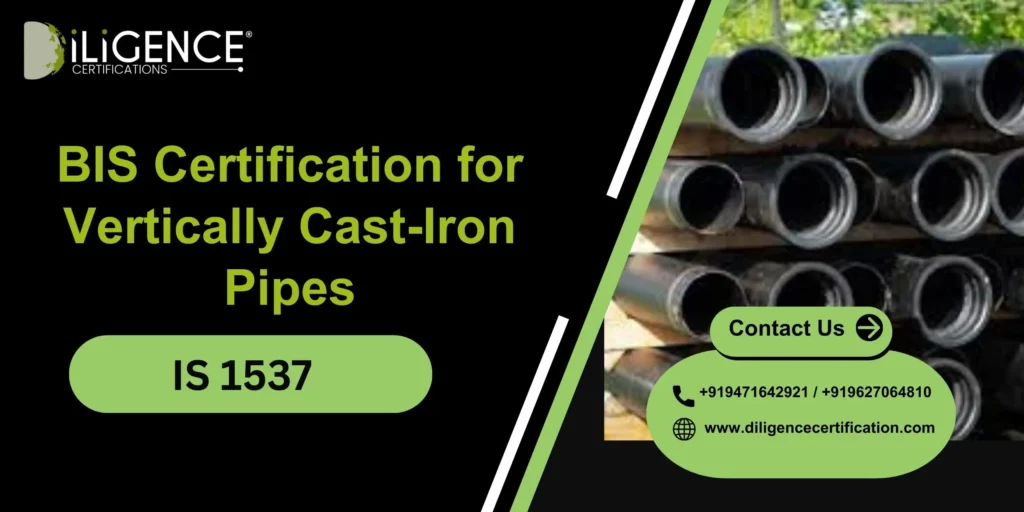
- IS 1537 deals with the requirement for Vertically Cast-Iron Pipes for water, gas, and sewerage reticulation.
- It specifies material composition, casting, and tolerances to guarantee a strong and robust product.
- All pipes have to be tested for hydraulic pressure, tension resistance, and leakage resistance at BIS-approved labs.
- The manufacturers are required to carry out quality control, marking, and traceability activities according to the BIS ISI Mark Scheme.
- The ISI Mark-certified pipes ensure conformity to Indian standards of safety and performance.
Introduction
“IS 1537 Vertically Cast-Iron Pipes” providing the requirements for the manufacture of vertically cast-iron pressure pipes in India and ensures that the pipes are of standard quality to facilitate the orderly growth of the country’s water and gas supplies and sewage systems. Certification of Vertically Cast-Iron Pressure Pipes to IS 1537 by the Bureau of Indian Standards (BIS) ensures that the pipes are able to withstand pressures inside and outside the system and are able to perform well under effective service conditions. Being an ISI Mark standard, those products that conform to the requirements of “IS 1537: Vertically Cast-Iron Pressure Pipes” are entitled to the ISI Mark that symbolizes that the product meets the requirements of the standard and complies with the standards of quality that India adheres to.
What is IS 1537?
IS 1537 is an Indian Standard published by the Bureau of Indian Standards (BIS), defines the requirements for Vertically Cast-Iron Pipes used for the conveyance of water, gas, and sewage. This standard includes requirements for the material composition of the iron pipes in terms of casting method, dimensions, mechanical performance requirements, and tests such as hydraulic pressure tests and leak tests. The standard ensures that such pipes can resist, sustain, and be used freely without any hazard in underground and above-ground installations.
Key Points:
- IS 1537 specifies the minimum requirements for a series of Indian Standard vertically cast iron pressure pipes for water, gas, and sewage pipelines.
- It specifies the composition of the material and the casting procedure to meet high strength and durability.
- This standard defines the dimensions, tolerances, and surface finish so that quality is kept uniform.
- It includes requirements for testing hydraulic pressure, tensile strength, and leakage, among others, to ensure performance.
- Conformity to IS 1537 enables any manufacturer in obtaining certification by BIS with the ISI Mark.
Why is BIS Certification Mandatory
BIS Certification: BIS certification of the vertically cast-iron pipes in accordance with IS: 1537 is mandatory in a bid to ensure compliance with the necessary set standards when it comes to their safety and strength for use in the water, gas, and sewage networks. Vertically cast-iron pipes can be a major hazard in case of an accident, and thus BIS certification ensures that the products sold in the market must be accredited and tested by BIS-recognized labs in a bid to ensure compliance with set standards.
Key Reasons:
- This guarantees safe and reliable operation of the pipes employed in water, gas, and sewage networks.
- It protects against the use of sub-standard or low-quality materials in critical infrastructure.
- It requires testing in BIS recognized labs regarding strength, resistance to pressure, and durability.
- It assists in regulating quality standards for firms in India.
- It serves to improve public health and safety through the elimination of the risks of leaks and failures of the pipes and the possibility of contamination of the water .
Importance and Benefits of BIS Certification
| Importance | Benefits |
| Vertically cast iron pipes are ensured to meet country-specific safety and quality standards. | It builds confidence in the product for the consumers, the engineers, and the government. |
| Confirms strength and pressure resistance for water, gas, and sewage. | Enhances durability and life expectancy while operating under severe environmental conditions. |
| It prevents defective and sub-standard pipes from circulating in the market. | Enables the use of the ISI mark by the manufacturer, which improves the market acceptance of the product. |
| Facilitates regulatory compliance in public and private infrastructure development projects. | This reduces the chances of leakage, corrosion, and actual breaking of the pipes. |
| Facilitates consistency and reliability in pipe production. | Strengthens the credibility and competitiveness of the brand in public and private bids. |
Step-by-Step Process of BIS Certification
Step1:Documentation
- Collect required technical documents
- Prepare product specifications
- Gather company registration details
- Ensure documents follow BIS format
Step2:Product Testing
- Send samples to a BIS-approved lab
- Conduct safety and quality tests
- Receive test reports
- Confirm compliance with BIS standards
Step3:Application Submission
- Fill out the BIS application form
- Upload all required documents
- Attach valid test reports
- Pay the necessary BIS fees
Step4:Scrutiny and Inspection
- BIS reviews submitted documents
- Authority verifies test results
- Factory/product inspection may occur
- Clarifications requested if needed
Step5:Grant of License
- BIS approves the application
- License number is issued
- Product can carry BIS mark
- Renewal required before expiry
Documents Required for BIS Certification
| Category | Documents Required |
| Business Documents | Business license/registration, ISO certificate, organizational details |
| Manufacturer Details | Factory layout, process flow chart, machinery list, production details |
| Product Documents | Product specifications, component list, user manual, model details |
| Testing Documents | Test report from BIS-recognized lab, sample details, test request form |
| Legal & Compliance | Authorization letter, brand ownership proof, trademark certificate (if any) |
| Import/Foreign Manufacturer (If applicable) | AIR (Authorized Indian Representative) details, contract agreement, overseas manufacturer documents |
Timelines, Costs, Validity & Renewal
- Timelines: Usually from 20 to 30 days, with only 7-15 days for the testing.
- Costs: The cost of the government and the test varies depending on the product. There can be some additional charges though.
- Validity: The validity period is 2 years in most situations.
- Renewal: The renewal is done before the expiration; there should be updated documents/tests; the renewal
Why Choose Diligence Certifications
Diligence Certifications is an authentic compliance and BIS certification consultant to offer end-to-end solutions to gain BIS approvals. With professional assistance, efficient document processing, and proper coordination between testing labs and BIS government agencies, certification can be acquired hassle-free by Diligence Certifications. With Diligence Certifications, importers and domestic product manufacturers can look forward to gaining authentic regulatory compliance to successfully introduce their commodities in India.
Conclusion
The importance of BIS certification in accordance with IS 1537 cannot be overstated, as this standard is necessary for vertically cast iron pipes used in water, gas, and sewage installations. By meeting this standard, defects can be averted, and health hazards can be prevented. Not only is a BIS certificate necessary for complying with the standard, but it also provides assurance to customers, and thus, this process is necessary for manufacturers who wish to acquire credibility in India.
Frequently Asked Questions (FAQs)
What is IS 1537?
IS:1537 is the Indian standard for vertically cast-iron pipes for water, gas, and sewage pipework.
Is BIS certification necessary for IS 1537 pipe?
BIS certification is indeed a must in the matter of safety, strength, and quality.
What are the products encompassed by IS 1537?
Molds for vertically cast-iron pressure pipes for water supply, gas, and sewerage purposes.
What is the purpose of requiring BIS certification?
In an effort to avoid the usage of sub-standard pipes.
What is the mark given after certification?
"The ISI mark is given on certified pipes."
Where is product testing carried out?
Testing carried out by BIS-approved laboratories.
What tests are needed?
Hydraulic pressure, tension strength, and leak tests.
What is the duration of the BIS license?
Usually, it is valid for two years.
Is a BIS certificate renewable?
Yes, it has to be renewed before expiration with new documents and testing results.
Who can apply for BIS certification ?
Manufacturers & authorized Indian representatives of foreign manufacturers.