 BIS Certification
 CDSCO
CDSCO
 PESO
PESO
 CPCB
CPCB
 LMPC
LMPC
 WPC Approval
 Global Approvals
 TEC
TEC
 ARAI
ARAI
 BEE
BEE
 ISO Certification
 DGCA Certification
 NOC For Steel
 APEDA Registration























 Business Registration
 FSSAI Mark Certification












 (32).jpg)
 Legal Services
 Trademark Registration
 Copyright Registration
 Patent Registration
 By
By - BIS For Home appliances to a variety of household appliances is provided for various Quality Control Orders (QCOs)
- Is applicable to both locally manufactured and imported appliances
- Covers several key household products, including refrigerators, air conditioners, washing machines, microwave ovens, electric irons, toasters, immersion heaters, etc
- Products must be in accordance with the relevant Indian Standards (IS codes) before they can successfully enter the single market
- Certifying agencies include product testing done through BIS-approved labs, auditing of the factory (for Scheme-I)
- Foreign manufacturers must designate an Authorized Indian Representative (AIR) for BIS compliance
- BIS license will have a two-year shelf life (renewable as long as compliance details are updated and additional testing is accomplished).
Introduction
According to the Safety of Household, Commercial, and Similar Electrical Appliances (Quality Control) Order, 2025, as published by the Bureau of Indian Standards (BIS), all home appliance manufacturers must be BIS certified. This includes appliances such as vacuum cleaners, electric knives, tumble dryers, cookers, ovens, etc. To sell these products in the Indian market, manufacturers must ensure compliance with Indian Standard IS 302 (Part 1): 2024.
Obtaining the ISI Mark for electrical home appliances shows that the manufacturer is complying with BIS Certification safety and performance standards. Obtaining the ISI certification ultimately demonstrates product reliability for consumers and public confidence in the product, as well as compliance with the latest quality control requirements in India, as it allows brands to remain legally compliant and competitive in such a heavily regulated marketplace.
Why is BIS for Home Appliances is necessary ?
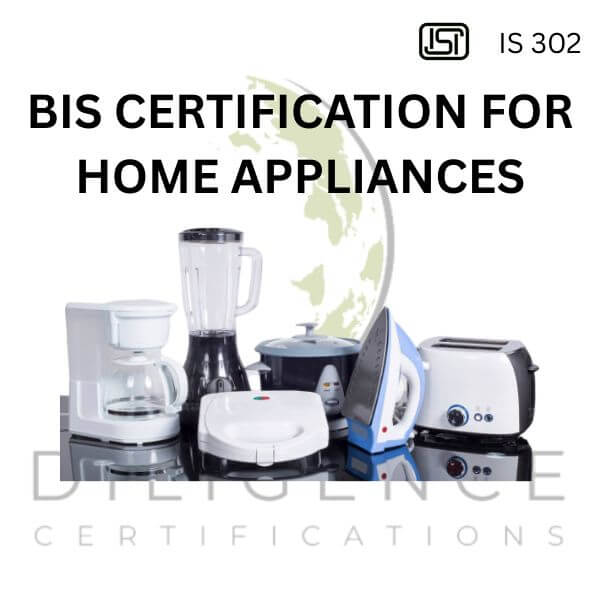
BIS Certification for household electrical appliances is important to ensure compliance with India’s safety and quality standards. Without BIS certification, household appliances such as vacuum cleaners, electric ovens, cooking ranges and similar appliances can pose severe hazards such as electric shock, short circuits, or electrical fire hazards. To mitigate such risks, the Government of India mandates certification according to important standards such as, IS 302 (Part 1): 2024.
The ISI mark for electrical home appliances assures consumers that the product in question has gone through rigorous independent testing in BIS accredited laboratories. Thus, it develops consumer confidence, improves product credibility, and establishes that the product can be safely and reliably operated by the consumer when used under typical operating conditions.
In major policy development, the Ministry of Commerce and Industry, through the Department for Promotion of Industry and Internal Trade (DPIIT), published the Safety of Household, Commercial and Similar Electrical Appliances (Quality Control) Order, 2025 on 19th May, 2025. This Quality Control Order stipulates that all electrical appliances that operate at voltages of 250V for single-phase AC and 415V for three-phase AC must obtain BIS certification per IS 302 (Part 1): 2024.
This policy development not only enhances safety calibration, but also strengthens the enforcement of quality control in sales of household appliances across the Indian market, which also works to ensure that consumers receive only through high quality, BIS certified product out to them.
IS 302 (Part 1): 2024
IS 302 (Part 1): 2024 is the updated safety standard for electrical appliances used in domestic and similar environments. It is harmonized with IEC 60335-1: 2020 to align Indian regulations with international best practices.
The main safety aspects include:
these products must have:
1. Adequate insulation,
2. Protection against electric shocks,
3. Thermal cutoff and temperature control,
4. Resistance to mechanical failure.
The previous version IS 302 (Part 1): 2008 will continue to be in force until February 23, 2026, thereafter only the 2024 version will be used for certification purposes.
BIS QCO for Household, Commercial, and Similar Electrical Appliances - 2025 Notification
On 19th May 2025, the Ministry of Commerce and Industry, through its Department for Promotion of Industry and Internal Trade (DPIIT) announced a significant regulation called the “Safety of Household, Commercial and Similar Electrical Appliances (Quality Control) Order, 2025.” This Quality Control Order (QCO) requires that appliances identified as electrical appliances that can be used in either of the domestic or commercial scenario in its nomenclature, must demonstrate compliance with Indian Standard IS 302 (Part 1): 2024 and gain Bureau of Indian Standards (BIS Certification) certification. The electrical products specified under this notification are those that operate at 250V (single-phase AC) and 415V (three-phase AC), which is the most widely used electrical voltages for household and commercial uses in India.
- Any appliances which fall within the definition of domestic appliances would include:
- Household electrical appliances such as vacuum cleaners, cooking ovens, electric knives, tumble dryers
- Commercial electrical appliances that would be used in similar environments, such as food service or hospitality related environments
- Importantly, to understand the products captured under this notification, you must note that they will need to have BIS certification (indicated by the ISI mark requirement) before they are permitted into the Indian market when offered for sale or distribution.
Products Covered under IS 302 (Part 1): 2024
The IS 302 (Part 1): 2024 standard outlines general safety requirements for a wide range of household and similar electrical appliances, ensuring their compliance with BIS Certification safety norms. These appliances must obtain the ISI Mark under the BIS Certification Scheme to be legally sold in India, as per the Quality Control Order (QCO) 2025.
This standard applies to appliances used in:
- Domestic households
- Commercial kitchens
- Hospitality industry
- Professional or similar non-industrial environments
Key Appliances Covered:
Here is a list of major product categories that fall under IS 302 (Part 1): 2024 and require BIS certification:
| Appliance Type | Examples |
| Cleaning appliances | Vacuum cleaners, electric brooms, carpet cleaners |
| Cooking & heating appliances | Electric ovens, hot plates, hobs, grills, toasters, deep fryers |
| Laundry appliances | Tumble dryers, washing machines, spin extractors |
| Food preparation appliances | Electric knives, mixers, blenders, food processors |
| Personal care appliances | Hair dryers, electric shavers, epilators |
| Air-treatment appliances | Room heaters, air coolers, humidifiers, dehumidifiers |
| Cooling appliances | Water dispensers, ice cream makers, wine coolers |
| Entertainment-related | Motorized curtains/blinds, massage chairs, heated recliners |
| Health-related appliances | Vaporizers, facial steamers, electric heating pads |
Note:
Products operating under 250V single-phase AC or 415V three-phase AC are included.
Appliances must comply with the safety requirements of IS 302 (Part 1): 2024 / IEC 60335-1:2020.
Even imported appliances must undergo BIS Registration before being marketed in India.
BIS Registration Process for Electrical Appliances in India
For any manufacturer wanting to put electrical appliances into the Indian market, it is mandatory to get BIS certification under IS 302 (Part 1): 2024, per the Quality Control Order 2025. This process ensures the product meets safety and performance standards and is durable enough for the designation of obtaining the ISI Mark to function as an applicable level of market-perceived credibility.
The Process to Obtain the BIS Certification for Home Appliances.

Submit Application
Manufacturers start by submitting their applications on the BIS Certification portal or have BIS consultant. The manufacturer has to provide complete and very detailed technical specifications of the product, outlining the manufacturing process specifications of specifications.
Product Testing
A product sample will be sent to an ISO certified BIS laboratory for testing. Testing is based on the requirements for IS 302 (Part 1): 2024. Testing will look at very critical parameters, such as thermal safety, thermal withstand, electrical insulation, and durability testing.
Factory Inspection
Facility inspection is the next stage of the process. BIS Certification will send their team to visit the production facility to assess infrastructure, workflow and in-house quality controls. This inspection certifies that the plant architecture will permit manufacturers to consistently produce compliant products.
Test Evaluations
The lab testing and facility audit are complete. BIS Certification has had the time to evaluate the results. Provided the lab tests meet all of the necessary conditions of IS 302 (Part 1): 2024, the manufacturer will proceed to the next stage.
Issuance of BIS Licence
BIS Certification awards a license to certificate and, allows manufacturer to use the ISI mark on electrical home appliances, which signifies that the products have met the requirements of Indian Standards.
Documents Required for BIS Certification for Home appliances
For manufacturers to have a smooth and mistake-free certification process, it has to have the following documents available:
- Duly filled BIS application
- Fully completed and correct flowchart of the manufacturing process
- Internal quality control manual and procedures
- Test report from BIS approved laboratory
- Factory layout plan and equipment list
- Business registration Certificate of the company
- User manual and Technical specifications
- A declaration of conformity with the Indian Standards
The missed or incorrect document is one of the major excuses, and causes, for delays or rejections in the BIS Certification approval process. Working with a professional consulting firms like Diligence Certifications will assist you with this step.
Why the BIS Quality Control Order (QCO) 2025 Matters?
The Safety of Household, Commercial, and Similar Electrical Appliances (Quality Control) Order, 2025 (QCO 2025) issued by the Ministry of Commerce and Industry represents a landmark achievement in India’s consumer safety regime. BIS QCO 2025 requires that household and commercial electrical appliances be compliant with IS 302 (Part 1): 2024, which underlines the focus on safety, quality, and reliability in electrical items.
Some of the important benefits of the QCO 2025 are as follows:
Consumer Safety First
The QCO requires a BIS certification which will reduce the likelihood of electric shock, short circuits, overheating, and electrical fires, and allows appliances to be used safely at home and at work.
Market Standardization
It provides uniformity in product quality, thus providing a level playing field for manufacturers, and increased consumer trust through the ISI Mark on electrical appliances.
Progress toward Global Standardization
The IS 302 (Part 1): 2024, is harmonized with IEC 60335-1:2020 standard which is a global standard for appliances, which means Indian manufacturers are complying with global safety standards that can enhance exports & global competitiveness.
Grace Periods and Exemptions for Small Businesses
To assist the transition, the government has introduced some relaxation measures under the QCO:
Micro Enterprises have a 12-month grace period for obtaining BIS certification.
Small Enterprises have a 9-month grace period for seeking compliance.
Import Exemption: Manufacturers can import up to 200 units per year for R&D without BIS certification if it is not being sold commercially.
These provisions should ensure that businesses, big or small, are given the flexibility to adjust as appropriate without being impacted immediately.
Why Choose Diligence Certification?
Implementing BIS certification is a complex process characterized by extensive technical knowledge and regulation compliance and coordination with the BIS Certification Regulatory Body. This is where Diligence Certification can help you as your partner.
BIS Experts
Diligence Certification is with you, every step of the way, from identifying your product specifics, to documenting, testing, and factory auditing with 100% coordinated project management to complete the BIS certification process.
Assurance of Accuracy
Diligence Certification will manage all interactions with BIS and will process an accurate, complete, and timely submission, ensuring compliance with relevant Indian laws and regulations, avoiding costly delays or rejections of submissions.
Providing Support for all Enterprises
Diligence Certification supports small enterprises or multinational brands to ensure all electrical home appliances are compliant with all criteria according to QCO 2025, and will support the completion of requirements for entry and market participation into India.
Conclusion
The Bureau of Indian Standards (BIS) QCO for electrical appliances for household and commercial use was established with not just a regulatory intention but a long-term strategic approach to support product safety and harmonization in India. Manufacturers must now comply with IS 302 (Part 1): 2024 in order for them to continue selling or importing electrical appliances to the Indian market.
Contact Diligence Certifications today and allow our team of compliance experts demystify the BIS compliance process for you and your company where our priority will be to protect your company and brand reputation and to allow you the ability to access the Indian market with confidence.
Frequently Asked Questions (FAQs)
What is BIS Certification for Home Appliances?
BIS Certification for home appliances is a mandatory quality mark issued by the Bureau of Indian Standards. It is used to ensure that electrical appliances such as ovens, vacuum cleaners, and dryers are built according to IS 302 (Part 1): 2024, and that they are safe and functional per standards defined by Indian legislation.
Is BIS certification mandatory for electrical appliances in India?
Yes, monitoring under the, "Safety of Household, Commercial and Similar Electrical Appliances (Quality Control) Order, 2025," means that BIS Certification is mandatory for any person or company selling, manufacturing or importing electrical appliances in India.
What is IS 302 (Part 1): 2024?
IS 302 (Part 1): 2024 is the Indian Standard that describes the safety requirements for electrical appliances. It is based on the international standard IEC 60335-1:2020, which considers potential hazards arising from the use of electricity, such as fire, overheating, and electrical shock.
Who must apply for BIS Certification for home appliances?
Any manufacturer, importer, or brand owner that sells electrical appliances in the Indian market must apply for BIS Certification, and must obtain the ISI mark to comply with legislation.
How long does it take to get BIS Certification?
BIS registration and certification usually takes 4 to 6 weeks depending on the completeness of documentation, the current turnaround time for testing, and the time allowable for factory inspections.
Are small or micro enterprises able to get extra time for compliance?
The Quality Control Order 2025 allows 12 month grace period for micro enterprises and 9 month grace period for small enterprises to achieve BIS certification.
Are there any exemptions under BIS QCO 2025?
Yes. A manufacturer can import 200 units a year for R&D purposes which is not required to be BIS Certified on the condition these appliances will not be sold.
If a product is sold without BIS certification, what could happen?
It is a breach of the BIS QCO 2025 to sell or distribute a non-certified product and penalties may be incurred as well as the confiscation of products by regulatory bodies or legal action.
What is ISI Mark?
The ISI Mark is a mark of quality and safety from the Bureau of Indian Standards. The ISI Mark on electrical appliances guarantees consumers that the appliance meets all minimum safety requirements under Indian legislation.
Who can help with the BIS Certification process?
Diligence Certification is a leading BIS consultant that can help manufacturers meet the requirement for the necessary documentation, testing, audits of the factory and provide full support to achieve ISI Mark for electrical appliances quickly and efficiently.


