 BIS Certification
 CDSCO
CDSCO
 PESO
PESO
 CPCB
CPCB
 LMPC
LMPC
 WPC Approval
 Global Approvals
 TEC
TEC
 ARAI
ARAI
 BEE
BEE
 ISO Certification
 DGCA Certification
 NOC For Steel
 APEDA Registration















 Business Registration
 FSSAI Mark Certification











 (32).jpg)
 Legal Services
 Trademark Registration
 Copyright Registration
 Patent Registration
 By
By - BIS certification for mobile phones is legally mandatory under IS 13252 (Part 1):2010 to protect user safety in India.
- Without BIS certification for mobile phones, no device can clear customs or be sold in Indian markets.
- Mobile phone manufacturers must test samples at BIS-approved labs before registration.
- Each brand and manufacturing site needs a separate BIS CRS certification to comply with Indian law.
- BIS certification for mobile phones helps maintain consistent quality, prevent counterfeit risks, and assure end-user confidence.
Introduction
Back in 2022, I received a call from a small smartphone brand from Hyderabad. They had already booked containers of their new mobile models for the Indian market. But at the port, Customs refused clearance because they had no BIS certification for mobile phones, which is mandatory under IS 13252 (Part 1):2010.
This is a scenario I see too often. Importers or manufacturers invest crores in production and logistics, only to discover BIS registration is not just another “nice-to-have” stamp. It is a legal gateway for launching any mobile phone in India. Without the right BIS CRS certification, your products cannot move past customs or find place on Indian shelves.
Overview
The mobile phone is now inseparable all over the world; it is almost a need for every person. The mobile phone was invented by Martin Cooper who was employed with Motorola in 1973. Originally, the mobile phone was designed to make and receive calls - a device to keep people connected without meeting in person.
Mobile phones have changed dramatically in a short time period with rapid technological advancement allowing mobile phones to become handheld computers with additional features such as cameras, internet access, and all sorts of other applications. Mobile phones now can save images, documents, and audio files, enabling everything from business activities to emergency calls.
In India, there are more than 1.5 billion mobile phones, with nearly 750 million of them are smartphones. Since these devices are so prominent and they reach every age group (young and old), the Bureau of Indian Standards (BIS) regulates the proper use and safety of mobile phones. As the regulator of all standards within India, all mobile phones operate under the Compulsory Registration Scheme.
In effect, BIS CRS certification is a critical checkpoint that every manufacturer must respect.Prior to being sold in India, all mobile phones must comply with IS 13252 (Part 1):2010, through BIS regulatory approval. By following the BIS certification for mobile phones under IS 13252, manufacturers show their commitment to product safety, giving end users peace of mind. Since the standards are rigorous, ultimately consumers in India can still be assured these mobile phones will be safe, reliable, and of high quality.
What is BIS Certification for Mobile Phones?

The Bureau of Indian Standards (BIS) issues a Compulsory Registration Scheme (CRS) licence for electronic goods, including mobile phones. As per IS 13252 (Part 1):2010, this certification verifies that mobile phones meet essential safety parameters for user protection against fire, electrical hazards, and harmful emissions.
A BIS certification for mobile phones is not optional. If you plan to market, distribute, or sell mobiles in India, whether you are a domestic manufacturer or a foreign supplier, you must obtain BIS CRS certification.
“BIS certification for mobile phones is a legal compliance, not a marketing feature.”
Why Mobile Phones Need BIS Certification Before Sale
In India, mobile phones see one of the highest rates of product recalls if they lack proper certification. BIS CRS certification ensures:
- Electrical safety for Indian climatic conditions
- Compatibility with local voltages
- Protection against battery fires
- Consumer trust
- Regulatory clearance from Customs
International giants like Apple and Samsung never skip BIS registration before their flagship launches, because non-compliance could cost them millions in seizure fines or damage their brand.
If a Chinese or Taiwanese brand plans to import budget mobiles, skipping BIS certification for mobile phones is a recipe for port seizures, legal notices, and trade bans.
“BIS certification for mobile phones is not a one-size-fits-all process. Domestic and foreign applicants have unique paths.”
Basic Requisites for BIS Licence: 4 Pillars
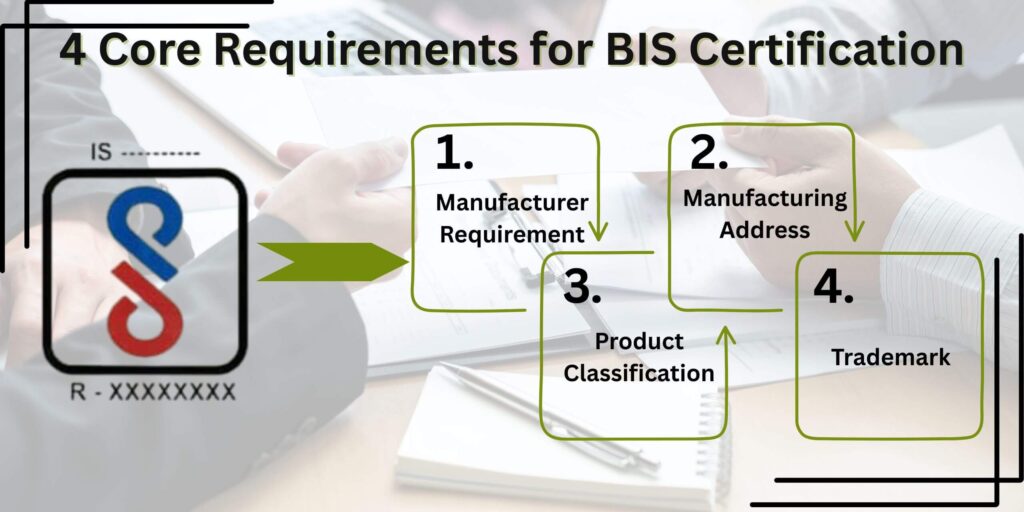
Any applicant seeking a BIS certification for mobile phones must satisfy these four pillars:
1. Manufacturer
BIS licences are only issued to manufacturers. Importers may act as their Authorised Indian Representative (AIR), but the certificate is always in the manufacturer’s name.
2. Manufacturing Address
The application must clearly show the factory location. If you manufacture the same product at multiple plants, you need separate licences for each location.
3. Product
Each product category needs its own BIS licence. However, if one category has multiple models (for example, smartphone models with different storage capacities), a single registration can cover all, provided the product design is fundamentally the same.
4. Brand or Trademark
Every trademark requires its own BIS CRS certification. A brand cannot piggyback on someone else’s licence without documented trademark authorisation.
BIS Registration Procedure for Mobile Phones IS 13252 (Part 1):2010

The BIS certification process for mobile phones differs depending on whether you are manufacturing in India or abroad. Below is a structured guide tailored for each scenario to help you plan your compliance smoothly.
A) For Foreign Manufacturers
Step 1: Appoint an Indian Representative (AIR)
Foreign manufacturers who want to apply cannot apply directly and must have an Authorised Indian Representative (AIR), who will communicate with BIS on behalf of the foreign manufacturer.
Step 2: Online application process
The AIR will put together and submit the online application application through the BIS portal with all necessary preliminary information.
Step 3: Submit the product samples to a BIS-approved laboratory
This step is an essential step - the product samples must get safety testing from a BIS-approved laboratory that is accredited to IS 13252 (Part 1): 2010.
Step 4: Submission hard copy and online application with the test reports
Following that testing, the full application, test reports, and any supporting information must be submitted to the BIS both online and in the form of physical hard copy.
Step 5: BIS review and verification process
The BIS officials will review the application and the technical details, and verify the test reports. Prior to moving forward, the BIS officials will investigate any discrepancies or missing information at this point.
Step 6: Grant of licence
After the BIS is satisfied that everything is in compliance, the licence issued to the manufacturer under the Compulsory Registration Scheme will be finalized.
B) For Domestic Manufacturers
Step 1: Online application
To submit their application online, Indian manufacturers can go directly to the BIS portal where manufacturers will fill out the application using their own login, and upload all of the required documents.
Step 2: BIS lab testing samples
The manufacturer is required to send product samples to a BIS-recognized lab for testing, and to test against IS 13252 (Part 1):2010 standards, which will provide evidence of safety and performance of the mobile phone.
Step 3: Online application and hard copies submitted with test reports
Upon successful testing, applicants are required to submit the final application along with the original lab test report as both online application and physical application.
Step 4: BIS document review
The officials at BIS are required to thoroughly review and verify the documentations and the results for completeness and accuracy and can, if necessary, ask for clarification.
Step 5: Minimum requirements for licensing is confirmed
BIS will issue the BIS certification for mobile phones after review and confirmation of the verification of documents, therefore, it shall permit you to manufacture, import, or sell the phones in India.
Documents Required for BIS Certification of Mobile Phones
Clients often forget how strict Indian authorities are about documentation. Here’s the bulletproof checklist to get BIS certification for mobile phones without unnecessary rejections:
- Completed CDF/CCL form (product technical construction and critical components)
- Duly filled BIS application form
- Manufacturing unit’s business licence in English and local language
- Scope of business licence (electronics category)
- Manufacturer’s ISO certificate
- Marking label sample for BIS logo and warnings
- Authorisation letter for signatories
- Trademark certificate
- Trademark authorisation letter if brand is third-party
- Indian Representative company registration proof (foreign manufacturers only)
- Photo ID of AIR/authorised signatory
- Technical specification sheet or product manual
Key Timeline & Fees for BIS Registration
Typically, BIS registration for mobile phones takes around 30-45 working days. Testing alone consumes 10-15 days, assuming the sample passes first go.
Fee heads to expect:
- Application processing fee
- Sample testing fee
- Licence grant fee
- Courier/translation/legalisation fee (for foreign brands)
Every brand should budget a minimum of INR 1,50,000 to 2,50,000, but costs can be higher depending on how many models you register. To know exact cost our BIS consultants is here, Diligence certificati
Common Challenges in BIS Certification for Mobile Phones
Clients often get stuck due to:
- Submitting incomplete test results
- Missing trademark documents
- Submitting a business licence in a language not translated to English
- Appointing an Indian Representative without proper power of attorney
Our team recently supported a Korean brand whose shipment worth ₹10 crore was stuck for 28 days in Chennai port due to a missing BIS test report. It was a hard lesson for them.
“BIS certification for mobile phones is mandatory under IS 13252, covering product safety, lab testing, trademark verification, and separate licensing for each brand
Conclusion
Any manufacturer partnered with, or looking to engage with, the sizable Indian Market cannot ignore BIS certification for mobile phones. Regardless if you are a start-up or an international presence, you will need IS 13252, lab tests, and valid BIS CRS certification in order for your product to be able to enter Indian Channels.
From evaluating your technical file and protecting a trademark, every detail is important and it requires careful attention and oversight. Many companies find that hiring a BIS certification consultant with experience and professionalism is a sound investment to avoid your shipment’s port seizure, weeks of lost sales, and issues with compliance and regulations. We have supported brands through the maze of mobile phone certification and can help ensure that your business continues to operate and succeeds in growing with continuity.
If you would like to get in touch with the compliance team to discuss BIS certification for mobile phones or engage in a different model launch, please reach out to us. We can provide you with real-world strategies and assist you with a professional and diligent certification BIS consultant to ensure you run a successful and safe business.
Frequently Asked Questions
Is BIS certification for Mobile Phones required?
Yes, according to IS 13252 (Part 1):2010, BIS certification for mobile phones is mandatory in India, and customs will deny clearance to products that do not have this approval and they cannot be legally sold. It is intended to ensure safety, quality, and a trusted Indian mobile market.
How long does BIS certification for Mobile Phones take ?
The BIS certification process takes about 30-45 working days once products have been tested and documentation checked and submitted and the BIS has assessed the application. The timeline may vary depending on laboratory capacity and the accuracy of the submitted documentation.
Can an importer apply for BIS certification for mobile phones?
No, the BIS licence is only granted to the manufacturer. However, an importer can act as an Authorised Indian Representative (AIR) for a foreign manufacturer to help submit the application
Which standard applies to mobile phone certification in India?
All mobile phone certification in India is governed by IS 13252 (Part 1):2010 under the BIS Compulsory Registration Scheme to ensure user safety and product reliability.
Can I change my factory address after getting BIS CRS certification?
No, if the manufacturing location changes, you must apply for a new BIS certification for mobile phones because each licence is location-specific.
Which labs can test mobile phones for BIS certification ?
Only BIS-recognised laboratories accredited under the CRS scheme are authorised to test products for BIS certification for mobile phones in India.