BIS Certification
 CDSCO
CDSCO
 PESO
PESO
 CPCB
CPCB
 LMPC
LMPC
 WPC Approval
 Global Approvals
 TEC
TEC
 ARAI
ARAI
 BEE
BEE
 ISO Certification
 DGCA Certification
 NOC For Steel
 APEDA Registration























 Business Registration
 FSSAI Mark Certification












 (32).jpg)
 Legal Services
 Trademark Registration
 Copyright Registration
 Patent Registration
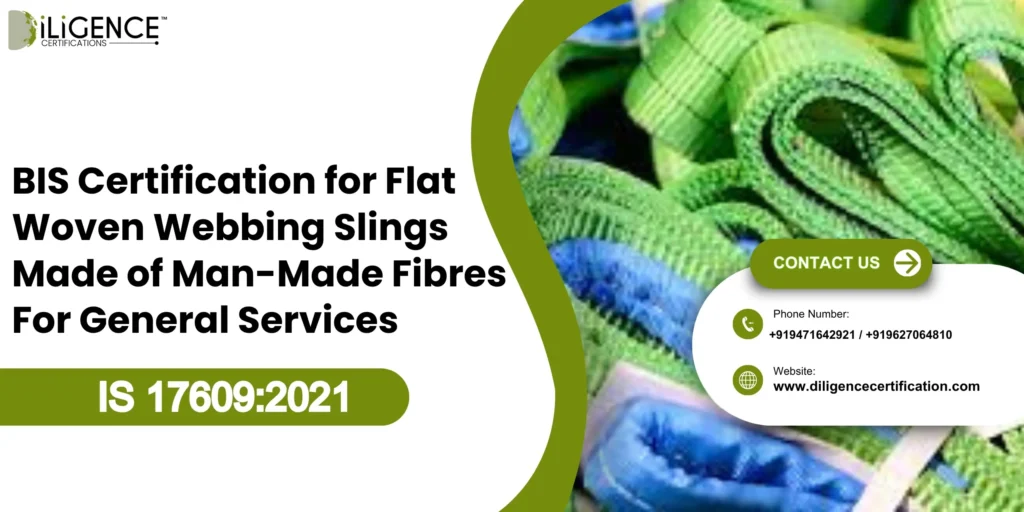
 By
By - Ensures slings comply with IS 15041:2001, guaranteeing safety, strength, and durability.
- Provides the ISI mark, building customer trust and market credibility.
- Mandatory for legal sale in India, preventing penalties and compliance issues.
- Opens opportunities for government tenders, industrial contracts, and exports.
- Helps manufacturers maintain consistent quality, protect brand reputation, and support national standards.
Introduction
A major provider of lifting solutions from Gujarat lost a large industrial contract when the client refused to accept their flat woven webbing slings which did not have BIS certification. The client insisted that the flat woven webbing slings produced be clearly marked with the ISI (Indian Standards Institute) mark per IS 15041:2001.This example highlights how important certification IS.
This example is what commonly happens to manufacturers of flat woven webbing slings made out of man-made fibers for general service. If a product has no BIS certification, the product simply cannot be legally sold in India, meaning that manufacturers risk losing business, tenders, and customers’ trust.
The BIS certification of slings means that the products have met required laws and the product is safe and durable, which provides the manufacturer with the legal protection with respect to the competitive advantage around strength in other Indian markets and the international arena.
What is IS 15041:2001?
IS 15041:2001 is the Indian Standard issued by the Bureau of Indian Standards (BIS) that specifies the quality, safety, and performance requirements for flat woven webbing slings made from man-made fibres for general services.
It covers:
- Material Specifications: Defines acceptable man-made fibres for manufacturing slings.
- Strength Requirements: Ensures slings can safely handle specified loads.
- Performance Testing: Includes tests for tensile strength, elongation, abrasion resistance, and durability.
- Safety Standards: Guarantees slings are reliable for lifting, construction, and industrial applications.
In short, IS 15041:2001 ensures that all certified flat woven webbing slings are safe, durable, and compliant with Indian industrial standards.
Why BIS Certification is Mandatory for Flat Woven Webbing Slings Made is Essential
- Assures Safety and Reliability
Flat woven webbing slings are widely used in lifting, construction, and industrial transport. Any failure due to poor-quality slings can cause accidents, property damage, or injuries. BIS certification ensures that slings are manufactured to IS 15041:2001 standards, making them strong, durable, and safe to use. - Legal Compliance in India
The Bureau of Indian Standards (BIS) mandates that all flat woven webbing slings made from man-made fibres for general services must be BIS-certified before sale. Selling non-certified slings is illegal and can lead to fines, product seizure, or legal action. - Builds Customer Trust
The ISI mark on BIS-certified slings is a visible symbol of quality and credibility. Clients, contractors, and industrial buyers often insist on ISI-marked products because it guarantees consistency, safety, and compliance. - Market Advantage and Tender Eligibility
Government and large industrial tenders require BIS-certified slings. Without certification, manufacturers may lose major contracts. Certification not only opens doors for domestic tenders but also enhances export potential, as international buyers prefer verified, standard-compliant products. - Standardized Quality Assurance
BIS certification ensures all slings undergo rigorous testing for tensile strength, elongation, abrasion resistance, and load-bearing capacity. Manufacturers must maintain a proper quality control system, ensuring uniformity across all products. - Protects Brand Reputation
Using BIS-certified slings demonstrates professionalism and commitment to quality. It reduces the risk of product failure in the field, which protects the manufacturer’s brand and builds long-term trust with clients. - Supports National Industrial Standards
By adhering to IS 15041:2001, manufacturers contribute to “Make in India” quality initiatives and promote standardization in the lifting and industrial sectors.
Understanding the ISI Mark
The ISI Mark on flat woven webbing slings indicates that:
- The sling complies with IS 15041:2001
- Manufacturing quality is consistent and controlled
- Safety and performance standards are verified by BIS inspections
Manufacturers must obtain a BIS license before using the ISI mark on their products.
Importance and Benefits of BIS Certification
| Benefit | Description |
| Ensures Product Quality | Slings are manufactured as per IS 15041:2001, safe and reliable |
| Customer Trust | ISI mark signals quality and safety |
| Legal Requirement | Mandatory in India; selling without it is illegal |
| Safety Assurance | Reduces workplace accidents and injuries |
| Market Advantage | Helps secure government and private tenders |
| Avoids Penalty | Compliance prevents fines or seizure |
| Brand Image | Shows professionalism and commitment to quality |
| Supports Export | Accepted in international markets |
| Customer Satisfaction | Reliable products lead to repeat clients |
| Supports National Standards | Promotes “Make in India” quality products |
Eligibility Criteria for BIS Certification
To qualify for BIS certification, manufacturers must:
- Be a registered business (Company, LLP, or Proprietorship)
- Operate a functional factory for manufacturing slings
- Maintain a quality control system with proper documentation
- Ensure product compliance with IS 15041:2001
- Employ trained staff for production and testing
- Allow BIS officers to inspect the facility
- Have financial capability to pay testing and licensing fees
Step-by-Step Process for BIS Certification For flat woven webbing slings produced
Step 1: Check Product Standard
Confirm that your sling matches the IS 15041:2001 standard.
Step 2: Apply Online
Use the BIS Manakonline portal to submit your application and documents, including:
- Factory license
- Product details
- Quality control records
Step 3: Product Testing
Send samples to a BIS-recognized lab for tensile strength, elongation, and abrasion tests.
Step 4: Factory Inspection
A BIS officer inspects your factory, checking production setup, QC systems, and equipment.
Step 5: Verification
BIS verifies lab reports and inspection outcomes.
Step 6: Grant of License
Once approved, you can affix the ISI mark on your slings.
Step 7: Renewal
BIS licenses are valid for 2 years and must be renewed with updated documents.

Documents Required for BIS Certification
| Category | Required Documents |
| Company Proof | Incorporation Certificate, GST, MSME/Udyam |
| Factory Details | Layout, Machinery List, Production Flow Chart |
| Quality System | Internal QC Records, Calibration Certificates |
| Product Testing | Lab Report (IS 15041:2001 compliance) |
| Technical Details | Product specifications, raw material data |
Validity and Renewal of BIS Licence
| Point | Details |
| Initial Validity | The BIS licence is usually valid for 2 years from the date of issue. |
| Renewal Period | It can be renewed for a further period of up to 5 years at a time. |
| Renewal Time | The manufacturer should apply for renewal at least 3 months before the licence expiry date. |
| Requirements for Renewal | 1. Updated product test reports2. Proof of consistent production3. BIS licence fee and renewal charges |
| Inspection During Renewal | BIS may conduct another factory inspection to confirm that the product still meets IS 15041:2001 standards. |
| If Renewal is Delayed | Late renewal can lead to temporary suspension or cancellation of the licence. |
| After Renewal | Once approved, the manufacturer can continue using the ISI mark on the product. |
Common Challenges in BIS Certification for Flat Woven Webbing Slings Made
- Incomplete Documentation - The absence of factory layouts, quality documentation, or product specifications could provide grounds for delayed or rejected applications.
- Non-Conformity of the Product - Products may fail the lab tests if they do not comply with IS 15041:2001 and will also require rework or modification.
- Factory Inspection Problems - Facilities not in good condition or without quality control systems may lead to the factory not passing an inspection.
- Lab Testing Delays - If the samples have been improperly prepared, or a BIS-endorsed lab has too many contracts, the application will take longer for Certification.
- Renewal Difficulties - If the renewal takes longer than expected and the updates are not in place, the BIS license could be temporarily suspended.
- Consultant Detractor - A company with poorly educated consultants might make an error in the application or documents.
- Lack of Finance - Smaller manufacturers may struggle to manage costs associated with testing, inspection, and licensing.
- Understanding Standards - If a sampling of the audience misunderstands the IS 15041:2001 standard’s technical requirements, they might non-compliances that leads to a rejected application.
Cost of BIS Certification for Flat Woven Webbing Slings Made
The total cost of BIS certification depends on several factors, such as your factory size, production capacity, and number of products. The main components are:
| S.No | Cost Component | Details |
| 1 | Application Fee | Paid while submitting the application online. Covers processing of documents. |
| 2 | Product Testing Fee | Cost of testing fibre rope samples in a BIS-approved lab. Varies depending on tests required. |
| 3 | Factory Inspection Fee | BIS may charge for visiting and inspecting your manufacturing facility. |
| 4 | License Fee | Fee for granting the BIS licence, usually based on production capacity. |
| 5 | Renewal Fee | Fee for renewing the licence, typically every 2 years. |
Why Choose Diligence Certification for BIS Certification?
- Expert Assistance: Diligence Certification has years of experience in getting BIS certification for manufacturers of products like polyester, polyolefin dual fibers, fibre ropes etc. We will take you through the process step-by-step, and help you avoid common pitfalls.
- Faster Turnaround: Our team will help facilitate the application, documentation turn and testing of your product so you can get the ISI mark without lengthy waits.
- Complete Document Assistance: We will prepare, and prepare you for the minimal documentation such as factory details, prior test report review, quality control records to qualification and ensure you are prepared to provide such documentation as required by BIS.
- Compliance Review: We will review your documents to ensure your product is compliant with IS 15041:2001 wherever possible and reduce the potential for rejection or legal action.
- Manufacturer Preferred: Many rope manufacturers or exporters within India’s trust Diligence Certification to assist them in developing credibility and trust in the market.
- Post Certification Services: Even after obtaining the BIS license, we will continue to support and assist with renewal, inspections, or compliance audit.
Conclusion
The BIS certification procedure for flat woven webbing slings produced is an important measure for producers to safeguard safety, quality and specifying IS 15041:2001 standards. An ISI Mark not only generates trust to customers and industrial purchasers, but also allows access to government tenders and easier access to export business. When producers follow required certification procedures and keep the commitment to high-quality production, they can both protect their brand reputation, remain legal, and represent themselves favorably in the marketplace. Working with an experienced consultant will help ease this process and develop a safe certification process that supports longevity.
Frequently Asked Questions
What is IS 15041:2001?
IS 15041:2001 sets the requirements for the quality, safety, and performance of flat woven webbing slings made of man-made fibres intended for general services.
Is BIS certification necessary for flat woven webbing slings?
Yes, it is illegal to sell these slings in India without the BIS certification and ISI mark. You may incur penalties.
What is the lifespan of a BIS license?
Typically a BIS license is valid for 2 years and may be renewed provided they prove compliance.
Can foreign manufacturers apply for a BIS certification?
Yes, they can apply via the Foreign Manufacturers Certification Scheme (FMCS).
What tests are included under IS 15041:2001?
The tests cover tensile strength, elongation, breaking load, abrasion resistance, quality of stitching, and finishing of edges.
What documents are required to apply for BIS certification?
The documents include company ID, factory plan, list of machinery, quality records, specifications, and reports from labs.
How long does it take to gain BIS certification?
BIS certification roughly takes 30-45 total working days (including lab tests and verification).
Can BIS revoke the license?
Yes, BIS can suspend or cancel a license if the products do not comply with IS 15041:2001 or they fail the market surveillance audits.
What are some frequent obstacles in regard to BIS certification?
Some obstacles include incomplete paperwork, products being non-compliant, failure of inspections, testing delays from laboratories, and renewal challenges.
Who can assist with obtaining BIS certification?
Accredited consulting firms such as Diligence Certification can support you throughout including application, documentation preparation, inspection, and renewal.